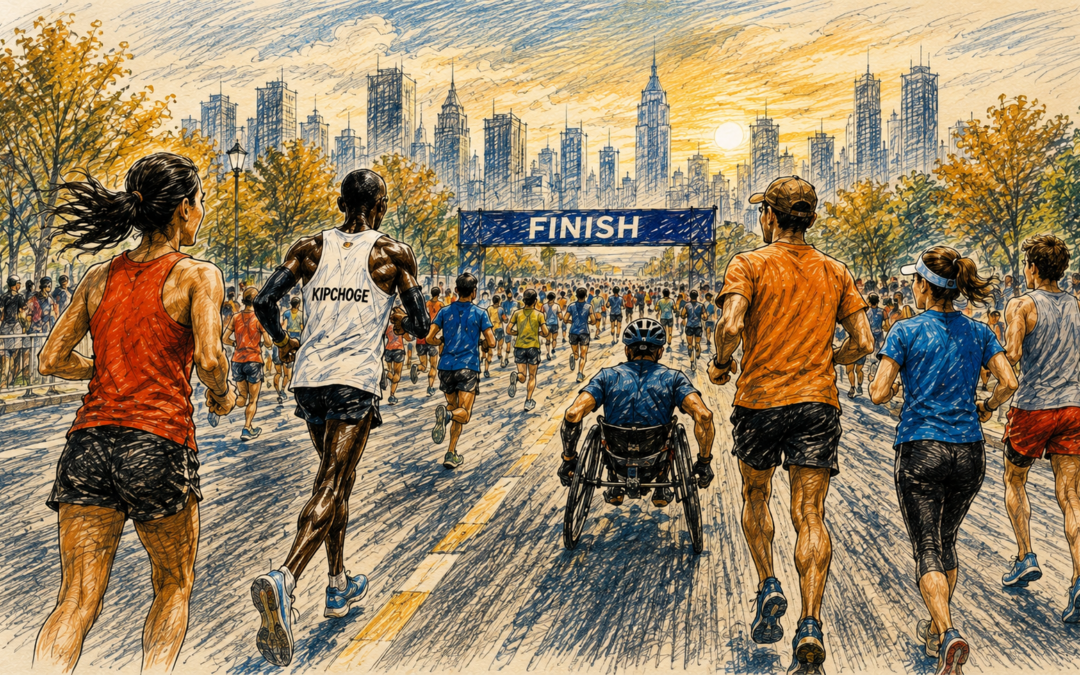
I joke (partially) with my running buddies that the day I ran against Eliud Kipchoge in Berlin (2017), he needed a world record to beat me. Sure, I started in wave 4 and was 15 miles behind when he crossed the finish line, and while I certainly had no chance of beating him, the statement is still 100% true.
All you need is the will to go for a run. Everything else is additional (Image by Grok)
Consider this: what are your chances of standing in the huddle in a Super Bowl, strategizing the next play? When will you face Shohei Ohtani on an MLB field? How about your odds of standing with or against Lio Messi during the World Cup? Driving in an F1 Grand Prix? US Open. Golf or tennis?… Anyone?
But running is different. When the marathon’s 2-hour mark was broken, a runner I trained was there. When Kipchoge broke his last world record (Berlin 2022), another runner I trained was there. During the epic battle between Alberto Salazar and Rodolfo Gomez at the 1982 NYC Marathon, my dad was there. A close friend crossed the finish line in Boston, 10 minutes before the bombing. The last time the immortal Bill Rodgers won a marathon (Orange Bowl 1983), he had to beat me, too.
So, you get the point. Running is the most democratic of sports. The one with the most open access, equal opportunity to participate, low barriers of entry, and outcomes driven mostly by effort rather than status.
Remember dreaming of running, or lacing your shoes for the first time? Or how you felt after a long hiatus? Remember the struggle to finish that first long run? Have you checked the back of the packers at a race? Have you taken the time to watch the videos of the last finishers at a big-city marathon? Is there any other sport where regular people, even with a variety of disabilities, can beat the odds by finishing the biggest and most iconic races in the world?
Sure, only a selected few will run in the Olympics or the world championships, but even you, dear reader, can run the mythic Boston Marathon, even if you don’t qualify. We know you have a better chance of hitting the Powerball than the London Marathon Lottery, but the chance is there, and you still have charity entries. And if you are not into multitudinous mega races, there are local 5Ks everywhere, every week.
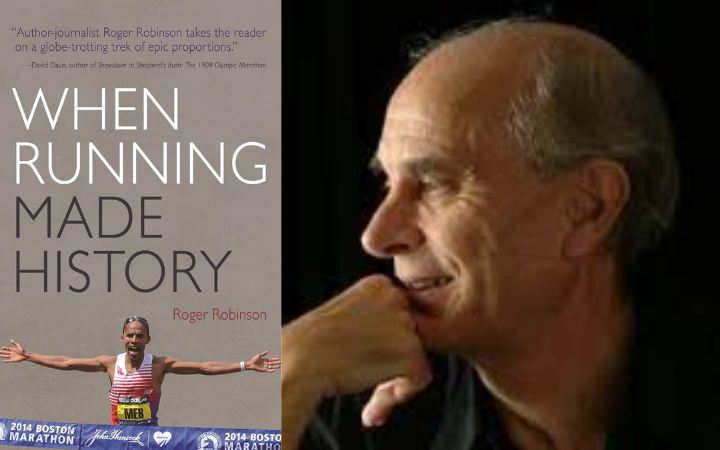
In his book “When Running Made History”, literature professor and former elite runner Roger Robinson said: “Being a runner (this sounds naive but isn’t) gives you direct and unfiltered access to all other runners. That’s one thing that makes running so remarkable; it is an intensely competitive sport that is also an egalitarian community. Just put your shorts and shoes on and if you’re fast enough, you can run with, befriend, and, if so inclined, interview the greatest celebrities on earth.”
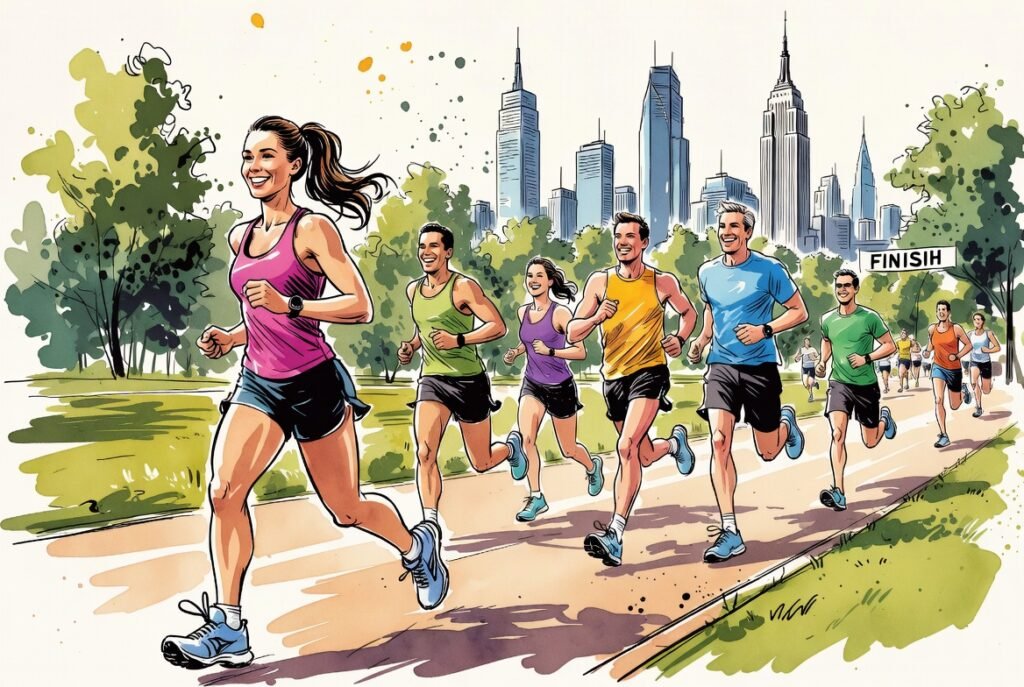
In running, you will only get out what you put into it (Image by Grok)
Think about it: when it comes to running, you don’t need an opposing team or a field. Let alone a golf course. You don’t need a court, like tennis, basketball, or pickleball. You don’t even need a group of friends or a rival. All you need is the will to run. Everything else, everything, is extra.
You can run in the crappiest of shoes, or even barefoot. You can run in jeans and cotton socks if that is all you have. You don’t need a watch, you don’t need company, and you don’t need a dedicated surface or place. The comfort of a good pair of running shoes, a tech shirt/shorts, moisture-wicking socks, and a running path with good friends will surely make it more enjoyable, but as for requirements, none beyond your willingness to go out for a run.
Biologist and 2:22 marathoner Bernd Heinrich wrote in Why We Run: A Natural History: “Running is perhaps the most fundamental of all sports… it is the most democratic and most competitive of all sports because individual merit can prevail despite economic equality. It is a sport for everyone, the whole world over.”
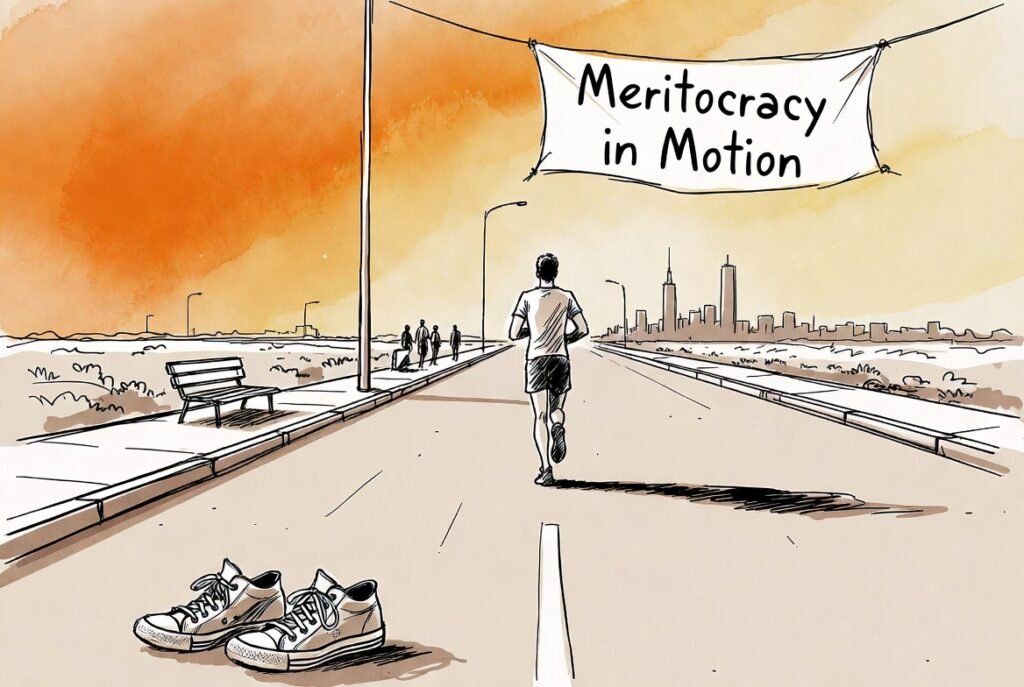
Meritocracy in action. What a beautiful concept!
The great running author and philosopher George Sheehan said, “Life is a positive-sum game. Everyone from the gold medalist to the last finisher can rejoice in a personal victory.”
Fred Lebow, the father of the NYC Marathon, said, “In running, it doesn’t matter whether you come in first, in the middle of the pack, or last. You can say, ‘I have finished.'”
Beyond the health and social benefits, running is a sport where you can only get out as much as you put in. The one sport where we have the chance to participate in the biggest local, national, and international competitions. The one we can practice at a moment’s notice, just when we need it. Yes, need it. The one where the winner and the last one across the finish line get the same medal. The one where we can make friendships to last a lifetime.
Let’s go for a run, then. What are you waiting for?
👇Do you want the key takeaways of this blog post? 👇 👇Click below to watch the video summary 👇
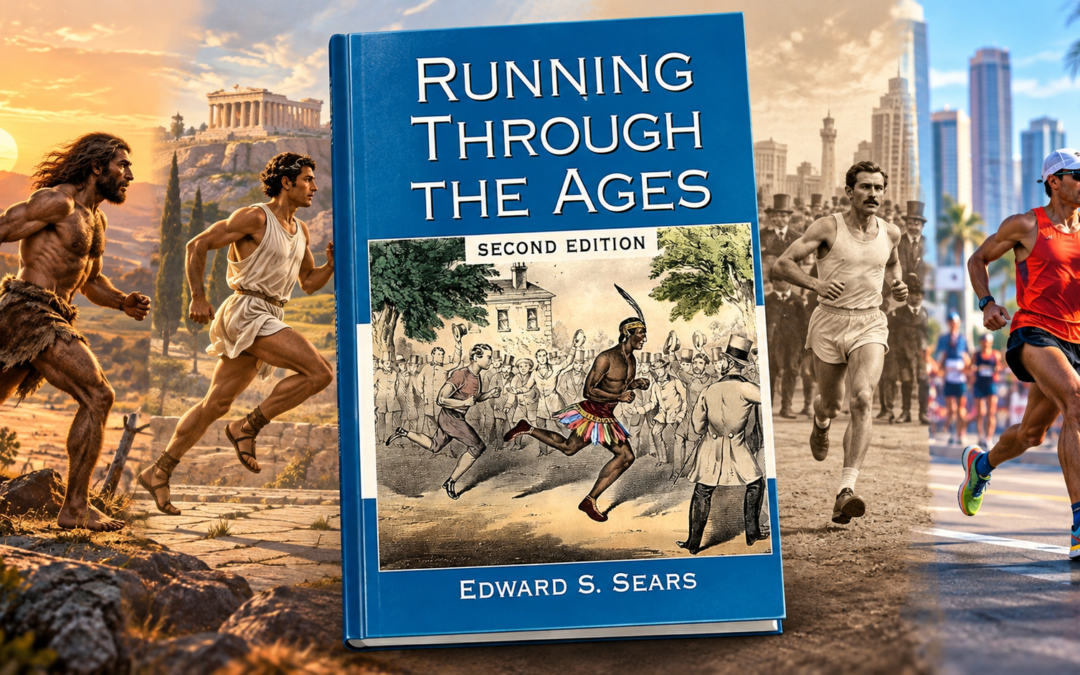
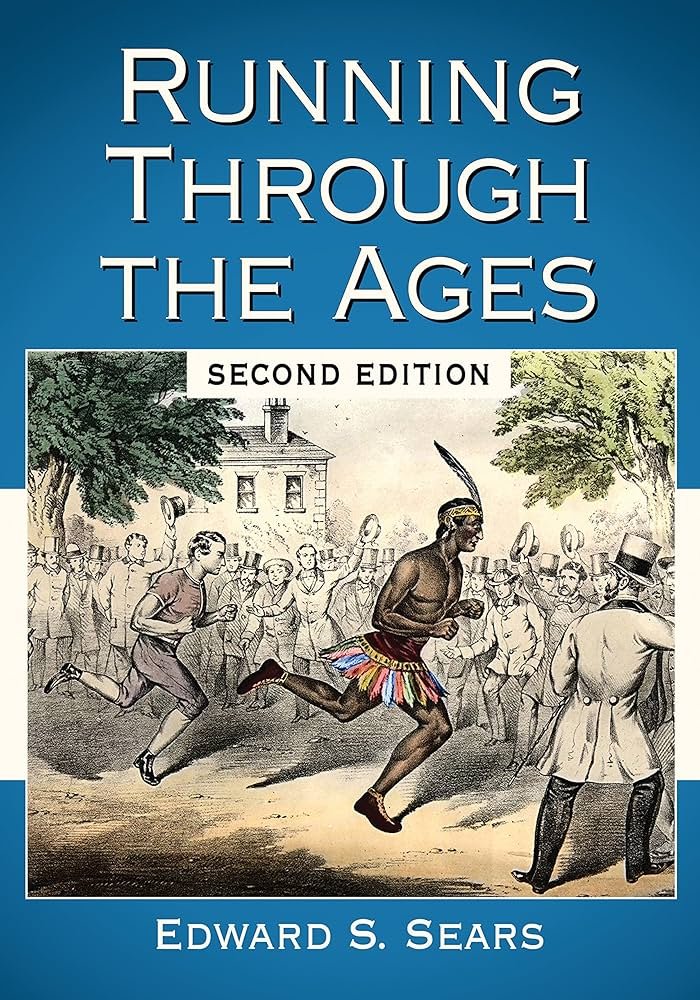
Running Through the Ages surprisingly delivers exactly on its title. It is a history of running since we became humans and had to, as the author states in the first four words of the text: “Eat or be eaten”.
Running has been in our DNA since forever
Between the earliest versions of prehumans, between 7,000,000 and 50,000 BC, our tools of the trade were our legs. The author starts by explaining how, as humans, we are very slow runners and no match for most other species. Yet, we could hunt them and rely on them for subsistence because of our ability to run longer.
Our evolution has gifted us with a cooling system, which he describes as the best on the planet. It has also provided us with the Achilles tendon, which returns about 90% of the work put into stretching it, with the rest provided by the foot arch, another spring.
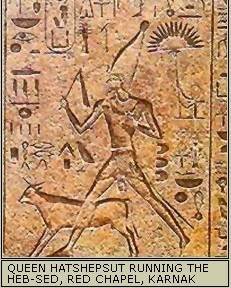
From there, he continues the journey through the ancient world: Egypt, Ur, the Old Testament, Greek mythology, the Olympic Games, and literature. It is fascinating to see how each culture used running to speed up their development and how running competitions became a staple of each culture.
From there, the journey takes us through the Middle Ages and up to the 19th Century when pedestrianism became the rage.
I enjoyed this part of the book because it was about the history and evolution of running as a sport, about winning races and setting records. At first, there were no time devices to allow records of who was the fastest at a certain distance or how much of it could be covered in a certain segment of time.
Once timing became readily available, all changed dramatically. Chronographs were able to split the second into fifths, which was good for certain distances but insufficient for shorter sprints. The evolution of timing, not just the watch technology but the mechanics of automatization, is fascinating.
As more newspapers started chronicling the sport, records became available and we start learning about the first stars. We see the first local sports heroes looking for greener pastures by running in other countries, taking the first steps into the globalization of the sport and the differentiation between professionals and amateurs.
As we enter the 20th Century, when reliable records and accurate times were kept and athletic achievements easily verified, the book becomes dense with names and figures. It goes into detail on each distance, both for men and women. Not that it is unimportant, but for readers who may be familiar with running in this period, it became too much while adding too little new information.
The 2nd Edition includes an update on 21st-century running
The book was initially published in 2001, with its 2nd edition published in 2015. The 2nd edition has a new chapter on the 21st Century, and it goes deep into doping and cheating, which is a new reality in the sport and worth reading.
The conclusion of the book is about the upcoming world of marathoning (this was written before Eliud Kipcohge’s sub-2 attempt and Kelvin Kiptum’s current world record).
“The men’s marathon record is approaching two hours. Will two hours turn out to be another “barrier” like the four-minute mile? A sub-two-hour marathon requires averaging 4 min 35 sec[onds] per mile, a much tougher challenge than the four-minute mile was in 1954 […] Road races are open to all and the ordinary runner can compete with themselves or against the best in the world. It is a democratic sport. It is also inexpensive compared to other sports. Most sports require specialized, expensive equipment and facilities. All a road runner needs are running shoes and an open road.”
If you want to learn about the evolution of running as we evolved as a species, this book is worth the time and the money. Sure, it gets dense at the end, but that doesn’t mean it is useless information. And you can always skip it if it is not relevant to you.
I welcome your comments about your thoughts on this book in the box below.
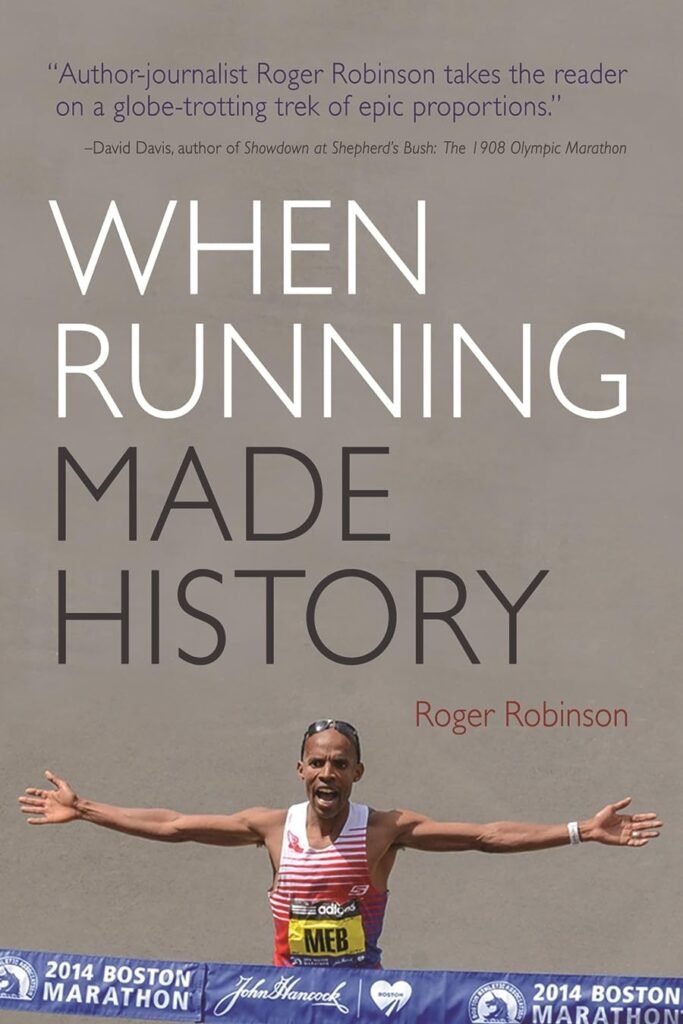
Running has made news for many decades. Even though the running boom is more of a recent phenomenon, Roger Bannister broke the 4-minute mile barrier 70+ years ago, and the Boston Marathon has been running since 1897. But this book has a different approach. As the title states, it has to do with running making history, not just running news. The common thread is that the author witnessed everything covered in the 21 articles/essays in which this book is divided.
His journey starts on July 30, 1948, at the London Olympics, when, as an 8-year-old kid, he witnessed Emil Zatopek become the first human to run the 10,000 in under 30 minutes; through October 2, 2016, when he saw 65-year-old Kathryn Martin become the oldest woman to run a sub-20 5K, and Libby James, at 80, ran 25:11.
A well-written book by an eyewitness of the greatest running moments over 7 decades
Born in 1939, Roger Robinson is a celebrated runner, scholar, and author. A professor emeritus of English at Victoria University of Wellington and a Ph.D. graduate from Cambridge, he is an authority on New Zealand literature. As a runner, the author competed internationally from 1966 to 1995, winning Masters-level marathons in the 1980s and continuing to race into his 80s despite two knee replacements. An award-winning sports journalist and author of Running in Literature (2003), he is a prominent voice in running history. He resides in New York State and New Zealand with his wife, Kathrine Switzer (yes, that Kathrine Switzer), author of Marathon Woman.
The author has witnessed a lot but has also missed a lot. He did not run the first New York City Marathon, nor did he witness Joan Benoit at the 1984 Olympics. But that doesn’t take away the impressive collection of first-person accounts spanning from 9 years old through 78.
Robinson saw Abebe Bikila run the cobblestones in the 1960 Rome Olympics, beginning the African dominance in distance running. He was there in 1990 when 26,000 runners went under the Brandenburg Gate, signaling the German reunification during the Berlin Marathon. He ran the 100th Boston Marathon, the 2001 NYC Marathon after the 9/11 terrorist attacks, and was there to see Med Keflezhighi become the first American in 31 years to win Boston, just a year after the infamous bombing, among many, many events.
He is like Forrest Gump, serendipitously placed in so many historic events and places when running took center stage. Some as a spectator, some as a participant, and some as one of the multiple moving parts that made the event possible.
There is an interesting essay about his witnessing of what is now the Running Boom. The author spent between June and September 1980 in the United States on teaching commitments and, in the interim, participated in a handful of races. He chronicles the small steps running took to become mainstream. How little races became staples on the calendar, and how the public responded by participating in massive numbers. An industry with race t-shirts, timing companies, nutrition, hydration, media coverage, and sponsorships started taking over, starting at small towns like Fountain Valley, CA, through the birth and explosion of what has become the New York City Marathon.
Beyond a great writer, Robinson is/was an elite runner
As someone who ended up marrying running icon Kathrine Switzer, he delves into an essay about women’s running. He notes that in England and New Zealand, women were able to run with some but not much interference, unlike in the US, where the stories of Bobby Gibb and Switzer dominated headlines and forced changes.
Because the author is British and has spent most of his life as a New Zealand resident, despite having witnessed many historic running moments in the US, this is not a USA-centric narrative. This makes it even more interesting for many US-based readers, such as me, who tend to see much of the running world through the lens of our local authors.
When Running Made Historyincludes the best description I’ve ever read about hitting the wall. While participating in the 100th Boston Marathon, he writes: “But suddenly at 18 miles, I started walking. There was no warning, no crisis, no decision. It just happened. I stopped running. My race ended. The tank ran empty. It felt as if somewhere in Newton, there was a dark, fetid hole invisible to the eye, like some dire vortex of fantasy fiction. I fest straight into it. I was powerless, a tattered rag on two bent sticks.” WOW!!
Another gem from this book is: “Marathon Running is a sport of goodwill. It’s a sport where if a competitor falls, the others around will pick him or her up. It is a sport where never boos anybody.”
When Running Made History is an excellent book for any runner. It is beautifully written and divided into easy-to-read chapters that do not require a massive time commitment. It is a good pick for any runner with the tiniest interest in the history of our sport. It is worth the time and the money.
Please share your thoughts about this book in the comment box below.
👇Do you want the key takeaways of this blog post? 👇 👇Click below to watch the video summary 👇
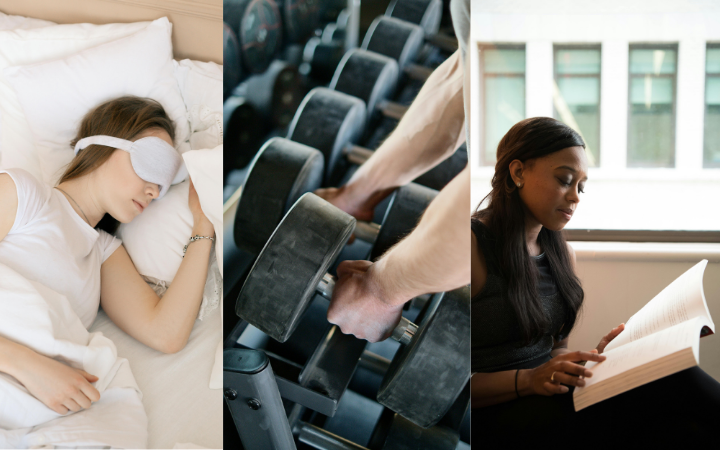
It took me a while to understand it, but with maturity, I finally did. Training consists of two separate and different elements: Work and recovery. They are equally important, and they complement each other. Their symbiosis confirms the Aristotelian saying that the whole is more than the sum of the parts.
Recently, I heard that the second element is labeled as The Invisible Training.
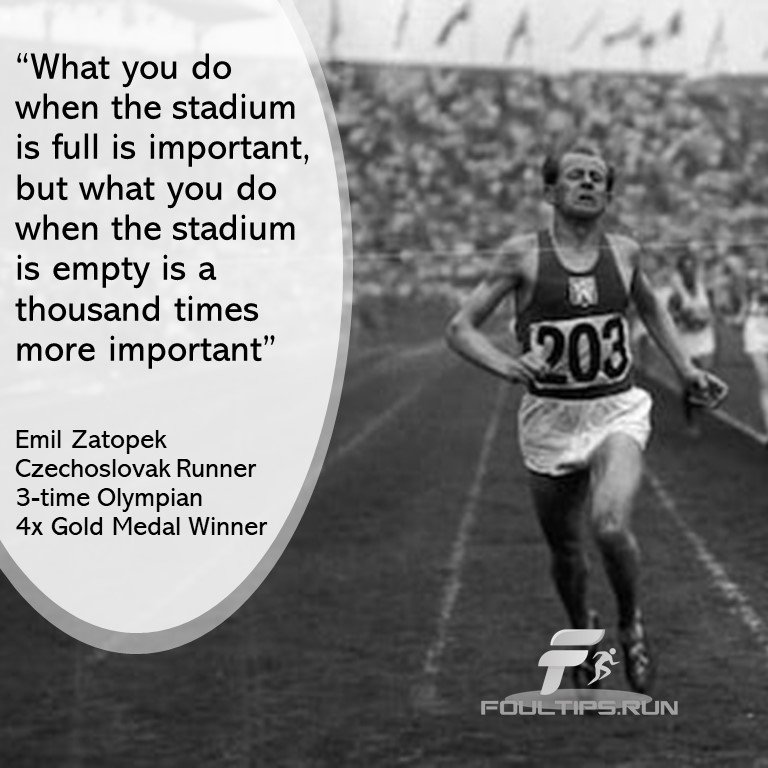
It got me thinking about a classic Emil Zatopek quote where he states: “What you do when the stadium is full is important, but what you do when the stadium is empty is a thousand times more important.”
For us amateur weekend warriors, a standing ovation at an Olympic stadium is no more than a pleasant dream. Yet, well into the XXI Century, each one of us has the equivalent of our own Olympic stadium, and we have become addicted to that standing ovation of kudos Strava, followers on Facebook, and likes on Instagram. These may be cool for many, but they won’t get you any better.
As Zatopek (a 4-time Olympic gold medalist and multi-world record breaker) said, that is not the key to success. It is what we do outside the limelight that counts. A thousand times more.
► It is the strength training that will help you get stronger, more resilient, have a better form, and make you injury resistant.
► it is the physical therapy you do to take care of your bones, muscles, and soft tissues. Not just face-to-face with a professional, but as a prehab to avoid a recurring injury.
► It is your daily nutrition that allows your body enough of the good stuff to repair itself and be appropriately fueled for your activity.
► It is the hydration throughout the day that will allow you to sustain a hard run even in the harshest of weather conditions.
► It is the scheduled recovery for your body to adapt to the stress we have put it through and accepting that sometimes it will require more time.
► It is understanding that sleep is the champion of recovery tools in your arsenal and that lack of sleep is not a badge of honor.
► It is accumulating knowledge about the sport and the function of your body, which will allow you to understand what’s happening and why.
► It is the evaluation of your training, especially when you have bonked or screwed up, and accepting it as an opportunity to learn and build experience.
► It is living a balanced life, one where your job, your family, and your friends won’t be neglected, and end up resenting you and your running.
► It is allowing yourself to have fun outside your running life. Keeping it all in perspective and always remembering why you are doing this.
These are just ten of hundreds of parameters of what is encompassed within the realm of invisible training.
In summary, everything you do while you are not running is equally essential to the running time.
Yes, it all sounds intuitive, simple, even obvious. But we’ve all fallen into the trap of only accepting hard work as worthwhile training. And to many, an injury has taught us how wrong we were. My wish is that this brief writing will help avoid the injury part for you, dear reader.
Share your thoughts in the box below so other runners may benefit from your experience.
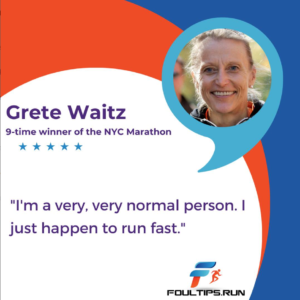
When it comes to the pioneers of women’s long-distance running, Kathrine Switzer is usually the first one to come to mind. Joan Benoit Samuelson is another. Roberta Gibb, Micki Gorman, Ingrid Kristiansen, and others deserve participation in the conversation. But one that usually gets left out is Norwegian Grete Waitz. If you never heard that name, just know this: she is a 9-time winner of the New York City Marathon. No, not a typo: Nine times!
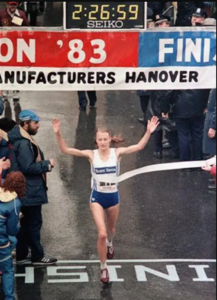
In 1983 Grete Waitz won her 5th NYC Marathon, just a couple of days after we crossed paths running in Central Park.
In these days of social media and harvesting of likes, when you don’t even need to be a good runner to become famous, the field of celebrity athletes has become very crowded. Yet, Grete was known for shying away from fame, endorsements, and interviews because as much as she enjoyed running and winning, she disliked fame and the inconveniences brought by fortune.
The trailblazing pigtailed blonde revolutionized women’s distance running by showing the world what was possible. She initially competed in shorter distances, but it was her switch to the marathon that cemented her legacy. She made history in 1978 when she won the New York City Marathon with a world record in her first attempt at the distance despite having neither experience nor training. Later she became the first woman to finish under 2:30 and also earned the silver medal in the 1984 Olympic marathon, the first time the event was held for women. Throughout her career, she set several world records, won five World Cross Country Championships, participated in three Olympics, and inspired countless male and female runners globally.
The Great Grete Waitz is an eBook compilation of eight articles published by Runner’s World Magazine between March 1981, after her third straight NYC win, and July 2011, a few months after her untimely passing due to cancer at age 57. The articles vary from lengthy features to short write-ups. Seven of them were written about her by other people, except for “My First Time” a candid, memorable, first-person account of her first marathon, which is the lore of legend.
There is also a beautiful first-person account by the marathon founder Fred Lebow about his side-by-side run with Grete of the 1992 race. The back story, if you don’t know it, is that Lebow was diagnosed with brain cancer. He always wanted to run his five-borough race, but as his time was running out, he ran it with his friend in 5:32. A delightful read that guarantees teary eyes even on the toughest macho reader.
Because this eBook consists of so many articles written within such a wide time frame, some facts are constantly repeated. Some stories may have a few minor contradictions here or there because they are memories of the same incident by so many people over such a long period of time, but they are not a reason to question her accolades or achievements.
I heard the name Grete Waitz for the first time in 1982, as she won NYC the year my dad ran his first marathon. The following year, when I ran my first NYC she won again. My best Grete memory was when my dad and I went for a shakeout run in Central Park the Friday before my race and we saw her running. For an 18-year-old kid from Venezuela, crossing paths with The Great Grete Waitz was the equivalent of seeing a Martian.
Beyond her racing success, Waitz was known for her humility and dedication to giving back. After retiring, she focused on philanthropy, supporting cancer research and youth sports, even as she battled cancer herself. She remains a beloved figure in the running community, celebrated not only for her extraordinary accomplishments but also for her role in making distance running more accessible for women. While Kathrine Switzer was the catalytic force that brought women\’s running to the forefront, Waitz showed the world what women could achieve if they were just allowed to try.
This eBook is only 127 pages and can be acquired via Amazon for your Kindle for just $1.99. It must be available for other platforms. It is a negligible investment for an insight into one of the names of women’s running that should never be forgotten or underestimated.
Please like this post and share any recommendations from your previous experiences in the box below. Let’s build a community of informed and prepared runners.
👇Do you want the key takeaways of this blog post? 👇 👇Click below to watch the video summary 👇




 Because this eBook consists of so many articles written within such a wide time frame, some facts are constantly repeated. Some stories may have a few minor contradictions here or there because they are memories of the same incident by so many people over such a long period of time, but they are not a reason to question her accolades or achievements.