For anyone living in the Northern Hemisphere, the summer has been brutal. It gets sultrier year after year. In some areas, it’s the heat; in others, it is humidity; and in some, it is both. Conditions can get inhospitable and dangerous very quickly.
Always give yourself a way out if it is too hot for a safe run (Image by ChatGPT)
Last week I drove to my Thursday afternoon group run. As soon as I turned off the car’s air conditioning and set foot out in the open, I realized this was not happening. I decided to walk. I did so with one of my athletes and discussed her upcoming racing schedule. We walked for about an hour, got back drenched, and I was at peace with my decision. As I checked the temperature and humidity afterward, I learned the heat index was 98º (36.7ºC). Inhuman conditions.
I’ve already written about training in the heat this year (click here to read). Still, this experience got me thinking, yet once again, about accepting that I’ll survive the season rather than focusing on the metrics as a measure of success as if the temperature were 30 degrees lower (17ºC).
Alex Beach, a 2:24 marathoner based in South Florida, recently posted the following thought on Instagram: “I’m training year-round in a hot environment (Miami). Understanding the aerobic work you’re getting and not putting too much stress on hitting specific paces every workout in the heat allows you to avoid issues with overtraining.”
Running in the summer requires heavy adjustments. The weather is not just the temperature. It includes atmospheric pressure, visibility, pollen count, and more. When it comes to running, we must expand our perspective beyond temperature and, at the bare minimum, include wind and humidity in the equation.
What Happens to Your Body in the Heat?
Your body goes into overdrive to keep you cool during summer running (Image by Grok)
As a runner, you must understand the physiology of training in severe heat. When you run in hot weather, your body works harder to keep itself cool. As your core temperature rises, your muscles become less efficient, you fatigue sooner, and your overall performance inevitably declines. Accept it.
To prevent overheating, your body redirects blood to your skin, blood that would normally supply oxygen to your working muscles. From the skin, the heat is released. In dry conditions, sweat evaporates, and you cool down. In humid weather, that sweat doesn’t evaporate as easily, making it much harder for your body to regulate its temperature. That’s why running in heat and humidity feels significantly tougher than running in dry heat, even at the same pace.
So, account for that reality and focus on effort rather than metrics. The people you’re trying to impress on Instagram don’t know you, won’t visit you in the hospital if you suffer heat stroke. They certainly won’t help pay your medical bills.
What to do when it is too hot to run outside?
One of the best pieces of advice I’ve heard on summer training comes from Steve Magness, a renowned running coach, author, and performance expert who has guided athletes from high school to the Olympic level. His recommendation is simple: always give yourself a way out.
He explains how in extreme heat and humidity, it’s much easier to dig yourself into a hole that can take days, or even weeks, to recover from. Instead of stubbornly forcing yourself to complete every mile exactly as planned, build flexibility into your workouts. Rather than committing to a continuous hard workout, consider breaking it into shorter intervals with brief recovery periods. If your body is sending warning signs, don’t be afraid to stop early. Adjusting a workout isn’t a sign of weakness. It’s a smart decision that allows you to recover, stay consistent, and be ready for your next quality session. Summer training rewards athletes who know when to push and, just as importantly, when to back off.
In conclusion: Don’t try to be a hero. No PR is worth a heat injury. No social media post is worth a health breakdown. No Strava kudos are worth an ambulance ride. Be smart, play it safe, and always live to run another day.
Please share your thoughts in the comment box below.
👇Do you want the key takeaways of this blog post? 👇 👇Click below to watch the video summary 👇
The last handful of weekend runs around my South Florida home area have been a brutal prelude to what the upcoming summer may be. If you are in the Northern Hemisphere, it is only a matter of time before it reaches you. It depends on your latitude.
Both running injuries are very serious, but one of them may be fatal (Image by ChatGPT)
A running buddy recently invited me to join his team for the upcoming “Inferno 25K Club Championship” on July 18th in Southwest Florida. I was honored to be asked, but with that name, on that date, at that location, I happily declined.
Running safely in summer is feasible if you play it smart. You can plan accordingly, continue training for fall races and enjoy the process, or hibernate until October. Your choice. So, get acquainted with the signs of heat injury so you can act quickly for yourself or others.
The information in this blog post should not be considered medical advice. I am not a doctor or licensed healthcare professional. Always consult a qualified medical professional before making decisions related to health or treatment. With that out of the way, let’s go!
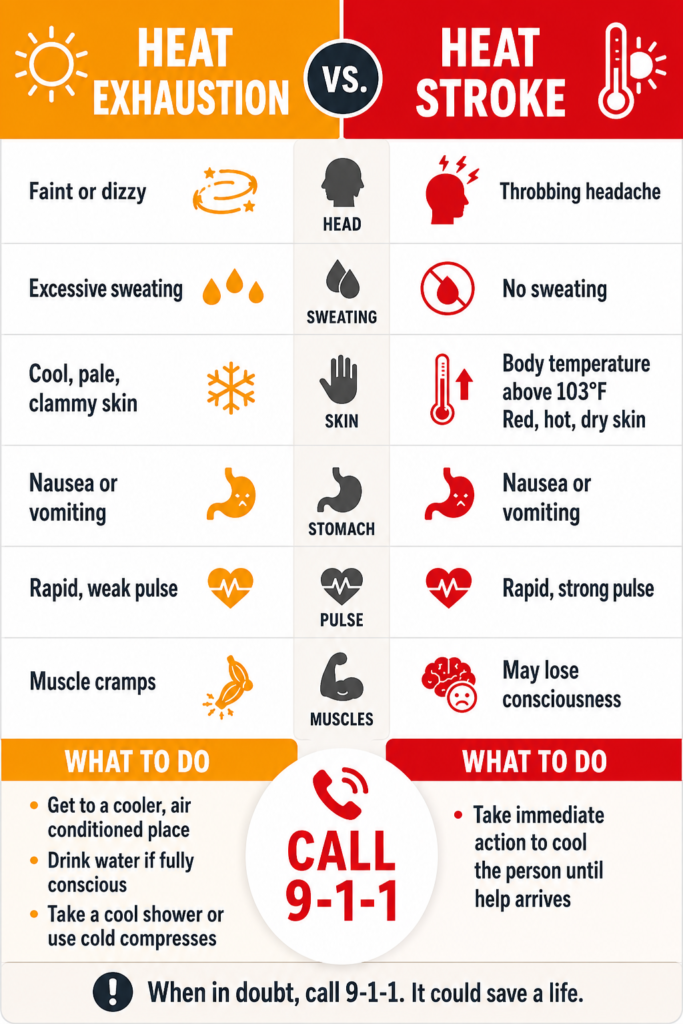
Understand the signs and symptoms of heat injuries, including heat exhaustion and heatstroke. Both are serious, but the latter can be fatal. A close friend survived heatstroke after final preparations were being made at the hospital.
According to the Mayo Clinic’s website, heat exhaustion is caused by exposure to elevated temperatures, particularly when combined with high humidity and strenuous physical activity. Without prompt treatment, it can turn into heatstroke, a life-threatening condition that can be prevented by avoiding entering the heat exhaustion zone in the first place.
Heatstroke, the most serious of heat injuries, is a condition caused by your body overheating, usually resulting from prolonged exposure to high temperatures and physical exertion.
Certain conditions and medications can increase your risk of heat-related illness. Ask your doctor whether any part of your medical history or current prescriptions could make you more susceptible to these conditions, given your level of physical activity during the warmer months.
Recognizing the symptoms of heat-related syndromes is crucial to avert tragedy.
Heat Exhaustion Symptoms
The evaporation of your sweat regulates your body temperature. However, when you exercise strenuously or otherwise overexert yourself in hot, humid weather, your core temperature (the body’s heat combined with environmental heat) fails to be regulated, preventing your body from cooling itself. A normal core temperature is around 98.6°F (37 °C). If you don’t address this situation immediately, it may progress to a dreaded heatstroke.
The symptoms of Heat Exhaustion are:
Cool, moist skin with goose bumps
Heavy sweating
Faintness
Dizziness
Fatigue
Weak, rapid pulse
Low blood pressure upon standing
Muscle cramps
Nausea
Headache
What to do if you feel any of these symptoms? Stop running immediately, move to a cooler place, drink cool water and/or sports drinks, and rest. If these symptoms don’t improve within an hour, contact a medical professional. Avoid an escalation into heatstroke at all costs.
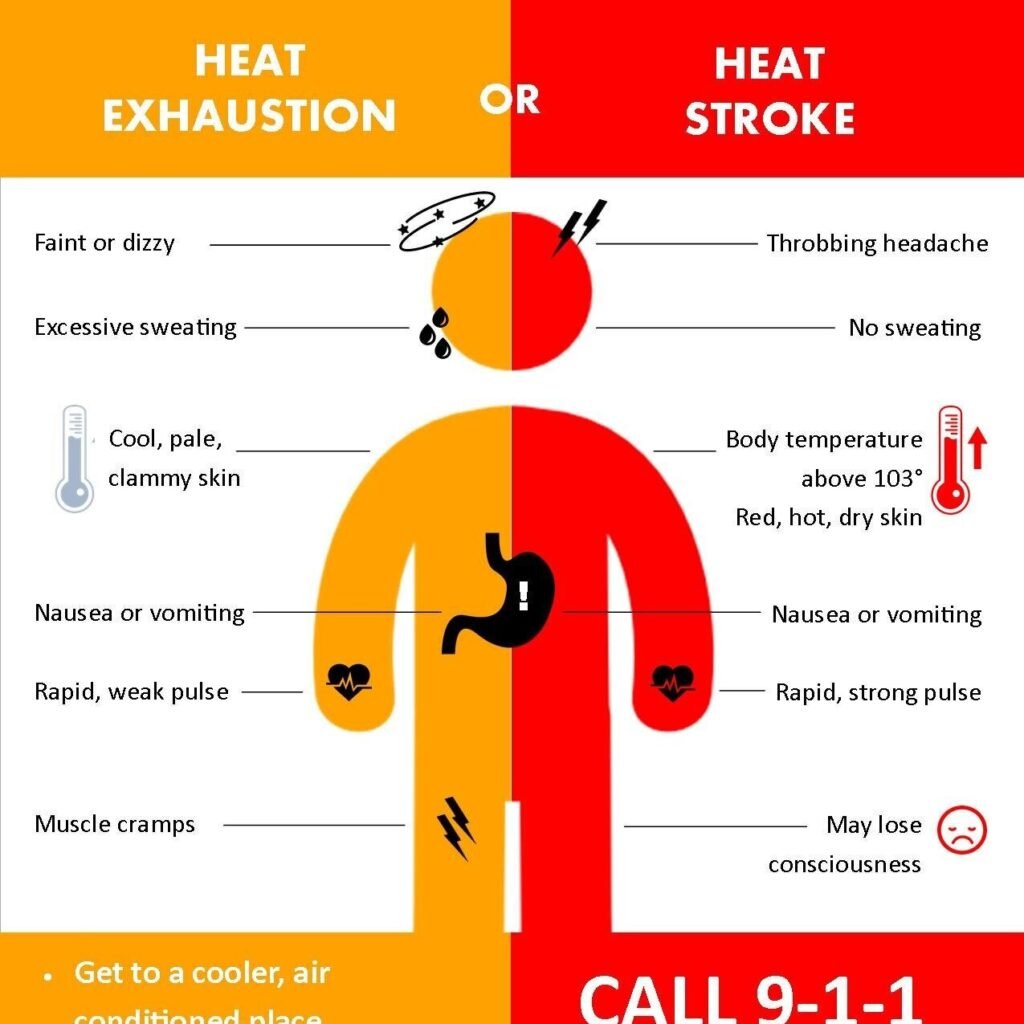
Make sure you are aware of what this image states. It could save a life. No exaggeration
Heatstroke Symptoms
Heatstroke can quickly injure vital organs and requires immediate attention. Delayed treatment may cause extensive damage or even death.
The symptoms of Heatstroke are:
High body temperature (over 104°F or 40°C),
Altered mental state or behavior (Confusion, agitation, slurred speech, irritability, delirium, seizures),
Alteration in sweating (skin feels hot and dry to the touch),
Nausea and vomiting,
Flushed skin. (Skin may turn red as the body temperature increases),
Rapid breathing (rapid and shallow),
Racing heart rate (Pulse may significantly increase),
Headache (Throbbing).
How to Prevent Heat Injuries?
Be proactive for yourself and your running mates. Always err on the side of caution. Mayo Clinic recommends:
Wear loose-fitting, lightweight clothing,
Protect against sunburn,
Drink plenty of fluids,
Take extra precautions with certain medications (ask your doctor),
Take it easy during the hottest parts of the day,
Get acclimated to the new weather conditions.
During my seven years of blogging in this space, I’ve written many times about this subject. I urge you to revisit some of these writings, so you may prepare for the upcoming weather conditions. These are the links:
Last weekend gave us runners a preview of brutal summer weather in South Florida. It wasn’t as bad as mid-July, but in mid-May, it signaled what’s ahead. If you live in the Northern Hemisphere, expect this soon.
Hydrate, sure, but don’t overhydrate (Image by Grok)
The line between toughness and doing something stupid is very thin, and if you cross it, you can get seriously hurt. So, my yearly blog post urging runners to stay on top of their training during the summer has been forced to be published earlier than expected.
Adjust your training and expectations for survival, not just performance. Heat injuries can permanently impact your health and your running future.
Here are five adjustments for safe training during the summer.
1 – Know what’s happening – You can’t fight the weather; you can only adjust for safe running. Two basic things occur:
1A – When air turns humid, it feels thicker, making each run more effortful. Running at the same speed takes more work.
1B – The second one is basic biology: The human body cools off by sweating, and the blood is about 92% water. The more you sweat without replenishing fluids, the more water gets sucked out of your bloodstream, and the thicker the blood becomes, the more difficult it is to circulate. This spells deep trouble.
2 – Adjust your running time – If the brutal summer is an unavoidable part of your home zip code, your options for outdoor running are reduced to: A- adjusting to run in the heat/humidity, or B- not running at all. If you choose A, you must do so at the coolest time possible, when it is gentler to the body. The basic choices are before sunrise or after sunset. Wake up earlier or wait until later. If you can’t, there is always a frightening Option C: The dreaded treadmill.
A good hack is to keep a running shirt and hat in the freezer and put them on right before you hit the road. This will cool your core and provide you with a few comfortable initial miles before the inevitable sets in.
3 – Slow your pace – Do you know why mainstream races take place in the fall or the spring? Who wants their goal race in the thick of a scorching summer? This is the time to get ready for the upcoming season; the time to tackle strength training and base building. The latter is achieved by running at a lower effort level, regardless of speed. Your fall and spring PRs are built during the summer. Don’t worry about what “the fast” people may think. Stop posting on Instagram if your followers’ opinions matter.
4 – Overhydration is a real danger – Your body is designed to lose fluids as you run, without replenishing every single drop of sweat. So, don’t fall into the temptation of overindulging in water or sports drinks. Hyponatremia is a serious condition that happens when too much fluid is ingested, diluting your sodium levels to the point that it may cause seizures, coma, and even death.
Hydration is not just about what you consume while running. Hydration is a 24/7 habit that has you ready to go by the time you press start in your GPS watch.
5 – Beware of the signs – The challenges of summer running go beyond training earlier, later, or slower. Heat exhaustion and heat stroke are among the most serious dangers in inhospitable climates. It’s each runner’s responsibility to recognize the symptoms and adjust before it becomes a 911 call. With luck, a mishap may keep you out for a few weeks; without it, it could kill you. In a previous post, I wrote about heat exhaustion and heat stroke. I invite you to revisit it by clicking here.
In Conclusion
There are no medals or podiums during training. Be smart and remember you are only getting ready for next season.
Running in heat and humidity is doable if you prepare properly. Never lose sight of the fact that you need to live to run another day. As stated earlier, the line between toughness and doing something stupid is very thin, and if you cross it, you may get seriously hurt.
👇Do you want the key takeaways of this blog post? 👇 👇Click below to watch the video summary 👇
When it comes to running, cadence is one of those parameters everyone can relate to, as the concept is straightforward. Yet, upon deeper inspection, most people have no idea what to do with it. It’s a bit like BMI (body mass index): Okay, it’s 29.6. Great! Now what?
Cadence is not a one-size-fits-all parameter (Image by Chat GPT)
The right running cadence can help reduce fatigue, become a more efficient runner, avoid injuries such as shin splints, and thus allow you to run longer. And while higher cadence can be beneficial, it is not the secret sauce that is missing from your training. And, if you don’t know what you’re doing, cutting your stride indiscriminately is not without its consequences.
Cadence is a simple, straightforward concept: the number of steps you take per minute. Each step starts when one leg touches the ground and ends when the other does. It measures both sides, and most running watches quantify it as a standard function. While most everyday runners’ cadence is around 160-170ish, it is usually higher for elite and track athletes. There’s even a myth about the “magic 180 cadence.”
The idea that all runners should aim for 180 steps per minute for maximum efficiency is traced back to observations by exercise physiologist and coach Jack Daniels during the 1984 Olympics. Daniels counted the cadence of elite distance runners and found that most were running at about 180 steps per minute, or slightly higher. His observation was descriptive, not a universal prescription. However, as the finding spread through coaching circles, books such as Daniels’ Running Formula, and running watches that track cadence, the nuance was lost. What began as an observation of elite runners gradually became gospel among many recreational runners.
The problem with 180 is that only a tiny fraction of runners will ever become Olympians. So, while 180 is indeed a great cadence, it depends on factors such as height, weight, leg length, structural issues, and now even shoes. The runner pushing a sub-3 marathon, wearing carbon-plated shoes, has different mechanical requirements than one aiming for his first sub-30 5K. You can’t expect both to run at a 180 turnover.
If you take away one thing from this post, may it be getting rid of that 180 myth. While it is a great cadence, it is not a magic pill that will have you winning marathons next year. Past and present elite distance runners have succeeded without 180. Meb Keflezighi, Galen Rupp, and Frank Shorter won Olympic marathon medals and were all most efficient in the low 170s. Bill Rodgers won four Bostons and four New Yorks between 160 and 170. Paula Radcliffe set the marathon world record, also around 170.
Cadence is not a magic pill to solve all your running problems and have you set world records (Image by Grok)
Varying your cadence must have a clear intention; it is not just upping the number for the sake of more-is-better. Changing your mechanics without a purpose is a recipe for injury.
Bryan Heiderscheit, PhD, Director of the Runners’ Clinic at the University of Wisconsin Sports Medicine Center, explains: “Research shows that when runners increase their turnover, they reduce the impact on their knees and hips and often improve their stride mechanics. Increasing turnover will help the chances of your foot landing closer to or underneath your pelvis, reducing overstriding tendencies, and increasing your lower extremity stiffness with less bounce and braking in your steps.”
That said, reducing your stride to increase your cadence while still overstriding won’t help you at all. Quite the contrary. You will be overstriding more often, speeding up your breaking point, and thus increasing your risk of injury.
“If you’re going to increase your step rate, also try to land with your foot closer under your hips,” Heiderscheit says. “You don’t want to keep reaching in front of yourself.” Jonathan Beverly compliments the idea by stating: “My experience as a runner and coach confirms this: A faster cadence comes, in fact, as you learn to run tall, land closer, and push back-all part of the same process.”
In conclusion: Even though cadence is a simple concept, and the benefits of adjusting it are real, not every runner needs to do it, and not every leg malady gets solved by it. Assessing it and making a few adjustments is a good place to start, but if the issues don’t subside quickly, you may want to check with a physical therapist before continuing to adjust your cadence indiscriminately. You don’t want to end up with a stride that is too short for your frame, which will result not only in discomfort but in injury.
There are plenty of exercises and techniques to work properly on your cadence, but they are beyond the scope of this post. But beware: When researching online, make sure the author’s background and credentials are legitimate. Don’t just do what the flavor-of-the-month influencer recommends. They may know what they’re talking about, sure, but they may not.
👇Do you want the key takeaways of this blog post? 👇 👇Click below to watch the video summary 👇
When it comes to the long run, theories abound. A certain influencer says this, scientific research says that (yet somehow you believe the influencer, but that’s another story). Or your buddy swears at a new esoteric formula that allows you to run only twice a week and still improve all your PRs, but then, here comes fill-in-the-blank.
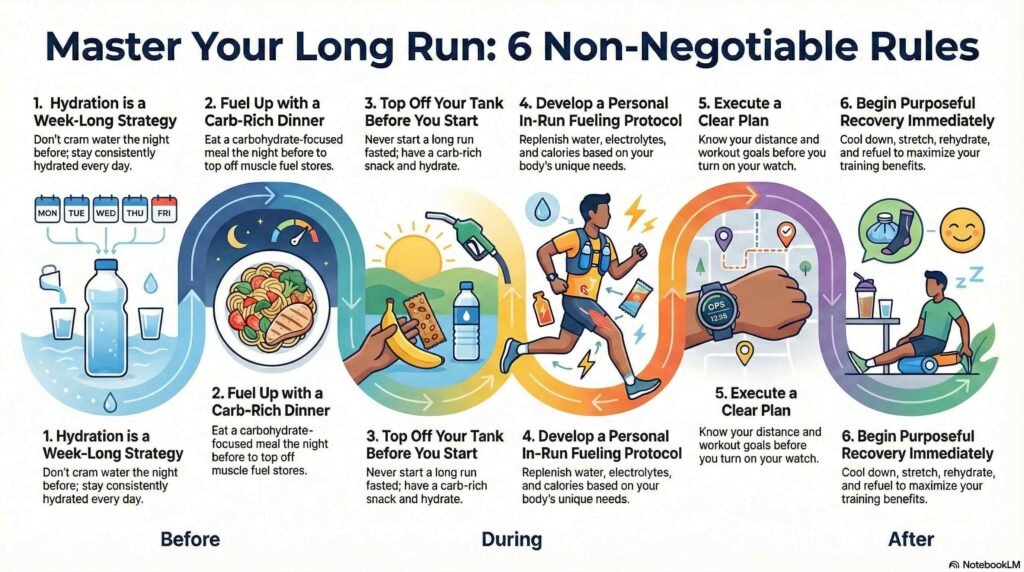
Most theories and formulas have their merit, but some are just quacks. Yet certain non-negotiables can’t be overlooked if you strive to improve your endurance, times, PRs, and enjoyment in running. These are my six non-negotiables:
Hydration – it is not about drinking water during your long run. It is about setting a hydration strategy that goes beyond your time pounding the asphalt. Hydration is a weeklong strategy. You can’t cram hydration the night before or the morning of your long run. A healthy intake of water and electrolytes throughout your day, every day, every week, will ensure you are primed to withstand the sweating rigors of your run, during which you must rehydrate as you go, of course. Don’t start on a deficit. In the best circumstances, it is a recipe for a bad run; in the worst, for disaster.
Night-Before Dinner – A key component to the next day’s long run success. It must be carb-rich, as they will help top off your glycogen (muscle fuel) stores. This is not the time for a big-ass stake or a huge salad. This is not the time to try that new restaurant your family has been dying to go to. This dinner is “me time”. It is about preparing for tomorrow. It’s the time to be a little selfish and make sure your posse understands your nutritional needs. You can please everyone else with their meal choice tomorrow. One more thing: Give yourself plenty of time to digest your dinner.
Pre-Run Fuel – There are plenty of benefits to running in a fasted state, but those do not apply to your long run. Even if you had the perfect meal the night before, your body used glycogen and water to keep you alive through the night. So, even if you feel you can tough it out, hydrate and have a carb-rich snack before you start. There is no reason to start your journey without your tank topped off when the solution is so accessible. Your body will thank you with better performance and less fatigue.
In-run Fueling – Even though your body is designed to perform at a certain level of dehydration and calorie deficit (meaning you don’t need to replace every drop of water as you sweat it or every calorie as you burn it), you must eventually replenish so your body continues performing over the energy demands throughout the workout. For that, you must develop your personalized protocol. Forget what experts say and figure out what is best for you. When do you need water? When do you need a gel? When do you need electrolytes? It is all about your individual needs so that you may keep the engine burning hot.
Execute your plan – When you go out for a long run, be clear about what you want to accomplish from your training, and make sure of that before you turn on your watch. You shouldn’t be surprised by a mile-repeat in the middle of your run. You shouldn’t figure out you are going 12 miles at mile 2. You should have known that yesterday, if not earlier. Being prepared is the key to success, and it’s better to avoid needing a week to recover instead of a day or two.
Purposeful Recovery – You finished your long run. Great! Congrats! Let the Strava kudos and the Instagram likes pour in. What now? Well, if you want your body to benefit from the workout, you must start the recovery process ASAP. This means you should not get in your car 30 seconds after you are done. You should catch your breath, cool down, stretch, rehydrate, ingest protein and carbohydrates (chocolate milk is an excellent way to do so), and make sure that, as your body enters recovery mode, it can recuperate stronger, faster. Eat, hydrate, and sleep so you are ready to use the benefits of that long run as soon as possible.
There are many theories about the long run, some with merits, some without. If you want to build strength, endurance, and confidence, not just for race day, but for years to come, I truly recommend you incorporate your non-negotiables into the long run. These have all been proven.
Please share your thoughts in the comment box below.
Back in June, I watched online as Faith Kipyegon unsuccessfully tried becoming the world’s first sub-4 miler woman. The event was one of those multi-million-dollar circus shows put on by Nike to test human physical limitations. It was elaborate enough that, just like Eliud Kipchoge’s Sub-2 in 2019, it would not have counted as a world record should she succeed.
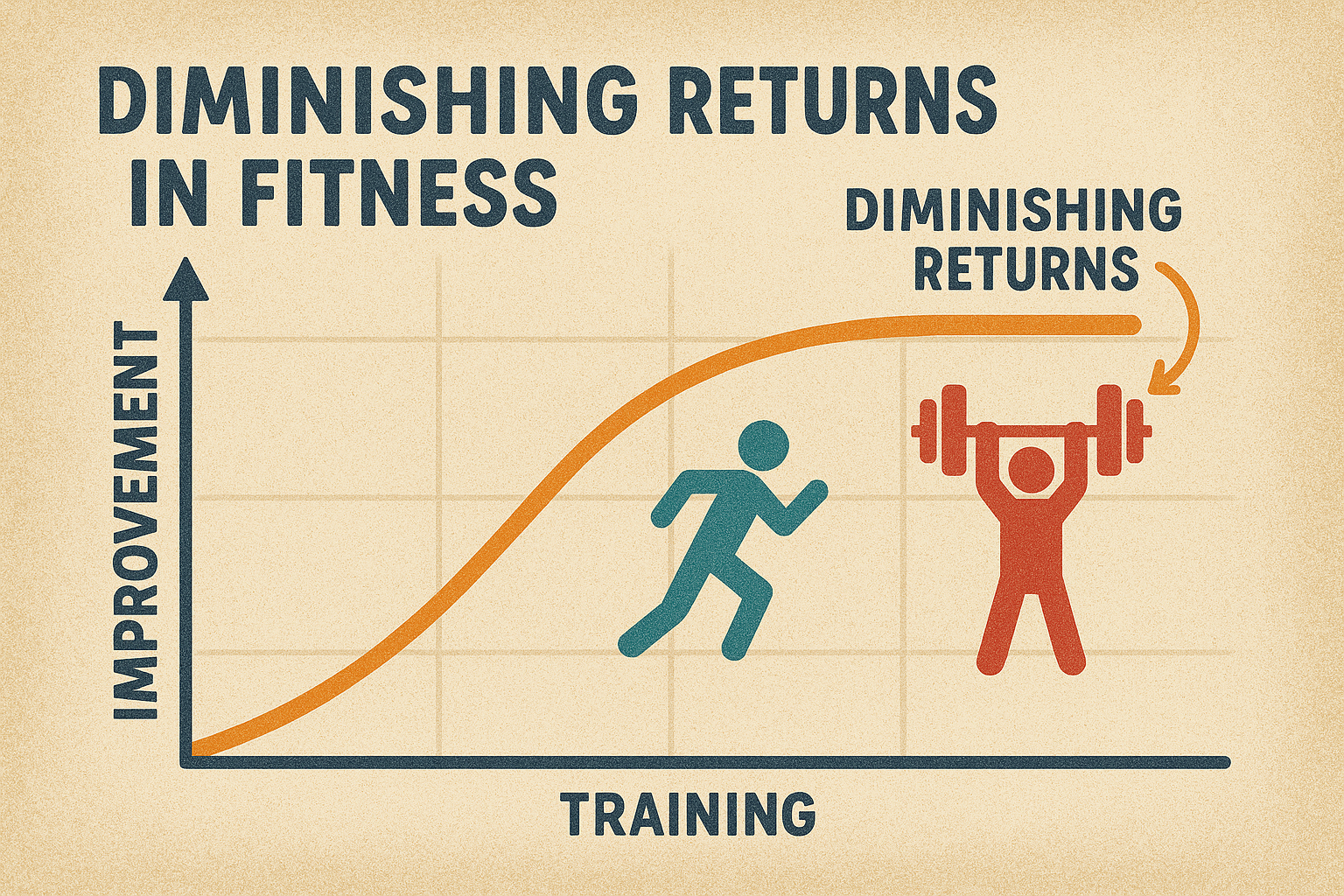
Athletics and the principle of diminishing returns (Image by ChatGPT)
Kipchoge needed to improve his marathon time by 100 seconds, and he did, finishing 19 seconds ahead of his previous record. Kipyegon needed to shave about 8 seconds (7.65) to achieve her goal, but she ended up about 6.5 seconds short. Even with the circus, space technology, support, and male pacing, she couldn’t do it.
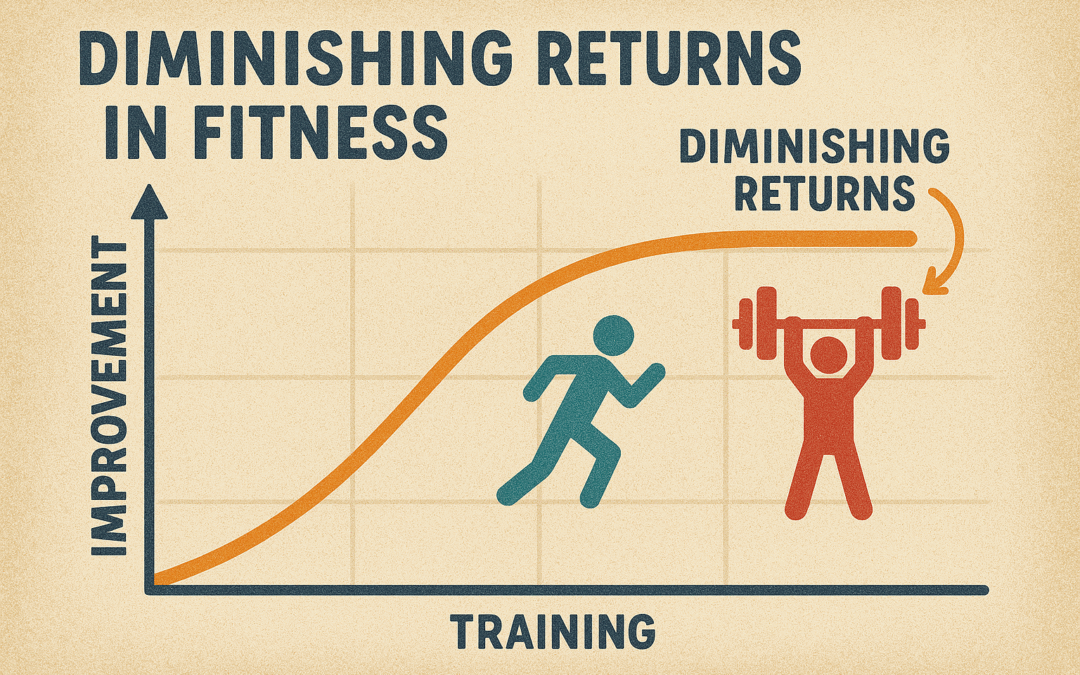
The failed attempt got me thinking about a basic concept in economics that easily applies to running: the principle of diminishing returns. In economics, this means that ff you improve one variable while keeping all the others constant, the incremental output gained from each extra unit will eventually fall. In other words, building a skyscraper in one day won’t be solved with more workers.
The same principle applies in athletics. Dr. George Sheehan, one of the greatest running writers, put it this way: “The first mile is the most helpful one as far as conditioning goes. Each succeeding one gives less and less benefit than the one before. Runners who work more and more are working for less and less. […] It doesn’t take much to get 90% fitness, only a few miles a day. But it takes progressively more and more training as you get closer to your ultimate potential. At the highest levels, you are putting in a huge investment for a very small return. It is the small gains what makes the difference between winning and losing.”
Think about it, it’s obvious. If not, it would be a matter of time and more miles before we all became elite athletes and broke world records. We all have a limit, and while reaching it is feasible, it requires a tremendous amount of work.
I recently heard Coach Steve Magness share a story where Shalane Flanagan told him something along the lines of, “The difference between being in 2:30 marathon shape and 2:20 is astronomical.” For you and me, average, mid-to-back-of-the-pack marathoners, a 10-minute improvement may be a diligent training cycle away. For elites in a Marathon Major, this same result guarantees them peeing in a cup to verify cheating.
Nice background, Coach! But how does this apply to me, the average weekend warrior?
It is about training smarter, not harder (Image by ChatGPT)
I am glad you asked! The point of this introduction is for the reader to understand that the curve of progress in running flattens as we improve. It is a reality we can’t solve with harder training. Progress is not a linear proposition.
And, while achieving the last 10% requires an astronomical effort, it is feasible. It is about figuring out what works for you. Just because Jacob Ingebrigtsen uses the Norwegian double threshold method doesn’t mean it is the solution you’ve been looking for. He is in such shape that this is the only type of training that will extract the extra hundredths of a second needed to break a world record. This training may land you, my dear average-runner reader, on the injury list.
Working around the principle of diminishing returns to reach your apex requires smarter training. Not just harder. As gains slow, finding that sweet spot between effort and recovery is the magic sauce. It may mean varying your workouts, adjusting intensity levels, or prioritizing recovery and nutrition more seriously. As we improve, we must tune into our body’s signals, such as fatigue, soreness, or lack of motivation. These can guide adjustments before you hit a training (or overtraining) wall. If in doubt, a training plan tailored exclusively for you may help you progress without burning out.
In conclusion, In athletics, more is not necessarily better. Most of what elite runners do to squeeze that last sliver of greatness out of their performance does not apply to you. We are all limitless, sure, but not in all areas of our human performance, athletics being one of them. Let’s work hard to reach our goals, but not at the expense of burning out.
What are your thoughts on this principle? I will read and answer your comments.