A couple of months ago, I was at church, and the Pastor wanted to illustrate a Bible teaching, so he asked, “By a show of hands, who here has finished a marathon?” I couldn’t believe it (Drop exploding head emoji here). Three of us lifted our hands. Running and finishing marathons has become so ubiquitous that it’s even used for Bible teachings at church.
Interest in running has become so popular within the last few years that we must conclude that we are well into a running boom. The Third Running Boom.
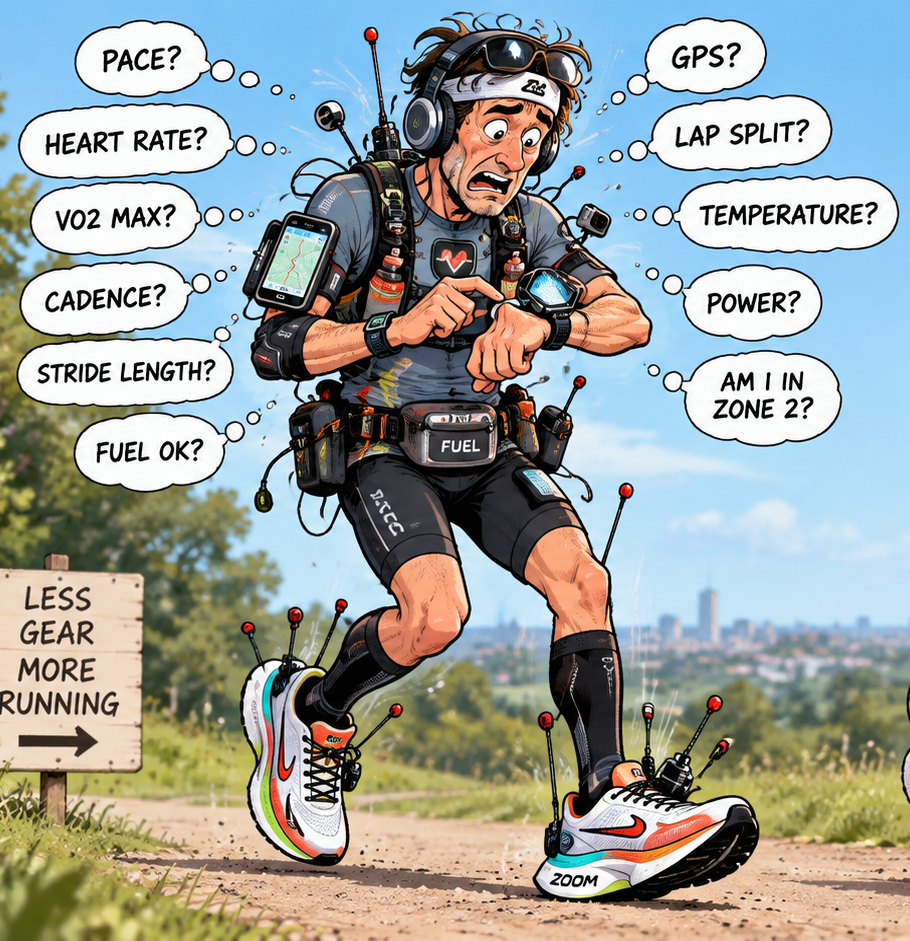
Three very distinctive running booms have seduced different type or runners into our beautiful sport. (Image by ChatGPR)
The first running boom happened after the 1968 publication of the book “Aerobics” by Dr. Kenneth Cooper and Frank Shorter’s Olympic marathon gold in 1972. The second boom began in the mid-1990s, fueled by the need to achieve something huge in your lifetime and big-city marathons providing that opportunity even to the humblest of weekend warriors.
Then came COVID, when the only chance for solace and sanity was exercising outside. This, plus the combination of oversharing life via social media and the birth of the motto “if it is not on Strava it didn’t happen,” led a new generation to discover running as a lifestyle. Many people started trading dating apps, bars, and weekend drinking binges for Saturday-morning long runs with their peers. They embraced lifestyle influencers, vlogging their running journeys and validating their efforts through half-marathon or marathon finishes.
The KPIs that confirm the post-COVID boom start with increased global participation in the sport. Up to 785 million worldwide, based on numbers I’ve read. But there is so much more:
► We no longer run in our gym shoes or the first shorts and shirt we find in our drawer. Clothing and shoe brands have invested billions in advertising, and fashion has become part of the allure. Styles, color schemes, and the latest fashion are as important as the achievements.
► Investment in research for nutrition, hydration, books, media exposure, wearable and recovery gadgets has reached levels that the earlier booms couldn’t even fathom in their niche world.
► Awareness of the need for wellness through exercise, nutrition, and a sense of belonging in an increasingly isolating world is bringing the younger generations into a world that was primarily shaped by middle-aged people who got hooked on trying to extend their lifespans by making radical changes to their sedentary lives.
► The change in demographics is revealing. While in 1967 Kathrine Switzer became world famous for defying the Boston Marathon’s “unofficial” ban on women, today the male/female split among participants is approaching 50/50. About 60% of half marathon finishers in the US are female.
► Young adults have embraced the running trend, and now the 18-29 age group is about 21% of race participation. They are no longer a rare breed at the marathon finish lines. They are there either to check off a bucket-list item or to test their limits (while sharing it with the world on Instagram, of course).
The perfect color scheme and the Instagram post have become more important than the achievement (Photo by RUNFFWPU, Pexels)
According to an article by Matteo Sargenti on The Running Week website, this 3rd boom is very healthy because it’s driven by new people coming in, not older people staying put. Yet two trends threaten its continued growth: A – the constant increase in race registration fees, which leaves out the new entry-level runners needed to sustain the boom. And B – While women continue to raise their participation numbers, their share of marathon finishes has been slipping from its 2017 peak.
Back when dinosaurs roamed the earth, and I was in my late teens and early 20s, I was the only kid running with my dad’s running buddies. I did it because I liked it, not because I was going to meet friends or find the love of my life. 40 years later, clubs packed with 50, 60, or 80 young runners, with millions of social media followers, led by a wannabe influencer, are a dime a dozen. And that is a good thing.
It doesn’t matter why someone in their 20s or 50s wants to run. The positive thing is that they both want to adopt a healthy lifestyle, socialize, test their limits, or inspire strangers through social media. Let’s embrace that our sport is healthy and growing, and reap the benefits of having access to choose from 250 models of running shoes, 50 brands of gels, 25 podcasts to listen to, or laugh at pseudo-influencers talking crap they know nothing about on Instagram.
Please share your thoughts in the comment box below. I read and respond to all of them.
👇Do you want the key takeaways of this blog post? 👇 👇Click below to watch the video summary 👇
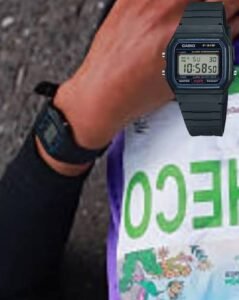
Last August, Peruvian Olympian and 2:07 marathoner Christian Pacheco won the Mexico City Marathon. Yet his victory was somehow overshadowed by traditional and social media because he was wearing a basic Casio watch, which retails for $22. No GPS supercomputer tracking all the latest and trendiest parameters.
Where is the fun in running like this? And this image doesn’t even show taking the mandatory selfie (Image by ChatGPT)
I thought this was remarkable. I don’t know what he uses for everyday training, but in images I reviewed, he won the Pan American Games and the South American marathon championship wearing the same basic watch. At least to me, who has been running since the 2nd running boom, it is refreshing to see some elite runners still capable of improving without the latest space-age technology and gadgets.
I am not against the use of technology. Running has advanced as an industry through investment, research, and the development of consumer products, and that is good. Very good. I don’t think we should go back to the jealous days of hardcore amateurism and leather running shoes. What I don’t like is overcomplicating what should be a very simple sport, especially for those of us who run for fun, to the point where joy and progress are subservient to the broadcast of your VO2Max or strangers pitching in on your latest 400-meter repeats.
Talya Minsberg, a runner and a New York Times fitness and health writer who has extensively reported on distance running, recently wrote: “Running is a simple sport. You don’t need a ton of equipment or expertise to do it, and running is a great way to improve your health, spend time outdoors, and connect with other runners.”
If you are not trying to make it to the Olympics and your living is earned outside the sport, enjoyment should be enough to make running a part of the rest of your life. It is not permission to be lazy or to be OK with being stuck in a rut. If you can run a sub-3 marathon, go for it! If we want to pursue that elusive sub-2 marathon, keep working towards it! If you want to run 1000 miles this year, focus on it. Goals are good.
Check the wrist. This is the Casio watch that suddenly became famous again.
Steve Magness, a running coach I look up to, recently wrote an article titled “An Exercise Program for Life, Not Instagram”. More than a cliché, it is a guideline many runners should start adopting. “Nail the basics for a very long time, and you’ll get 99% of the way there,” said the coach.
In his book The Kenyan Method, Joseph Kiprono explains that the edge of Kenyan runners from the Great Rift Valley isn’t based on genetics, running to school as children, altitude training, or super shoes. It is based on accepting that running should be very simple.
“The Kenyan method is not complicated,” states Kiprono. “That is precisely what makes it hard for the modern runner to accept. It is built on things your grandmother would approve of: run mostly slow. Run sometimes very hard, and mean it. Rest like it is your job. Eat simple food. Run with other people. Be patient for years, not weeks. Respect the hill. Keep your life quiet enough that your running can speak.”
To me, the key to the entire paragraph is the part about “what makes it hard for the modern runner to accept.” We can’t run if the watch runs out of battery. We use our $300 Nike Alphaflys even though we heel strike. We become running philosophers, posting runs with motivational quotes on how tough we are. We pause our watch when we stop for water so it won’t mess our averages on Strava. We sweat over our VO2Max or our functional threshold power, having no clue what they mean, let alone what they measure.
Look. I am not pontificating on the return of the 1960s-style bare-bones running. I do have a Garmin watch, I use highly engineered fueling gels and running shoes, too. It is not about becoming monastic about our running. It is about understanding that all the gadgets out there just give us an edge. And no edge will set a PR for us if we don’t put in the work. Just like that. As simple as The Kenyan Method.
A few Mondays ago, I got an urgent text from one of my trained athletes. His workout for today wasn’t in the app; could I tell him what to run? Sure, sometimes it happens, so I checked the app and called him back.
This is not the time to realize you do not have water. It takes so little to avoid this scenario (Image by ChatGPT)
“You are off today,” I said. “You put in a very hard weekend of work, so I gave you a rest day. It is in the app.”
“But I am already at the park,” he said. “Then run 30 minutes super easy”, I replied.
The mistake was harmless enough, and we laughed about it. But it illustrates something I see surprisingly often: runners prepare all sorts of things without first preparing themselves for the workout they are actually supposed to do today.
This is not about the long-term mistakes that can eventually derail your training or lead to injury. This is about today’s run and whether you are prepared to execute it properly. Unfortunately, this happens more often than you may think. I have lost count of how many runners have asked, “What’s up for today, Coach?” when we are already on the move. Baffling!
Being prepared is more than knowing how far or how fast you are supposed to run. It is also thinking through what you will need along the way. I once had a runner at mile 6 of a marathon who realized he had a hole in his pocket and that his gels had been scattered somewhere along the course. I was running with him as part of the half-marathon, so I gave him my nutrition to at least mitigate the problem.
You have no idea how many runners finish a hot summer afternoon training run exhausted and drenched in sweat, only to discover that they do not have water or electrolytes waiting for them. If they did not think to bring water, chances are they did not bring a dry shirt either. They planned the run but failed to plan for what their bodies would need afterward.
Another one I see a lot is running your buddy’s training run instead of yours. You go too fast, too slow; perform repetitions that were deliberately left out of your schedule, or you end up going too long or too short. You may be running together, but you are not necessarily training for the same thing.
Is this the right time to figure out your plan calls for a day off? (Image by Grok)
Training is a long-term proposition. There are no magic workouts, and a single altered run won’t make or break your training cycle unless it leads to an injury. Occasionally changing a workout to help a friend or simply have some fun is usually not a problem, provided the change is intentional. Accidentally ending up with six one-mile repeats when you were supposed to run a 30-minute recovery session is an entirely different matter. One is flexibility. The other is a failure to prepare.
The gist of today’s writing, and sorry if it feels like a rant (maybe it is), is simple: Prepare for today’s run. Know the purpose of today’s workout, what it requires, and what you will need before, during, and after.
Getting it wrong once will not derail your training. But getting away with it may convince you that preparation does not matter. Repeat that often enough and carelessness becomes a habit, your training loses direction, and your mental toughness begins to erode. Do not wait for the mistake that finally costs you. Prepare for today’s run, today.
I would love to hear your thoughts on this one. Please share your thoughts in the comment box below.
👇Do you want the key takeaways of this blog post? 👇 👇Click below to watch the video summary 👇
A friend of mine- unfortunately, I can’t remember who, forwarded me an Instagram reel recently from the @therunningweek account. A running coach who did not identify himself was delivering advice from the entrance arch in Iten, Kenya’s iconic running town, renowned for producing many Olympic and world champions. This one resonated.
The Kenyan 5-Minute Rule for Runners (Image by ChatGPT)
He said:
“Don’t want to run today? Good!
In Kenya, we have a rule for days like this. Put on your shoes. Go outside. Run for five minutes. Only five. Then you’re free to stop, no guilt. But watch what happens after minute three: the legs warm up, the head goes quiet, the excuses get tired, and you keep running. Not because you must, but because now you want to.
I coach runners in Iten. Even champions lose to the bed some mornings. They do not fight for 40 kilometers; they fight for the first five minutes. Because the hardest part of running is not the running; it is the starting. So, forget the 10 kilometers. Win the five minutes.”
There is so much to deconstruct in these 118 powerful words. So much.
Every runner, regardless of their commitment to the craft, has a day when they do not feel like training. Excuses are endless; explanations to justify them are plentiful, and alternative activities to rival today’s session always seem more appealing. It is human nature.
Like the coach stated in his brief yet powerful declamation: “Even champions lose to the bed some mornings.” If Eliud Kipchoge, Jacob Kiplimo and Sebastian Sawe have days like these, what’s left for us? We weekend warriors, in addition, must deal with work, deadlines, unpaid bills, cranky bosses, spouses, kids, daily commutes, and whatnot.
This is the coach who recited those 118 powerful words
This is the genius of the Kenyan 5-minute rule. We are thinking about running but looking for a way out. Let’s take advantage of the thinking part and commit just five minutes to it. And if it is not your day, then you stop, go home, and life goes on. No guilt required. We are not machines. We live to run another day.
We must be vigilant, though. This 5-minute rule is not a way out of today’s run and definitely shouldn’t become an excuse for complacency or a mask for laziness. Quite the contrary, we apply it to give today’s run a chance of happening. We give ourselves an honest chance for personal victory.
But we know, because it has happened a million times, that once we start running, we will feel better. We have experienced that post-run euphoria. We know that once we are done, we will be thrilled that we did not skip it. Yet, seldom, when it is time to change into our running clothes, leave the A/C comfort of our car to face the summer heat, or proceed to the starting point, our will to push forward is nowhere to be found.
Don’t focus on it as a guilt-free card. If elite Kenyan’s do it?. The spirit of this rule is not permitting yourself to go home guilt-free. It is what happens as you experience those tough first five minutes:
Like the coach said: “Watch what happens after minute three: the legs warm up, the head goes quiet, the excuses get tired, and you keep running. Not because you must, but because now you want to.”
And there it is: You are running because you want to, for the pleasure of it. And it only took the discipline to commit to five minutes to see what happens. And now, if it is not there, then you pack it up and go home, yes, guilt-free. You don’t look back, and tomorrow you resume your scheduled program.
Feel free to share your thoughts about this in the comment box below. I want to know what real runners think about the Kenyan 5-minute rule.
👇Do you want the key takeaways of this blog post? 👇 👇Click below to watch the video summary 👇
For anyone living in the Northern Hemisphere, the summer has been brutal. It gets sultrier year after year. In some areas, it’s the heat; in others, it is humidity; and in some, it is both. Conditions can get inhospitable and dangerous very quickly.
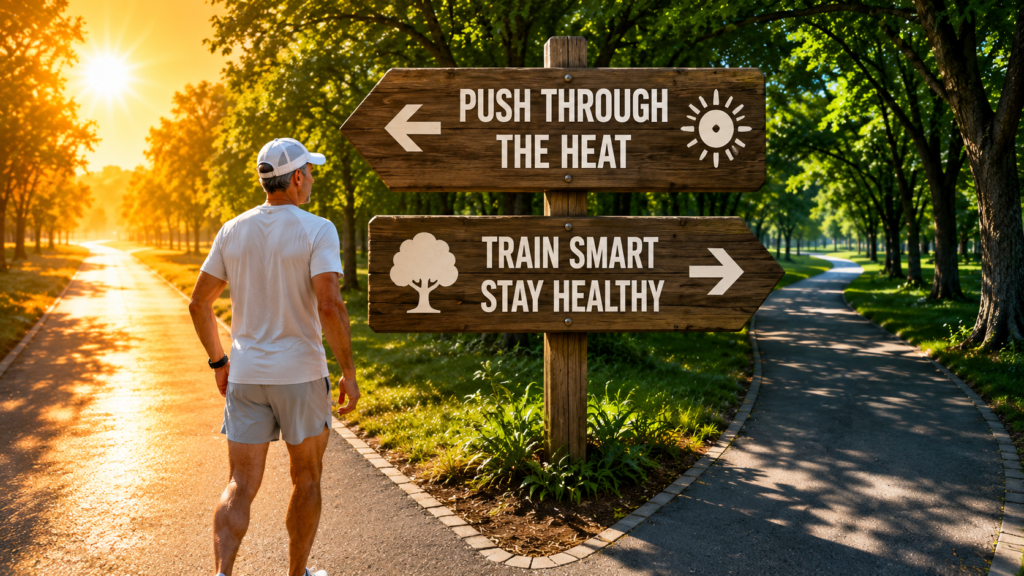
Always give yourself a way out if it is too hot for a safe run (Image by ChatGPT)
Last week I drove to my Thursday afternoon group run. As soon as I turned off the car’s air conditioning and set foot out in the open, I realized this was not happening. I decided to walk. I did so with one of my athletes and discussed her upcoming racing schedule. We walked for about an hour, got back drenched, and I was at peace with my decision. As I checked the temperature and humidity afterward, I learned the heat index was 98º (36.7ºC). Inhuman conditions.
I’ve already written about training in the heat this year (click here to read). Still, this experience got me thinking, yet once again, about accepting that I’ll survive the season rather than focusing on the metrics as a measure of success as if the temperature were 30 degrees lower (17ºC).
Alex Beach, a 2:24 marathoner based in South Florida, recently posted the following thought on Instagram: “I’m training year-round in a hot environment (Miami). Understanding the aerobic work you’re getting and not putting too much stress on hitting specific paces every workout in the heat allows you to avoid issues with overtraining.”
Running in the summer requires heavy adjustments. The weather is not just the temperature. It includes atmospheric pressure, visibility, pollen count, and more. When it comes to running, we must expand our perspective beyond temperature and, at the bare minimum, include wind and humidity in the equation.
What Happens to Your Body in the Heat?
Your body goes into overdrive to keep you cool during summer running (Image by Grok)
As a runner, you must understand the physiology of training in severe heat. When you run in hot weather, your body works harder to keep itself cool. As your core temperature rises, your muscles become less efficient, you fatigue sooner, and your overall performance inevitably declines. Accept it.
To prevent overheating, your body redirects blood to your skin, blood that would normally supply oxygen to your working muscles. From the skin, the heat is released. In dry conditions, sweat evaporates, and you cool down. In humid weather, that sweat doesn’t evaporate as easily, making it much harder for your body to regulate its temperature. That’s why running in heat and humidity feels significantly tougher than running in dry heat, even at the same pace.
So, account for that reality and focus on effort rather than metrics. The people you’re trying to impress on Instagram don’t know you, won’t visit you in the hospital if you suffer heat stroke. They certainly won’t help pay your medical bills.
What to do when it is too hot to run outside?
One of the best pieces of advice I’ve heard on summer training comes from Steve Magness, a renowned running coach, author, and performance expert who has guided athletes from high school to the Olympic level. His recommendation is simple: always give yourself a way out.
He explains how in extreme heat and humidity, it’s much easier to dig yourself into a hole that can take days, or even weeks, to recover from. Instead of stubbornly forcing yourself to complete every mile exactly as planned, build flexibility into your workouts. Rather than committing to a continuous hard workout, consider breaking it into shorter intervals with brief recovery periods. If your body is sending warning signs, don’t be afraid to stop early. Adjusting a workout isn’t a sign of weakness. It’s a smart decision that allows you to recover, stay consistent, and be ready for your next quality session. Summer training rewards athletes who know when to push and, just as importantly, when to back off.
In conclusion: Don’t try to be a hero. No PR is worth a heat injury. No social media post is worth a health breakdown. No Strava kudos are worth an ambulance ride. Be smart, play it safe, and always live to run another day.
Please share your thoughts in the comment box below.
👇Do you want the key takeaways of this blog post? 👇 👇Click below to watch the video summary 👇
The Surprising Synchrony Between Running and Your Professional Life
By Arijit Gosh*
There is a moment every runner knows. You are three kilometers from home, your legs are heavy, your lungs are burning, and every rational thought is telling you to stop. But you don’t. You recalibrate, find your rhythm, and keep moving.
The discipline you build on the road bleeds into everything else. (Image by ChatGPT)
That moment, quiet, unglamorous, entirely personal, is also one of the finest pieces of professional training you will ever have.
Running and your professional life are, at their core, training the same person.
The Miles You Log in Private Shape Who You Are at Work
It does not matter whether you are a teacher, a nurse, a freelancer, or a small-team manager. The discipline you build on the road bleeds into everything else.
Running teaches you to delay gratification. You do not get fitter in a week. You do not see the results of your consistency until you have quietly stacked dozens of sessions together, and then one day, almost without warning, you run a distance that would have broken you six months ago. Professional growth works exactly the same way. The people who seem to leap forward are almost always the ones who were doing invisible, unglamorous work long before anyone noticed.
Running teaches you to sit with discomfort. Not to enjoy it but to stop fearing it. And when you stop fearing discomfort in your professional life, your relationship with hard conversations, difficult projects, and uncertain outcomes changes completely.
Science Is on Your Side
Here is something worth knowing: exercise reduces cortisol, your primary stress hormone. It also stimulates the production of BDNF, a protein that supports brain function, memory, and focus. Runners who train consistently often find themselves sharper in their thinking, calmer under pressure, and better at bouncing back from setbacks.
This is not a coincidence. You are literally building a more resilient mind every time you lace up and head out the door.
Discipline Is the Common Currency
The most important thing running and professional life share is not motivation. Motivation is unreliable. It shows up when conditions are good and disappears the moment things get hard. What both demand, in the long run, is consistency.
Showing up on the days you do not feel like it. Sticking to a plan even when progress feels invisible. Trusting the process when the results are not yet visible.
Every runner who has trained through a grey November morning or found time for a lunchtime run during a chaotic week, understands this intuitively. You are not only training your cardiovascular system. You are training your relationship with commitment itself.
What Running Teaches Us About Balance
The discipline of long-distance running transforms professional performance, builds resilience, reduces cortisol, and boosts focus (Image by Grok)
One of the most underrated lessons in running is this: Recovery is not weakness. Rest days exist for a reason. Overtraining does not make you faster; it breaks you down. The adaptation happens during rest, not during effort.
The same truth applies to professional life. Burning yourself out is not a badge of honor. The people who sustain long, meaningful careers are rarely those who ran the hardest in their twenties and burned out by forty. They are the ones who learned to manage their energy as carefully as their effort.
Running gives you a built-in framework for this. Easy days. Hard days. Recovery weeks. Long runs that build your base. It is a rhythm, and once you start applying that rhythm to how you manage your professional energy, something shifts.
The Bottom Line
Running is not only for elite athletes or people chasing podiums. It belongs to anyone willing to show up, do the work and trust that consistency compounds over time.
This is not a running philosophy. This is a life philosophy.
So, the next time you are out on a long run and things get tough, notice what you do. Because the way you run is probably a lot like the way you work. And both are worth running well.
*Arijit Ghosh is the founder of Fitness Fortitude, a platform based in India focused on connecting fitness professionals, sports coaches, athletes, and working professionals with science-based training and coaching. His background combines corporate strategy and fitness, which is a recurring theme in his content.