Running with Lymphoma

Running with Lymphoma

By Coach Annamarie McCormick-Howell

 I’ve been a distance runner for years, so when lockdown started in 2020, I was still in my element, as running outdoors in Germany was still allowed and encouraged. I found myself kind of tired as the year went on. I attributed it to the pandemic fatigue so many of us were experiencing, as I was unexpectedly homeschooling my 4-year-old twins and confined to our tiny neighborhood. I completed my birthday run in July, starting my 32nd year with 32 miles and a renewed attitude.

Running with Lymphoma

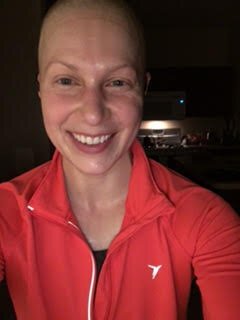
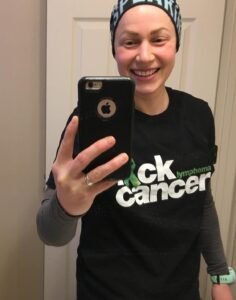
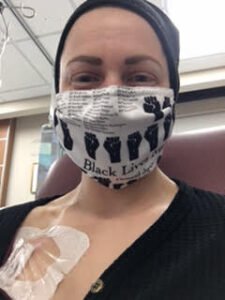
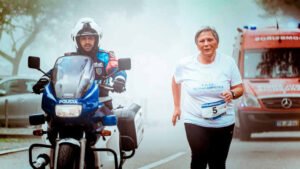
Before her last cycle of chemo, Annemarie set out to complete a half marathon.

Shortly after that, I started having some mid-back pain. Within a few weeks, I noticed my toes were numb. I was having ascending weakness when I was exercising, and then I began to fall. I went to see a German physiotherapist, thinking I had a herniated disc.

He did an assessment, and then sat me down and said: “Annamarie, do you ever have night sweats?” I knew then that there was a chance something bigger was going on. He helped me navigate the German hospital system, and I was able to get an MRI in early October. The radiologist came to get me afterwards and broke the news that I had a tumor on my spinal cord. He recommended I have surgery immediately, or risk permanent lower limb nerve damage.

I went to the American hospital at Landstuhl but was told they were not comfortable performing the surgery. I would need to take the next medevac flight to Walter Reed Army Medical Center. In one of the hardest days of my life until that point, I left my husband and children and flew to back to the US for a hemilaminectomy.

The surgery was a wild success. I woke up and was walking with full feeling in my legs and feet within the hour. I was elated and asked my neurosurgeon when I’d be able to run again. He laughed, but was supportive of my enthusiasm and, when I left the hospital a few days later, while I waited for the pathology results, he told me I could walk as much as I wanted and to be as active as I could without putting direct pressure on my scar.

The next week, despite feeling good enough to be walking 8-10 miles per day, my world was turned completely upside down. I was diagnosed with lymphoma. The next few days felt like I was in a wind tunnel of information, learning everything I had never wanted to know about cancer. My oncology team was wonderful, and incredibly supportive, from day one.

Running with Lymphoma

Within an hour of her surgery, she asked her neurosurgeon, when would she be able to run again.

I underwent a series of invasive and painful tests and then got a port placed to start chemotherapy. My doctor told me that his patients that manage chemotherapy the best are those able to be the most active throughout.

Feeling beat up, alone, and nearly unrecognizable, I had my first chemotherapy infusion the day before Thanksgiving. I knew that the person I was before cancer was gone, but that I could hang onto the elements that made me feel most like myself, so I got up and walked a Turkey Trot on Thanksgiving morning. I started counting down the days (30 more) until I would be allowed to resume running, rotating among long walks, bodyweight strength training, and indoor cycling.

A few days after Christmas, and in the middle of my second cycle of chemotherapy, I got out and did a 3-mile run/walk. This felt as big as any other running accomplishment I had achieved—however small and inconsequential it seemed to anyone else. I began running every other day, not worrying about my pace, just focusing on how my back and tibia felt. I enjoyed the movement and the normalcy. Within a few weeks, I was running almost daily, free of any post-op discomfort.

I set a secret goal to run a half marathon before my last cycle of chemotherapy, scheduled for the first week of March. I found that, no matter how tired or sore I felt, running gave me relief. I felt normal, I forgot that I was bald and bloated and nauseous and a shell of myself. I felt normal, alive, even powerful.

On March 6, 2021, the Saturday before my final cycle of chemo, I set out to run a Chemotherapy Half Marathon. Just over 2 hours later, I finished in front of our new house, smiling and sweaty (such a familiar, proud feeling), noticing that the light in my kids’ room was on, knowing that I had managed to exceed my own expectations, and that I would get to walk inside, a finisher of my first and only Chemotherapy Half Marathon, and be a mom to my kids. A mom who been carried through chemotherapy on a pair of running shoes and a lot of endorphins.

Coach Annamarie McCormick-Howell is an RRCA Certified Running Coach and an ACSM Certified Personal Trainer . She lives in Fort Meade, Md. You can follow her at @amcchowell on Instagram or reach out to her via email at amccormickhowell@yahoo.com.

 
The Journey of “The Fat Runner”

The Journey of “The Fat Runner”

By Coach Marci Braithwaite

 I am Marci Braithwaite. I am a runner. I am a marathoner who has also completed many halves as well as nearly a hundred races of many distances, both virtually and in-person, over the last twelve years. I am an elementary school teacher, and I am a mother of two teenagers. I am a chapter leader of my local, 900-member She Runs This Town running group. I am the leader of a virtual community of new runners, and a USATF certified coach.

 I am also fat.

The Fat Runner

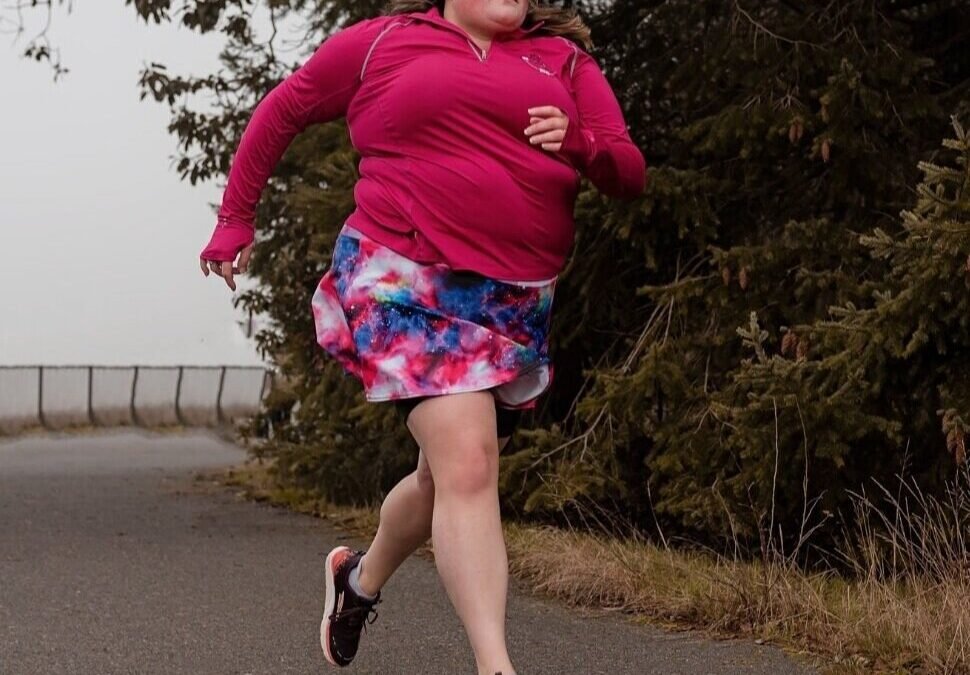
I use that word to describe myself because it is simply that – a descriptor (Photo by Patrick Krohn Photography.)

I use that word to describe myself because it is simply that – a descriptor. The word itself often causes an immediate reaction. When I use it, the occasional person will smile and say I’m brave. More often, people cringe and ask why I use that term: it’s an insult used by many to demean and diminish. To them I ask, “Why is fat demeaning? Does the fat on my body make me lesser than you? Does it diminish my accomplishments in any way? What about my fat makes you better than me?”

 Twelve years ago I started my running journey the way so many of us do, to lose weight. I thought my weight was the cause of my back pain at the time. It wasn’t (two pregnancies producing ten-pound babies tend to mess up your lower back). I did lose weight back then, but in the time since, and even through marathon training, running more than 40 miles per week, I gained it back. I’m at the same weight I was 12 years ago. I no longer have that back pain, which I attribute to strengthening my core and cross training. After more than a decade of consistent running and literally thousands of miles on my feet, I’m still fat.

 Through all that time, I started to notice something. People seemed to think that what I was doing was revolutionary. Running while fat? That’s not allowed. Fat people are sent that message every time someone yells, “Go faster, fatty!” when they’re on a run or walk, or made to feel uncomfortable, or that they don’t belong at the gym. The prevailing message is that fat people shouldn’t show themselves in the fitness arena, because you should only be visible if you’re thin and have an “acceptable” body type.

The Fat Runner

“I want people who look like me to realize that they do belong. That the shape of our bodies does not define us or our abilities (Photo: Marci Braithwaite)

Then I discovered Mirna Valerio. She is an ultrarunner and public speaker, a blogger, and the head of her own FatGirlRunning online community. One day I discovered a video she had made for REI, about an email she read while she was running a multi-hour endurance event. The email accused her of lying, that she wasn’t really running, that she didn’t actually finish the ultramarathons that she claimed to have finished. As I watched this video, which, again, was filmed while she was completing an endurance event, I realized that what she was doing, simply existing and doing incredibly badass things in her fat body, was exactly what I wanted to do, too.

 We don’t see fat runners on the roads and trails very often, do we? Why do you think that is? It’s definitely not because they don’t want to be there. Nor is it because fat people are inherently lazy. It’s a matter of access. When people like Mirna, a fat black woman, receive criticism and accusations of dishonesty for simply participating in an event that many thin people joined without a second thought, it should give you pause about the inclusivity of the running and outdoor community.

 I want to change that. I want people who look like me to realize that they do belong, both in the outdoors and in the running community. That the shape of our bodies does not define us or our abilities. That there is no definition of the word “runner” beyond “someone who completes a movement that involves both feet in the air at once during a stride.” There is no weight requirement, no speed requirement, or any definition that anyone must fit into for someone to be able to enjoy the outdoors and the running community.

 I’m Marci. I’m a fat runner and a fat running coach. I want you to join me on my running journey.

 For more information:
Facebook: Request an add to the group Fat Athletes
Instagram: @The_Fat_Athlete
Website: http://www.thefatathlete.biz
Email: coach.thefatathlete@gmail.com

EDITOR’S NOTE: The day before this entry was scheduled to post, Mirna Valerio, plus-size ultrarunner, author, and spokeswoman (mentioned earlier in this post), announced her partnership with Lululemon clothing, using the slogan, \”Running is for everyone who has a body and wants to run.\” Click here to see the announcement.


10 Guidelines on Runners Etiquette

10 Guidelines on Runners Etiquette

By Coach Adolfo Salgueiro

After years of running, 100+ races and thousands of miles under my soles, I have all developed my very personal running habits. Just as you have developed yours. Some good, some bad, some questionable. At the same time, we have all established our running pet peeves.

Even though there is nothing written, there are some basic guidelines that every runner must keep to be part of an ever-improving running community. One where friends and strangers can be proud of being a part of. Some are to keep us safe, some to make the running experience more fulfilling and some to have more enjoyable races.

These are my 10 basic guidelines on running etiquette:

  1. Runners Etiquette

    Slow runners are no less of an athlete than fast runner. Each group needs to be aware and respectful of the other (Photo Pexels)

    Be mindful of other runners around you: It doesn’t matter if you are fast, slow, walker or if you are so tired you are crawling. Most of the time you are not the only person on the road, so you need to be aware of other runners. The last thing you want is to get injured, so make sure you are not the one responsible for someone else getting injured.

  2. Respect slower runners: Both in training and in races, you will cross paths with slower runners. The fact they can’t run as fast as you, doesn’t make them less of an athlete. No need to be rude or discourteous. Be aware and respectful of the fact they are also putting their best effort forward.

  3. Respect faster runners: Just as you expect to be respected as a slow runner, if you are in this category you must respect the presence of runners faster than you. Don’t crowd the corners, don’t take the inside lane on the track, don’t clog the path by running side-by-side with too many people and be aware of your surroundings when stopping to walk.

  4. Acknowledge other Runners: Nobody expects you to stop what you are doing or change your pace to say hi to a stranger. But as runners, I think we all agree that acknowledging each other’s presence is the most basic form of good running etiquette. Tip your hat, make eye contact, nod, grunt, lift your arm or say an audible “hey”.

  5. Don’t interfere while taking selfies: They have become ubiquitous in running. If there is no selfie, it didn’t happen. We get it! You can take all the running selfies you want as long as it doesn’t interfere with other runners, especially during a race. Go to the side of the road, get out of the way and then knock yourself out with as many selfies your phone can handle. But always remember that your selfie is not another moving runner’s priority.

  6. Just because you isolate with your headphones doesn’t mean I am not there: it is your prerogative to run with headphones. If it provides you with a better experience, go for it. But it is your responsibility to be aware of your surroundings, not mine. I don’t know if you are wearing them or not so don’t expect anyone to be on the lookout for you while isolated.

  7. Do not stop abruptly at water stations: I am not sure where this walk-break at water stops trend began. This is a place where lots of moving people congregate simultaneously, many eyeing the same cup of liquid, and it is usually very slippery. If you need to stop, take your water, move out of the way, check your surroundings, and then stop. It is basic, common sense.

  8. Carry your own trash: Even when running we usually produce trash. At races, your entry fee includes trash pick up at water stop, but when training, it is not the case. Just as you carried your gel or your water bottle with you, make sure you carry their byproduct trash until you find the proper way to dispose of it. During a race, this is the water stop.

  9. Act like an adult when it comes to bodily functions: They are inevitable when you are running. Burping, snot rockets, spitting and farting are commonplace and a normal part of a healthy functioning body, especially when running. Don’t make anyone feel bad. Be mature and just let it go. Because it is a matter of time before it is your turn.

  10. Respect your membership in WhatsApp and Facebook groups: Most runners are in more than one social media group, and most groups have way too many people to keep track of multiple conversations. Limit your interactions to group related postings so your group can become relevant. I bet you are member of plenty of other groups where you share your non-running memes, jokes and political commentary.

Anything I missed? What is your running pet peeve?

The Inspirational Story of Marie Bartoletti

The Inspirational Story of Marie Bartoletti

 By Marie Bartoletti

My name is Marie Bartoletti. I am a proud daughter, mother, girlfriend, and athlete. I have done many things in my life, including the completion of 500 marathons.

Marie Bartoletti

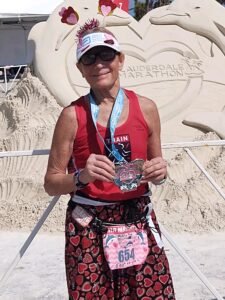
Marie finished the 2021 A1A Marathon on February 14th, 2021, in 4:38:26, her 500th.

I was born on August 2nd, 1957 in Kalamazoo, Michigan, into a large family with four brothers and two sisters. I grew up playing sports and having fun with my siblings. I’ve always had a passion for running and athletics. In my lifetime, I have extended this passion to many areas. I have been a physical education teacher and coach of all types. I have hiked, biked, and ran all over the world, even been on a Wheaties box!

 I have also faced a great deal of struggles. On November of 2015, I had a massive stroke. This has disrupted my life in so many ways but has only pushed me to be stronger. It has been a long recovery process and I take so much pride in my ability to continue overcoming these struggles every day.

 The side effect of the stroke I was most concerned with, was the loss in my ability to speak. It appeared I could understand everything but not respond with my words. This hit me extremely hard as I am a very social, outgoing person. I began to do rigorous therapy and continue to work on my speech to this day.

 The doctors were shocked to find out that I required no physical therapy after my stroke. I was able to complete all the challenges they tasked me with in the hospital. I was so thankful to find this out.  After having already lost so much of my speech ability, I feared losing my physical talents as well. I continued to persevere through these struggles and remain passionate about everything I do.  

 I have run in 181 marathons since my stroke.  This is something that gives me great pride because I enjoy competing in marathons very much!

  My first marathon was Pittsburgh, on May 7th of 1995. This race taught me my first real lessons about how to run marathons. I finished in 4:01:48. My biggest mistake was that I neglected to drink water in preparation for the race. Even throughout the race I turned down fluids. I was in terrible pain and completely worn down after this experience. I committed to never running another marathon again. Clearly that did not stick.

 
Marie Bartoletti

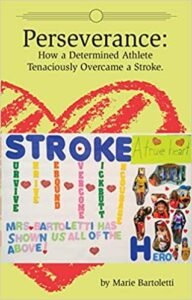
Marie’s inspirational story is written in this book. Directions on how to acquire it are at the bottom of this post.

My next marathon was in South Bend, Indiana. This was the town in which my mother was born, and my brother Tom, lived. I started the trend of traveling for marathons early, this was number two. Throughout the next few years, I continued to run marathons while also competing nationally in tennis, another passion of mine. Fast forward to 2005, I had traveled to Hawaii to achieve my goal of running a marathon in each state. This marathon also was my 50th. In the running world this is called my titanium marathon. I was able to check off both boxes with one race.

  I have gone through many injuries including operations on my bunions, broken ankles, and several concussions. Through each of these injuries I have learned perseverance. Remarkable instances in my life were my 300th and 500th marathons. They both took place at the A1A Marathon in Ft Lauderdale, Florida, on 2/15/2015 and 2/14/2021. 200 races and almost exactly six years apart.

 The 500th marathon, earlier this year, was a major accomplishment for me. I have gone through so much and I was so excited to achieve such a remarkable feat. In 2019 I published a book that tells my life story. I explain how I have persevered through so much and continue to be strong every day. This book is titled “Perseverance: How a Determined Athlete Tenaciously Overcame a Stroke”. I have sold numerous copies due to how inspirational people have found my journey.

 I would have not been able to do any of this without the support of my amazing family and friends. I have two lovely sons who have given me beautiful grandchildren. I am so thrilled to watch them grow up as well. My boyfriend, John, was present when my stroke occurred and has been essential to my recovery throughout the years. I am a devout Catholic and I pray to God and thank him every day for these blessings in my life.

 My 500th marathon was a very prideful moment, but I am most proud of the beautiful life that I am fortunate enough to live every day.

Editor’s Note: This blogpost is just a quick snapshot of Marie’s inspirational story. To find more about it, you can purchase her book by sending $23.75 to:
Marie Bartoletti
5495 Library Rd Apt 20
Bethel Park, PA 15102

2022 UPDATE: During the Miami Half Marathon, I caught up with Marie at about Mile 6. She was pacing the marathon. I have never met her in person. I approached her and as soon as I said hi, she knew who I was. It was a heartwarming experience do exchange a few words during an actual race.

The Joys and Benefits of Running on Sand

The Joys and Benefits of Running on Sand

 By Coach Adolfo Salgueiro

 Back in December of 2020, something called The Barefoot Mailman 5K Virtual Race popped up in the South Florida racing calendar. We talked about it among my peeps from No-Club Runners and decided we would make an adventure of it. Not only that, but we would also run it barefoot, so we could emulate the 19th Century mail carriers who took the 100-mile mail route down the beach from what today we know as Palm Beach to the little fisherman’s village we now know as Miami.

Running on Sand

If you have access to a beach and an appetite for a running adventure, gather your running buddies and go for a barefoot run. The smiles of all the people in this photo should give you an idea of what a cool experience this is.

We were not sure what to expect. We ran about 1.5 miles to the beach as a warm-up, left our shoes and started running. It was an overcast day, with choppy waters and the start resembled the opening scene of Chariots of Fire. The rest of the 5K was even better. Running on the packed sand, waves coming in and sometimes splashing water up to your knees… Magic!

It was so freaking cool, that we decided to make it a regular occurrence. On February 27th, a larger group met at the same place in Dania Beach to run the 5K to The Pier and back. This time we were in for a surprise. Sand was not as hard-packed as we remembered it, and each step required additional efforts. It didn’t take much for most of us to start walking. Once we got back, with burning legs, exhausted and sweaty, we still decided we had to do it again, sometime in the near future.

A couple of months ago I wrote about the wonderful experience of running barefoot on grass. Most of the benefits of grounding yourself are perfectly transferrable to doing it on the sand. But the sand offers a few extra challenges and benefits, that running on the smooth grass doesn’t.

The first requirement to enjoy your sand run and do it safely, is to forget about your watch. Your time, cadence, VO2Max, etc., are irrelevant. You must switch off your data-driven brain. This is about fun, not about PRs.

Nicolas Vitale, Coach with Club 10K, stated in a recent article that running on sand could provide benefits in the areas of agility, equilibrium, strength, power, joint strength, adaptivity to effort and endurance. After your first mile on the sand you will agree with all seven of these items. The variability of terrain the sand offers from step to step will force you to make many adaptations, sometimes simultaneously.

To get the most out of your run in the sand, you can always move from the hard-packed sand on the shore to other areas of the beach where the sand is looser. This will help you use other muscles, go through a harder effort, get less return from the ground, and adjust on the fly to adverse conditions. All at the same time.

By the way, the fact that No-Club Runners runs it barefoot doesn’t mean it is the only way to do it. If it works better for you in shoes, nothing is stopping you. Personally, I enjoy the multiple advantages that direct contact with the ground provides. We have plenty of opportunities to run in shoes.

My recommendations for running on the sand include:

1 – Regardless of the instability of the terrain, work on maintaining correct running posture.
2 – Start with a shorter distance or time until your body gets used to it. Don’t overdo it.
3 – Shorten your stride if the sand is too loose and you feel you are overworking.
4 – Don’t forget hydration, especially on hot or humid days.
5 – Focus on having fun and recharging from the direct contact with the ground. Forget you have a watch.
6 – Take advantage of the water and jump in once you are done.

If you have access to a beach and appetite for a different running adventure, grab your running buddies and meet at the shore. You won’t regret it.

The Road to My Skydive 100-Mile Ultramarathon

The Road to My Skydive 100-Mile Ultramarathon

By Ethel Belair

 My name is Ethel Belair. I am 51 years old and I am a runner. I enjoy long distances. At one time half marathons were my favorite. I\’ve ran over 25 of them. But I wanted to try something a little more challenging.

Skydive 100-Mile Ultramarathon

Not much explanation needed on how Ethel felt after achieving her goal. Just look at her face.

In 2016 I signed up for the Miami Marathon. It was tough because I had just lost my father, Jean Belair, to cancer. He passed away three months before my running, so I ran in honor of his memory. He always inspired me, reminded me to be strong and keep going. After running that marathon, which was on my bucket list, I was done. Or so I thought.

The very next day I went for a recovery run and friends though I was crazy. But after running three miles and walking one, my legs felt okay. I wasn\’t tired at all, so I said to myself: “I think I\’ll do another one”. I\’ve ran 6 full marathons so far. 

What led me to ultramarathons? A week prior to my 50th birthday, I ran a “Birthday Unofficial 50k” (31.069 miles) with a few friends. Then, on June 26th of last year, my actual birthday, I met up with friends and had another birthday run, this one was 51 miles.

A fellow runner, Lucien, asked me why not run a hundred miles? “You\’re a distance runner”, he said. I told him that I didn’t believe I was ready for that. He then suggested 100k (62.137 miles) to get started. I prayed about it and got the go to do it. Two months later, I ran and finished 100 kilometers. Two weeks later, I signed up and ran an official 50 miler. 

On December 26 of last year, I ran a 40-miler in Atlanta. This was the toughest race I\’ve ever done. It was held under freezing conditions (23°), with hills galore and hurting inclines. Grateful to God, I completed the race despite injuring some tendons. My Doctor recommended two weeks of rest. I was not a happy camper.

Skydive 100-Mile Ultramarathon

Yep! That’s right! First you skydive and then you run 100 Miles.

Despite the harsh experience in Georgia and the injury, I was still considering the Skydive Ultra 100-miler in February. I was registered since October. I had to pray, dig deep in my faith, ask God\’s grace for strength and healing. I was battling feelings of fears and anxiety. Should I still do the race? I prayed to God and found the peace to do it. “You will finish. You are strong. Be strong and courageous”. Strong is the word I kept hearing.

On January 16th I ran 5 miles for my very first run of the year. By the end of the month, I ran the #MiamiFamous Virtual Half Marathon and felt great for most of the race. At mile 10, while I was doing a recovery walk, I felt pain in my tendons, so I decided to do intervals—more running than walking. I was overly concerned as the Skydive Ultra 100-miler was only a week away. I even considered calling an Uber.  But I pushed through to completion, with some additional mileage for or a total of 16.67.

Race day was here. I wanted to skydive when I turned 50 but didn\’t get a chance to do it. I\’m one who fear heights, yet I took a chance by participating in \”The world\’s only running race that starts with a skydive”: The Skydive Ultra in Clewiston, Florida.

I got on the plane and my instructor asked me if I wanted to deploy the parachute. I Did. I was the 2nd person to jump. I just looked down and jumped. I felt great free falling 14,000 ft. (4,267 Mts). The endorphins… Wow! After landing, it was time to run my hundred-miler.

Skydive 100-Mile Ultramarathon

Somewhere along the 100-mile route sporting her trademark million-dollar smile.

The loops were 7.25 miles. I met people along the way. My amazing crew of Monique and Gerda supported me with anything I needed. I had many fellow friends and runners who called to check on me through my crew and cheered me from afar. I ran strong with God\’s grace and power. I felt the prayers of my friends and family. Every mile I felt happier and stronger.

Mile 86 was a turning point in the race. This is where my entire body started to hurt. I had to summon my will power and remain focus on my faith. I had to dig really deep and from the kindness of friends to push through to the end. Marcus, a runner himself, who was working as the DJ for the event, was kind enough to help me run two loops through a very dark night. Monique walked 2.5 miles with me, and Gerda accompanied me the last two loops. She held my hands as I pushed through the pain. My left pinky toe had a big blister, which it caused me to slow down tremendously. Then, my left knee began to ache. I told Gerda that if I had to crawl to the finish line, I would.

I am grateful to God, for the prayers, persistence, perseverance through pressure and great support from my friends. I finished 101.50 miles, my first hundo in 33:29:38. I am forever grateful. Never, ever give up!

\”The most powerful tool you have to run long distance is your mind, and when you master it, the boundaries of your endurance disintegrate.\”  Michael D\’Aulerio

 “Let us run with endurance the race that is set before us.”  Hebrews 12:1

Skip to content