Keeping a Running Logbook

Keeping a Running Logbook

By Coach Adolfo Salgueiro

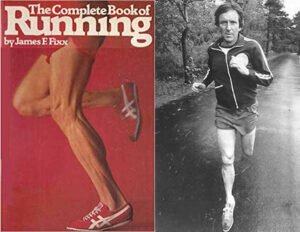
Maybe because I started running way before personal computers and the internet were ubiquitous. Or because I am a visual person. Or because I am just traditional. I like to keep track of my sporting activities in a written log. For years I handwrote in a 3-ring binder and, as the technology progressed, I set up a spreadsheet that has been constantly changing as I learned more about the wonders of MS Excel.

These days, with Garmin, Strava, TrainingPeaks, RunKeeper, and many, many more, you just forget about it, and someone keeps track for you. And they do so with more parameters than you will ever need, know what to do with, or care for. I do believe it is inevitable that any ā€œseriousā€ runner will end up with a GPS watch and an online account, and that is a good thing. But at the same time I believe that so much data, uploaded up there in the cloud, where you can access but small portions of it at a time, is not necessarily better. Yes, well into the 21st Century, I advocate for a written running log.

Running Logbook

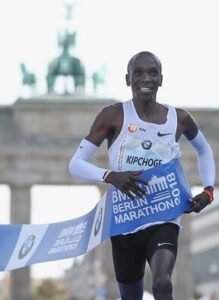
World Record holder Eliud Kipchoge has been keeping a handwritten running log since he turned professional

Eliud Kipchoge, —yes, that Eliud Kipchoge— has kept a had written, yearly running log since he became a professional runner. He records in every single workout as detailed as possible, also adding things and thoughts from outside the running world that may help his training. ā€œWhen you write, then you rememberā€, he says. If it works for Kipchoge, maybe you should give some thought.

There are multiple ways to keep track of your activity. You can do it by hand in an appointment book, a 3-ring binder, or a notebook. There are also a variety of journals on sale specifically designed for this purpose. In your computer you can develop an Excel sheet to track what is important to you, or you can just write in your entries in a Word (or equivalent) document. Google has spreadsheets and documents that are accessible in your desktop computer and phone. The options, these days, are limitless.

It is important to take your time to write or type something into your journal, purposefully, so you can internalize it, meditate on it, and visualize. Your GPS watch doesn’t record your thoughts.

Your entries can be arranged, based on the platform where you keep them: daily, weekly, or monthly. My personal preference is monthly because it allows me to review a bigger segment of my training in a single glance. Since I developed my Excel sheet, I have added weekly totals, monthly and yearly totals, pace average, heart rate, temperature, humidity, cross training, and much more.

Why do we keep track?

  • Because when we get in a rut (and you will), you can go back to when you were doing great and check what worked for you back then.

  • Because when you are training for your goal race you can glance your entire training without thumbing through hundreds of single entries in Strava or Garmin.

  • Because when you decide to change GPS watch brand, or want to change your online tracking platform, you won’t lose the data in your account.

  • Because when you are looking for a specific piece of data you can flip a page or two instead of combing through thousands upon thousands of data entries that were not designed with your needs in mind.

  • Because you can store it by year, month or whatever parameter works for you so data will be easily accessible when you need to consult it.

  • Because it creates a spectacular database that will become your frame of reference to get you from where you are today to where you want to be, tomorrow.

Running Logbook

Handwritten logbooks or computer spreadsheets can become as elaborate or a simple as your individual needs.

If by any chance I have persuaded you to give a running log a try, start right away. Now! Write down date, mileage, time and specific, detailed notes of each workout. If you did a particular mobility exercise or weightlifting routine that made you feel good, write it down. If you ran with someone who helped you get the best out of your ability, write it down. If the temperature or humidity became a pro or a con on your run, write it down. If you started with a new pair of shoes, write it down. If you feel any parameters become key in every workout, start tracking them.

The key to the usefulness of your log is the quality and trustworthiness of the data. If you fail to do your entries after each training, if you don’t keep good notes on why it went great or why you bonked, if you are just guessing your mileage and time, if you are lying to yourself, if you misplace your logs in your home or computer; then you are better off not wasting your time.

Think of all the benefits I’ve enumerated and check for yourself if they have any merits.

Ā 
The Case for Urinals at Starting Lines

The Case for Urinals at Starting Lines

By Coach Adolfo Salgueiro

I visited The Netherlands for my birthday, a few years ago, and of course I looked for a race. I was going to be in The Hague, and God smiled at me with the Den Haag Marathon on the exact same weekend I planned to arrive. I ran the half. It was an unbelievable experience. The most beautiful course in one of the prettiest and quaintest cities I’ve ever visited.

But one of the memories that has endured from my experience in the Den Haag race is kind of weird. The urinals at the starting area, which was in a public park. Yes, urinals. And not just at the starting line but also in many public places around town and as permanent structures throughout several cities in The Netherlands.

Urinals at starting lines

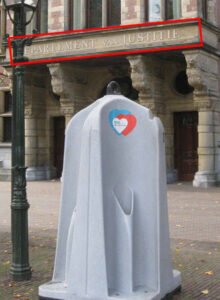
Public urinal in front of the Department of Justice in Den Haag, The Netherlands.

While waiting for the gun to go off at Den Haag, I saw these weird rigid plastic structures. They were on top of a square shaped base, maybe 4 feet to a side, about 7 feet tall, each side bisected with a wall, which created four ā€œcubiclesā€. Each space had a ā€œVā€ shaped opening at about 3 feet high at the innermost corner. They looked like… No!!… It can’t be!!!… But they were! They were urinals and weirdest of all, men were actually urinating in them, leaving the port-a-potty facilities for those males with ā€œbigger needsā€ and women.

As you may imagine, I did not take pictures of people using these artifacts, but I did take a picture of an exact one, at a later date, this one in a square surrounded by restaurants, bars and located right in front of the Department of Justice (See accompanying image). It was there 24/7 for people (men) visiting their favorite watering holes to ā€œtake care of businessā€ without resorting to the unsanitary and illegal option of going against the walls, cars, trees or bushes. Very pragmatic, like most Dutch solutions.

I know this may be a weird topic for this forum, but I assume we are all adults and we can discuss the issue with some degree of maturity. And, since every runner has at least a handful of port-a-potty horror stories during their racing career, I wanted to make the case in favor of the use of urinals for races in the United States.

THE MATH

Let’s set up a case study with a mid-size race of 3000 runners. Let’s assume a 50-50 split on the binary genders (1500 each). And let’s assume for this example the race director calculated a port-a-potty for each 75 participants, for a total of 40. If 75% of people use the facilities pre-race (2,250) and let’s say one third of them (563) are in line at any given time before the gun goes off, this means an average line of 19 people per door. Assuming an average time of 3 minutes per use, the average waiting time is 57 minutes per user. We’ve all been there and if not, we haven’t raced enough.

Now, let’s say this same race director decides to be pragmatic and exchange just five traditional port-a-potties with 4-corner urinals placed at an appropriate location in the starting area. For this example let’s say 75% of the male users (844) are using the facilities only for urination. Then, the overall population of runners using the port-a-potties has been reduced from 2,250 to 1,406, which at 35 doors and the exact parameters of usage as before, the average runner will be waiting in line for 40 minutes. Does it sound like still a long wait? I’ll take it. It is 30% shorter. It is a start.

Ā THE SOLUTION

Urinals at starting lines

There is a solution to this problem. Do we have the maturity to solve it?

I don’t assume to be speaking for all male runners, but I believe I am for a vast majority. Let’s face it, most of us at some point have found a tree, a bush or a wall to relieve ourselves while waiting at the starting area of a race. And while there, very likely have witnessed females crouching with their shorts half down doing the same and for the same reason as us. And let’s come clear here, there is nothing sexy or sexual about adults exposing themselves to take care of business before a race. I haven’t experienced the first sexual frenzy in such situation. So let’s grow up and find a solution. There is one and it has been in use in Europe for years.

A difference between the Dutch and the Americans is that the former are extremely pragmatic in the solutions to their public issues while the latter are still embarrassedly prudish with anything related to sexual organs, even if they are being used for purposes other than procreation or related fun-driven activities. While the municipality of Amsterdam installed urinals around the bar areas once they figured out a substantial percentage of drowned men in the canals were found drunk and with their fly open, in the USA we would face a ā€œToday Show exclusive investigation on the immorality of urinals in foot racesā€, reported by non-runners, despite the fact that it will ameliorate a big problem within this industry.

The use of port-a-potties is as part of a race as complaining of nagging injuries with your friends. None of them are going away anytime soon. There is a solution out there. Can we grow up and use it? Or are we to prudish to implement it?

Any thoughts?

Ā 
The Power of Being Constant

The Power of Being Constant

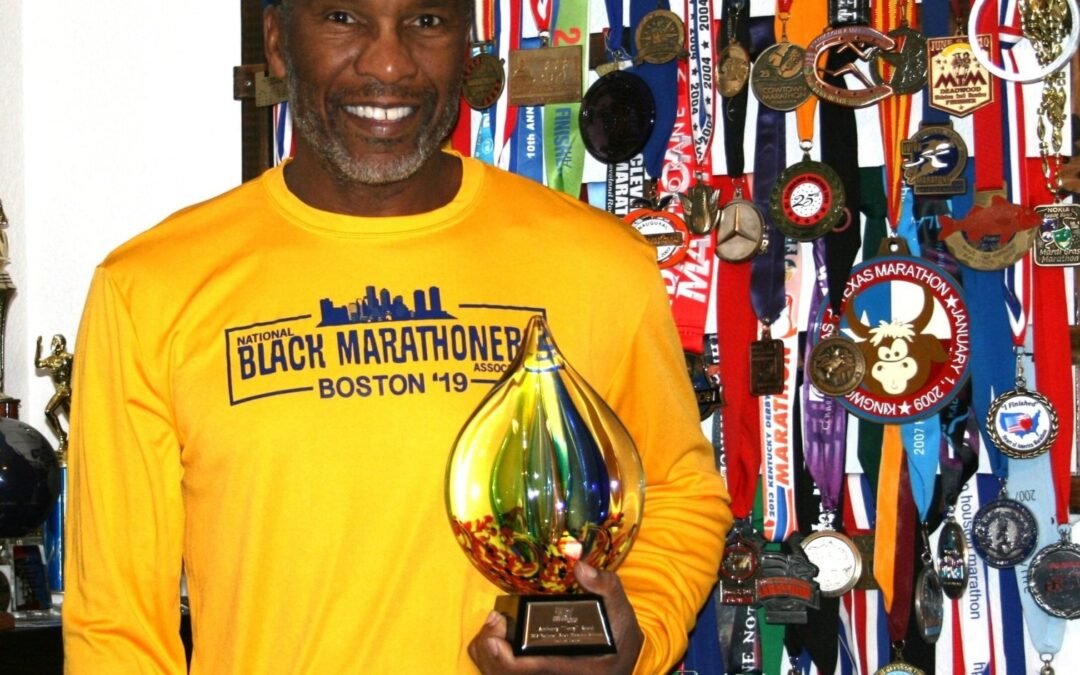
By Anthony Reed *

Editor’s Note:Ā  This is a posting from Mr. Reed in our RCAA Coaches Group. I requested, and obtained, his permission to repost it here. I believe it shows the power of remaining constant and relentlessly moving forward towards your lifetime goals and its compounding results.


Life-Long Goal Setting: Maintaining a three miles per day in average.

Ā 
Being Constant

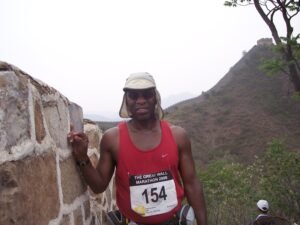
The Great Wall Marathon, China (Photo courtesy of Anthony Reed)

Many runners focus on various goals, such as running 100 miles per month. Today (6/6/21), during a 15-mile run, I finally logged over 47,000 miles over 42 years.

Ā In 1976, I set a lifetime goal to average three miles of running per day as a way of avoiding insulin. My primary goal was to run about 90 miles/month and the secondary goal was at least 100 miles per month. Also, I only wanted to run only three or four days per week. I’m a very firm believer in ā€œeverything in moderationā€.

Ā I was diagnosed as pre-diabetic in 1963 and was told that I’d be on insulin by the 1970’s. I started running as a way to avoid this prediction. In the mid-1970’s, a co-worker lost his sight due to glaucoma, had his foot and leg amputated, and died to complications from diabetes. I don’t believe he was more than 50 years old. I was scared to death.

Ā I’ve maintained a handwritten running journal since 1979. The detailed, monthly data is summarized in an Excel workbook. Here’s a brief analysis of 509 months of running.

RUNNING DATA

Ā – Averaged 3.03 miles/day over 509 months.

Being Constant

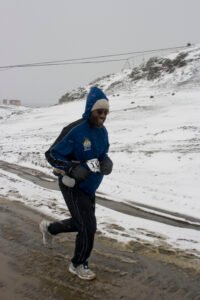
Antarctica Marathon (Photo courtesy of Anthony Reed)

– Ran 5,359 days (34.6%) out of a possible 15,496 days. As a father and husband, I wanted to keep running simple, fun, flexible, and injury-free. Thus, I felt that running everyday would put undue pressure on me. So, I opted to run only 3 or 4 days a week.

Ā – I was not perfect. I failed to reach my primary monthly goal 40% of the time, including 29 months of not running a single mile. However, I never lost sight of my goal AND my reason for achieving it. I wanted to live past 50, keep my eyesight, not have any limbs amputated, and not be on insulin. The money saved from paying for insulin was used to travel around the world and finish marathons on seven continents (completed in 2007) and fifty States (completed in 2013).

Ā – Longest streak of reaching at least 100 miles per month was 21 months; from June 1985 through February 1987. Averaged 148.7 miles/month.

Ā – Longest streak of not reaching primary goal was 29 months; from August 1990 through December 1992. Averaged 60.74 miles/month.

Ā – Maximum miles in one month: 200.13 in January 1986 over 17 days of running.

RACING DATA

Ā – Fastest races: Marathon – 3:36:45 (1984); 20-Miler – 2:35:54 (1987); Half marathon – 1:34:11 (1985); 10K – 41:31 (1983) [BTW – These PB’s were run while weighing about 195 pounds at six feet tall, which wasn’t easy.]

Ā – Completed 226 races between 1979 and 2018 (averaged 5.3 races/year).

Ā – Averaged 2.3 marathons/year between 1982 and 2000. Only one marathon (Chicago) of my first 42 marathons was outside of Texas, which included 15 Cowtown Marathons (Ft. Worth) and 15 Dallas Marathons (formerly White Rock). You have an entire lifetime to run marathons, so take it easy on the racing, especially if you\’re just beginning.

Ā – Completed 131 marathons between 1982 and 2018 (averaged 3.5 marathons/year).

Ā – Longest monthly streak: 15 marathons between February 2012 and January 2013.

Ā By keeping focused on a lifetime AVERAGE, it took the stress off everyday living and goal setting. Next month, I’ll turn 66 and am still not on insulin.


* Anthony Reed is the National Black Marathoners Association Co-Founder & Executive Director. He is the author of the book ā€œFrom the Road Race to the Rat Raceā€ which was published in September 2020.

Ā The National Black Marathoners’ Association (NBMA) is the country\’s oldest and largest, not-for-profit organization of Black American distance runners. It is open to everyone, regardless of athletic ability or previous marathon experience. Objectives are to:
Ā·Ā Ā Ā Ā Ā Ā  Encourage Black Americans and others to pursue a healthy lifestyle through long distance running and walking.
Ā·Ā Ā Ā Ā Ā Ā  Serve as a vehicle for Black American distance runners across the nation to meet in mass at a single marathon.
Ā·Ā Ā Ā Ā Ā Ā  Recognize the accomplishments of Black American distance runners.
Ā·Ā Ā Ā Ā Ā Ā  Provide scholarships to deserving high school boy and girl distance runners.

For more information about the National Black Marathoner’s Association, you can click here.

Ā 

Fours PRs, a BQ and a 62 Minute Marathon Improvement

Fours PRs, a BQ and a 62 Minute Marathon Improvement

By Coach Adolfo Salgueiro

As a coach, you put the same emphasis and hard work on every athlete that passes through your programs. You make sure to provide every single one of them with all the tools at your disposal to get the best out of their individual capabilities during their quest to achieve their goals. Yet, every so often, a special runner shows up at your door, just by chance, and blows your mind. For me, this runner is Yolmer Garcia, 45. A Venezuelan native currently residing in Pompano Beach, Florida.

Improvement

A committed athlete with a personalized training program. Results speak for themselves.

I met Yolmer just by chance. We both ran at the Pompano Beach Airpark trail and from crossing paths on a regular basis, just started giving each other the ā€œrunner’s hiā€. Then, when we coincided at the parking lot, we exchanged pleasantries and talked running. Two and a half years later, not only we have become good friends, but he has also exceeded all my expectations. As the title of this post reveals, he has improved leaps and bounds, and he is just getting started.

When I met him, sometime in late 2018, he was just a guy who loved running. With a ton of natural talent but no plan beyond running whatever he felt his body allowed him on any particular day. He had a few half marathons around 1:42. Not only he wanted to run a marathon, but he had already registered for Miami 2019 and was going to do it, rain-or-shine.

His first marathon was quite an adventure, given we only had 10 weeks prior to race day. We focused exclusively on distance. No time for speed. He had to go with whatever he had already built. He completed the race in a competent 4:16:31. Not bad at all, but not close to his potential as a runner. Plenty of space for improvement.

As he finished the ā€œLight at the End of the Tunnel Marathonā€ in North Bend, WA., on June 13, 2021, he has improved his half marathon time to 1:31:15 and lowered his marathon time 62:15, since his maiden journey into the 26.2 monster.

Yolmer was lucky enough to get into the New York City Marathon for November 2019. We set up a 20-week training program with all the necessary elements. A PR was a given, it was a matter of by how much. Unfortunately, he had severe leg cramping as he crossed from Bronx to Manhattan and his finishing time suffered considerably. Still, he finishes in 3:54:36, a 21:55-minute PR. An amazing performance regardless, and gutsy given the circumstances.

Improvement

Hal Marathon PR has come down from 1:42 to 1:31

The redeeming race was Miami 2020. A plan was set to build on endurance so he could set a comfortable PR. We wanted to focus on having a more enjoyable experience through which he could build the confidence that he is able to finish strong and without cramping. Despite a bumpy last month, when life and work got in the way of training, Yolmer was able to set a 10:30 PR, finishing in 3:43:36 without cramping. Awesome, but still not within his potential.

As races resumed after the Covid pandemic, we worked on speed to tune him up for the best half marathon time we could get. He ran 1:32 in Space Coast, 1:33 in the Miami virtual and his current PR of 1:31 in A1A Ft. Lauderdale. Then it was time for the Tunnel Marathon in Washington State.

Training was not without its challenges. South Florida is flat, at sea level and with little trails to recreate race conditions. Yet, we did the best we could with what we had available. Because Yolmer is registered for Berlin in September, our main focus was on making sure he had the distance so he could finish strong and then set up a solid speed program to fine tune a BQ. Training was solid and a PR was expected. As a coach I would have been happy with a 3:30. We must have done something right, because he PR’d and BQ’d with 3:14:01, a 29:35 improvement from his previous. Now, this is within his running potential!

From Miami 2019 to Tunnel 2021, Yolmer has improved his marathon PR by over 62 minutes (2:25 per mile), with PRs in each one of his races. And he hasn’t run his fastest marathon yet. Now that he has BQ’d, the next step in his progression is a sub-3 marathon, which I have no doubt he has the conditions to achieve. It is just around the corner. Maybe even closer that he or I think. In Berlin 2021? We will give it our best shot.

What Motivates Runners

What Motivates Runners

By Coach Adolfo Salgueiro

Ā I was recently having a conversation with a group of friends regarding the reasons we lace up our shoes three, four, or five times a week. It became obvious that even though most of us may have the same basic reasons, if we dig deeper and list the top five things that motivate us to engage in this sport, the lists will be as unique as the uniqueness of each runner.

What Motivates RunnersWhen it comes to running, we all have a main reason why we do it. The answers can fit into a wide spectrum ranging from ā€œbecause I like itā€ through ā€œI just can’t stopā€, with infinite shades in between.

As I was recently re-reading ā€œThe Science of Runningā€ (a book by Steve Magness, which I highly recommend to anyone wanting to delve very deep into the subject of the title), I was surprised to see a section with an array of scientific studies that classify runners according to their motivations.

Three of them caught my attention, and thus, I share them with you here, so you can find where you fit based on each one of them.

According to a paper titled ā€œMotives for Participation in Recreational Runningā€, published in The Journal of Leisure Research by Peter Clough, John Shepherd and Ronald Maughan, back in 1989, runners’ motivations could be divided into six groups:

a.Ā Ā Ā  Well-Being
b.Ā Ā Ā  Social
c.Ā Ā Ā  Challenge
d.Ā Ā Ā  Status
e.Ā Ā Ā  Fitness/Health
f.Ā Ā Ā Ā  Addiction

According to this study, while most leisure activities include one or many aspects of the first four aforementioned reasons, the last two separate running from other activities. Interesting to me is the last one. I am sure we all know someone we consider ā€œaddicted to runningā€, but to realize there are scholarly studies that actually classify addiction as a real motivation for the sport, puts such compulsion in a new light. At least for me.

In his latest book, ā€œA Runner’s Highā€, Dean Karnazes states: ā€œIf running is a drug that threatens my life, let me have itā€.

Magness also cites a study titled ā€œMotivations for running and eating attitudes in obligatory versus nonobligatory runnersā€ Ā by Heather Slay, Jumi Hayaki, Melissa A. NapolitanoĀ and Kelly D. Brownell, published in 1998 in the International Journal of Eating Disorders.

As the title suggests, runners were separated in two groups based on the reasons they participate in our sport. This study separated those who run because they want from the ones who run because they must. The ā€œObligatorā€ group is motivated by negative or external factors. These are the runners that if they take a week off will start thinking they are letting themselves down or the pounds will start creeping in by tomorrow. On the opposite side are the ones who just run because they want to. That is where I fit in, and I just prefer it this way.

The third study that caught my attention is a paper titled ā€œA typology of marathon runners based on cluster analysis of motivationsā€, published in 2003 in the Journal of Sports Behavior by B.M. Ogles and K.S. Masters. In this one, marathoners are separated into five categories based on their motivation:

a.Ā Ā Ā  Running Enthusiasts
b.Ā Ā Ā  Lifestyle Managers
c.Ā Ā Ā  Personal Goal Achievers
d.Ā Ā Ā  Personal Accomplishers
e.Ā Ā Ā  Competitive Achievers

What Motivates Runners

Runners train in Ngong, Kenya, in 2012. The country has produced the world’s best distance runners for decades, and most belong to the Kalenjin people.

Of course, there are many more motivations for running. According to a study by Professor Vincent Onywera in 2006, the main motivator for Kenyan Elite Runners is financial gain. Lower in their list are talent and national tradition.

If you read the recently published book ā€œOut of Thin Airā€, by anthropologist Michael Crawley, you will realize that Ethiopian runners have the same financial motivation, even those who are still far of the ā€œeliteā€ label but working towards it.

Financial is not a motivation for 99.9% of the readers of this blogpost. If anyone fits into the 0.1% remaining, please identify yourself.

This blogpost ended up a bit denser on science than I what I originally intended, but I found this subject fascinating. Somehow, I am sure we can all find ourselves in each one of these studies and understand a bit more why we do this. Because if you are a runner, it doesn’t matter what motivates you, as long as it keeps you moving forward.

Any thoughts? Leave me a comment, below.

Ā 

Heat Exhaustion Vs. Heatstroke

Heat Exhaustion Vs. Heatstroke

By Coach Adolfo Salgueiro

Once again, the usual disclaimer: I am not a doctor, so please do not take medical advice from me. If you have any questions on what you are about to read, please consult a professional, which, yet once again, it is not the author of this blogpost. Now, let’s proceed.

Heat Exhaustion vs. Heatstroke

Running in the summer heat requires a certain level of preparation to avoid heat related issues, including death (Jonas Ferlin, pexels.com)

As we enter the Summer months in the Northern Hemisphere and the coolness of the spring weather turns into a combination of heat and humidity that can make even the most motivated runner miserable, the time has come to refresh our knowledge on two important concepts. It is extremely important to understand and differentiate the signs and symptoms of heat related illnesses, such as heat exhaustion and heatstroke. They are both serious conditions, but one can lead to death.

According to the Mayo Clinic’s website, there are three heat-related syndromes that may affect your body depending on your exposure to extreme heat conditions. In order of severity, they are: heat cramps, heat exhaustion and heatstroke.

Heat Exhaustion is caused by exposure to high temperatures, particularly when combined with high humidity and strenuous physical activity. Without prompt treatment, it can turn into a heatstroke, a life-threatening condition that can be prevented by avoiding entering in the heat exhaustion zone in the first place.

HeatstrokeĀ is a condition caused by your body overheating, usually as result of prolonged exposure to physical exertion in high temperatures. This most serious form of heat injury, it can occur if your body temperature rises to 104 F (40 C) or higher.

Certain conditions and medicines can enhance your risk of a heat-related illness. Ask your doctor if any of your medical history or current prescriptions can make you more susceptible to these diseases considering your level of physical activity during the warmer months.

I can’t state enough how important to know and understand the symptoms of each one of these syndromes. Not only it could help you prevent them, but it can avert a tragedy.


Heat Exhaustion

The evaporation of your sweat regulates your body temperature. However, when you exercise strenuously or otherwise overexert yourself in hot, humid weather, your core temperature (body\’s heat combined with environmental heat) fails to regulate, preventing your body to cool itself. A normal core temperature is around 98.6 F (37 C).

Ā If you don’t deal with this situation immediately, it may develop into a dreaded heatstroke.

The symptoms of Heat Exhaustion are:

  • Cool, moist skin with goose bumps

  • Heavy sweating

  • Faintness

  • Dizziness

  • Fatigue

  • Weak, rapid pulse

  • Low blood pressure upon standing

  • Muscle cramps

  • Nausea

  • Headache

Should you feel these symptoms, stop your activity immediately, move to a cooler place, drink cool water and/or sports drinks and rest. If these symptoms don’t get better within in an hour, contact your doctor. Remember you are avoiding at all costs to have this escalate into a heatstroke.

Heatstroke

Heatstroke not only requires immediate treatment, but it can quickly injure the brain, heart, kidneys, and muscles. Damage can get worse the longer treatment is delayed and lead to serious complications and, once again, even death.

The symptoms of Heatstroke are:

  • High body temperature (over 104 F or 40 C),

  • Altered mental state or behavior (Confusion, agitation, slurred speech, irritability, delirium, seizures),

  • Alteration in sweating (skin feels hot and dry to the touch),

  • Nausea and vomiting,

  • Flushed skin.Ā (Skin may turn red as the body temperature increases),

  • Rapid breathing (rapid and shallow),

  • Racing heart rate (Pulse may significantly increase),

  • Headache (Throbbing).

    Ā 

Prevention

  • It is imperative to be proactive, both for ourselves and on behalf of our running mates, in the avoidance of situations that may trigger heat exhaustion during the hot summer months. The Mayo Clinic recommends the following:

  • Wear loose-fitting, lightweight clothing,

  • Protect against sunburn,

  • Drink plenty of fluids,

  • Take extra precautions with certain medications (ask your doctor),

  • Take it easy during the hottest parts of the day,

  • Get acclimated to the new weather conditions.

Last year we wrote a blog post on Training Adjustments for the Summer Months, which may be worth revisiting as we prepare for the upcoming weather conditions.

Let’s take a little bit of time and learn about heat exhaustion and heatstroke so we can prevent a tragedy.

Ā 
Skip to content