As in every aspect of our functional lives, we pick up bad habits while running. Some are silly or quirky, while others derail important areas of our lives. They become unnoticeable the longer they remain unidentified, so we become immune to them.
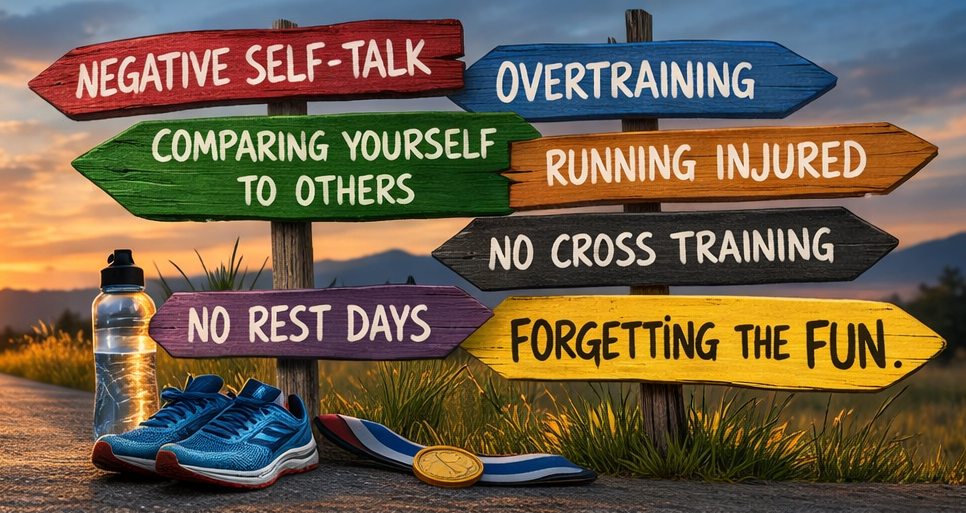
Image by ChatGPT
We’ve heard about Major League pitchers getting drilled because a certain move telegraphs their next pitch; or public speakers who get stuck repeating verbal fillers as they deliver a speech; or job interviewees who undermine themselves by constantly apologizing before answering a question. Those are just bad habits, all of which can be overcome.
Runners are no different.
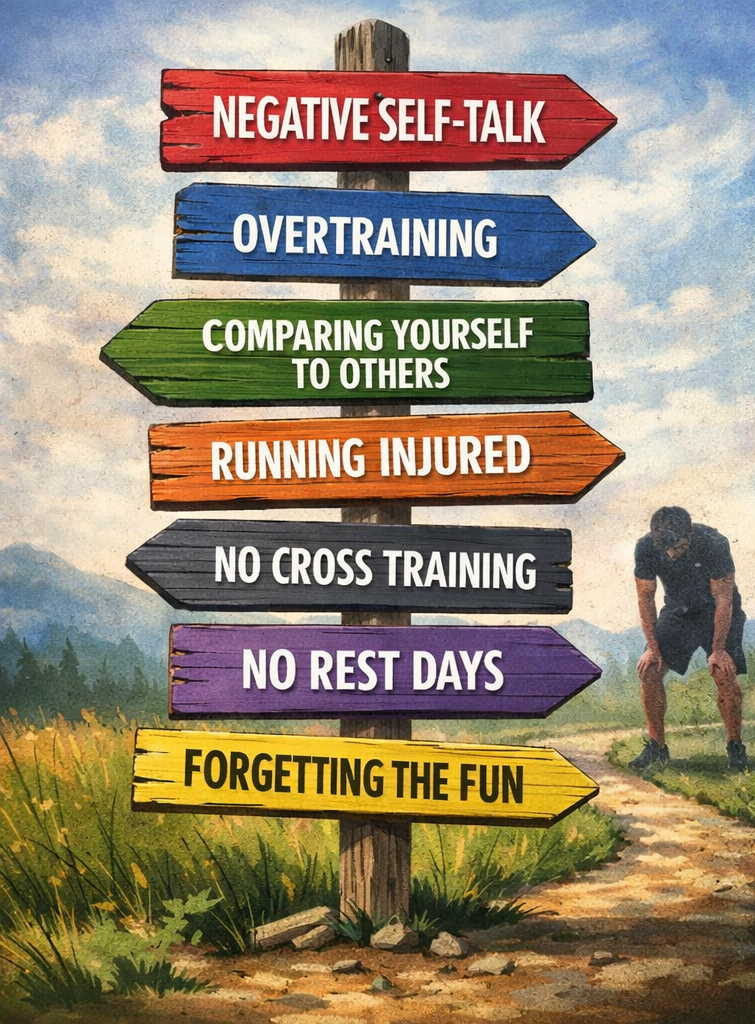
These are seven bad habits to consider and analyze whether they are sabotaging your progress as a runner.
1 – Diminishing your accomplishments: If you are training for a marathon, running “just 10 miles today” is an easy day. But running 10 miles is running a lot of miles. Take your car and drive 10 miles from your house, and see how far it is and how long it takes. It is a matter of presentation. Be proud of your accomplishments, whether the medal is around your neck or you are training to earn it.
2 – Refusing to embrace rest: Working hard is essential to maximize your running potential. Recovering so your body can adapt to the stress of those hard workouts, so you can do it again and get better, is equally important. If you return to grinding while unrecovered, you will overwork an unprepared body and get injured. Never feel guilty for “executing” your day off as written, or for taking an additional one when needed. Resting is not a sign of weakness, but of mental strength.
3 – Believing you are not a real runner: Do you run? Then you are a runner. You are not a marathoner if you don’t complete a marathon, but there is no pre-qualification in terms of time or distance to define you as a runner. The only qualification needed is to run. So, stop feeling guilty because you think you are slow, or because you don’t run what you feel like far enough, or because you take walking breaks. None of that matters. You run; you are a runner. Done!
You must ensure your body remains strong and resilient (Image by Grok)
4 – Comparing yourself to others: If you’ve read my blog before, you have seen this one: Stop obsessing about what your friends are doing. Avoid overthinking what others share on Strava or Instagram. Don’t worry about how fast your friend is running his mile reps. Worry about you, what you can do better, and how you can become the best runner you can be. That last sentence says “you” four times. It is on purpose, because your running is all about you.
5 – Running while injured: This is non-negotiable. If you are injured, you don’t run. I am not talking about aches and pains, or little niggles here or there. I am talking injured. Not all injuries require a bone sticking out of your flesh. If you compensate your mechanics to avoid pain, you change not only the way the body was designed to move but also the way your body is used to move. This guarantees that something else will get out of whack. And then, instead of taking two or three days now, your body will force you to take two or three weeks (if not months) sometime later.
6 – Neglecting Cross Training: Running is a repetitive exercise. A high-impact sport. You won’t have to crash into a 300-lbs defensive lineman, but in a 10K, you are landing about 5000 times per leg at 3-5 times your body weight. Constant repetition leads to overuse, and overuse leads to injury. You must ensure your body remains strong and resilient. Strength training is key. You can also do other sports activities, such as yoga, cycling, or swimming, from time to time. This will provide physical gains without the pounding of running.
7 – Forgetting to have fun: Does your next mortgage payment depend on your next PR? Is the happiness of your marriage dependent on your invitation by Abbott to the next Marathon Major? Is next weekend’s race-pace effort the key to qualifying for the Olympic trials? Most likely no, no, and no. Understand why you run. Sure, some people run to get over a tragedy or to regain control of their health and lives. But most of us weekend warriors run because of the joy it brings us. The post-run high, the outdoors, the sense of freedom and accomplishment, or the social component. Never forget that. If you do, you are in for a short running career.
Running can be a lifelong sport if we diligently strive to do it right and remain injury-free. Don’t overcomplicate it. You have plenty of worries in life to add running to the list. Especially since you are not a professional.
If you know me in person, have read my blog posts, or checked my website, you know I have been running for quite a while. Physical activity, running in particular, has been an intrinsic part of my life for over four decades (I am 59). Yet, I am still learning.
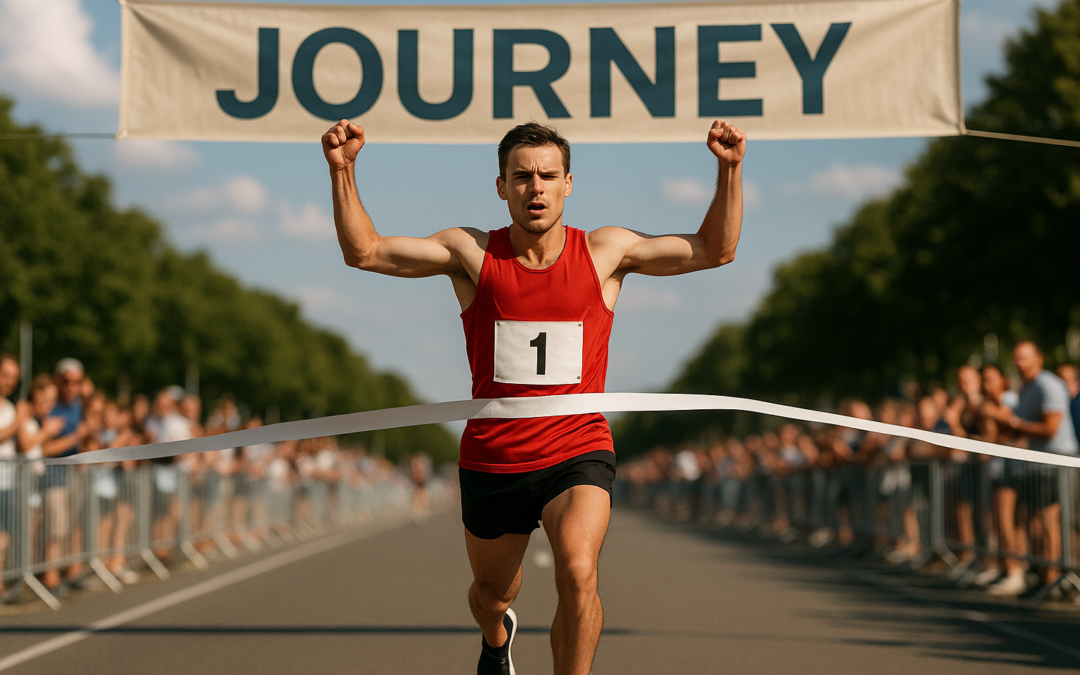
And I am doing so because running is a journey, not a destination. You don’t stop doing martial arts when you reach the black belt. You don’t stop practicing piano once you have mastered Rachmaninoff’s Symphony No. 2. You don’t stop riding a bike the day you take the training wheels off. You get the point. This is a process with no end target.
The journey of running has no destination (Image by Windows Copilot)
While racing and accomplishments are important stepping stones, as they should be, becoming a runner for life requires more than a new PR in your next 10K, running your 100th half marathon, beating your buddy in the next marathon, or reaching for a new ultra distance. While all those are worthy goals, they should be there for you to remain focused and avoid unnecessary detours in the journey.
So, as there is no finish line, focusing on the journey is a must if we want to become lifetime runners. There are worthwhile stops on the way, sure. That marathon you always wanted to run, that time you always wanted to beat, or that trash-talking runner you want to leave in the dust at the next race. But if you miss the big picture, once that temporary goal has been achieved, you will look outside of running to provide your endorphin fix.
All this sounds interesting and philosophically sound, but what does it mean?
To me, the journey is what I learn about myself along the way. It is testing my physical and mental limits and my will to do the hard work so I can reach the goals I seek. It is the lifetime and temporary friendships I build through the miles. It is my medal display that reminds me when I am down or injured, of what is possible. And so much more. And if this wasn’t enough, I have the health benefits of the exercise.
The journey is individual and should have its own meaning for each runner/reader. I encourage you to find yours so you can keep moving forward.
My brother, a three-time marathoner, has a great saying that summarizes the idea that it is not about one specific accomplishment: “On marathon day, you are just going to pick up the medal. The marathon is already behind you.”
I would love to hear about your running journey. Please share in the comment box below.
Most likely you’ve heard the term before. Proprioception has become a sports buzz word whose use has increased exponentially within the last 10 years. If you practice yoga or martial arts, you may have noticed.
Somehow, I associate it with Vo2Max. We hear it, talk about it but most don’t know exactly what it is or what it is good for. Proprioception is important for runners, and I will dig into why. But first, let’s define it.
Our body has hundreds of thousands of sensors that tell the brain where we are with respect with our environment (Photo: Pexels)
According to JL Taylor’ in the 2009 Encyclopedia of Neuroscience: “Proprioception, or kinesthesia, is the sense that lets us perceive the location, movement, and action of parts of the body. It encompasses a complex of sensations, including perception of joint position and movement, muscle force, and effort. These sensations arise from signals of sensory receptors in the muscle, skin, and joints, and from central signals related to motor output. Proprioception enables us to judge limb movements and positions, force, heaviness, stiffness, and viscosity. It combines with other senses to locate external objects relative to the body and contributes to body image. Proprioception is closely tied to the control of movement.”
Yes, a dense definition, but worth reading a couple of times if necessary so you understand it. When we run, we are jumping from one leg to the other, so we must be in balance and aware of the position of our body in relation to its surroundings. Here is where improving it comes into play.
Every time your foot strikes the ground, hundreds of thousands of sensors throughout the body send instantaneous feedback to the brain, which immediately responds with adjustments. This is why when we step on something, instinctively your foot goes around it to avoid unpleasantries. The right response/reaction optimizes the control of your motor skills and allows you to work several sections of your body at once, finding the most effective and energy saving paths for motion.
Proprioception is fundamental for runners because it allows us to:
improve balance.
upgrade control and awareness of our body.
enhance responsiveness.
improve leg injury recovery.
boost stability on uneven surfaces or when avoiding obstacles.
regain balance quickly to avoid falls.
create stability in our joints.
enhances postural and joint stability.
coordinates tendons and ligaments working in unison with the muscles to thoroughly absorb the impact of each step.
expand our running efficiency to boost speed and endurance.
Walking barefoot is one of the best ways to improve your proprioception (Photo Pexels)
All this sounds great, sure, but how do we get better at proprioception, so we become better runners? Here are a handful of tips:
walk barefoot.
balance exercises with closed eyes.
cross training such as yoga or tai chi.
exercises over unstable surfaces.
add movement and weight to floor exercises.
one-leg exercises to challenge your balance.
sitting and stability exercises on a Swiss ball.
strength and plyometric exercises.
Since running is an exercise where we are in contact with the ground one leg at a time, balance is one of the most important aspects of the sport. One that gets lost amid the chit-chat about speed, distance and PRs. Yet, none of the previous conversations can occur if we don’t master our balance, which is done through proprioception. So, let’s work on it continuously so we may become better runners avoid injuries, especially those caused by falls that could have been prevented with proper balance.
In last week’s post we talked about the value and benefits of a proper warmup. This week we are going to delve into its first cousin: The Cooldown. The benefits of taking some time to regroup, especially after a hard workout, can’t be underestimated. Getting into your car and driving home right after your run should be minimized, if not extricated completely from your training routine.
The cooldown is the portion of your training that comes right after the hard work. Not only slowing down the last few minutes or miles but also mobility and stretching routines, breathing exercises and debriefings that occur once the hard part of your training program for the day has been performed. This will allow blood to return from the muscles to your heart, the excess lactate to be flushed out of your system, and start the process of getting you heart rate, body temperature and blood pressure back to their baselines.
The cooldown is the proper time for static stretching excises that should not be performed during warmup (Photo by Marcus Aurelius, Pexels.com)
According to Penn State’s Extension website, “Completing a cool-down is not only beneficial immediately after the completion of exercises but also helps prepare your body for future workouts. By stretching out those muscles and properly cooling down, you will be more prepared to exercise sooner rather than later. If your body does not cool down properly, it will take longer for you to feel up to exercising again.”
Steve Magness, former coach at the University of Houston and in my opinion, one of the brightest scientific minds in running, stated that the cooldown has two main goals: A – Returning your body and mind to a baseline, normal state. B – Assist in your body’s adaptation to the stress of the workout you just performed.
“You are shifting your body away from this breakdown-and-consume mode to a repair, rebuild, recover mode – explains Magness – You are trying to decrease the amount of stress hormones, which are great to prepare your body to do crazy things, and you are trying to get recovery hormones, such as testosterone, back.”
The cooldown is especially important after a hard race or a hard workout where you have almost depleted your body’s resources. For long-distance runners, a speed workout or a long run with a progression or pace intervals is a perfect example of when not to skip a cooldown, so you can reap all the benefits of what you just did.
“Even if you go for a 3-mile easy run –continues Magness— you are doing it in a state where your lactate is probably elevated, your glycogen levels are depleted, especially in certain muscle fibers; fatigue is lingering, etc. And you are still doing some work, so, because of that, you will be getting some kind of training adaptation.”
In a June 2021 article from Runner’s World, Ally Mazzerole, a breath work teacher at a mindfulness studio, recommends breathing exercises once your workout is over. And it doesn’t have to become an additional time-consuming element of your routine.
Simple breathing exercises can help you cool down without adding too much time to your workout (Photo: Monstera, Pexels.com)
“Breathwork can easily be incorporated during your cooldown stretching”, says Mazerolle. “It can be as simple as taking 10 to 15 slow inhales through your nose followed by slow exhales through your mouth, or something more intentional like box breathing, where you inhale for four counts, hold your breath for four counts, exhale for four counts, and hold there for four counts, then repeat.”
“This kind of practice is so important for runners because if running puts your body in a stress (or fight or flight) response. Breathwork stimulates your parasympathetic nervous system, relaxing the heart rate and signaling the body that it’s time to rest and digest and recover,” says Mazerolle. And that recovery period is when your body rebuilds and repairs itself from the stress of exercise.
When it comes to a longer cool down after a particularly hard race or workout, Jonathan Marcus, Head Coach at High Performance West, insists that it shouldn’t be perceived like additional mileage: “As we are coming back of a workout or a race, where we go in crescendo from low to high, now we are going from high to low, so the flush is an in-between bridge. It can be a very easy running, jogging, or walking. It is this ingenious workaround to get more of a training effect in a low intensity state. Sometimes it is the most difficult part of the workout because you are tired and fatigued.”
Of course, if you are not coming from a grueling training session, then a 10–15-minute jog, plus mobility and flexibility drills should suffice.
So, just as the warmup last week, make sure you make time for the cooldown. The benefits and the science back them up.
As runners who always want to perform at our best, it is normal to have more fun running at race pace than going through all the peripheral stuff that gets us there. Stretching, cooldown, mobility drills, reps, days off and very often, warming up properly. Unfortunately, many runners see the warmup not as an element that to enhance your workout, but a waste your time or something to screw your average pace.
Reasons to skip your warmup abound. You may want to keep up with the buddy that runs faster than you, or you may be afraid of what your friends will say when they see you in Strava. Maybe you’re on a rush to get to that runner’s high. Whatever your reason is, you are not helping yourself in becoming neither a better athlete nor a healthier runner.
Ethiopian runners go out of their way to force themselves to run super slow while warming up.
In the book “Out of Thin Air”, anthropologist Michael Crawley, went to Ethiopia to learn about its running culture. He explains how locals start running painfully slow. They go to the forest to warm up zigzagging around trees, assuring that pace can’t be picked up; and in a single file, to guarantee that nobody will be surging ahead of time.
You don’t have to be an Ethiopian, Kenyan, or Ugandan to apply the slow warmup concept. Western elite runners apply it all the time. In his book “Run for Your Life”, Dr. Mark Cucuzzella, tells how he sometimes runs 13, or 14-minute miles and still feel happy to be out there running. This is a guy who has won marathons, and into his 50s, can still run sub-3.
The Purpose and Value of Warming Up
Steve Magness, former coach at the University of Houston (in my opinion one of the most knowledgeable coaches on the scientific side of our sport), reassures that the warmup sets up your run. It helps you get the body revved up and prepared for whatever we want it to accomplish with it.
“Physiologically -he explains- we get our core temperature, body temperature and muscle temperature up a little bit. We get our metabolism going, we get our VO2 up, and we are priming the body’s systems. If I didn’t do a warmup and just went out the door and start running as hard as I can, my energetic system wouldn’t be ramped up and ready to go. Then, my body will try to cover all the energetic demands with the anaerobic system before the aerobic system is ready.”
Coach Steve Magness explains the physiological and psychological benefits of warming up properly.
“From a physiological side, you are priming your motor system so when it comes time to flip the switch to work hard, your body can recruit the muscle fibers to do the job”, assures Magness.
You don’t have to be a rocket scientist or a doctor to understand the multiple benefits of what was said in the last two paragraphs. The more you work on your warmup and the more you make it part of your daily routine, the more you will realize its benefits during the hard part of your workouts. And soon enough, without noticing, it will become part of your ritual.
“The warmup also gets you in the best psychological state -continues Magness- so you can see your training or your race as a challenge instead of a threat. Something you can take on instead of confronting. It can give you a semblance of control in a situation where you often lack it.”
Keys to the Warmup
The warmup is a personal aspect of your training. You need to find out what it works for you, not what works for your friend or for Eliud Kipchoge.
When we talk about warming up it is not exclusively about running. Dynamic stretching and mobility drills should be part of it, too. This includes easy lunges, hip and ankles rotations, etc. Remember that arms are a key element of your running, so include range of motion of arms, and arm swings as part of your ritual.
The key to the warmup, I insist, is to go slow. Very slow. You can’t be worried on what that it will do to your Strava averages. But, if you can’t control yourself and you must brag to your friends, stop the watch after warmup and then start another session with the work portion of your workout. This should suit your ego just fine.
How long should you warm up? You don’t want to be burning more glycogen than necessary. For a long-distance runner (5k and over), 10 to 15 minutes is usually sufficient.
“Glycogen is a limited resource in the muscle tissue and organs – explains Jonathan Marcus, Head Coach at High Performance West- so, if you start warming up too fast, the body has to cover the gap burning a high-efficient energy source that you should be using during your hard workout, or race, before you even get started. This is why the warmup needs to be taken super slow.”
If you are not warming up properly, today is the perfect time to adjust, make it part of your ritual and start reaping its benefits.
To check a YouTube video with the key takeaways of this article, click here.
Back in December of 2020, something called The Barefoot Mailman 5K Virtual Race popped up in the South Florida racing calendar. We talked about it among my peeps from No-Club Runners and decided we would make an adventure of it. Not only that, but we would also run it barefoot, so we could emulate the 19th Century mail carriers who took the 100-mile mail route down the beach from what today we know as Palm Beach to the little fisherman’s village we now know as Miami.
If you have access to a beach and an appetite for a running adventure, gather your running buddies and go for a barefoot run. The smiles of all the people in this photo should give you an idea of what a cool experience this is.
We were not sure what to expect. We ran about 1.5 miles to the beach as a warm-up, left our shoes and started running. It was an overcast day, with choppy waters and the start resembled the opening scene of Chariots of Fire. The rest of the 5K was even better. Running on the packed sand, waves coming in and sometimes splashing water up to your knees… Magic!
It was so freaking cool, that we decided to make it a regular occurrence. On February 27th, a larger group met at the same place in Dania Beach to run the 5K to The Pier and back. This time we were in for a surprise. Sand was not as hard-packed as we remembered it, and each step required additional efforts. It didn’t take much for most of us to start walking. Once we got back, with burning legs, exhausted and sweaty, we still decided we had to do it again, sometime in the near future.
A couple of months ago I wrote about the wonderful experience of running barefoot on grass. Most of the benefits of grounding yourself are perfectly transferrable to doing it on the sand. But the sand offers a few extra challenges and benefits, that running on the smooth grass doesn’t.
The first requirement to enjoy your sand run and do it safely, is to forget about your watch. Your time, cadence, VO2Max, etc., are irrelevant. You must switch off your data-driven brain. This is about fun, not about PRs.
Nicolas Vitale, Coach with Club 10K, stated in a recent article that running on sand could provide benefits in the areas of agility, equilibrium, strength, power, joint strength, adaptivity to effort and endurance. After your first mile on the sand you will agree with all seven of these items. The variability of terrain the sand offers from step to step will force you to make many adaptations, sometimes simultaneously.
To get the most out of your run in the sand, you can always move from the hard-packed sand on the shore to other areas of the beach where the sand is looser. This will help you use other muscles, go through a harder effort, get less return from the ground, and adjust on the fly to adverse conditions. All at the same time.
By the way, the fact that No-Club Runners runs it barefoot doesn’t mean it is the only way to do it. If it works better for you in shoes, nothing is stopping you. Personally, I enjoy the multiple advantages that direct contact with the ground provides. We have plenty of opportunities to run in shoes.
My recommendations for running on the sand include:
1 – Regardless of the instability of the terrain, work on maintaining correct running posture. 2 – Start with a shorter distance or time until your body gets used to it. Don’t overdo it. 3 – Shorten your stride if the sand is too loose and you feel you are overworking. 4 – Don’t forget hydration, especially on hot or humid days. 5 – Focus on having fun and recharging from the direct contact with the ground. Forget you have a watch. 6 – Take advantage of the water and jump in once you are done.
If you have access to a beach and appetite for a different running adventure, grab your running buddies and meet at the shore. You won’t regret it.