
Fours PRs, a BQ and a 62 Minute Marathon Improvement

Fours PRs, a BQ and a 62 Minute Marathon Improvement

By Coach Adolfo Salgueiro

As a coach, you put the same emphasis and hard work on every athlete that passes through your programs. You make sure to provide every single one of them with all the tools at your disposal to get the best out of their individual capabilities during their quest to achieve their goals. Yet, every so often, a special runner shows up at your door, just by chance, and blows your mind. For me, this runner is Yolmer Garcia, 45. A Venezuelan native currently residing in Pompano Beach, Florida.

Improvement

A committed athlete with a personalized training program. Results speak for themselves.

I met Yolmer just by chance. We both ran at the Pompano Beach Airpark trail and from crossing paths on a regular basis, just started giving each other the “runner’s hi”. Then, when we coincided at the parking lot, we exchanged pleasantries and talked running. Two and a half years later, not only we have become good friends, but he has also exceeded all my expectations. As the title of this post reveals, he has improved leaps and bounds, and he is just getting started.

When I met him, sometime in late 2018, he was just a guy who loved running. With a ton of natural talent but no plan beyond running whatever he felt his body allowed him on any particular day. He had a few half marathons around 1:42. Not only he wanted to run a marathon, but he had already registered for Miami 2019 and was going to do it, rain-or-shine.

His first marathon was quite an adventure, given we only had 10 weeks prior to race day. We focused exclusively on distance. No time for speed. He had to go with whatever he had already built. He completed the race in a competent 4:16:31. Not bad at all, but not close to his potential as a runner. Plenty of space for improvement.

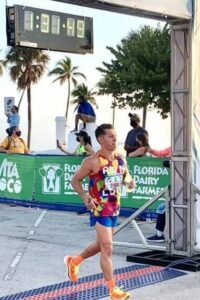
As he finished the “Light at the End of the Tunnel Marathon” in North Bend, WA., on June 13, 2021, he has improved his half marathon time to 1:31:15 and lowered his marathon time 62:15, since his maiden journey into the 26.2 monster.

Yolmer was lucky enough to get into the New York City Marathon for November 2019. We set up a 20-week training program with all the necessary elements. A PR was a given, it was a matter of by how much. Unfortunately, he had severe leg cramping as he crossed from Bronx to Manhattan and his finishing time suffered considerably. Still, he finishes in 3:54:36, a 21:55-minute PR. An amazing performance regardless, and gutsy given the circumstances.

Improvement

Hal Marathon PR has come down from 1:42 to 1:31

The redeeming race was Miami 2020. A plan was set to build on endurance so he could set a comfortable PR. We wanted to focus on having a more enjoyable experience through which he could build the confidence that he is able to finish strong and without cramping. Despite a bumpy last month, when life and work got in the way of training, Yolmer was able to set a 10:30 PR, finishing in 3:43:36 without cramping. Awesome, but still not within his potential.

As races resumed after the Covid pandemic, we worked on speed to tune him up for the best half marathon time we could get. He ran 1:32 in Space Coast, 1:33 in the Miami virtual and his current PR of 1:31 in A1A Ft. Lauderdale. Then it was time for the Tunnel Marathon in Washington State.

Training was not without its challenges. South Florida is flat, at sea level and with little trails to recreate race conditions. Yet, we did the best we could with what we had available. Because Yolmer is registered for Berlin in September, our main focus was on making sure he had the distance so he could finish strong and then set up a solid speed program to fine tune a BQ. Training was solid and a PR was expected. As a coach I would have been happy with a 3:30. We must have done something right, because he PR’d and BQ’d with 3:14:01, a 29:35 improvement from his previous. Now, this is within his running potential!

From Miami 2019 to Tunnel 2021, Yolmer has improved his marathon PR by over 62 minutes (2:25 per mile), with PRs in each one of his races. And he hasn’t run his fastest marathon yet. Now that he has BQ’d, the next step in his progression is a sub-3 marathon, which I have no doubt he has the conditions to achieve. It is just around the corner. Maybe even closer that he or I think. In Berlin 2021? We will give it our best shot.

The Art and the Science of Coaching Runners

The Art and the Science of Coaching Runners

By Coach Adolfo Salgueiro

A few weeks ago I went for a run with one of my trainees. He brought a friend to join in. He knew how beneficial it had been for my trainee to follow a structured, individualized, and supervised training plan. He was very aware of my trainee’s progress during the months we worked together. So, as we ran, he picked my brain with a few poignant questions.

Coaching RunnersThere was one that caught my attention and kept me thinking for a few days. He was training for a 50-mile race, and he wanted to know: As a coach, what is the weekly mileage I recommend for someone wanting to complete his distance?

As you may imagine by now, there is one and only one answer for such a question: “It depends”.

It was then when I started enumerating the different variables that need to be considered before I answered such a question. There is a whole set of variables that needs to be pondered and expressed in a training plan before a goal may have a chance to be realized. These variables, among others and in no particular order, are:

* Goal – What is it that you are trying to achieve?
* Balance – There must be a reason why miles are prescribed. No junk miles.
* Rest – It is a much part of a training plan as a long run.
* Nutrition – Without being a dietitian, a coach must understand the basics of healthy eating.
* Speed work – has to be balanced between long runs and recovery days.
* Intensity – It is not about how fast but how hard you are pushing.
* Aerobic capacity – For runs over 800 mts, it is the basic measurement of endurance.
* Strength training – core and weight work are key to the success of a runner.
* Cross Training – It can’t be all running. Supplementary activities need to be performed.
* Hydration – Not only about avoiding dehydration but when and how much fluids to consume.
* Fueling – caloric intake that needs to be consumed for the body to complete the task efficiently.
* Race strategy – What will you do on race day with what you have worked so hard to obtain.
* Recovery – What to do once you are done with your training cycle, so you don’t burn out.

Coaching RunnersCombining all these and many more variables in a reasonable, achievable, and well-balanced plan, requires knowledge, preparation, and experience, both as a runner and as a coach. But even with all these elements, coaching runners is still not an exact science.


Each body reacts different to the same stimuli, and because life affect every runner in an individual way, it is imperative for a running coach to be openminded, flexible and willing to adjust as weeks go by. This can’t be achieved by cookie-cutter, generic plan downloaded from the internet.

Running a 10K, a half marathon or a marathon is not unachievable. Hundreds of thousands of people do it year in and year out. But as you look to achieve certain distance or time goals, if you want to get the best out of what you have and/or if you want to improve and test your limits, the guidance of a knowledgeable coach, one who can balance art and science, becomes more important, if not indispensable.

2 Breathing Techniques to Improve Your Running

2 Breathing Techniques to Improve Your Running

By Coach Adolfo Salgueiro

A few months ago I bumped into a challenge with one of my coached runners. As soon as she reached mile 3 or 4, she got a side stitch. It didn’t matter what we tried with the timing on her nutrition or her fluid intake. Come that point, boom! Stitch! We needed to attack this problem and fast. Before it became a psychological issue.

I consulted with a few coaches I know, and they gave me their suggestions and home remedies. While we found a couple of things to temporarily remedy the nagging stitch, they were not the permanent solution we were looking for.

While researching the issue I came across a book from 2013 called “Running on Air: The revolutionary Way to Run Better by Breathing Smarter”, by Bud Coats and Claire Kowalchik. This was a publication of Runner’s World Magazine, published by Rodale.

The book goes into details about many things that are not necessarily related to breathing. So, since this is not a book review, I am skipping them. But it does go into detail on the science and mechanics of breathing and breathing while running in layman terms. To my trainee, there were two specific aspects that not only made the difference, but solved the problem:


Breathing Techniques

Breathing from the belly and doing in in an add-number pattern may help you improve you running. Worth giving it a try (image from pexels.com)

1-   DIAPHRAGMATIC BREATHING

Known colloquially as “belly breathing”, involves engaging the stomach, abdominal muscles, and diaphragm, which means actively pulling the diaphragm down with each inward breath. Compared with coastal breathing, it helps the lungs fill more efficiently.

I cannot teach you diaphragmatic breathing in a few paragraphs, but I can tell you that I’ve been doing it for over 20 years, and it has worked for me beautifully. It also helps you strengthen the diaphragm, located beneath your lungs, which is the major muscle of the respiration process. It contracts and flattens when you inhale, creating a a vacuum effect that pulls air into the lungs. A stronger diaphragm means more air, more air means more oxygen for your body to burn, and less side stitches.

Regardless of your preferred type of breathing, a strong diaphragm will help you breath better, relax, meditate, improve digestion, and provide you the obvious running benefits that more oxygen in your system can offer.

If you want to learn more about diaphragmatic breathing, its benefits and strengthening exercises, click here for a YouTube video from the UCLA Integrative Digestive and Health Wellness Program, which can help you get started.

2 – RHYTHMIC BREATHING

I have been breathing on a 3/2 count (inhale for 3 steps and exhale for 2) for about 5 years, and the benefits have been tangible. I don’t even think about it anymore, it just happens. In my personal experience, it works better than the 2/2 I did for years. Once I got my hands on this book, I understood why, and it made sense.

It is because “the greatest impact stress of running occurs when the foot strikes the ground at the beginning of exhalation and also that core stability is at its lowest during exhalation”.

Based on this, it is easy to understand that by breathing on an odd count, you will be alternating sides each time you are at your weakest while hitting the ground. Think of it this way: In one mile, you will be hitting about 750 times on each side instead of 1500 on the same one. Multiply this by the number of miles you run in a week, a month, or a year, and if you are not breathing on an odd number count, my suggestion is you better start thinking about it, today.

How do you do it? Just do it. Three in, two out. It will be weird at first, but with time, it will feel more natural and within a couple of weeks you won’t even notice it anymore.

As for rhythmic breathing, there is plenty more to learn than what four paragraphs can tell you. So, if you are interested, this is a good book where to get started.

As for my trainee, she read the book, she started strengthening her diaphragm, breathing in a 3/2 pattern, and finished not one but two half marathons with a time beyond our wildest expectations. Oh! And no more side stitches.


World Record Breaker Finishes 50K, trained by Foultips.run

World Record Breaker Finishes 50K, trained by Foultips.run

 Carlos Coste is a world-class, high-performance athlete, 12-time world record breaker in the disciplines of apnea and free diving. In the last two years, the Venezuelan born athlete has ventured into the running scene with the goal of competing in the Zion 50K Ultramarathon, in Utah. A few setbacks and a bout of Covid forced the cancellation of his plan, twice, yet he still persevered. Last month, he finished a 50K ultra in Bonaire.

50k

Running 50K in Bonaire, to make up for the Zion 50K Ultra in Utah.

“I am still a beginner in this ultra-running thing”, stated Coste. “In my first year I was coached by a friend who helped me in the transition to trail running and long distances. But then I realized I needed a coach with the experience and technical knowledge to get me to the next level. A common friend recommended Coach Adolfo Salgueiro, from Foutlips.run. I researched his background, certifications, and experience, and decided to give it a go. We connected online and started working right away.”

Coste’s training presented a few challenges from the start. He lives in the Caribbean island of Bonaire, at sea level, and his race was in Utah, starting at 3500 feet and going up from there. Also, Mr. Coste runs a successful apnea school in Bonaire, and he works with his physique on an everyday basis, so, the running is an addition to his body demands. On top of this, it was the thick of the Covid pandemic. A flexible and constantly adjusted training plan was paramount for him to reach his goals.

“During the training season there were issues with timing, small nagging injuries and this Covid thing that has affected us all” continued Coste. Coach Adolfo helped me with a fluid adjustment of the training plan. We were using a phone app that allowed us instant feedback and immediate adjustment of the work when needed. It was the perfect way to work virtually.”

50k

Carlos and Coach Adolfo before a run in Miami Beach, in late May 2021

Amid the training, Coste contracted Covid. A mild case, thankfully, but Covid, nevertheless. Once he was cleared to continue, the focus of his training had a dramatic shift, from “let’s do great” to “let’s just finish”. As if this wasn’t challenge enough, logistics and lockdown prevented him to travel to his race. So, despite the frustration and with the help of the local running community, a 50K ultra was improvised.

“I felt great during the race,” explains Coste. “First 35-40K were exceptionally good. We started at 4 AM and it was amazing to run in the desert through the night. The heat in Bonaire hit me hard after dawn so the last 10K were rough. I had to combine run and walk, but that’s what I was expecting.”

Despite the two cancellations of his Zion 50K Ultra, which was his goal for both 2020 and 2021, and the multiple adversities he had to face during training, this word-record breaker maintains his enthusiasm for running and is ready to give it a go for 2022.

“This was just my 2nd Ultra -he concluded- And for next year I am already looking forward to running in Zion. I am already talking with Coach Adolfo so after I recover, we can start the training cycle as soon as possible.”

You can follow Carlos Coste in Instagram (@carloscoste1) and by Strava . For more information on his athletic achievements, you can visit his website at https://deepseabonaire.com.


7 Additional Bad Running Habits to Quit

7 Additional Bad Running Habits to Quit

By Coach Adolfo Salgueiro

Back in September of 2020, we published a post titled “7 Bad Running Habits to Quit”. I was surprised by the response it got, but especially how so runners identified themselves, including myself, as being guilty of one or more of these bad habits.

The more I thought about the list, and the more feedback I got, the more I realized there were plenty of missing bad habits that were not mentioned in the previous posting. Of course, neither that list nor this one, or the combination of both, is meant to be a comprehensive one, nor the final word on the subject.

So these are 7 additional bad running habits to quit:

Bad Running Habits

No runner is immune to bad habits. We always have to be on the lookout to avoid them

1.      Allowing fear of failure to derail your goals: Failure is inevitable. If we learned something from it, it will always be worthwhile. Always remember that when we don’t obtain what we originally were looking for, we gain experience, which can be used in the future, making future goals attainable, feasible and possible. Coach Steve Magness puts it this way: “Making failure something that isn’t big and scary, but something that leads to growth, goes a long way in helping dissipate the fear surrounding it”.  So, never fear failure. Embrace it.


2.      Running too hard on easy days: This is the cardinal sin of running. For some reason, most runners have a Superman complex that make them (or us, since I am included) believe that they are indestructible. An easy recovery run is not scheduled because your coach hates you. It is there to get the oxygen/nutrient rich blood circulating through your muscles so they can recover quicker, and you can then go for another enjoyable, hard session sooner while avoiding injury.

3.      Pushing for Results instead of letting them happen: When your program states 8×800 at 3:45; or a 30 -minute tempo run at 9:30/mile; these are guidelines. Nothing else. Of course, we all want to hit our targets and they are there for a reason. But we need to know when to quit. There is nothing to gain on a bad day by pushing on the last couple of repeats and needing a week to recover. We must know our bodies enough to understand where the fine line between being a badass and doing something stupid, lies.

4.      Controlling every parameter through your watch: Science fiction writers from just 25-years ago could not even imagine what wrist watches can do, today.  We still call them watches only because they are on our wrist. They are advanced computers. They measure pulse, oximetry, quality of sleep, recovery, resting heart rate, route, etc. And if that wasn’t enough, they can even tell us time. As great as all this is, we can’t become slaves to the graphs and let them overtake our training. They are but guidelines to consider, not the Gospel of running.


Bad Running Habits

Complicated graphics you can’t even understand are not going to make you a better runner. Concentrate on a few parameters you can control and understand.

5.      Thinking the unsexy stuff is worthless: Our training program will often call for easy recovery miles, or for an easy long run on a day we know we can push, or a foam rolling session, or a day off when we are still feeling strong. But never underestimate the importance of the boring stuff. It is there for a reason. To help you recover, to make you stringer, to make you versatile, to make you patient, to avoid injuries. All worthy qualities in a runner.

6.      Focusing on a system instead of the whole person: Anaerobic work, hill repeats, tempo runs, the weekend long run, or lactate threshold runs are staples of a well-balanced training program. But none of them work individually and this is not the time to look for personal bests. All parts all need to work as a well-tuned machine to provide the results you are training for. It is not in your best interest to set up a 5K PR in a tempo run when you are training for a marathon. Remember that the whole is always better than the sum of the parts.

7.      Believing that only running can make you a better runner: Cross training is basic for our running. If the only thing you do is run, you will most likely suffer overuse injuries.  If running is our main sport, such cross training needs to be in support of our running. Yoga, strength training, core workouts, stretching, biking, swimming, etc., can be beneficial by providing aerobic capacity, strength, flexibility or core stability. If you want to be the CrossFit champion in your gym, a marathon may not the best option at this point.

In the future I will most likely publish “7, Even More, Bad Running Habits to Quit”. Let me know if you want to contribute with one of them by leaving a comment, below.

The Mechanics of the Arm Swing

The Mechanics of the Arm Swing

By Coach Adolfo Salgueiro

Last week I wrote about the first aspect of arm swing biomechanics, which is pushing your elbows back. If you haven’t read that one yet, I invite you to do so by clicking here, before returning to this post. You will find the link back to this one at the end of that post.

US runners usually keep their arms in a 90-100 degree angle and do not cross their bodies as they swing. East Africans use a different technique. This is US Marathon record holder, Ryan Hall.

Pushing backwards is just the first part of the equation and by no means its only part. Many pieces need to be coordinated so the best biomechanical and energy-saving results can be reaped. As with everything else in our sport, it starts with a good posture. There is nothing to gain when you have a beautiful arm swing motion if you are not running upright, leaning forward at the correct angle, and not bending from your waist.

When it comes to arm swing, there are many components that need to work in a coordinated fashion. It must be a seamless symphony of motion between the upper and lower body. One where the arms will complement and enhance what is happening with your legs and feet.

Check what Coach Steve Magness has to say on this subject in his book The Science of Running: “it goes beyond just the arms and legs working in opposition; when they both stop, forward and backward motion is also coordinated. When the arm stops moving forward and is about to reverse direction the opposite leg should reach its maximum knee height before starting its downward movement. Similarly, when the arm reaches its maximum backward movement before switching directions and coming forward, the opposite leg and hip should be at their maximum extension backwards”.

Arms should be relaxed and that starts at the fingertips. When you tighten them in a fist, the rest of the muscles follow the trend upward until you reach the shoulders. This refrains the free flow of the arm swing. The best way to relax that kinetic chain is with the “potato chip technique”.

Pretend you are holding a potato chip between your thumb and index fingers. They are very fragile and will break if you press too hard. As you do this, the remaining three fingers will be forced to relax and easily positioned below the potato chip. This relaxation on your hands will start creeping upwards and relaxing your arms, as long as you are positioned properly. Avoid having your wrists parallel with the road, as it will make the relaxed wrists sag down. They should be perpendicular to the road.

East African runners hold their hands closer to the heart and cross their bodies as they swing. US runners have a different technique. This is Tirunesh Dibaba, from Ethiopia, winner of the 2017 Chicago Marathon, who also has two seconds in London.

Regardless of your arm swing technique, the movement begins at the shoulder, like a pendulum and not from the elbows. From there down, what I like to teach my athletes is to have forearms below the elbow at an angle from 90-100 degrees, with the relaxed hands at the end. As you push back your elbows, the relaxed knuckles should reach the hip, before changing directions. As you began to run faster or sprint, they will automatically start reaching further back.

In his book Run for Your Life, Dr. Mark Cucuzzella goes through his Five Principles of Running. Number 3 is “Use your arms and hands to set your rhythm”. The key here is that when you swing your arms from your shoulders using the strong lower trapezius muscles “your knuckles stay close to your sternum but should not cross your center line”.

As in everything, there is no one-size-fits-all technique when it comes to arm swinging. Elite East African athletes run with their arms tucked closer to their bodies, in an acute angle (about 45 degrees) and with their hands very close to their hearts. They also cross their torsos on the swing. In the US we carry our arms lower and we don’t cross. Regardless of what style you use, they both have relaxed arms, and they both push elbows back.

I tried this East African arm-swing style for myself and I did feel a change in my stride. It became shorter and started falling closer to my center of gravity. But it was exceedingly difficult to keep my arms relaxed in that position and it required extra effort to push my elbows back. My arms became automatically tense. But it works for Eliud Kipchoge and his running buddies, so we can’t discount it.

As for the many benefits of the proper arm swing technique, Dr. Cucuzzella adds that the arm swing will help also in providing stability, counterbalancing the movement of the opposite leg, balancing the pelvis, and helping maintain forward momentum. This alone should be enough for any runner to start paying attention to their arm swing technique, right away.

Please understand this is not a comprehensive research paper on arm swing. There are entire books and studies on this subject. It is just a review on the basics biomechanics and technique so you can understand how important this is in your running form. If you start being aware of your arm swing, you can make your running way more efficient.


Skip to content