Book Review – Running in Literature

Book Review – Running in Literature

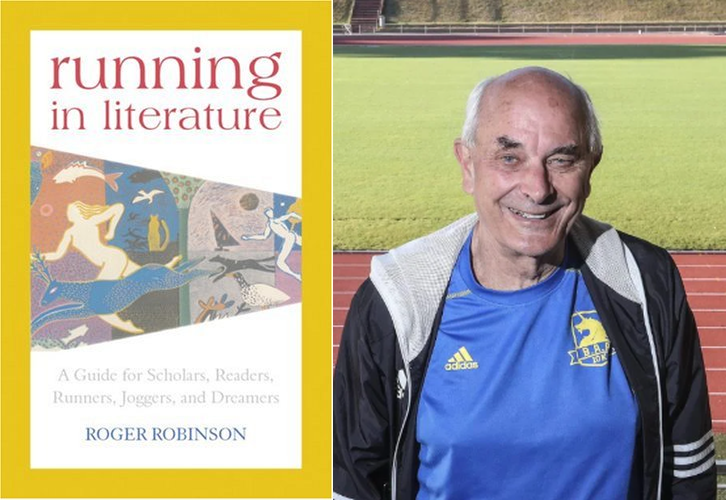
Written by Roger Robinson
Reviewed by Coach Adolfo Salgueiro

As explained in detail in Born to Run, the 2011 masterpiece by Christopher McDougall, the human body was designed to run. Not for sport, not for pleasure but for survival of the species. So it can’t be a surprise when we find out that the concept of running has been a leitmotif of the written word since human beings started recording themselves for posterity.

Running in Literature

Roger Robinson

From the eldest classics in Greek literature through the publishing of Born to Run and beyond, we can taste the influence of our favorite sport in the daily life of all civilizations, all races, all social strata, in all continents and through every delimited period of humanity.

The sub-title of this book is “A Guide for Scholars, Readers, Joggers, and Dreamers”. It was published in 2003. The author is Roger Robinson, a former world-class runner for over 30 years. An essayist, critic, editor and academic who has held teaching positions at Victoria University in New Zealand. His writing as a literary critic has appeared in significant journals and anthologies and he is an avid sportswriter for magazines and book. He is also married to Kathrine Switzer.

In the early chapters, Robinson goes through Greek and Roman literature and how running was an important part of classics such as The Odyssey and The Iliad as well as how philosophers and writers like Plato and Pindar boarded the subject. And who can forget the classic Aesop fable of The Tortoise and the Hare? The author also spends an entire chapter on the running references in The Bible. Christian runners may be familiar with Paul’s references in 1 Corinthians 9, but there are many more, such as in 2 Samuel, Jeremiah, and Psalms.

I was amazed to learn that until Henry VI, by William Shakespeare, there was a 1500-year gap on mentions of running as a competitive sport in Literature. The last one was the Paul in 1 Corinthians reference.  But the developments in technology, such as the printing press and the streamlining of the processes to manufacture paper, made the written word affordable and widespread, so literature, including running literature, started its grown spurt towards what it is today.

Running in Literature

This is a jewel that any book-loving and/or history-loving runner should read

As the sport of pedestrianism developed during the late 18th and early 19th Centuries, we see the publishing of the first running book, in 1813. The author was Walter Thom. As titles of old books usually go, this one, with 32 words on it, is very comprehensive: “Pedestrianism, or an Account of the Performance of Celebrated Pedestrians During the Last and Present Century; With a Full Narrative of Captain Barclay’s Public and Private Matches and an Essay on Training”. Quite a mouthful.

As we approach our times, and especially the Post WWII years when the access to literature and affordability of books became common, and as the first and second running booms arrived, a wide array of novels, poems, magazines and books came to market, some with much success, enough to become cult classics. Later, as the running scene exploded, more and more runners wanted to delve into de minutiae of the sport, its history, its science and the insight only the highest performers could offer through their memoires, so non-fiction and history books started showing up on the shelves.

The author dedicates chapters to the best fiction and non-fiction running books, and offers a short, personal review on each one of his selections. These are good recommendations for anyone wanting to dig deeper into the history and/or literature of our sport.

This is a very comprehensive book that covers over 3000 years of literature, so it is full of references and a collection of rotating protagonists that makes it very dense. This is not a pejorative reference on the book, just a warning so you will take your time to read it and digest it properly. This way you can get the most enjoyment and benefit from your time with this jewel that any book-loving and/or history-loving runner should read.
 

The Basics About Electrolytes

The Basics About Electrolytes

By Coach Adolfo Salgueiro

Electrolytes

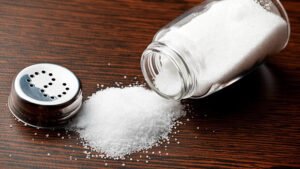
Table salt is the most basic and cheapest way to keep your electrolytes in balance, but there is still much more to it than that.

As runners, we’ve all heard the term “electrolytes”. We know they are key to our success and most likely they are at fault when we bonk during a long run on a hot day. We know that Gatorade has them. We know we better replenish them lest we get into trouble. As Robb Wolf, co-founder of LMNT Hydration well put it: “Electrolytes can mean the difference between feeling like a champ and feeling like garbage”.

But… do we know what they are? Do we know what they do? There hast to be more than one of them since the word is plural, so, which ones are they?

According to Medlineplus.gov, “Electrolytes are minerals in your body that have an electric charge. They are in your blood, urine, tissues, and other body fluids. Electrolytes are important because they help balance the amount of water in your body, balance your body\’s acid/base (pH) level, move nutrients into your cells, move wastes out of your cells and make sure that your nerves, muscles, heart, and brain work the way they should.”

As you can see, you don’t need to be much of a scientist to realize these are important elements to keep well stocked and balanced within your body, not only during long runs but during your daily life.

Your body can and should take in electrolytes during the day through the foods and drinks you consume. You don’t need to drink Pedialyte all day to keep them topped off.

Electrolytes

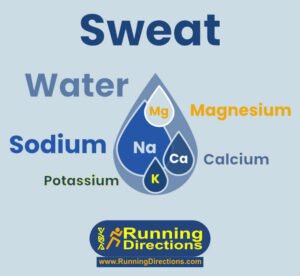
As you can see in this graphic, there is way much more than water in your sweat.

We need to be careful with electrolytes as we may run into trouble not only if we run low, but we can also break homeostasis if we consume too much of them. Have you ever washed an electrolytes tablet with Gatorade in the latter part of a long run? Believe me, you don’t want to know.

It all has to do with the delicate balance of water your body requires to function properly. Tipping such balance either way will affect the electrolyte concentration and could have you either dehydrated or overhydrated. None of these options are good.

The key electrolytes to keep your eye on, are:

Sodium and chloride: maintain fluid balance and nerve function.
Potassium: prevents cramping.
Calcium and magnesium: control muscle contraction and heart rhythm.
Phosphate: Used as a building block for the substances used by the cells for energy, cell membranes and DNA

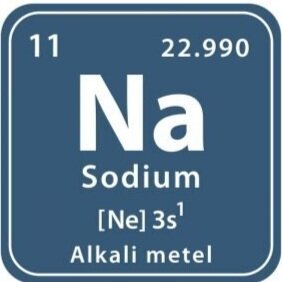
According to hydration experts, during your running the most common electrolytes you sweat are sodium (Na) and chloride (Cl). These are the two elements that form common table salt (NaCl). This comes to show that replenishing basic electrolytes can be as basic and cheap as having a plan to do so before you get into trouble. Other elements like potassium, magnesium and calcium are sweated in lesser amounts but shouldn’t be overlooked.

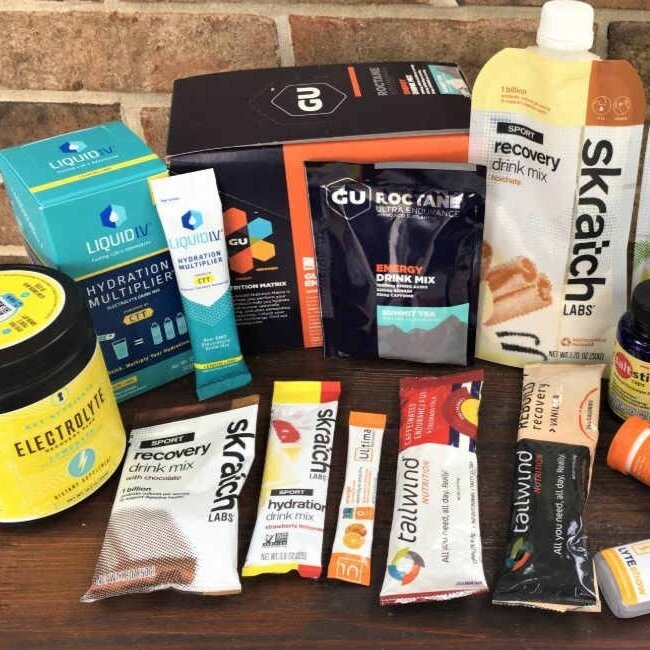
There are many electrolyte options in the market to keep yourself properly hydrated and balanced throughout your day and long runs. Personally, I am not a fan of Gatorade because of the excess sugar, which causes a spike as soon as you ingest it, but it is followed by a crash. That is why I no longer take it even during races.

My electrolyte choice for the last couple of years has been the Nuun tablet. I also consume Hammer Endurolytes as an alternative and they both have worked like a charm for me. I have also experimented with Generation UCan hydration with solid results but no longer use it. Coconut water is amazing but since it is not easy to carry around and it is not offered during races, I had to stop using it.

None of these products endorses me. There are plenty of other options in the market. The ones I mentioned are based on my individual experience. Visit your local running store and ask for help, they should be able to offer you choices based on what type of runner you are.

Keep yourself hydrated and your electrolytes well balanced so you can safely enjoy the countless benefits of a long run.

Running with a Mask in Times of Pandemic

Running with a Mask in Times of Pandemic

By Coach Adolfo Salgueiro

Before we get started, I must remind everyone that I am not an infectious medicine specialist. If you want scientific advice, I recommend you listen and follow what Dr. Anthony Fauci has to say regarding Covid-19. With this disclaimer out of the way, the following are my thoughts on running with a mask during times of pandemic.

Running with a Mask

By trial-and-error we will find what works best of us individually (Photo by cottonbro from Pexels)

Eight months or so into the Covid-19 pandemic, and four after the economy was inevitably reopened, we’ve returned to our group activities such as work, extended family and exercising with as much caution as possible. Social distancing keeps being the new norm, hugs and kisses have been replaced to fist and elbow bumps, and masks have become a political issue. As runners, we’ve had to adjust to this new reality in order to keep moving forward and to keep the social aspect of our sport alive. The uncomfortableness of wearing a mask is a small price to pay.

According to Certified Personal Trainer Timothy Lyman in a recent article in Runner’s World Magazine,  “Running with a mask, or any other type of face covering, is inherently more difficult because you have to work harder to get the same amount of air into your lungs”. Of course this will vary depending on the type of are wearing.

Getting used to running covering your nose and mouth requires time, commitment and training. Figuring out what mask works better for you, when is the best time to have it on or just available for immediate use, are part of such training. Knowing in what situations you should or should not wear it has also been a trial-and-error endeavor.

The same article in Runner’s World states that: As a general rule, a mask is necessary if you’re running in a populated area where you’re likely to encounter other people. If you’re running alone in an area where you won’t encounter others or come within 6 feet (at a minimum) of others, it’s likely not necessary. But keep in mind that wearing a face covering is not a substitute for physical distancing—make sure to still keep at least six feet of distance between yourself and others while running.

Through my personal experience running over 600 miles during the pandemic, what I’ve figure out is that even though I may not need a mask when I run alone, I rather have one because inevitably I will cross paths with strangers that either do not care to help you create the safe distance or, you meet them in places where it is just impossible to separate. Therefore, I always run with a cloth mask on my chin or neck, which I can immediately access to cover my face when required. It has worked so far for me and I recommend it.

Running with a Mask

It is important to keep your social distance even if you are running with your buddies (check how I have a mask on my neck ready to be used at a moment’s notice) – Photo by Ted Sassi.

In my two running groups, we all use face coverings until we start. As for running together, we try to stay close enough to keep the social aspect of running alive but separate enough to adhere to the protocols. The post-run cafĂŠ-con-leche or beers, are strictly held outdoors.

For group running, Dr. Jennifer Marin, from @Obesalud, recommends not running one behind the next but keeping a diagonal formation with 5-meter (15 feet) of separation. This is an interesting, overcautious suggestion, worth looking into.

An important consideration is that, regardless of the type of mask you wear, you need to go out of your way to keep it clean and disinfected. The constant breathing will dampen it and thus less effective. I you don’t wash it; it will attract microorganisms that you will be breathing in and may negate the benefits of wearing a mask in the first place. So make sure you keep several of them in your running bag so you can rotate them appropriately.

Yes, running with a mask is a pain in the ass. No questions about it. But a worse option is having Covid-19. So suck it up, get used to the discomfort, wear a mask like a good citizen and keep on running with your buddies.

The Hydration Urine Test

The Hydration Urine Test

By Coach Adolfo Salgueiro

We’ve heard about the pee test to figure out how well hydrated we are or not. If the pee it is clear, or pale yellow, then you are hydrated and ready to run; if it is yellow or darker, then you are dehydrated. Sure, this is a quick, easy and free test, but it does have some limits.

Hydration Urine Test

The need for sodium for us, long-distance runners, goes beyond the recommended guidelines

According to Andy Blow, a British Sports Scientist, the pee test is a good tool to gauge the general state of your hydration, but it is not the end-all word on the issue. “The time to look at your pee is when you wake up in the morning—Says Blow, who served as hydration specialist for two Formula 1 teams—because the color of the urine you first produce is a good indication if you are hydrated or not that day. By then, your body had all night to recalibrate itself, move fluids around and get into equilibrium. If you wake up and you feel a little bit thirsty, it is a good indication you are dehydrated.”

The problem of looking at your pee during the day is that you eat, you drink, you do things and the results become skewed. If you had a bottle of water, or two; if you drank a coffee, or two; or a sports drink, your body may be discarding a lot of the fluid it took in, which doesn’t mean you are fully hydrated. Even if your urine is clear as water.

Remember that dehydration doesn’t get solved chugging a gallon of water. If you are in a dehydration state, it may take your body 24-48 hours to recover. You can gulp all the Gatorade you want, yet this will not restore you. The body can’t absorb it all and most of that excess water will be peed out.

Hydration Urine Test

Dehydration doesn’t get solved by chugging a gallon of water (or five)

In a recent interview I heard, Mr. Blow explained that we see with a lot of overhydrated athletes at the starting line of races. They take a lot of water before starting and that has nothing to do with their state of hydration. A recent study showed that a significant percentage of athletes are in an early state of hyponatremia when they start long races on hot days, most likely because they prepare by drinking a lot of water to confront the weather conditions. They end up peeing the excess water, and valuable sodium with it, which eventually leads to trouble.

The best way to address this, according to Blow, is to ingest a much smaller amount of a high-sodium drink. This sodium will make it into the bloodstream and will hold water there as a reservoir so that you have something extra when you start. “This is a lot better than drinking loads and loads of water”, he affirms.

Sprinkling salt in a glass of water will do the trick. The right amount is about 1.5 grams of salt per liter of water consumed. But since it is hard to drink “ocean water”, Andy Blow recommends sodium citrate, which is more palatable. Sodium citrate can be purchased at a nutrition store or via internet. This is about three times stronger that any commercial sports drink.

Understand that a higher consumption of sodium is important for athletes that train a lot AND sweat a lot, like us as long-distance runners. Consuming all this sodium for sedentary people is not recommended. Our salt requirements can be up to three or four times more than those of sedentary people. That is why we crave salty stuff, such a pretzels or potato chips, after a hard training session.

Also, understand that you don’t need to replace 100% of what you are losing. You are supposed to sweat and lose electrolytes. Nothing wrong with that.  You need to find the sweet spot between what you are losing and going hyponatremic; and from there, test what works better for you. Then, go check your morning pee.

The Medal Collection is Finally Complete

The Medal Collection is Finally Complete

By Coach Adolfo Salgueiro

 In today’s blogpost I am going to go personal, as something super cool just happened to me a couple of weeks ago. So cool, that I am still trying to figure out if it actually happened. Well, I wouldn’t go that far, but amazing, nevertheless.

As many of my friends know, as well as readers who have taken the time to read My Running Story page in my website, I started running when I was very young. At 17 I ran my very first marathon. That race was an amazing experience that, almost four decades later, I still cherish and one of the coolest ones from my teenage years. There are not many high schoolers with a full marathon under their soles.

Medal Collection

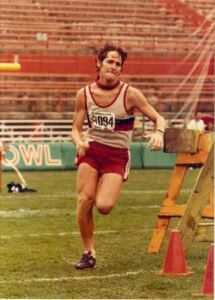
At 17, a senior in high school, and just a few yards away of finishing my very first full marathon

On January 22nd, 1983, my dad and I lined up at the foot of the old Orange Bowl Stadium for a 7AM start of the Orange Bowl Marathon. I remember a humid and rainy day in Miami and Bill Rodgers as the favorite to win. Our plan was to run the first 35K (about 22 miles) together and then every man was on his own. We cross paths with Rodgers twice during in-an-outs at Coral Way and Coconut Grove. Then, at mile 22 my dad left me in the dust and finished in 3:55. After walking a few painful and humbling miles, I triumphally crossed the finish line in 4:11:11. What a thrill to fall on my dad’s arms a few feet after and ask him: “When do we do this again”. But I digress.

The point of this story is that back in 1983, getting a medal worth its place in an art gallery was not the norm. New York was famous for handing medals to every finisher. My dad had one from the previous year. The Orange Bowl offered medals to the first 500 or 1000 finishers, I don’t recall precisely. What I do recall is that I did not get one. I have finished eight more marathons and despite some beautiful medals to represent my achievements, there was always a hole in my collection. A hole that may never be filled.

Until now.

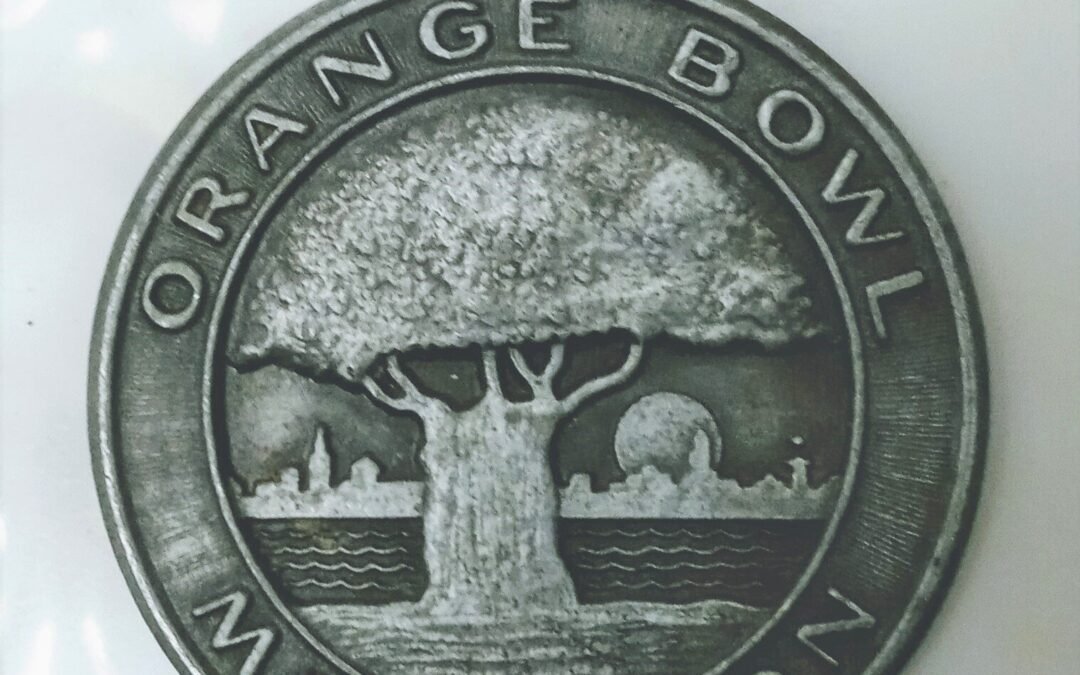
On September 2, I was at my computer and for some reason the thought of the 1983 Orange Bowl Marathon and my lack of medal, crossed my mind. So I did a Google search and, to my most absolute astonishing surprise, there was one for sale in eBay for $15.99 plus $2 for shipping. I could not believe my eyes. The elusive medal was somewhere out there. I have never even seen one. But from my race shirt I recognized the logo and that was it. Just a few clicks away. Calling my name. Winking at me. I could not let the opportunity go. I purchased it right away.

The times I thought about the missing piece in my collection, I entertained finding a nice shell in the beach, hang it in a string, and call it my Orange Bowl 1983 memento. But it never went beyond a passing thought. The absence in the collection persisted.

On September 9, 2020, 37 years, 7 months, and 18 days after I crossed the line of my first marathon, the package arrived. I finally had the medal in my hands. A plain, cheap, worn out piece of metal. Maybe an inch and a half in diameter and not even attached to a string or lace. Not the prettiest puppy in the litter, but MY medal. The representation of MY achievement on that day, from when I was still a senior in high school.

This medal doesn’t fill a hole in my soul, just a hole in my medal collection. With nine marathon finishes I have done better times, travel to other states and countries, ran in some of the biggest races in the world, and accumulated countless stories. How I got my medal 13,746 days later, has just been added to the memories.

Skip to content