

Avoiding Bathroom Issues While Running

Avoiding Bathroom Issues While Running

 By Coach Adolfo Salgueiro

 Not to be super graphic, but we runners behave like little kids when it comes to bathroom issues and bodily functions related jokes. A fundamental truth of our sport is that if you haven’t pooped your shorts while running, you just haven’t run enough. Keep running and you will.

We even have a term coined to describe that inescapable moment when we will inevitably have to face nature: “Code Brown”. Descriptive enough.

Bathroom Issues

Make sure you know where is the best place for a pit stop, before you may need it (Photo: Pexels)

I do believe that gastrointestinal issues in runners are as unavoidable as falling. Still, we must do our best, prepare as thoroughly as we can, pray for the best and eventually both fall down and poop our pants, anyway. But for that part that we can control, the key is to get intimate with your gastrointestinal system’s nuances. To build a relationship with it, so you can learn to listen to each other start working together.

But, as with any best friend, a spat here and there are part of the package. So, here are a few things you can work on to avoid unpleasant, running GI issues for as long as you can hold them at bay:

1 – Befriend the trial-and-error method: Make sure you take notes, mental or written, of what works on your behalf, and what doesn’t. This will allow you to know what is best to eat, when to eat it and, how much of it to eat. At the same time, it will let you know what to avoid and how far in advance to avoid it.

2 – Plan ahead: Even though GI issues may happen at any time, the most dreaded time is in the middle of the long run, when most likely you’ll be farther from home but hopefully, close to a stinky port-a-potty. Most of us have a solid idea on when we will be hitting the road, so we should time our food intake based on the best practices we have developed through time.

3 – Map out the bathrooms along your route: Hopefully, you won’t need them, but it is always good to know where they are, just in case. Gas stations, drug stores, supermarkets or isolated bushes will do the trick, but only if you know where they are.

4 – Time your pre long-run/race dinners: Some runners swear by the night-before pasta, others go for a burrito or a pizza. Regardless of the nutritious value of your meal, the key is to make sure it has been digested by the time you go to bed and/or start running. The timing of such meal, as well as pre-run snacks, is key to avoid unscheduled and unpleasant stops.

Bathroom Issues

You need to get intimate with your GI system so you can manage unpleasant stops as much as possible

5 – Try various fueling products until you find “the one”: There are hundreds of in-run fueling options in the market. Gels, powders, chewables, drinks, you name it. They also come in unnumerable flavors, concentrations and with added stimulants. After awful experiences with a certain brand of sugary gel, I found my favorite and I know what works for me. The time to figure out you can’t stomach a fifth gel should not be in the 22nd mile of your marathon.

6- Figure out how fiber, sugar and caffeine affect you: While all these substances are useful when consumed in the right quantities and times, each runner has its own level of tolerance for them. A bowl of oatmeal may be good for someone’s pre-run breakfast while it will have others running to the bushes. Same with caffeine. Sugar can hit your stomach hard if you consume too much of it during your run, especially as an ingredient of energy gels. Know what is best for you.

7 – Stay hydrated: This doesn’t mean only during your run, but in general, throughout your day. Dehydration can lead to GI issues such as constipation, bloating, nausea, ulcers, and acid reflux, among others. Remember that consuming alcohol sucks the moisture out of you, so avoid it, especially on hot days.

Any tips or horror stories you would like to share with my readership?
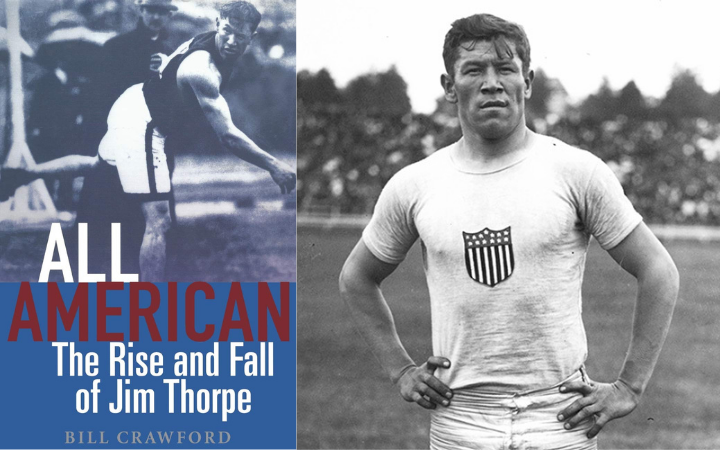
 

Book Review: All American. The Rise and Fall of Jim Thorpe

Book Review: All American. The Rise and Fall of Jim Thorpe

Written by Bill Crawford

Reviewed by Coach Adolfo Salgueiro

All American

James Francis Thorpe (1887-1953) was a member of the Sac and Fox Nation who became labeled as “The Best Athlete in the World” By King Gustav of Sweden after winning both the pentathlon and decathlon in the 1912 Olympics in Stockholm. He was also a college and professional football player, first President of the NFL (1920) and if that weren’t enough, also played Major League Baseball, among many athletic achievements.

As a lifetime sports fan, the name of Jim Thorpe evoked victory, nostalgia, athletic triumph and unfair treatment by the powerful institutions of sports of the earlier parts of the 20th Century.

As an early fan of sports history, Thorpe caught my attention at a young age mainly because of his Olympic triumphs, and because he also played Major League Baseball, of which I was a big fan at the time. The more I read about this mysterious character, the more the legend of “the best athlete in the world” grew for me. Then, as an adult, you get your hands on a serious biographical text like this one and you get to delve into so much more. I knew he was involved in other sports activities but wasn’t aware of the extent of it. Well, now I am.

The book covers in detail the birth of amateur sports and how the entire concept became established. It was a way for the snobby British of the late 19th and early 20th Centuries to keep the working class from competing against them. To keep the riffraff away. It was not about being paid to compete or win, it was about having to work to make a living instead of dedicating your life to leisure and sports. This forces the question: who was the amateur and who was the pro? I have read other books where this is explained the same fashion, so I tend to believe the theory.

All American

Jim Thorpe at the 1912 Olympics

Bill Crawford’s book should be a bonanza for football fans. Even though it was not his favorite sport, Thorpe was one of the great football players from the early days when the game was just getting established. It goes into plenty of detail on the evolution of the game, its main characters at the college and professional levels, both on and off the field. If you couldn’t care less about football, about sixty percent of this book may not be of your interest. I fall in that category but was able to make the best out of it just because I had so much interest on getting to know more about Mr. Thorpe.

His Olympic prowess and details of his participation at the Stockholm 1912 Olympics are covered in just one chapter. His participation in Major League Baseball is no more than anecdotal. His spectacular riise and fall are explained in detail, which is an important aspect of why his name became the historic figure we all know, today.

In summary, All American is a good book and if you are interested in learning about the man behind the myth, it will be money and time well spent. But if you are looking for a book about running, Olympic triumph and competition, this is not it.


Coach Adolfo Featured in the Old Crazy Runners Podcast

Coach Adolfo Featured in the Old Crazy Runners Podcast

Foultips.run Head Coach Adolfo Salgueiro was recently featured as a guest in the Old Crazy Runners podcast. The show was posted this last November 6. Old Crazy Runners is a weekly running podcast hosted by Nicholas and Fundy and features fun interviews with runner usually up there in years, thus, crazy old runners.

Past guests include Boston 1968 winner Amby Burfoot, master running legend Gene Dykes; Boston Marathon legend Kathrine Switzer and her husband, writer Roger Robinson; Runner\’s World strength coach Jess Movold, and physiotherapist Brodie Sharpe, among others.

Old Crazy Runners Podcast

Screenshot of the conversation with Nicholas and Fundy.

Coach Adolfo’s interview was not based on one subject. It was an enjoyable, running conversation, like the one you would have with your running buddies. It touched on many aspects of the running world. From starting in the sport, to coaching, motivation and even a few technical aspects that may be of use for some runners.

To listen to the Old Crazy Runners episode, click here: https://www.oldcrazyrunners.com/episodes/71fe2lm0gtm2fwgb19su7mcy52qwvt

We also invite you to learn more about the Old Crazy Runners podcast, by clicking here: https://www.oldcrazyrunners.com/

 
Old Crazy Runners Podcast

Old Crazy Runners Podcast

Foultips.run Head Coach Adolfo Salgueiro was recently featured as a guest in the Old Crazy Runners podcast. The show was posted this last November 6. Old Crazy Runners is a weekly running podcast hosted by Nicholas and Fundy and features fun interviews with runner usually up there in years, thus, crazy old runners.

Screenshot of the conversation of Coach Adolfo with Nicholas and Fundy

Past guests include Boston 1968 winner Amby Burfoot, master running legend Gene Dykes; Boston Marathon legend Kathrine Switzer and her husband, writer Roger Robinson; Runner’s World strength coach Jess Movold, and physiotherapist Brodie Sharpe, among others.

Coach Adolfo’s interview was not based on one subject. It was an enjoyable, running conversation, like the one you would have with your running buddies. It touched on many aspects of the running world. From starting in the sport, to coaching, motivation and even a few technical aspects that may be of use for some runners.

To listen to the Old Crazy Runners episode, click here: https://www.oldcrazyrunners.com/episodes/71fe2lm0gtm2fwgb19su7mcy52qwvt

We also invite you to learn more about the Old Crazy Runners podcast, by clicking here: https://www.oldcrazyrunners.com/

On Back Up Plans & Back Up Races

On Back Up Plans & Back Up Races

By Coach Adolfo Salgueiro

When set up to prepare for a race, we usually do so with a specific goal in mind. Maybe it is a PR. Maybe we want to go under a certain arbitrary round time like a Sub-4 marathon, a sub-1:45 half or a sub-50 10K. Maybe, given a certain personal issue, just finishing in one piece is the objective. They are all valid goals worth pursuing.

But life can and usually gets on the way of our perfect plans. Stars may not align on race day and then your car breaks down on the way to your race or there’s a traffic accident that makes you miss the start. Or it was too hot and humid, or you started too fast when you should have known better. It happens. So, what to do?

Back Up Plans and Races

Sometimes, achieving goals B, C or D can still mean a successful race (Foto: Pexels)

It may sound obvious, but in the midst of the frustration, runners don’t know how to react and adjust.  So I will spell it out in a direct manner: Set up A, B, C and even D goals for your races. And if your race doesn’t go as planned, sometimes it is good to have a back-up race to fall on to.

I follow a sub-elite runner in Instagram, who ran the recent Boston Marathon. In his post-race recap he said how his objectives kept changing throughout the race. His main goal was giving it his all to go sub-2:30, but as the miles went by, he realized this was not going to happen, so he decided to settle for a PR. In the 28th Km (17th mile), he suffered cramps that forced him to slow down. He ran some math in his head and realized he could still go Sub 2:40. At the end, 2:40:31 was his time. His final assessment was that despite not accomplish any of his preset goals, he wasn’t upset because he gave it all he had for the day. And he also knows this is not his last race.

This is the epitome of setting up multiple goals and completing a solid race despite facing multiple obstacles throughout. It is about learning to face and overcome those issues on the fly. It is about conquering what we are unable to control and yet, conquering those obstacles.

Just as it happens with the performance in a single competition, there are times that even the best prepared runners, or Goals R, S and T can’t cover a disappointment. When that happens, embrace the failure, learn your lessons, and move on to, or set up, your back-up race.

Back Up Races

It is not only a bad race that needs redemption. Sometimes circumstances beyond your control get in the way and derail your plans in a catastrophic manner. A second chance to perform is what will save the time, effort, money, and emotion you have invested in your training.

A few weeks ago, one of my trainees was on the plane to the Berlin Marathon. Door closed. Seatbelt fastened. Pre-flight instructional video played. But then… just like that… they kicked everyone out of the plane. The flight was cancelled. The only alternative given by the airline would put him in Berlin on Saturday at 5PM, with barely any time to pick up his bib and rest to make it to the starting line.

Back Up Plans and Races

Make sure you live to race anothe day, by being smart before you tackle the marathon agian, after a debacle. (Photo: Pexels)

This runner was lucky enough that had enter several Marathon Major lotteries and hit two of them. So, despite the frustration, at least he had Chicago, two weeks later. The plan had been to push in Berlin and coast for fun in Chicago. Now, the plan is to push in Chicago, even though the taper was extended to 4 weeks. Notwithstanding the disaster, he was able to put his training to effective use and ran 3:24. Below his expectations but solid enough for his abilities and given the circumstances.

Even though having two marathons lined up worked for this runner, this time, it was circumstantial. Having a marathon to fall onto is not necessarily the best strategy. A marathon requires a level of commitment and effort that for most runners it requites just all you’ve got. So, having another marathon in store just in case, in a few weeks, may mess you up subconsciously and may alter your subconsciously because you know you have another race coming up, so you can play it safe, or run too fast and crash.

My recommendation is that if you need to pick another marathon because you missed your goal race, there are plenty or marathons to fall back to. You won’t lack for options, so you don’t need to plan ahead. But, if you had a crappy marathon and need to redeem yourself, be smart, recover properly and reassess where you are and where you want to be eventually before doing something foolish and getting hurt.

You can run multiple 5Ks to make up for a bad one. You can run another half marathon or two, or three, to make up for a bad race. The marathon is a different animal.

Skip to content