
2 Breathing Techniques to Improve Your Running

2 Breathing Techniques to Improve Your Running

By Coach Adolfo Salgueiro

A few months ago I bumped into a challenge with one of my coached runners. As soon as she reached mile 3 or 4, she got a side stitch. It didn’t matter what we tried with the timing on her nutrition or her fluid intake. Come that point, boom! Stitch! We needed to attack this problem and fast. Before it became a psychological issue.

I consulted with a few coaches I know, and they gave me their suggestions and home remedies. While we found a couple of things to temporarily remedy the nagging stitch, they were not the permanent solution we were looking for.

While researching the issue I came across a book from 2013 called “Running on Air: The revolutionary Way to Run Better by Breathing Smarter”, by Bud Coats and Claire Kowalchik. This was a publication of Runner’s World Magazine, published by Rodale.

The book goes into details about many things that are not necessarily related to breathing. So, since this is not a book review, I am skipping them. But it does go into detail on the science and mechanics of breathing and breathing while running in layman terms. To my trainee, there were two specific aspects that not only made the difference, but solved the problem:

 

Breathing Techniques

Breathing from the belly and doing in in an add-number pattern may help you improve you running. Worth giving it a try (image from pexels.com)

1-   DIAPHRAGMATIC BREATHING

Known colloquially as “belly breathing”, involves engaging the stomach, abdominal muscles, and diaphragm, which means actively pulling the diaphragm down with each inward breath. Compared with coastal breathing, it helps the lungs fill more efficiently.

I cannot teach you diaphragmatic breathing in a few paragraphs, but I can tell you that I’ve been doing it for over 20 years, and it has worked for me beautifully. It also helps you strengthen the diaphragm, located beneath your lungs, which is the major muscle of the respiration process. It contracts and flattens when you inhale, creating a a vacuum effect that pulls air into the lungs. A stronger diaphragm means more air, more air means more oxygen for your body to burn, and less side stitches.

Regardless of your preferred type of breathing, a strong diaphragm will help you breath better, relax, meditate, improve digestion, and provide you the obvious running benefits that more oxygen in your system can offer.

If you want to learn more about diaphragmatic breathing, its benefits and strengthening exercises, click here for a YouTube video from the UCLA Integrative Digestive and Health Wellness Program, which can help you get started.

2 – RHYTHMIC BREATHING

I have been breathing on a 3/2 count (inhale for 3 steps and exhale for 2) for about 5 years, and the benefits have been tangible. I don’t even think about it anymore, it just happens. In my personal experience, it works better than the 2/2 I did for years. Once I got my hands on this book, I understood why, and it made sense.

It is because “the greatest impact stress of running occurs when the foot strikes the ground at the beginning of exhalation and also that core stability is at its lowest during exhalation”.

Based on this, it is easy to understand that by breathing on an odd count, you will be alternating sides each time you are at your weakest while hitting the ground. Think of it this way: In one mile, you will be hitting about 750 times on each side instead of 1500 on the same one. Multiply this by the number of miles you run in a week, a month, or a year, and if you are not breathing on an odd number count, my suggestion is you better start thinking about it, today.

How do you do it? Just do it. Three in, two out. It will be weird at first, but with time, it will feel more natural and within a couple of weeks you won’t even notice it anymore.

As for rhythmic breathing, there is plenty more to learn than what four paragraphs can tell you. So, if you are interested, this is a good book where to get started.

As for my trainee, she read the book, she started strengthening her diaphragm, breathing in a 3/2 pattern, and finished not one but two half marathons with a time beyond our wildest expectations. Oh! And no more side stitches.
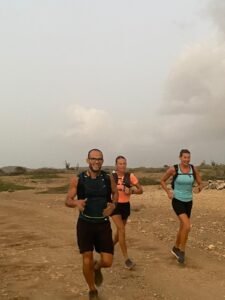
 

World Record Breaker Finishes 50K, trained by Foultips.run

World Record Breaker Finishes 50K, trained by Foultips.run

 Carlos Coste is a world-class, high-performance athlete, 12-time world record breaker in the disciplines of apnea and free diving. In the last two years, the Venezuelan born athlete has ventured into the running scene with the goal of competing in the Zion 50K Ultramarathon, in Utah. A few setbacks and a bout of Covid forced the cancellation of his plan, twice, yet he still persevered. Last month, he finished a 50K ultra in Bonaire.

50k

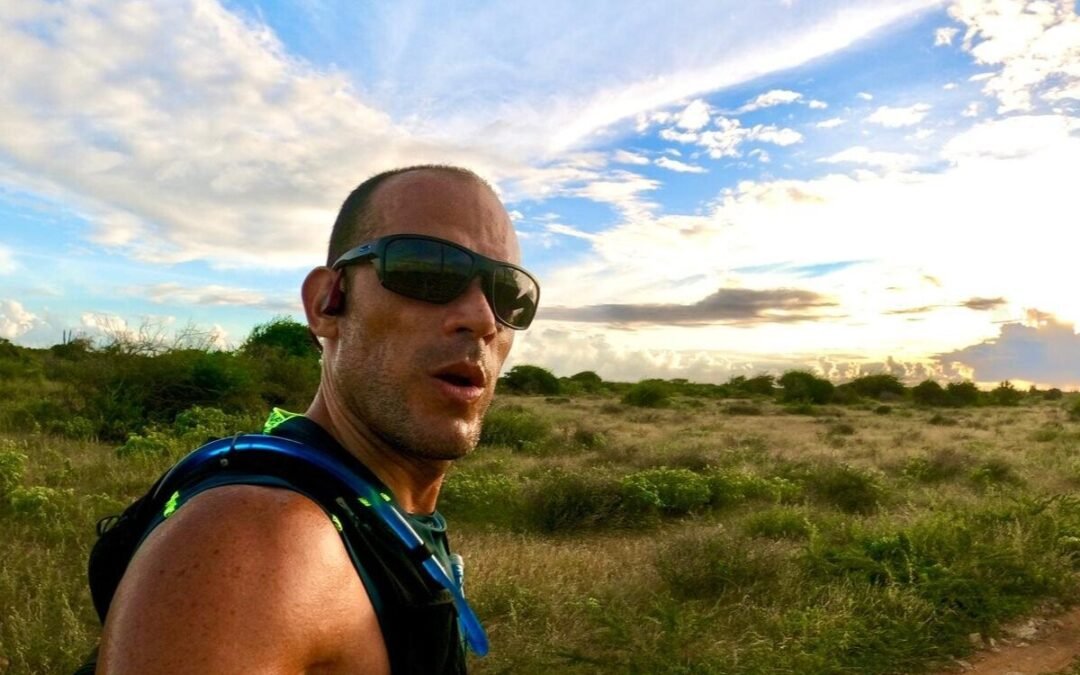
Running 50K in Bonaire, to make up for the Zion 50K Ultra in Utah.

“I am still a beginner in this ultra-running thing”, stated Coste. “In my first year I was coached by a friend who helped me in the transition to trail running and long distances. But then I realized I needed a coach with the experience and technical knowledge to get me to the next level. A common friend recommended Coach Adolfo Salgueiro, from Foutlips.run. I researched his background, certifications, and experience, and decided to give it a go. We connected online and started working right away.”

Coste’s training presented a few challenges from the start. He lives in the Caribbean island of Bonaire, at sea level, and his race was in Utah, starting at 3500 feet and going up from there. Also, Mr. Coste runs a successful apnea school in Bonaire, and he works with his physique on an everyday basis, so, the running is an addition to his body demands. On top of this, it was the thick of the Covid pandemic. A flexible and constantly adjusted training plan was paramount for him to reach his goals.

“During the training season there were issues with timing, small nagging injuries and this Covid thing that has affected us all” continued Coste. Coach Adolfo helped me with a fluid adjustment of the training plan. We were using a phone app that allowed us instant feedback and immediate adjustment of the work when needed. It was the perfect way to work virtually.”

50k

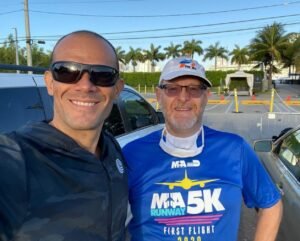
Carlos and Coach Adolfo before a run in Miami Beach, in late May 2021

Amid the training, Coste contracted Covid. A mild case, thankfully, but Covid, nevertheless. Once he was cleared to continue, the focus of his training had a dramatic shift, from “let’s do great” to “let’s just finish”. As if this wasn’t challenge enough, logistics and lockdown prevented him to travel to his race. So, despite the frustration and with the help of the local running community, a 50K ultra was improvised.

“I felt great during the race,” explains Coste. “First 35-40K were exceptionally good. We started at 4 AM and it was amazing to run in the desert through the night. The heat in Bonaire hit me hard after dawn so the last 10K were rough. I had to combine run and walk, but that’s what I was expecting.”

Despite the two cancellations of his Zion 50K Ultra, which was his goal for both 2020 and 2021, and the multiple adversities he had to face during training, this word-record breaker maintains his enthusiasm for running and is ready to give it a go for 2022.

“This was just my 2nd Ultra -he concluded- And for next year I am already looking forward to running in Zion. I am already talking with Coach Adolfo so after I recover, we can start the training cycle as soon as possible.”

You can follow Carlos Coste in Instagram (@carloscoste1) and by Strava . For more information on his athletic achievements, you can visit his website at https://deepseabonaire.com.


Foultips.Run to Coach 12-Time World Record Breaker, Carlos Coste

Foultips.Run to Coach 12-Time World Record Breaker, Carlos Coste

The athlete’s name is found multiple times in the Guinness Book of World Records

 Foultips.run is pleased to announce it has reached an agreement to train 12-time world record breaker Carlos Coste to his first ultramarathon. The Venezuelan-born athlete is training to participate in the Zion 50K race, which will take place through the Southern Utah desert, this upcoming April 10th, 2021. This will be his first ultramarathon race.

Carlos Coste

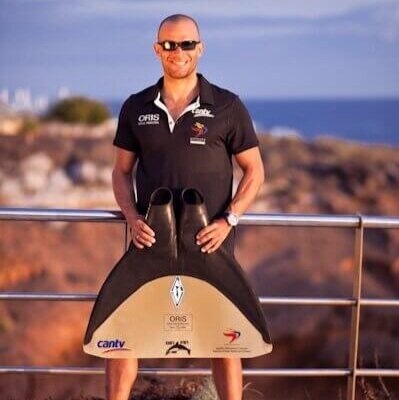
Coste is a world class athlete in the sports of apnea and freediving (Photos courtesy of Carlos Coste).

Coste, 44, is known worldwide for his superhuman feats as a freediver. He started training in apnea and free divining in 1996 and promptly broke several Venezuelan national records. In 2002 he broke into the world scene with his first couple of world records. In October 2003, he became the first human to achieve a free immersion dive of more than 100 meters (328 ft.), when he went down 101 meters (331 ft.). This was certified as an AIDA and Guinness World Records. In 2004 he became the first freediver to pass 100 meters (102 m/334 ft.) in Constant Weight, a record he later expanded to 105 meters (344 ft.) in 2005. After rewriting the record book in the sport, in November 2010 he broke another Guinness World Record in the Yucatan Caves, with 150 meters (492 Ft) of Dynamic Apnea at the Dos Ojos Cenote.

Carlos Coste

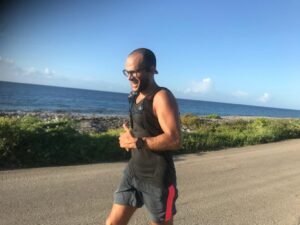
He wants to run for the rest of his life while combining his new found passion with the sports that made him a household name. (Photos courtesy of Carlos Coste)

“I discovered my passion for trail running about two years ago”, stated Coste, “and, in addition to my freediving career, I would like to run on a regular basis for the rest of my life. I contacted Coach Adolfo [Salgueiro] to help me improve my endurance and skills without risking injury. His blog has connected me to new concepts, as well as his knowledge and passion for the sport.”

There are many challenges to this particular training program, especially because the athlete lives at sea level in the Caribbean island of Bonaire, while the race will start at an altitude of 3500 feet (1067 mts) and will reach a maximum elevation of 5500 (1676 mts). The difference in weather between both locations will also be a test of wills.

“It is a big challenge to train an athlete of Carlos’ pedigree, especially for this race”, said Foultips.run Head Coach, Adolfo Salgueiro. “We want to make sure he can compete at the same high standards he is used to. At the same time, he needs to be trained in a safe and sustainable way so he can finish his race satisfied with his results and injury free”.

You can follow Coste’s training and progress via his Instagram account (@carloscoste1) and by Strava . For more information on his athletic achievements, you can visit his website at https://deepseabonaire.com.

Adolfo Salgueiro is the head coach at Foultips.run. He currently helps runners, both in person and online, achieve their running goals, from 5K to ultra-marathons. He is certified by the Road Runners Club of America as one of only seven Level II coaches in the State of Florida and one of only two in South Florida. If you want to contact Coach Adolfo, click here.

The Importance of Embracing Failure

The Importance of Embracing Failure

By Coach Adolfo Salgueiro


Embracing FailureA few days ago I got a meme where two people are having a conversation. Maybe a job interview. The meme is the first illustration of this blog post. They talk about the key to success and how to accumulate experience to make right decisions. What was the key? Wrong decisions. Why? because failure is not the opposite of success. It is part of it.

This meme got me thinking on how this applies to our sport of running. It applies to life in general, for sure, but that is beyond the scope of this blog. As runners we are always pushing our limits, both in training and races. We strive for that PR. We sweat to hit the splits on each interval. We suffer the day we feel great but the training plan ordains an off day. We can’t sleep the night before an important 20-miler but still wake up ready for action. Yet.. then… sometimes… we fail.

Common knowledge teaches us to “listen to our bodies”, but as runners, we rarely do. We even struggle with what “listen to your body” actually means. What we need to remember is that the body is a machine. An exceptionally complex, fine-tuned machine, but a machine, nevertheless. This means that it doesn’t always perform at its highest potential. Sometimes it needs maintenance, sometimes a part breaks down, sometimes you forgot to add oil or coolant. Even the best F1 cars fail to finish races due to mechanic failure.

We must understand that failure is an intimate part of our running life. Is not if we will have a bad run or a bad race, it is a matter of when. And we cannot hold this one bad day as the defining moment of our day, our training plan, or our life. Running great Dean Karnazes tells the tale of his failed attempt at Badwater in his book Ultramarathon Man, and he is not ashamed of it. Alberto Salazar also opens himself about facing death after overdoing it in a race in his book 14 Minutes. The key is, as they both tell us, what do you take from those experiences, and then how you apply what you learned while moving forward.

Imagine if we were not going to run another marathon because we hit the wall that one time. Imagine how many people would participate in your local 5K if the failed to set up a PR or place in their age group, last year. How many runners would you see on the track on any given afternoon if they could not hit their splits last week? Not very deep thoughts, sure, but so simple, so real, and so close to us all.

Embracing FailureThomas Edison said: “I didn’t fail. I just found 10,000 ways that won’t work”. This also translates to your 800 repeats, your first-mile pace in that 5K when you bonked, and your stupid decision of pushing too hard at mile 8 on that marathon because you were feeling so good.



As runners, it is imperative to have a short-term memory when It comes to failure so we can keep moving forward. Some need of more encouragement than others. The key is to remember that we run because we enjoy it. We are choosing the suffering. Nobody is forcing us to put ourselves in a position where we may and will eventually fail. We just must extract the lessons from what happened, put them into practice, move on and forget whatever happened that day. If we learned nothing from bonking on that long run, if we learned nothing from going out too fast the first half of that race, if we learned nothing from that day we got dehydrated; then we are bound to repeat those mistakes, and very soon.

Always remember that experience is what we get when we don’t obtain what we originally set out to get. So make sure you take advantage, and even embrace, your running failures. They will be visiting you soon enough and you should be prepared to deal with them.

To Fast or Not to Fast?

To Fast or Not to Fast?

By Coach Adolfo Salgueiro

It is an ongoing debate between runners, coaches, scientists and onlookers in general if we should run in a fasting state or not. Despite all the science, studies, anecdotal evidence and articles on the subject, the verdict boils down to a simple two-word answer: It depends.

Fasting

Figuring out what to eat and when is the responsibility of each runner.

It depends on what type of runner you are, how long you are running, when you’re going for a run, what are you trying to accomplish, and so many other factors. There are as many answers as there are runners. And what works for you doesn’t necessarily work for me.

If you run first thing in the morning, you can do a simple A/B testing and figure out what works for you. There are people that can’t function without a coffee and there are people that will have to rush behind the bushes if they have a coffee before running. You can try with an apple, or a banana, or a bagel, or toast, and from there find out what helps you out and what upsets your stomach. A running partner once told me she had a bowl of oatmeal before our long runs. If I had a bowl of oatmeal, I would be the one running for the bushes.

The key to this is not to overdo it. You are just looking to top off your glycogen stores before you hit the road. You are not taking breakfast. Digestion uses a lot of blood, same as running does. So when the body diverts the blood to fuel your running, digestion stops. The rest I will leave to your imagination.

Running on a fasting state, you will teach your body to use its own resources without depending on outside fueling. This is beneficial when you are training for a long effort, usually the half-marathon and above. As you your body adapts to the finite amount of glycogen it has available, it learns to use its stored fat as a source of fuel. This becomes invaluable when you go beyond the 18-20-mile mark, so you can avoid the dreaded wall.

I want to make absolutely clear that I am not saying to go run 18-20 miles just with what you woke up with. You should not neglect your fueling strategy (that is a topic beyond the scope of this blog post). What I am saying is that running in a fasting state will train your body to reach that critical point with something left in the tank.

Fasting

The time of the day in which you run is one of the key variables on fasting or not

The time of the day in which you run is key on deciding if fasting or not fasting is right for you. If you run in the afternoon, you shouldn’t be fasting all day. What you must do is adjust your eating habits so you can fulfill your training without interrupting digestion. Once again: A/B testing. You will have to discover what works best for you. You will have to eat something before your run, but what and when is the key. It could be some fruit, or a sandwich or handful of almonds; either two or three hours before your run. Or maybe its just one hour. It is your responsibility to figure that out.

Even if you prefer running in a fasting state, you must prepare for the task you will be facing. If you are running New York, or Boston, where you may be starting at 11AM, you can’t do it in a fasting state. You must eat something hearty for breakfast with enough time to digest (about 4 hours). You breakfast needs to be a low-waste meal so you can avoid number-2 unscheduled breaks. Astronauts for the first Mercury and Gemini missions, when bathrooms were not available in their spacecrafts, used to eat filet mignon, eggs and toast before launch. You may want to switch the filet mignon for another type of protein but in general, this is a great option. One that needs to be practiced before race day.

My recommendation is to start working on your A/B testing right away. Find the benefits and the drawbacks of fasting or not; of eating and eating what; of eating or not based on how long are you planning to go; on when to eat; on figuring out if coffee, oatmeal, fruit, toast or whatever, works best for you; or not. The time to work on this, is now, not when you are tapering for your marathon or the morning of your goal race.

Skip to content