Before I answer the question in the title, I want to answer something else: Is this a self-serving post? Yes. It is. I am a running coach. You are looking for one and have questions about how this works and whether it’s a good fit for you. I am here to provide you with answers. So, here we go.
If you Google “running coach,” as I just did, you will get over 300 million results. If you Google “marathon training plans,” the number is severely reduced to just 150 million. How are you supposed to sort through that? How will you find the right plan or coach that is a good fit for you?
A runner I coach told me once that a buddy of his stated that a running coach was a waste of money because you can download a free marathon plan from the internet. My client responded by saying: “It is more complicated than that. You need to know what you’re doing, and you must read about 40 books. My coach has the experience and has read them all. I don’t have time for that.”
According to a data study by RunnersConnect, runners with custom plans ran 10% faster. They were injured 36% less than those using basic, generic plans. If that wasn’t enough, they also achieved their goal 54% of the time, compared to 29% with stock programs.
It is essential to know that unless you live in your coach’s city or are part of their running groups, you will see very little of your coach in person, and you may never meet them. This is normal. The only coaches present at every one of their athletes’ sessions are either high school or college coaches or elite coaches. If you are searching for an online coach, most likely you don’t fit that description and your goals are different.
So, what are the advantages of hiring Foultips.Run as your running coach:
► Experience and Knowledge: I’m the head coach at Foultips.run with over 40 years of running under my belt. I hold an RRCA Level II certification, have completed over 150 races ranging from 5Ks to marathons, and I stay current on the latest scientific and physiological insights in the sport. To learn more about my background, click here. The coaches I work with are handpicked; each one personally vetted and backed by proven expertise.
► Individualized Plans: Downloadable programs are dime a dozen. Some free, some paid. Those programs, you must understand, are generic and do not consider neither your starting point nor your specific running goals. They apply equally to the Olympic swimmer transitioning to marathon training to the overweight middle-aged want-to-be runner just getting off the couch after 15 years. Additionally, they are not flexible and usually lack cross-training. Additionally, you won’t have access to the person who wrote it should a personalized adjustment be needed.
► Access to your coach: I cannot speak for other coaches, but with Foultips.run, your coach is a phone call or text message away. We pride ourselves on not just telling the runner what to do but educating them on why we recommend a specific workout or an extra day off. Access to your coach is the primary reason you chose an online coach over a downloadable static program.
► Tech platform: Foultips.run works with the FinalSurge software, which is included in the athlete’s monthly fee. This platform syncs with multiple fitness watches, allowing the coach to provide feedback based on all the performance parameters your watch records. This makes adjustments to optimize progress a common occurrence.
► Guidance: An athlete wishing to run needs a different level of guidance than an experienced runner pursuing another PR or returning after a hiatus. Your running coach has the necessary experience to understand the different stages of your journey, so you can be guided accordingly with the correct feedback and resources to navigate your process.
► Flexibility & Customization: You are not a professional athlete, and life will eventually get in the way. Maintaining a life/run balance is paramount, so sometimes runs need to be adjusted or shuffled. Sometimes it all needs to be scrapped and go back to the start
► Motivation, not cheerleading: While keeping the athletes motivated is vital, especially during the inevitable downturns of a running cycle, your running coach is not a cheerleader. They will guide you through thick and thin but will not sugarcoat it if you have screwed up. It is never a failure if you get a valuable lesson from it.
► To read what athletes have to say about their experience training with Foultips.run, click here.
► To read success stories about athletes who achieved their goals with our guidance, click here.
► To read our Google reviews, or with to leave one, click here.
Ready to get started with your online running coach? Leave a message below or send a message by clicking the WhatsApp logo icon at the bottom right of your screen.
It took me a while to understand it, but with maturity, I finally did. Training consists of two separate and different elements: Work and recovery. They are equally important, and they complement each other. Their symbiosis confirms the Aristotelian saying that the whole is more than the sum of the parts.
Recently, I heard that the second element is labeled as The Invisible Training.
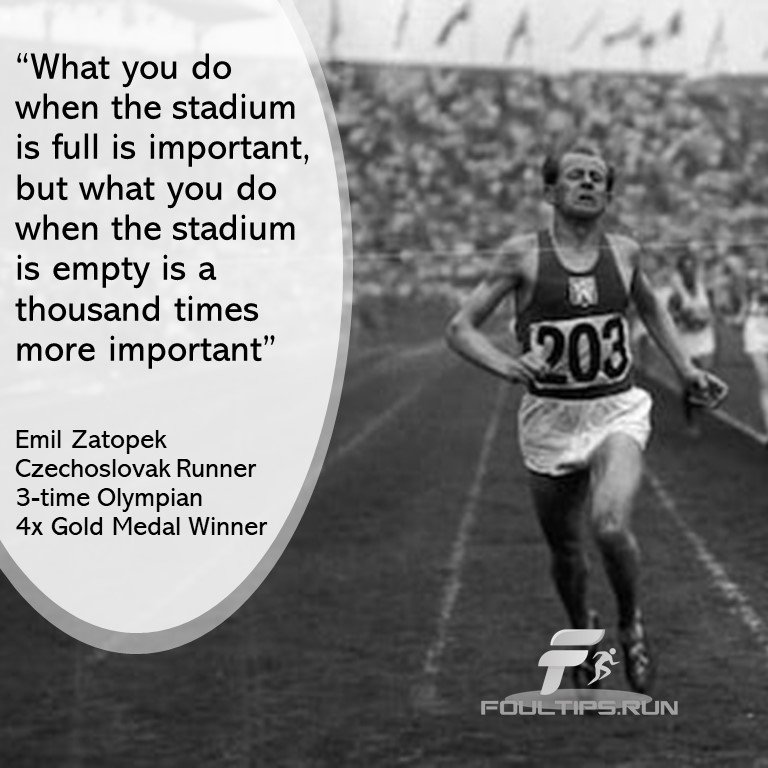
It got me thinking about a classic Emil Zatopek quote where he states: “What you do when the stadium is full is important, but what you do when the stadium is empty is a thousand times more important.”
For us amateur weekend warriors, a standing ovation at an Olympic stadium is no more than a pleasant dream. Yet, well into the XXI Century, each one of us has the equivalent of our own Olympic stadium, and we have become addicted to that standing ovation of kudos Strava, followers on Facebook, and likes on Instagram. These may be cool for many, but they won’t get you any better.
As Zatopek (a 4-time Olympic gold medalist and multi-world record breaker) said, that is not the key to success. It is what we do outside the limelight that counts. A thousand times more.
► It is the strength training that will help you get stronger, more resilient, have a better form, and make you injury resistant.
► it is the physical therapy you do to take care of your bones, muscles, and soft tissues. Not just face-to-face with a professional, but as a prehab to avoid a recurring injury.
► It is your daily nutrition that allows your body enough of the good stuff to repair itself and be appropriately fueled for your activity.
► It is the hydration throughout the day that will allow you to sustain a hard run even in the harshest of weather conditions.
► It is the scheduled recovery for your body to adapt to the stress we have put it through and accepting that sometimes it will require more time.
► It is understanding that sleep is the champion of recovery tools in your arsenal and that lack of sleep is not a badge of honor.
► It is accumulating knowledge about the sport and the function of your body, which will allow you to understand what’s happening and why.
► It is the evaluation of your training, especially when you have bonked or screwed up, and accepting it as an opportunity to learn and build experience.
► It is living a balanced life, one where your job, your family, and your friends won’t be neglected, and end up resenting you and your running.
► It is allowing yourself to have fun outside your running life. Keeping it all in perspective and always remembering why you are doing this.
These are just ten of hundreds of parameters of what is encompassed within the realm of invisible training.
In summary, everything you do while you are not running is equally essential to the running time.
Yes, it all sounds intuitive, simple, even obvious. But we’ve all fallen into the trap of only accepting hard work as worthwhile training. And to many, an injury has taught us how wrong we were. My wish is that this brief writing will help avoid the injury part for you, dear reader.
Share your thoughts in the box below so other runners may benefit from your experience.
No sugar coating it: Running in the heat and humidity of the summer sucks. It does. However, if we want to remain active during these challenging summer months of running and have any chance of having a solid racing season come fall, we must continue training. And to make hot weather running enjoyable and safe, the only way is by making substantial adjustments.
I’ve shared summer running tips every year since I began blogging, but this time I decided to do something different. I have gone through my previous writings on the issue and consolidated the tips. These, plus a handful of new ones I’ve added, bring the final count of summer running tips to 39.
To be clear, nobody expects you to apply all 39 of these hot weather running tips on every run. These are just guidelines and suggestions with very short explanations to get your thoughts started. I have included links to posts where I have explored the issues in more depth. And if you’re looking for more background or science behind these summer running safety tips, a quick Google search will point you in the right direction.
So, without further ado, here they are:
1 – Listen to your body – If you feel dizzy, nauseated, or overheated, don’t hesitate to stop, cut the run short, seek shade, ask for help, or just call it a day.
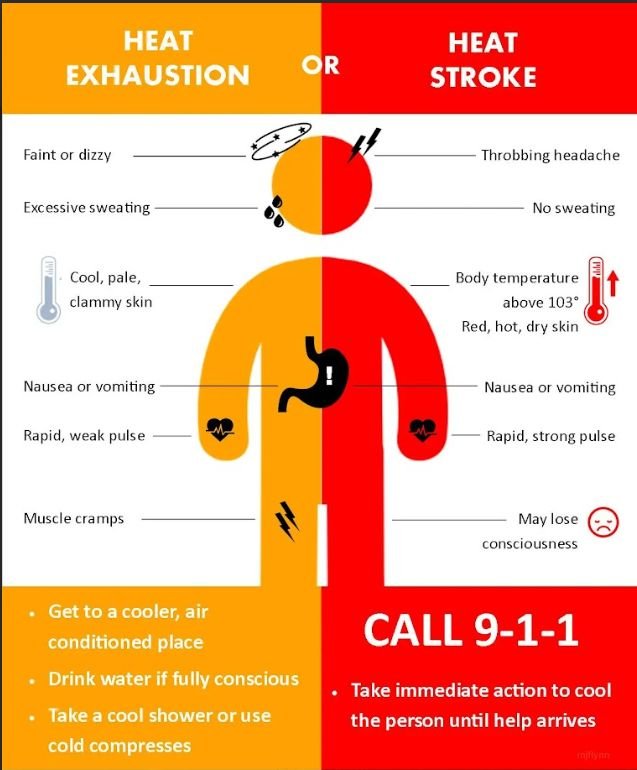
2 – Recognize heat stroke symptoms – Know the difference between exhaustion and heat stroke and familiarize yourself with warning signs like confusion, rapid pulse, or clammy skin.
3 – Hydrate all day – Hydration should be a 24/7 habit that keeps you close to fully hydrated by the time you start your GPS watch.
4 –Don’t overhydrate– Overindulging in water or sports drinks can cause hyponatremia, a condition in which diluted sodium levels may lead to seizures, coma, or worse.
5 – Use electrolytes– Supplementing with sodium, potassium, and magnesium helps your body retain and use the fluids you’re drinking more effectively.
6 – Run early or late – Run before sunrise or after sunset to avoid the most extreme heat and protect your body from overexertion.
7 – Monitor the heat index– Skip your outdoor workout if it’s over 98°F with more than 70–80% humidity, as your risk of overheating skyrockets.
8 – Slow down your pace – Running in the heat is harder, so let go of your pace goals and focus on effort instead of speed.
9 – Accept higher perceived effort – A rise in core temperature, not lactate or heart rate, becomes the main fatigue limiter in hot conditions.
10 – Use effort and time, not pace – In summer, pace and heart rate can be unreliable, so go by effort and run by minutes instead of distance.
11 – Recognize the signs of dehydration – Watch for fatigue, brain fog, darker urine, dizziness, or a dry mouth—these may all signal fluid imbalance.
12 – Prehydrate before long runs – Do not cram your hydration; it doesn’t work that way. Hydrate throughout the day and days, not just before your run.
13 – Rehydrate after running – After a sweaty session, replace fluids with water or an electrolyte drink. Not only as soon as you’re done but throughout the day.
14 – Dress light and bright – Light-colored, loose, and moisture-wicking clothing helps reflect sunlight and allow sweat to evaporate more easily.
15 – Train in the shade – Routes with trees or buildings that block direct sun can be 10–15°F cooler and far more comfortable, and safer.
16 – Freeze your gear – Put your shirt and hat in the freezer before a run to delay overheating and make the first few miles more tolerable.
17 – Take short breaks – Stop for 1–3 minutes during a hot run to drink, throw water on your head, or reset your effort perception.
18 – Use water for recovery – Jumping into a pool, cold bath, or even running through sprinklers post-run can drop your core temp and revive you.
19 – Know where the water is – If you don’t know where the reliable water sources are, run with a handheld bottle or hydration pack.
20 – Run indoors if needed – If conditions are extreme, choose a treadmill or indoor track to get your miles without the heat risk.
21 – Build heat tolerance gradually – It takes a few weeks to acclimate, so ease into hot-weather running instead of diving into hard efforts.
22 – Move workouts around when necessary – Move long or intense workouts to cooler days and use weather apps to plan smarter each week.
23 – Use a heart rate monitor – Heat elevates heart rate, so monitor it to avoid overexertion while running.
24 – Expect it to suck – The first few weeks of heat running will feel awful, but your body will adjust and it will suck less. Proceed with caution.
25 – Adjust your training plan – In very hot climates, push harder workouts like long tempos to the fall and focus on base-building instead.
26 – Exploit cooler days – When temperatures drop, use the opportunity for a strong tempo or threshold session to boost confidence.
27 – Don’t obsess over metrics – During summer training, forget about pace, Strava comparisons, or even distance—survival and consistency are the priority.
28 – Take advantage of trails – Shaded trails provide natural cooling, softer surfaces, and often more enjoyable running when it’s hot out.
29 – Eat hydrating foods – Boost your fluid intake by eating fruits and veggies like watermelon, cucumber, and oranges, which are 80–90% water.
30 – Beware of diuretics – Limit high doses of caffeine or alcohol around runs, as they increase urination and risk of dehydration.
Learn how to gauge your level of exhaustion (Photo: Tima Miroshnichenko, Pexels)
31 – Set hydration reminders – Pair water intake with daily habits like brushing your teeth, meals, or use phone alerts to stay on track.
32 – Sip, don’t guzzle – Drink water steadily throughout the day and during your run to avoid bloating and improve absorption.
33 – Internalize year-round hydration strategies – Treat hydration like a year-round discipline, not just something to focus on when it’s hot.
34 – Know your sweat rate – If you’re a heavy sweater, you may need more fluids and sodium than the average runner.
35 – Pair hydration with daily habits – Combine drinking water with routines like meals, workouts, or bedtime to form easy-to-remember habits.
36 – Double instead of going long – On non-long run days, two shorter sessions may be safer than a longer push under the brutal heat. Consider it if needed.
37 – Use treadmill for quality work – Use a treadmill to maintain pace accuracy or intensity when outdoor heat makes it unsafe.
38 – Keep someone informed – Always tell a friend or loved one your planned route and expected return time, or use live tracking apps.
39 – Know the line between tough and dumb – Being smart and cautious during summer training keeps you healthy and able to run tomorrow.
Did I miss anything, or would you like to contribute to the list? Please do so in the comment box below.
In a WhatsApp running group, one of our friends recently shared an article from Men’s Journal Magazine praising the benefits of training in a fasted state. The sub-title alone was promising: The Science-Backed Benefits of Running on Empty, by Spenser Mestel.
I opened it as I thought of how pseudo-science has affected even the most mundane, easy runs lately. Most come from unqualified social media influencers or studies commissioned by companies that will benefit from their results. Dr. Tim Noakes is famous for questioning Gatorade’s science-based recommendations about the benefits of consuming Gatorade. And like that, examples are plenty.
Running on empty has its scientifically proven benefits (Image by ChatGPT)
We tend to forget that humans have been running for thousands of years. Hunted gatherers did so for hours while chasing an animal until it collapsed. Yet, they were able to pick it up and take it home to feed their families. They didn’t carry water packs to replenish every drop of sweat. They didn’t carry chews or gels to replace every calorie they burned.
Sure, we have evolved in those thousands of years. The bushmen of the Kalahari were not used to spending their day under air conditioning, sitting in front of a computer, or wearing shoes before they went hunting. But we haven’t entered devolution either. Our bodies were built to withstand a certain level of dehydration and caloric deficit.
I want to leave no room for doubt that I am not advocating against electrolyte replenishment, chews, gels, or any other product. God knows I could not have finished my last few marathons without the help of Maurten gels. What I am advocating against is their overuse, to the point where our bodies become unable to learn how to use their own resources.
Running on an empty stomach is not a fad passed around by social media influencers. Based on the article in question and the study on which it was grounded, it is a well-rounded premise that “fasted cardio” and “low-glycogen” training are similar but distinct practices that can offer real metabolic advantages if done right.
While skipping breakfast can be beneficial, you don’t have to do it for every run (Photo Pexels)
Mestel brings in Professor Richard J. Bloomer, Dean of the College of Health Sciences at the University of Memphis, to clarify the lingo. According to him, a “fasted state” can simply mean not eating for 10–12 hours, like overnight. But low-glycogen training goes further. It implies depleting your muscle glycogen stores, typically by limiting carbs over a longer period. Both approaches can shift your body’s fuel source away from sugar and toward fat, especially during lower-intensity sessions.
According to the study, these are some of the benefits:
Fat Adaptation: By skipping that pre-run snack or breakfast, your body is nudged into burning fat for fuel. Studies cited in the article showed that both men and women increased fat oxidation after exercising in a fasted state. Simply put, you’re teaching your body to tap into a steadier, more abundant fuel source.
Less Stomach Drama: Fasted runs can reduce gastric discomfort for those with fussy guts. No food means nothing sloshing around in there. It’s a win for morning runners who’d rather not eat at 5:00 AM just to avoid bonking at 6:00.
Convenience: This one isn’t science; it’s life. Rolling out of bed, lacing up, and getting it done before breakfast is just easier sometimes.
The science goes even deeper. In a 2010 study from the Journal of Applied Physiology, Beneficial Metabolic Adaptations Due to Endurance Exercise Training in the Fasted State by Van Proeyen et al., this wasn’t anecdotal evidence; it was a tightly controlled experiment. Two groups trained identically on bikes for six weeks. One ate carbs before and during workouts; the other trained fasted.
The result? While both groups got fitter, the fasted group showed superior metabolic adaptations. Their muscles improved at burning fat, their ability to use stored fat (even deep in the muscle) improved, and they kept blood sugar stable over long workouts. The carb-fed group? They didn’t show those perks.
Conclusion
It is not about skipping breakfast forever or starting every workout on an empty stomach. But if you mix in a couple of easy runs each week without eating beforehand, especially when effort is low and stakes are even lower, your body might thank you. You’ll become more metabolically flexible, able to use fat when needed and carbs when it matters most.
Don’t go overboard. It’s about teaching your body to adapt so it can rise to the occasion, whether chasing a PR or just running for joy.
Curious to try it? Leave a comment and let me know your experience. And don’t forget to subscribe to the Foultips.Run newsletter by clicking the button below.
In the last post, we discussed the importance of building a strong aerobic base, one on which everything else can solidly rest. That post sparked valuable feedback. Many readers asked, “So, what comes after the boring stuff?”
Now that the foundation is in place, we build on it to get stronger and faster. Opposed to “the boring stuff” is what we I’ve heard called as “The Sexy Stuff”.
Speed over long periods/distances cannot stand alone. Adding speed work doesn’t mean abandoning the easy miles. It means balancing them with strategic sessions designed to improve strength, efficiency, pacing, and recovery.
Speed work isn’t a shortcut; it’s a complement. When done correctly and in harmony with your base mileage, it helps you become the strongest, smartest, and most resilient version of your running self.
Now that we have a base, it is time to work on speed (Image by CoPilot)
There are many types of speed workouts, each one with its own merits to help you run faster, with purpose, and without risking injury. The key is understanding that speed development isn’t about hammering every run to exhaustion. It’s about running with intention. Your easy runs remain the backbone of your training. But now, we are layering specific efforts designed for growth. To get faster, you need to run faster, but only when the time is right.
Examples of “sexy stuff” are the following:
1. Interval Training – Alternate fast running with recovery periods. They challenge your body to hold higher intensities and then bounce back. An example is short bursts of 200 or 400 meters at strong effort, followed by slow jogging. It’s tough but builds both strength and endurance quickly.
2. Fartlek – Fartlek means mixing in bursts of speed during a steady run. There’s no set structure. Just pick a landmark and push the pace, then ease up. It’s a fun, flexible way to teach your body how to change gears mid-run.
3. Tempo Runs – This is your chance to run at a challenging, steady pace that builds endurance and raises your limits. You should feel strong but unable to talk easily. These runs help you sustain faster efforts over longer distances without crashing.
4. Progressions – They are all about finishing fast. Start your run at a relaxed pace, then pick it up gradually. The goal is to finish the last stretch of the run feeling strong and in control, without gasping for air.
5. Hill Running – Short hill sprints build explosive power in your legs, improve form, and speed up your heart rate. They’re good for runners who want to boost their cadence and efficiency. Hills are strength work in disguise.
Other workouts such as Vo2Max, lactate threshold, double threshold etc., require a deeper knowledge of the science and physiology behind them before being tackled. Focus on what you know and understand, not on what the elite Kenyans are doing.
Cross-training is key to remaining healthy while running, especially as you age (Photo Pexels)
But that’s not all there is. To get faster and remain injury-free, you must do work beyond running. Some examples are:
6. Strength Training – Incorporating 2–3 strength sessions per week will make you stronger and, thus, faster. Full-body and compound movements will help with running economy and injury prevention. Think of squats, lunges, deadlifts, and core work.
7. Cross-training – Non-running activities like cycling, swimming, or yoga improve fitness, build strength, and reduce injury risk by working different muscles without the repetitiveness of movement and pounding of running.
8. Plyometrics – These exercises involve jumping and explosive movement to help improve your power and coordination. A few well-timed sets of bounding, hops, or box jumps before your run can sharpen your stride and reduce contact time with the ground.
9. Prioritizing Recovery –Your body needs time to adapt. Without quality recovery, your speed won’t stick, and you’re more likely to burn out or get injured. Sleep well, eat right, foam roll, and stretch as necessary. Gains don’t happen during training, they happen during recovery, where your body adapts and grows stronger.
10. Mental Strategies – Running fast requires mental fortitude. Breaking a tough run into small segments, repeating a mantra, visualizing success or adjusting your thought process may be just as important as the way you train.
Speed work is the exciting part of training, but it only works when done right and is well supported by your solid base. Both elements must work in harmony, complementing each other rather than competing between them. As you start integrating faster sessions into your week, keep your easy runs sacred, your recovery intentional, and your mindset focused on progress, not perfection. When done right, it is this balance what will make you a faster, stronger, and more injury-resistant runner.