I joke (partially) with my running buddies that the day I ran against Eliud Kipchoge in Berlin (2017), he needed a world record to beat me. Sure, I started in wave 4 and was 15 miles behind when he crossed the finish line, and while I certainly had no chance of beating him, the statement is still 100% true.
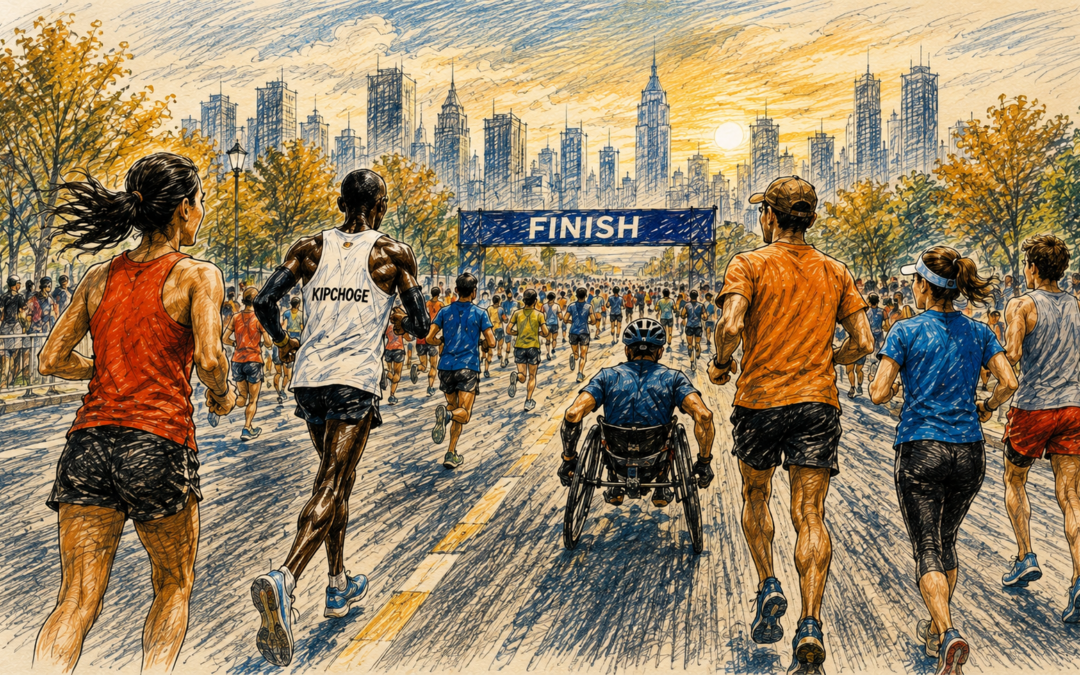
All you need is the will to go for a run. Everything else is additional (Image by Grok)
Consider this: what are your chances of standing in the huddle in a Super Bowl, strategizing the next play? When will you face Shohei Ohtani on an MLB field? How about your odds of standing with or against Lio Messi during the World Cup? Driving in an F1 Grand Prix? US Open. Golf or tennis?… Anyone?
But running is different. When the marathon’s 2-hour mark was broken, a runner I trained was there. When Kipchoge broke his last world record (Berlin 2022), another runner I trained was there. During the epic battle between Alberto Salazar and Rodolfo Gomez at the 1982 NYC Marathon, my dad was there. A close friend crossed the finish line in Boston, 10 minutes before the bombing. The last time the immortal Bill Rodgers won a marathon (Orange Bowl 1983), he had to beat me, too.
So, you get the point. Running is the most democratic of sports. The one with the most open access, equal opportunity to participate, low barriers of entry, and outcomes driven mostly by effort rather than status.
Remember dreaming of running, or lacing your shoes for the first time? Or how you felt after a long hiatus? Remember the struggle to finish that first long run? Have you checked the back of the packers at a race? Have you taken the time to watch the videos of the last finishers at a big-city marathon? Is there any other sport where regular people, even with a variety of disabilities, can beat the odds by finishing the biggest and most iconic races in the world?
Sure, only a selected few will run in the Olympics or the world championships, but even you, dear reader, can run the mythic Boston Marathon, even if you don’t qualify. We know you have a better chance of hitting the Powerball than the London Marathon Lottery, but the chance is there, and you still have charity entries. And if you are not into multitudinous mega races, there are local 5Ks everywhere, every week.
In his book “When Running Made History”, literature professor and former elite runner Roger Robinson said: “Being a runner (this sounds naive but isn’t) gives you direct and unfiltered access to all other runners. That’s one thing that makes running so remarkable; it is an intensely competitive sport that is also an egalitarian community. Just put your shorts and shoes on and if you’re fast enough, you can run with, befriend, and, if so inclined, interview the greatest celebrities on earth.”
In running, you will only get out what you put into it (Image by Grok)
Think about it: when it comes to running, you don’t need an opposing team or a field. Let alone a golf course. You don’t need a court, like tennis, basketball, or pickleball. You don’t even need a group of friends or a rival. All you need is the will to run. Everything else, everything, is extra.
You can run in the crappiest of shoes, or even barefoot. You can run in jeans and cotton socks if that is all you have. You don’t need a watch, you don’t need company, and you don’t need a dedicated surface or place. The comfort of a good pair of running shoes, a tech shirt/shorts, moisture-wicking socks, and a running path with good friends will surely make it more enjoyable, but as for requirements, none beyond your willingness to go out for a run.
Biologist and 2:22 marathoner Bernd Heinrich wrote in Why We Run: A Natural History: “Running is perhaps the most fundamental of all sports… it is the most democratic and most competitive of all sports because individual merit can prevail despite economic equality. It is a sport for everyone, the whole world over.”
Meritocracy in action. What a beautiful concept!
The great running author and philosopher George Sheehan said, “Life is a positive-sum game. Everyone from the gold medalist to the last finisher can rejoice in a personal victory.”
Fred Lebow, the father of the NYC Marathon, said, “In running, it doesn’t matter whether you come in first, in the middle of the pack, or last. You can say, ‘I have finished.'”
Beyond the health and social benefits, running is a sport where you can only get out as much as you put in. The one sport where we have the chance to participate in the biggest local, national, and international competitions. The one we can practice at a moment’s notice, just when we need it. Yes, need it. The one where the winner and the last one across the finish line get the same medal. The one where we can make friendships to last a lifetime.
Let’s go for a run, then. What are you waiting for?
👇Do you want the key takeaways of this blog post? 👇 👇Click below to watch the video summary 👇
Last weekend gave us runners a preview of brutal summer weather in South Florida. It wasn’t as bad as mid-July, but in mid-May, it signaled what’s ahead. If you live in the Northern Hemisphere, expect this soon.
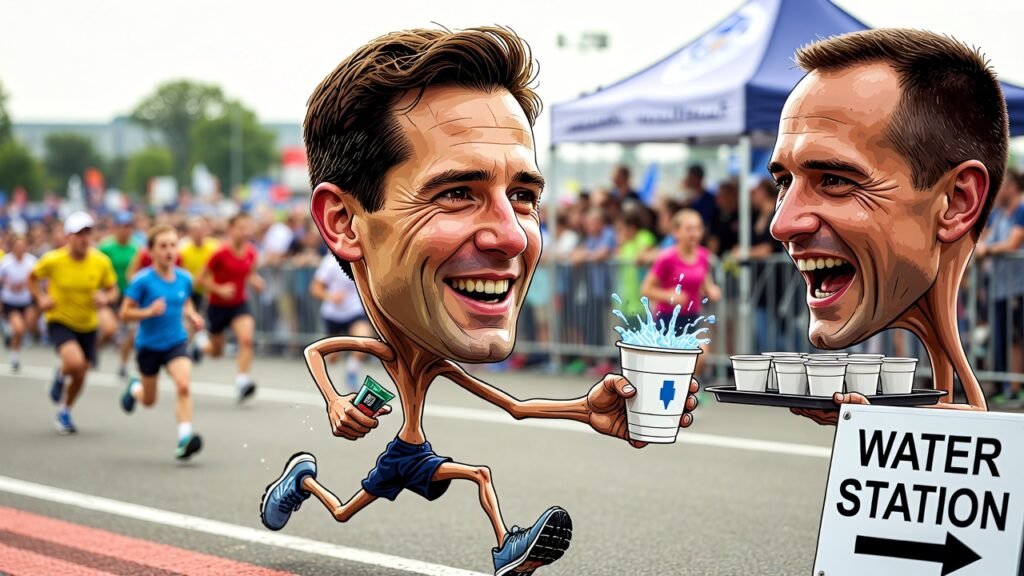
Hydrate, sure, but don’t overhydrate (Image by Grok)
The line between toughness and doing something stupid is very thin, and if you cross it, you can get seriously hurt. So, my yearly blog post urging runners to stay on top of their training during the summer has been forced to be published earlier than expected.
Adjust your training and expectations for survival, not just performance. Heat injuries can permanently impact your health and your running future.
Here are five adjustments for safe training during the summer.
1 – Know what’s happening – You can’t fight the weather; you can only adjust for safe running. Two basic things occur:
1A – When air turns humid, it feels thicker, making each run more effortful. Running at the same speed takes more work.
1B – The second one is basic biology: The human body cools off by sweating, and the blood is about 92% water. The more you sweat without replenishing fluids, the more water gets sucked out of your bloodstream, and the thicker the blood becomes, the more difficult it is to circulate. This spells deep trouble.
2 – Adjust your running time – If the brutal summer is an unavoidable part of your home zip code, your options for outdoor running are reduced to: A- adjusting to run in the heat/humidity, or B- not running at all. If you choose A, you must do so at the coolest time possible, when it is gentler to the body. The basic choices are before sunrise or after sunset. Wake up earlier or wait until later. If you can’t, there is always a frightening Option C: The dreaded treadmill.
A good hack is to keep a running shirt and hat in the freezer and put them on right before you hit the road. This will cool your core and provide you with a few comfortable initial miles before the inevitable sets in.
3 – Slow your pace – Do you know why mainstream races take place in the fall or the spring? Who wants their goal race in the thick of a scorching summer? This is the time to get ready for the upcoming season; the time to tackle strength training and base building. The latter is achieved by running at a lower effort level, regardless of speed. Your fall and spring PRs are built during the summer. Don’t worry about what “the fast” people may think. Stop posting on Instagram if your followers’ opinions matter.
4 – Overhydration is a real danger – Your body is designed to lose fluids as you run, without replenishing every single drop of sweat. So, don’t fall into the temptation of overindulging in water or sports drinks. Hyponatremia is a serious condition that happens when too much fluid is ingested, diluting your sodium levels to the point that it may cause seizures, coma, and even death.
Hydration is not just about what you consume while running. Hydration is a 24/7 habit that has you ready to go by the time you press start in your GPS watch.
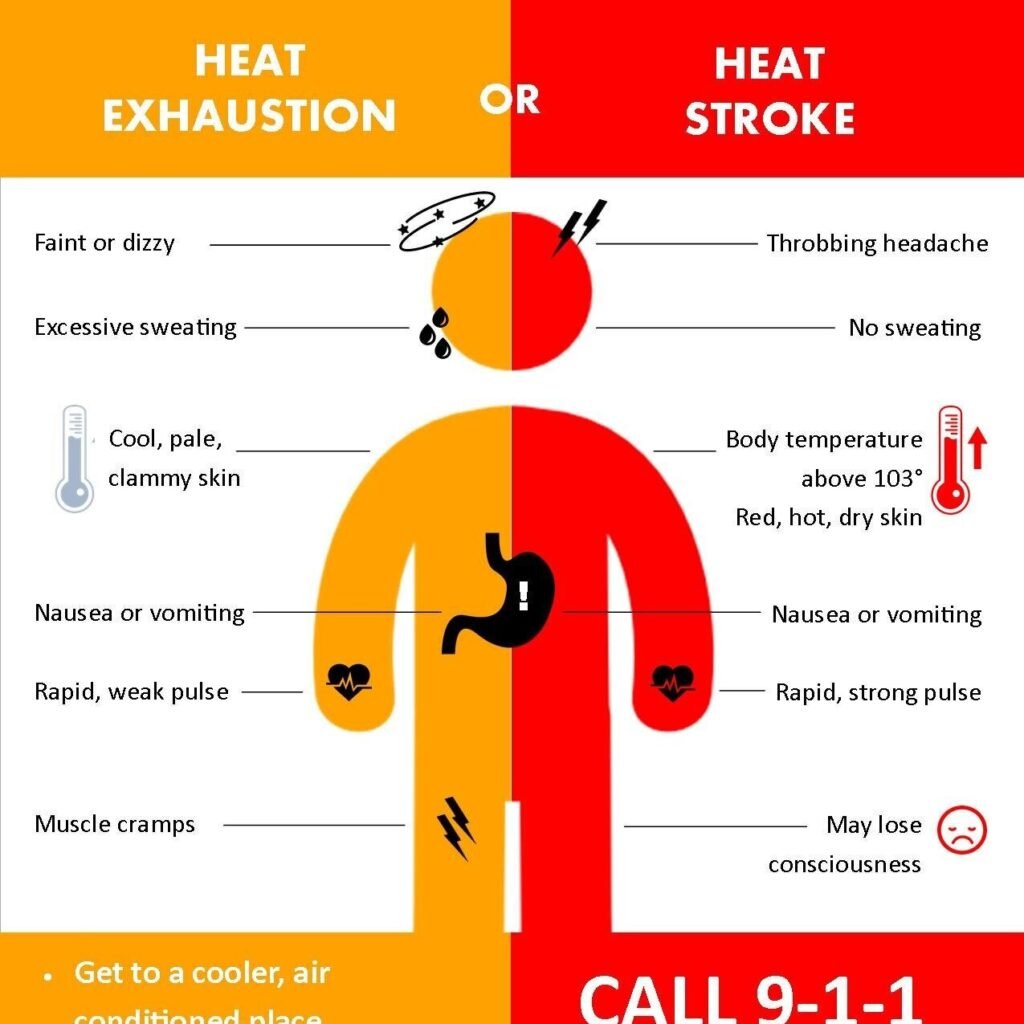
5 – Beware of the signs – The challenges of summer running go beyond training earlier, later, or slower. Heat exhaustion and heat stroke are among the most serious dangers in inhospitable climates. It’s each runner’s responsibility to recognize the symptoms and adjust before it becomes a 911 call. With luck, a mishap may keep you out for a few weeks; without it, it could kill you. In a previous post, I wrote about heat exhaustion and heat stroke. I invite you to revisit it by clicking here.
In Conclusion
There are no medals or podiums during training. Be smart and remember you are only getting ready for next season.
Running in heat and humidity is doable if you prepare properly. Never lose sight of the fact that you need to live to run another day. As stated earlier, the line between toughness and doing something stupid is very thin, and if you cross it, you may get seriously hurt.
👇Do you want the key takeaways of this blog post? 👇 👇Click below to watch the video summary 👇
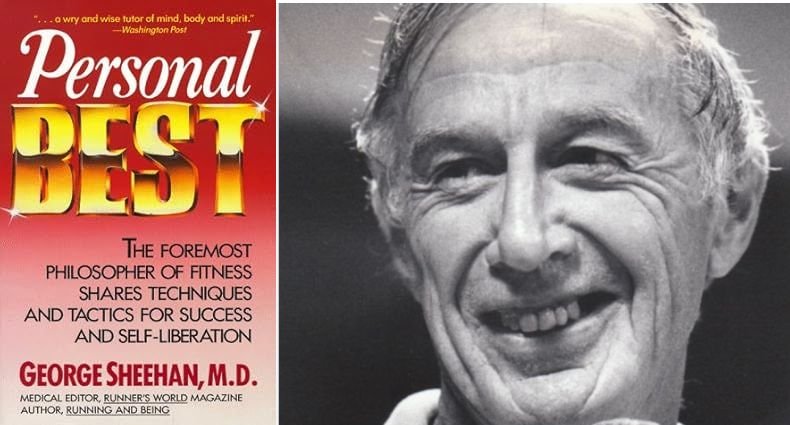
I was recently reading a book by an author I’ve known for years, yet somehow never truly delved beyond his famous running quotes and the occasional column: Dr. George Sheehan.
Personal Best by Dr. George Sheehan
Dr. Sheehan was a physician, but his legacy lives on in running. A passionate marathoner and prolific writer, he captured the soul of the sport through his columns and books. He did not just write about miles, but about purpose, identity, and the human spirit. His words helped generations of runners live training not as exercise, but as a path to self-discovery.
Despite passing away in 1993, his legacy as one of the most influential running writers ever is undeniable. He wrote 12 books, starting in 1972.
A chapter from “Personal Best,” published in 1989, caught my attention because it proposes segmenting our athletic experience. Even though it is nothing revolutionary, stating the obvious reveals its genius.
The original text reads:
“The athletic experience can be divided into three parts. One is the preparation, the training of the body. Two is the event, the challenging of the self. And three, is the aftermath. And for the runner, the ultimate athletic experience is the marathon. It takes training and challenging and creating to the absolute limits.”
In 54 powerful words, we are invited to deconstruct our running lives and turn it into a rewarding yet challenging process for exploring our limits.
Let’s break it down so we can squeeze every morsel of our athletic journey.
1 – TRAINING OF THE BODY
While we may certainly enjoy better PRs in our favorite distances, we can choose from two approaches. Running ourselves to the ground and having a short career or taking the time to prepare so our body can be strong, resilient, and injury-resistant.
Living for the challenge of competition and craving the adrenaline rush of finish lines are part of the allure of the journey. Sheehan once said, “Racing is the lovemaking for the runner. It is hard to pass up”. And I agree. But to keep doing it constantly, year after year, we must teach the body.
It takes time, planning, and execution. It is a long road with no shortcuts. So, we’d better be smart and make the process enjoyable, or we won’t last the distance.
2 – CHALLENGE OF THE SELF
Ok. Here it is: The challenge. For us runners, it is usually racing, but it could be whatever gets your endorphins going. This is your personal journey. It may be breaking 20 or 30 in the 5K; or how far you can go before collapsing. The point is that you are in charge. You can’t run to fulfill someone else’s dream.
For Dr. Sheehan, the epitome of this challenge is the marathon: “The marathon fills our subconscious with this gospel. Taking a well-trained body through a grueling 26.2-mile race does immeasurably more for the self-concept and self-esteem than years with the best psychiatrist.”
The challenge of the self is an ever-changing target. Every success should create a new goal. Every failure (and they will happen) should trigger a reevaluation of the processes or even the goals. The challenge of the self is the most rewarding part of the journey.
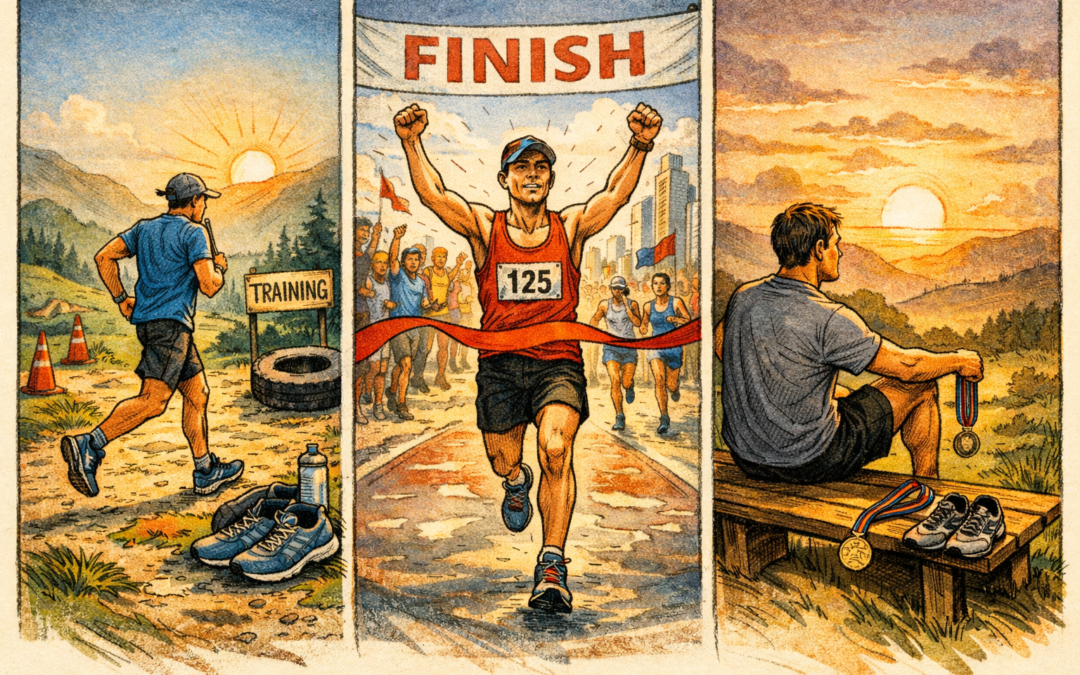
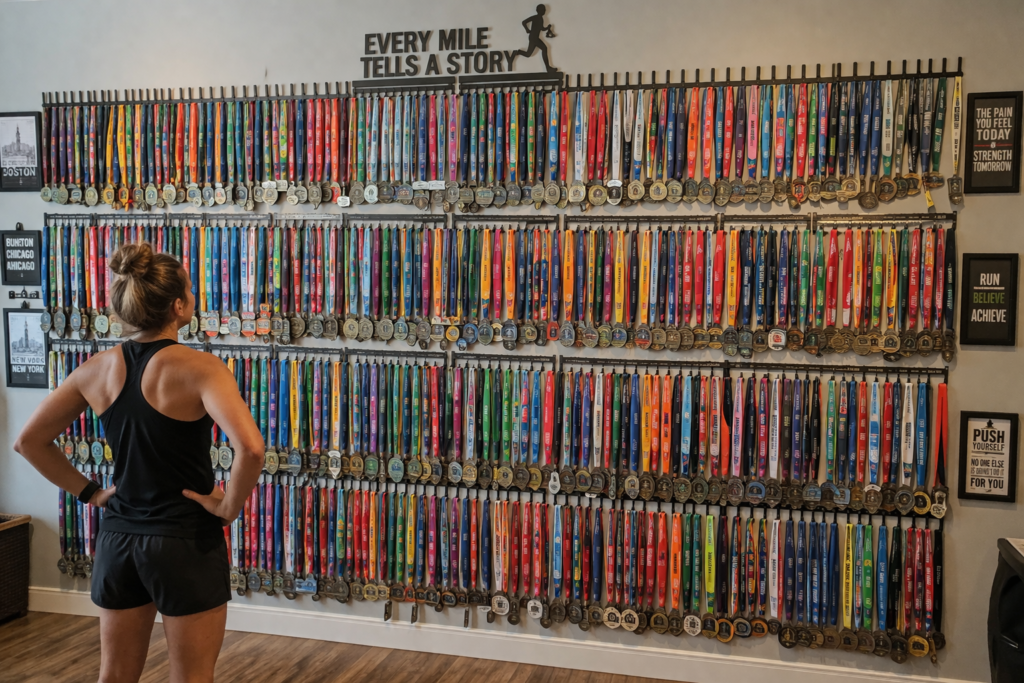
Enjoying the process will be more rewarding than a wall full of medals, but if you play it smart, you can have both (ChatGPT Image)
3 – THE AFTERMATH
Every running cycle, every accomplished goal, every medal displayed on your wall, every PR, every time we fell short, or every time we just had fun with our friends is an opportunity to reap rewards from our efforts. And the more prepared you are for the journey, the longer and more enjoyable it will be.
In the same writing that gave birth to this blog post, Dr. Sheehan states: “The long-distance race is a struggle that results in self-discovery. It is an adventure into the limits of the self, representing for runners what has been called the moral equivalent of war—a theater for heroism, where the runner can do deeds of daring and greatness.”
My takeaway is that running can be a worthwhile, ever-changing journey if you allow it to be. But you must be purposeful and flexible, especially as you achieve your goals and pursue new ones as you get older. Enjoying the process will be more rewarding than a wall full of medals, but if you play it smart, you can have both.
Please let me know your thoughts in the comment box below.
👇Do you want the key takeaways of this blog post? 👇 👇Click below to watch the video summary 👇
When it comes to running, cadence is one of those parameters everyone can relate to, as the concept is straightforward. Yet, upon deeper inspection, most people have no idea what to do with it. It’s a bit like BMI (body mass index): Okay, it’s 29.6. Great! Now what?
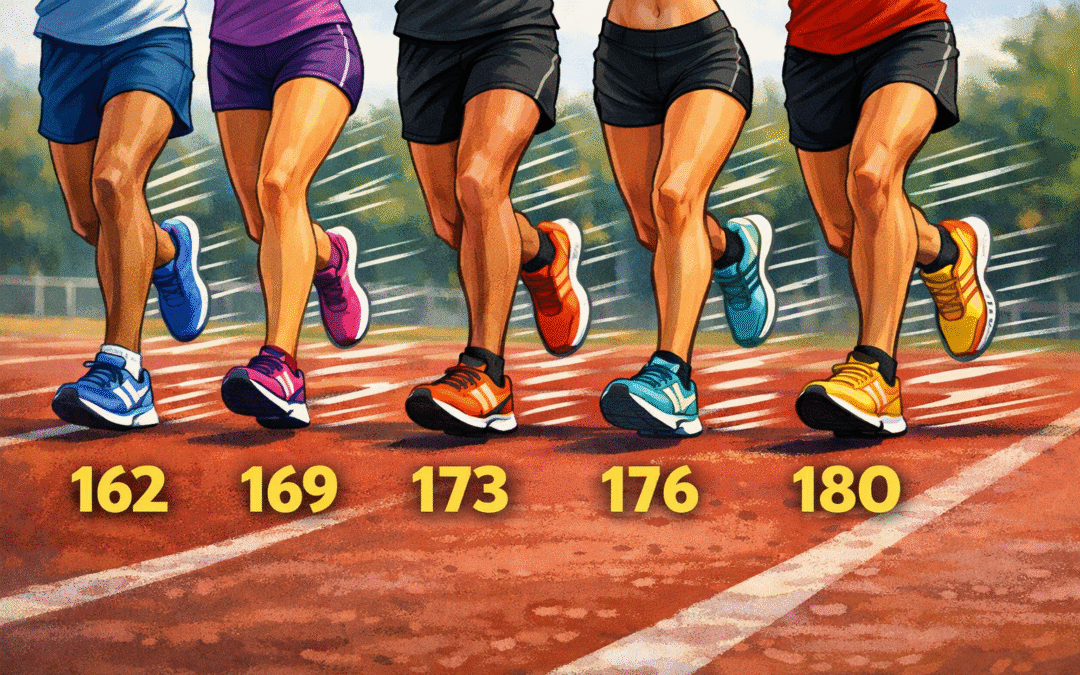
Cadence is not a one-size-fits-all parameter (Image by Chat GPT)
The right running cadence can help reduce fatigue, become a more efficient runner, avoid injuries such as shin splints, and thus allow you to run longer. And while higher cadence can be beneficial, it is not the secret sauce that is missing from your training. And, if you don’t know what you’re doing, cutting your stride indiscriminately is not without its consequences.
Cadence is a simple, straightforward concept: the number of steps you take per minute. Each step starts when one leg touches the ground and ends when the other does. It measures both sides, and most running watches quantify it as a standard function. While most everyday runners’ cadence is around 160-170ish, it is usually higher for elite and track athletes. There’s even a myth about the “magic 180 cadence.”
The idea that all runners should aim for 180 steps per minute for maximum efficiency is traced back to observations by exercise physiologist and coach Jack Daniels during the 1984 Olympics. Daniels counted the cadence of elite distance runners and found that most were running at about 180 steps per minute, or slightly higher. His observation was descriptive, not a universal prescription. However, as the finding spread through coaching circles, books such as Daniels’ Running Formula, and running watches that track cadence, the nuance was lost. What began as an observation of elite runners gradually became gospel among many recreational runners.
The problem with 180 is that only a tiny fraction of runners will ever become Olympians. So, while 180 is indeed a great cadence, it depends on factors such as height, weight, leg length, structural issues, and now even shoes. The runner pushing a sub-3 marathon, wearing carbon-plated shoes, has different mechanical requirements than one aiming for his first sub-30 5K. You can’t expect both to run at a 180 turnover.
If you take away one thing from this post, may it be getting rid of that 180 myth. While it is a great cadence, it is not a magic pill that will have you winning marathons next year. Past and present elite distance runners have succeeded without 180. Meb Keflezighi, Galen Rupp, and Frank Shorter won Olympic marathon medals and were all most efficient in the low 170s. Bill Rodgers won four Bostons and four New Yorks between 160 and 170. Paula Radcliffe set the marathon world record, also around 170.
Cadence is not a magic pill to solve all your running problems and have you set world records (Image by Grok)
Varying your cadence must have a clear intention; it is not just upping the number for the sake of more-is-better. Changing your mechanics without a purpose is a recipe for injury.
Bryan Heiderscheit, PhD, Director of the Runners’ Clinic at the University of Wisconsin Sports Medicine Center, explains: “Research shows that when runners increase their turnover, they reduce the impact on their knees and hips and often improve their stride mechanics. Increasing turnover will help the chances of your foot landing closer to or underneath your pelvis, reducing overstriding tendencies, and increasing your lower extremity stiffness with less bounce and braking in your steps.”
That said, reducing your stride to increase your cadence while still overstriding won’t help you at all. Quite the contrary. You will be overstriding more often, speeding up your breaking point, and thus increasing your risk of injury.
“If you’re going to increase your step rate, also try to land with your foot closer under your hips,” Heiderscheit says. “You don’t want to keep reaching in front of yourself.” Jonathan Beverly compliments the idea by stating: “My experience as a runner and coach confirms this: A faster cadence comes, in fact, as you learn to run tall, land closer, and push back-all part of the same process.”
In conclusion: Even though cadence is a simple concept, and the benefits of adjusting it are real, not every runner needs to do it, and not every leg malady gets solved by it. Assessing it and making a few adjustments is a good place to start, but if the issues don’t subside quickly, you may want to check with a physical therapist before continuing to adjust your cadence indiscriminately. You don’t want to end up with a stride that is too short for your frame, which will result not only in discomfort but in injury.
There are plenty of exercises and techniques to work properly on your cadence, but they are beyond the scope of this post. But beware: When researching online, make sure the author’s background and credentials are legitimate. Don’t just do what the flavor-of-the-month influencer recommends. They may know what they’re talking about, sure, but they may not.
👇Do you want the key takeaways of this blog post? 👇 👇Click below to watch the video summary 👇
As marathon training season arrives, you may be gearing up for the autumn Marathon Majors. Or perhaps you’ve chosen a less hyped, but equally fulfilling, 26.2. So, I invite you to reflect: why do you subject yourself to this fun—yet masochistic—activity? For 99% of the world’s population, it’s the equivalent of self-flagellation.
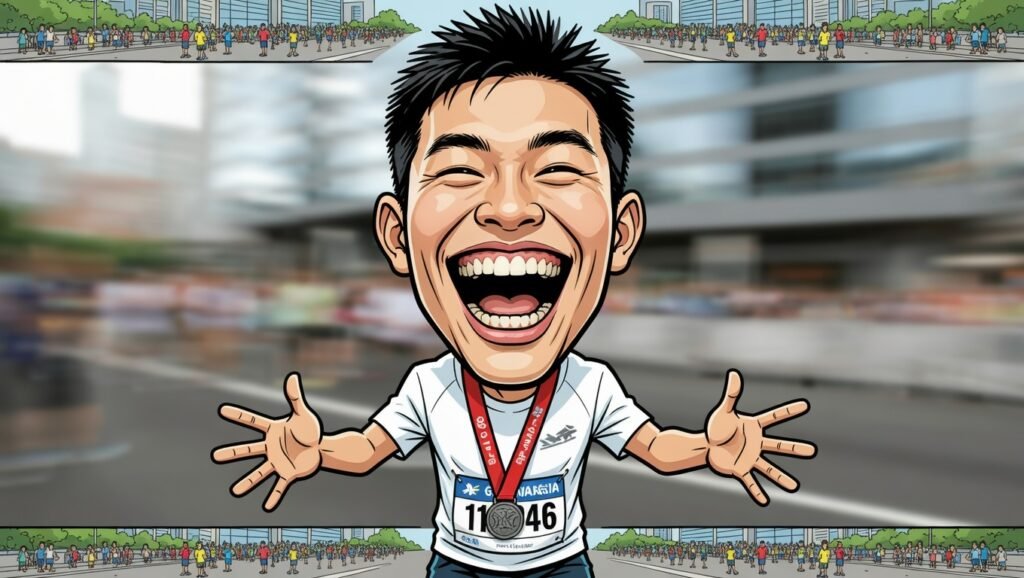
Running a marathon is way more than an Instagram post with a medal and a goofy smile (Image by Grok)
Some run a marathon to challenge their limits. Others just for bragging rights. Some want to fulfill a personal journey: 6-Star, 50 States, or something only you know. Regardless of your reason, it won’t define your legacy, affect your paycheck, or change the respect of your loved ones. Keep it in perspective. Enjoy the process. Suffer through with a smile. Embrace the suck.
Enjoying the process so you avoid burnout is the key to any successful marathon training cycle. Sure, it will be hard, and at some point, you will suffer. Absolutely, you will have to sacrifice certain events because you must train the next day. It is a given that something will eventually hurt. And somewhere during the process, you will question your sanity. But it won’t be a fulfilling process if you burn out. If you do, it will be miserable. Not worth pursuing and easily abandoned. So, let’s avoid that. Here’s how?
Remember why you started ► This is a personal journey, whether it’s your first or your 100th marathon. Make the training a connection to the personal reasons that brought you here. No one is forcing you to do this. Embrace failure (it will happen), grow through the struggle, and own the process.
Trust the Process, not just the pace ► While time goals are worthy and valid and marathon pace training is a key component to the puzzle, trusting the process is more important. Remember that training is about a multitude of stimuli; it is not about perfection. Hit the effort, learn from the session, don’t obsess over splits. If you trust the process, you should hit the pace.
It is your race ► Focus on your progress and don’t let other runners define you. Beating your friend or earning a BQ are legitimate goals. But if you focus only on those, you’ll drain your joy, push too hard, or skip recovery. This is your experience, and nobody else’s.
It is about consistency ► Consistency beats perfection every time. Miss a workout? Move forward. Focus on the next one. Flexibility is important, but don’t mistake it for complacency. Obsessing over a missed long run is stressful and unproductive, especially if you did complete the other 14 of 16 in your program. Life happens.
Fueling for a marathon goes beyond race day (Image by Grok)
Fuel your body properly ► Running a marathon requires a ton of fuel, not just on race day, but throughout training. This is not the time to lose weight, try a new detox fad, or fear carbs. Make sure your body has enough energy to perform and repair, so you can keep moving forward.
Remain resilient through strength training ► Strength training supports running. It protects your muscles, improves durability, and reduces the risk of injury. What more do you need to be convinced? Don’t think you can skip legs just because you’re already running. You don’t want to find out why the hard way.
Respect and prioritize recovery as part of training ► Rest days and easier weeks bring adaptation. Fitness grows when training and recovery are combined. Massage and therapies are a waste if you don’t prioritize sleep. Recovery gadgets are useless if you think they can replace the rest day you need. Be smart. You are not a machine. You are not indestructible.
Make sure to have fun ► As I said at the start, remember the reason you started. Don’t let social pressures take over the fun and fulfillment of the journey. Don’t be afraid to go easy on easy days. Run with friends and laugh. Give yourself permission for that post-run beer. Remember, your finish time is not what defines you as a human being.
Running a marathon is a formidable achievement. The 26.2 is a remarkable adversary. The challenge of training is what makes it special. So, be present, be purposeful, and above all, enjoy the process. Finishing a marathon is way more than an Instagram post showing a medal and a goofy smile.
Please share your thoughts on this subject in the comment box below.