The Surprising Synchrony Between Running and Your Professional Life
By Arijit Gosh*
There is a moment every runner knows. You are three kilometers from home, your legs are heavy, your lungs are burning, and every rational thought is telling you to stop. But you don’t. You recalibrate, find your rhythm, and keep moving.
The discipline you build on the road bleeds into everything else. (Image by ChatGPT)
That moment, quiet, unglamorous, entirely personal, is also one of the finest pieces of professional training you will ever have.
Running and your professional life are, at their core, training the same person.
The Miles You Log in Private Shape Who You Are at Work
It does not matter whether you are a teacher, a nurse, a freelancer, or a small-team manager. The discipline you build on the road bleeds into everything else.
Running teaches you to delay gratification. You do not get fitter in a week. You do not see the results of your consistency until you have quietly stacked dozens of sessions together, and then one day, almost without warning, you run a distance that would have broken you six months ago. Professional growth works exactly the same way. The people who seem to leap forward are almost always the ones who were doing invisible, unglamorous work long before anyone noticed.
Running teaches you to sit with discomfort. Not to enjoy it but to stop fearing it. And when you stop fearing discomfort in your professional life, your relationship with hard conversations, difficult projects, and uncertain outcomes changes completely.
Science Is on Your Side
Here is something worth knowing: exercise reduces cortisol, your primary stress hormone. It also stimulates the production of BDNF, a protein that supports brain function, memory, and focus. Runners who train consistently often find themselves sharper in their thinking, calmer under pressure, and better at bouncing back from setbacks.
This is not a coincidence. You are literally building a more resilient mind every time you lace up and head out the door.
Discipline Is the Common Currency
The most important thing running and professional life share is not motivation. Motivation is unreliable. It shows up when conditions are good and disappears the moment things get hard. What both demand, in the long run, is consistency.
Showing up on the days you do not feel like it. Sticking to a plan even when progress feels invisible. Trusting the process when the results are not yet visible.
Every runner who has trained through a grey November morning or found time for a lunchtime run during a chaotic week, understands this intuitively. You are not only training your cardiovascular system. You are training your relationship with commitment itself.
What Running Teaches Us About Balance
The discipline of long-distance running transforms professional performance, builds resilience, reduces cortisol, and boosts focus (Image by Grok)
One of the most underrated lessons in running is this: Recovery is not weakness. Rest days exist for a reason. Overtraining does not make you faster; it breaks you down. The adaptation happens during rest, not during effort.
The same truth applies to professional life. Burning yourself out is not a badge of honor. The people who sustain long, meaningful careers are rarely those who ran the hardest in their twenties and burned out by forty. They are the ones who learned to manage their energy as carefully as their effort.
Running gives you a built-in framework for this. Easy days. Hard days. Recovery weeks. Long runs that build your base. It is a rhythm, and once you start applying that rhythm to how you manage your professional energy, something shifts.
The Bottom Line
Running is not only for elite athletes or people chasing podiums. It belongs to anyone willing to show up, do the work and trust that consistency compounds over time.
This is not a running philosophy. This is a life philosophy.
So, the next time you are out on a long run and things get tough, notice what you do. Because the way you run is probably a lot like the way you work. And both are worth running well.
*Arijit Ghosh is the founder of Fitness Fortitude, a platform based in India focused on connecting fitness professionals, sports coaches, athletes, and working professionals with science-based training and coaching. His background combines corporate strategy and fitness, which is a recurring theme in his content.
Before I answer the question in the title, I want to answer something else: Is this a self-serving post? Yes. It is. I am a running coach. You are looking for one and have questions about how this works and whether it’s a good fit for you. I am here to provide you with answers. So, here we go.
If you Google “running coach,” as I just did, you will get over 300 million results. If you Google “marathon training plans,” the number is severely reduced to just 150 million. How are you supposed to sort through that? How will you find the right plan or coach that is a good fit for you?
A runner I coach told me once that a buddy of his stated that a running coach was a waste of money because you can download a free marathon plan from the internet. My client responded by saying: “It is more complicated than that. You need to know what you’re doing, and you must read about 40 books. My coach has the experience and has read them all. I don’t have time for that.”
According to a data study by RunnersConnect, runners with custom plans ran 10% faster. They were injured 36% less than those using basic, generic plans. If that wasn’t enough, they also achieved their goal 54% of the time, compared to 29% with stock programs.
It is essential to know that unless you live in your coach’s city or are part of their running groups, you will see very little of your coach in person, and you may never meet them. This is normal. The only coaches present at every one of their athletes’ sessions are either high school or college coaches or elite coaches. If you are searching for an online coach, most likely you don’t fit that description and your goals are different.
So, what are the advantages of hiring Foultips.Run as your running coach:
► Experience and Knowledge: I’m the head coach at Foultips.run with over 40 years of running under my belt. I hold an RRCA Level II certification, have completed over 150 races ranging from 5Ks to marathons, and I stay current on the latest scientific and physiological insights in the sport. To learn more about my background, click here. The coaches I work with are handpicked; each one personally vetted and backed by proven expertise.
► Individualized Plans: Downloadable programs are dime a dozen. Some free, some paid. Those programs, you must understand, are generic and do not consider neither your starting point nor your specific running goals. They apply equally to the Olympic swimmer transitioning to marathon training to the overweight middle-aged want-to-be runner just getting off the couch after 15 years. Additionally, they are not flexible and usually lack cross-training. Additionally, you won’t have access to the person who wrote it should a personalized adjustment be needed.
► Access to your coach: I cannot speak for other coaches, but with Foultips.run, your coach is a phone call or text message away. We pride ourselves on not just telling the runner what to do but educating them on why we recommend a specific workout or an extra day off. Access to your coach is the primary reason you chose an online coach over a downloadable static program.
► Tech platform: Foultips.run works with the FinalSurge software, which is included in the athlete’s monthly fee. This platform syncs with multiple fitness watches, allowing the coach to provide feedback based on all the performance parameters your watch records. This makes adjustments to optimize progress a common occurrence.
► Guidance: An athlete wishing to run needs a different level of guidance than an experienced runner pursuing another PR or returning after a hiatus. Your running coach has the necessary experience to understand the different stages of your journey, so you can be guided accordingly with the correct feedback and resources to navigate your process.
► Flexibility & Customization: You are not a professional athlete, and life will eventually get in the way. Maintaining a life/run balance is paramount, so sometimes runs need to be adjusted or shuffled. Sometimes it all needs to be scrapped and go back to the start
► Motivation, not cheerleading: While keeping the athletes motivated is vital, especially during the inevitable downturns of a running cycle, your running coach is not a cheerleader. They will guide you through thick and thin but will not sugarcoat it if you have screwed up. It is never a failure if you get a valuable lesson from it.
► To read what athletes have to say about their experience training with Foultips.run, click here.
► To read success stories about athletes who achieved their goals with our guidance, click here.
► To read our Google reviews, or with to leave one, click here.
Ready to get started with your online running coach? Leave a message below or send a message by clicking the WhatsApp logo icon at the bottom right of your screen.
If you know me in person, have read my blog posts, or checked my website, you know I have been running for quite a while. Physical activity, running in particular, has been an intrinsic part of my life for over four decades (I am 59). Yet, I am still learning.
And I am doing so because running is a journey, not a destination. You don’t stop doing martial arts when you reach the black belt. You don’t stop practicing piano once you have mastered Rachmaninoff’s Symphony No. 2. You don’t stop riding a bike the day you take the training wheels off. You get the point. This is a process with no end target.
The journey of running has no destination (Image by Windows Copilot)
While racing and accomplishments are important stepping stones, as they should be, becoming a runner for life requires more than a new PR in your next 10K, running your 100th half marathon, beating your buddy in the next marathon, or reaching for a new ultra distance. While all those are worthy goals, they should be there for you to remain focused and avoid unnecessary detours in the journey.
So, as there is no finish line, focusing on the journey is a must if we want to become lifetime runners. There are worthwhile stops on the way, sure. That marathon you always wanted to run, that time you always wanted to beat, or that trash-talking runner you want to leave in the dust at the next race. But if you miss the big picture, once that temporary goal has been achieved, you will look outside of running to provide your endorphin fix.
All this sounds interesting and philosophically sound, but what does it mean?
To me, the journey is what I learn about myself along the way. It is testing my physical and mental limits and my will to do the hard work so I can reach the goals I seek. It is the lifetime and temporary friendships I build through the miles. It is my medal display that reminds me when I am down or injured, of what is possible. And so much more. And if this wasn’t enough, I have the health benefits of the exercise.
The journey is individual and should have its own meaning for each runner/reader. I encourage you to find yours so you can keep moving forward.
My brother, a three-time marathoner, has a great saying that summarizes the idea that it is not about one specific accomplishment: “On marathon day, you are just going to pick up the medal. The marathon is already behind you.”
I would love to hear about your running journey. Please share in the comment box below.
As 2024 approaches (or it is already here depending on when you are reading this post) and we look forward to a blank canvas to fill out with new goals, challenges, and adventures, we quickly turn our heads back to the year that was, to reminisce and reflect on our running year.
We saw marathon world records fall to the point where it seems feasible that 2024 will give us the first sub-2 marathon for men and first sub-2:10 for women. We are just 36 and 114 seconds away from such feats. We saw the 6-star finisher list growing to 8,143 and it is a matter of time before a 7th Major is included. Many of our friends set PRs in their marathons, shorter distances or just lost their 26.2 virginities. But, for many of us, 2023 was a challenging year. One that tested our core as runner beings. I was in that latter group.
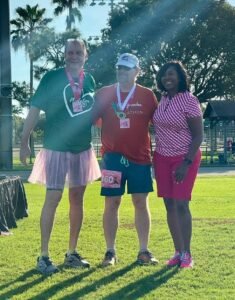
Winning my Age Group at the Plantation F*ck Cancer 5K was one of the few highlight of my 2023 running season.
I completed the 1000-mile challenge with just three days to spare. And sure, it is a nice achievement, but it doesn’t tell the whole story of my 2023. At least I did not get any injury and beyond the normal aches and pains, was able to run throughout the year with no interruption. That alone is a win. Still, it was far from what I expected it to be 12 months ago.
For some reason, it was very difficult to get into the running groove during the year. In my two half marathons early in the season, I was forced to walk after mile 10, finishing in unimpressive times that are embarrassing for me, when compared to what I have done in the recent past. I also had to withdraw from the Marine Corps Marathon because my body could not adjust to the heat and humidity of summer training in South Florida. It was impossible for me to complete more than 8 miles in one run, so I focused on 5 and 10K races until the end of the year. Those are not my favorite distances, as I prefer to go longer, but this was the adjustment that was required, and I am OK with it. I even won my age group in a local 5K, a rare occurrence.
For the first time in the last 15 years if felt little motivation to lace up and run. For the first time in recent memory, I dreaded waking up early on a weekend to go run long. Anxiety from my professional life, which was at an all-time high during the year, crept into my running life and affected me negatively. I gained weight, slowed down and lost the will to dig deep when a run got tough.
My lowest point was one day around September when for the first time ever, or at least that I can recall, I went out for a run and before the first minute was through, I decided I did not want to do this, so I stopped and drove home. Not before stopping at a gas station and stuffing up on cookies and chips. I still look back and can’t believe this happened.
Yet, I kept running. After more than 40 years of being active, I know how you will feel after a good run. The support of my two running groups kept me accountable and sometimes I just forced myself to go out despite not feeling it.
I completed a handful of races with not many results to brag about.
I have tried to pinpoint where the problem lies but I haven’t been able to do so. Maybe it is because I am approaching 60. Maybe two and a half years after my open-heart surgery I must accept I won’t be able to run the same as before. Maybe the anxiety my work life has put me through for the last 18 months is taking a toll on me. Maybe my peak running years are behind me. Maybe it is a combination of everything.
But this difficult year has been an opportunity to analyze life from a different perspective and realize I am still very blessed. My running life is not my life, it is just part of it. My value as a husband, as a father, as a friend, as a son, as a coach or as a professional, is not tied to my marathon PR or my medal rack display at home. I still have a healthy marriage with a wife I adore, a healthy and successful son, both my parents are alive in their eighties and living independently, I have a thriving coaching business, I am part of a phenomenal running community with true friends, and I am injury free. At this stage in my life this is more valuable than running sub-2 in the half once again, or setting up another PR. I call this maturity.
This does not mean I have given up on improvement. I still want to go over 1000 miles in 2024. I still want to run at least 4 or 5 halves and be part of one marathon cycle. I want to get rid of the source of anxiety and lose the extra pounds I added in 2023. I thank God that He is providing me with 12 brand-new, crisp, months to achieve it all.
On Sunday, January 16th, I participated in the 50th anniversary edition of the Chevron Houston Marathon. I want to start by stating that it was one of the most amazing experiences I’ve had in 40+ years of racing. From the organizational perspective, the race is at the same level of any big-city event. It is up there with any Major. On the personal side, it was uplifting. From the coaching side, it was memorable.
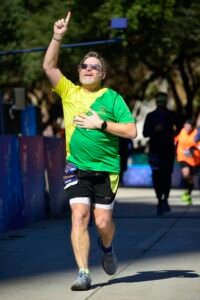
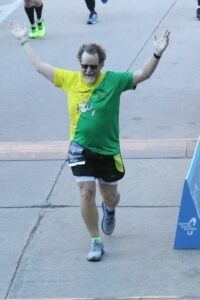
About to cross the finish line with a hand in my heart and the other one thanking The One who made this miracle possible
I knew the event’s center of operations was the George R. Brown Convention Center, which is huge. I never expected it to take the entire place. The execution of the bib pick up was flawless even though a bit more signage would have been welcome for the sake of out of-towners, such as me. I did not visit the expo, though. Friends told me it was a smaller version, given the Covid reality of the world.
Running morning was cold, cold, cold. Thirty-six degrees when we left our Airbnb. But we were able to find refuge, toilets and a place to rest while we waited for our corrals to open. Everything was so well organized and orderly that your only worry was walking to the start. The whole shebang was taken care of for you.
The course was flat, sans an overpass and two, minor underpasses. We ran through beautiful areas of the city and crowd support was solid without being overwhelming. There were so many port-a-pots throughout the race that I never saw a waiting line. There were even urinals at the starting line, first time I’ve seen this in the US. I stopped about mile 14, not because I had to but as a preemptive measure, just because I could and there were no lines.
Last mile, back in downtown, was stunning. Lots of fans and photographers lining up to welcome back the runners. After picking up our spectacular finisher’s medal, we went into the Convention Center to get our finisher’s shirt and food bag. The only unflattering thing I have to say about the race is the shirt. It was a cheapy fabric, fits poorly and the design was nothing to write home about.
I fully recommend this event to anyone interested in a big-city race. This is a Marathon-Major-like organization without the Marathon Major label nor price tag.
COACHING EXPERIENCE
I had a wonderful experience with my four coached athletes in the race. All three marathoners set PRs even though two of them contracted Covid just three weeks before the race. This hindered their expectations and the size of their PRs, but they both achieve their A-Goals through courageous performances. The half marathoner was able to cross the finish line strong, healthy and with a big smile on his face. His goal was finishing after a long hiatus, and that was accomplished, too.
All runners trusted the process, followed their training diligently and executed their race plans to the tee. Thus, the results.
There is nothing more satisfying for a coach than one of your runners telling you: “Thank you. I couldn’t have done it without you”. Even though it sounds (and it is) self-serving, it reminds you that, even though they all had in them the ability to achieve what they just did, your guidance made a difference in this runner’s race. And that is priceless.
MY RACE
On the personal side, I was able to complete the Houston Marathon (my 11th), just 207 days after open-heart surgery. I trained with a race/walk protocol that allowed me to make this a reality, despite having time for just two long sessions (16 and 17 miles). Yet, in just four months, I was able to complete the race in 5:16:45. The time is nothing special, but on my race, time was irrelevant. It was all about crossing the finish line.
Even though it was my 11th marathon, this finish line was special.
The chilly weather was helpful. I ran the first 7 miles biting an 11 pace, and from there started my walk/run protocol of .18/.82 (weird splits, sure, but it was where, after much practice, I felt more comfortable). I reached miles 16, 18 and 20, tired but strong. Legs started to hurt reaching miles 21 and 22 and after the walking break for Mile 23, the legs just stop firing. I tried to restart the running, but it wasn’t happening. I ran some quick math and realized that if I restarted now, I could go sub-5, but the legs were shot. Then I realized that being at Mile 23, 30 weeks after OHS, was miracle enough and I wasn’t going to let the clock dictate the terms of my happiness or what God was allowing me to do. So I walked most of the last 5K with a big smile, never resenting the time lost or wondering why I didn’t go for the half.
I crossed the finish line with teary eyes and a couple of seconds later, I hear the unmistakable screams of my beautiful wife welcoming me. Unfortunately, she was on the other side of the street, and it would take about an hour for me to hug her. But the fact that she witnessed the miracle of my finish, firsthand, uplifted my spirit.
Houston was a spectacular experience in every sense of the phrase. As a runner, as a coach and as the protagonist of something improbable. Because what I personally accomplished is so unlikely that it can only be explained by the divine intervention of God, through me. This is what proves that it is a miracle. Sharing it with my friends from the No-Club Runners multiplied tenfold the experience.