When set up to prepare for a race, we usually do so with a specific goal in mind. Maybe it is a PR. Maybe we want to go under a certain arbitrary round time like a Sub-4 marathon, a sub-1:45 half or a sub-50 10K. Maybe, given a certain personal issue, just finishing in one piece is the objective. They are all valid goals worth pursuing.
But life can and usually gets on the way of our perfect plans. Stars may not align on race day and then your car breaks down on the way to your race or there’s a traffic accident that makes you miss the start. Or it was too hot and humid, or you started too fast when you should have known better. It happens. So, what to do?
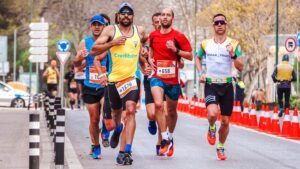
Sometimes, achieving goals B, C or D can still mean a successful race (Foto: Pexels)
It may sound obvious, but in the midst of the frustration, runners don’t know how to react and adjust. So I will spell it out in a direct manner: Set up A, B, C and even D goals for your races. And if your race doesn’t go as planned, sometimes it is good to have a back-up race to fall on to.
I follow a sub-elite runner in Instagram, who ran the recent Boston Marathon. In his post-race recap he said how his objectives kept changing throughout the race. His main goal was giving it his all to go sub-2:30, but as the miles went by, he realized this was not going to happen, so he decided to settle for a PR. In the 28th Km (17th mile), he suffered cramps that forced him to slow down. He ran some math in his head and realized he could still go Sub 2:40. At the end, 2:40:31 was his time. His final assessment was that despite not accomplish any of his preset goals, he wasn’t upset because he gave it all he had for the day. And he also knows this is not his last race.
This is the epitome of setting up multiple goals and completing a solid race despite facing multiple obstacles throughout. It is about learning to face and overcome those issues on the fly. It is about conquering what we are unable to control and yet, conquering those obstacles.
Just as it happens with the performance in a single competition, there are times that even the best prepared runners, or Goals R, S and T can’t cover a disappointment. When that happens, embrace the failure, learn your lessons, and move on to, or set up, your back-up race.
Back Up Races
It is not only a bad race that needs redemption. Sometimes circumstances beyond your control get in the way and derail your plans in a catastrophic manner. A second chance to perform is what will save the time, effort, money, and emotion you have invested in your training.
A few weeks ago, one of my trainees was on the plane to the Berlin Marathon. Door closed. Seatbelt fastened. Pre-flight instructional video played. But then… just like that… they kicked everyone out of the plane. The flight was cancelled. The only alternative given by the airline would put him in Berlin on Saturday at 5PM, with barely any time to pick up his bib and rest to make it to the starting line.
Make sure you live to race anothe day, by being smart before you tackle the marathon agian, after a debacle. (Photo: Pexels)
This runner was lucky enough that had enter several Marathon Major lotteries and hit two of them. So, despite the frustration, at least he had Chicago, two weeks later. The plan had been to push in Berlin and coast for fun in Chicago. Now, the plan is to push in Chicago, even though the taper was extended to 4 weeks. Notwithstanding the disaster, he was able to put his training to effective use and ran 3:24. Below his expectations but solid enough for his abilities and given the circumstances.
Even though having two marathons lined up worked for this runner, this time, it was circumstantial. Having a marathon to fall onto is not necessarily the best strategy. A marathon requires a level of commitment and effort that for most runners it requites just all you’ve got. So, having another marathon in store just in case, in a few weeks, may mess you up subconsciously and may alter your subconsciously because you know you have another race coming up, so you can play it safe, or run too fast and crash.
My recommendation is that if you need to pick another marathon because you missed your goal race, there are plenty or marathons to fall back to. You won’t lack for options, so you don’t need to plan ahead. But, if you had a crappy marathon and need to redeem yourself, be smart, recover properly and reassess where you are and where you want to be eventually before doing something foolish and getting hurt.
You can run multiple 5Ks to make up for a bad one. You can run another half marathon or two, or three, to make up for a bad race. The marathon is a different animal.
Not too long ago, a friend forwarded to me a posting of a runner’s prayer. It was so uplifting. You didn’t even have to be Christian or a profoundly or devout follower on any religion to enjoy it and find it inspiring. This is what it read:
Being thankful for the privilege of running is a key component of most runner’s lives.
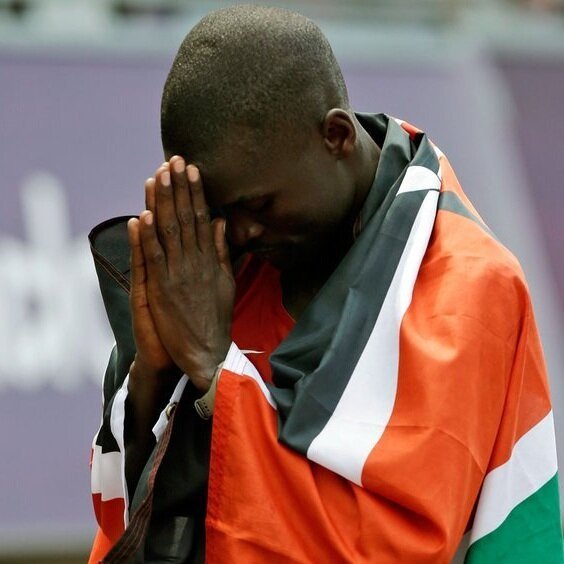
A Runner’s Prayer Run by my side; live in my heartbeat; give strength to my steps. As the cold surrounds, as the wind pushes me, I know you surround me. As the sun warms me, as the rain cleanses me, I know you are touching me, challenging me, loving me. And so I give you this run. Thank you for matching my stride. Amen.
Because of my journalistic background, I always want to attribute credit to authors. So, I did a quick Google search and found not only the author for this one, but a slew of inspiring runner’s prayers.
Originally, I intended to publish something short and uplifting, but with so many good runner’s prayers out there, I decided to compile a handful of the ones I found most inspiring to me. I hope they touch you, too.
Prayer Before Facing a Race A contemporary prayer for someone preparing for a race or marathon By Tamra Dollin Source: https://www.myjewishlearning.com
Dear God, As I stand here, at the foot of Mt. Sinai, I am filled with gratitude, For You, who have given me life. For my family, who sustains me with their love. For my community, who support me with their warm embrace. For the strength of my body, which I have cared for and prepared to greet this day. For the capacity of my mind, to allow me to reach beyond what I thought possible. For the courage of my soul, to conquer my fears and pursue my dreams. For the spirit You have placed in me that will allow me to prevail.
I humbly ask of You… Remove all obstacles from before me. Help me to run swiftly and without impediment. Grant me the courage to persevere in moments of weakness. To see and do acts of loving kindness along the way. And that through this endeavor, I may glorify your Great Name.
As it says in Isaiah 40:13, “…For those who hope in God will renew their strength. They shall soar on wings like eagles; they shall run and not grow weary.”
A simple prayer may change the outlook of your run.
Another Runner’s Prayer
Prayers don’t need to be too deep or full of theology. The simplest of them can touch us profoundly and rejoice our souls, like this one, I found in RunnersWorld.com:
May the road raise to meet you May the winds be always at your back May the race day temps be between 45 and 55 degrees And when we meet again May you be in another age bracket
Runner’s Serenity Prayer
The popular “Serenity Prayer”, written by the American theologian Reinhold Niebuhr (1892–1971) in 1951, has been adapted to many aspects of life. Running is not the exception. I found a couple of them.
I could not find a source for this one:
“God grant me the strength to travel this distance, The courage to push through pain, And wisdom to know when to pick up the pace. Without your guidance and understanding, I could not be the runner I am. Amen”
This next one is authored by Josh Cox, and it goes like this:
“God grant me the serenity to accept when I cannot run; The Courage to run when I can; and the wisdom to know the difference.”
Before Hitting the Road
And to complete this short sample or runner’s prayers, there is this one if found in fuelrunning.com, which I find particularly uplifting:
O Strong and Faithful God
Make me swift, today, as I run; give me stamina, courage, and strength. But mainly, O God, give me faith in You and in myself. For you have said: “For they who wait on the Lord shall renew their strength… they shall run and not be weary, they shall walk and not be faint.”
By striding with this faith, my efforts will be crowned, and my spirit rest secure in you, and in the knowledge of a race well run.
I make this prayer in imitation of all the saints who have run to you. O Lord, amen.
It doesn’t matter to what God you pray, or to what religion you feel either affinity or affiliation. May it be God, Jehovah, Allah, the Universe, Nature or any other; most of us feel a bigger power guiding our steps. Voicing out our gratitude or putting ourselves in the hands of that superior being, is of great comfort when we are about to participate in our favorite sport. I hope these prayers will help.
When I worked for the Florida Marlins in the early 1990s, manager Rene Lachemann often used a phrase that has stuck with me, almost 30 years later. Whenever a reporter asked him about an aspect of the game that was beyond his grasp, such as a pitching change from the opponent or the weather, he would indefectibly respond: “I can’t worry about something I can’t control.” For me, this has become a life lesson: If you can’t control it, don’t dwell on it, adjust, and move forward.
This applies perfectly to our running lives.
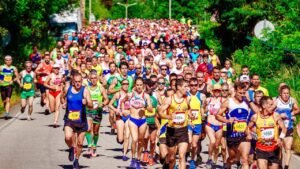
Crowded racing conditions are beyond our control, so suck it up and move forward (Photo: Pexels)
Just like Lachemann preached, we should only worry about the aspects of our running that we can have under our grasp. Other than that, we adjust to the realities that face us on the asphalt or the trail as soon as possible and then move forward. The obstacles are not going away regardless of how frustrating they may be, regardless of how much you bitch about them, so move on.
When it is time to run, workout or race, being cold, hot, humid, raining, too many people in the gym or the Garmin is not hitting the satellites, are irrelevant. No one expects you to run in the middle of an electric storm or run by a pack of stray dogs just because you carry mace. But you can always hit the treadmill if you have access to one, regardless of how boring it may be. You can run with a bottle of water if it is too hot and/or humid. You can dress up in layers for the chilly weather. You can run by feel if you forgot your watch. You can change your route if something doesn’t feel right. You get the point.
Also beyond our control are racing conditions. A bottleneck in the first curve, having to weave around slower runners, headwinds, inconsiderate people walking five side-by-side when they should have started at the back, people who abruptly stop at a water station, etc. Unless you always run in the front, you must have experienced most of these circumstances.
An uncharged running watch is not a valid excuse for skipping a workout
There are also issues that should have been under our control that just pop up unexpectedly. I’m referring to shoelaces getting undone, dropping off your phone, not carrying enough gels or chafing, just to name few. When these things occur, is there a solution? Yes, there is: Own your mistake. Do what you must do, get over the obstacle and keep moving forward. Don’t let it ruin your race. No amount of kicking and screaming will fix it. So suck it up!
Instead, concentrate on the aspects of your training and racing that are 100 percent under your domain. Those for which you can’t make excuses. Those where, if something happens, it is all on you. I am referring to, among others:
– Following your training plan
– Following your racing strategy
– Sticking to your fueling and hydration plan
– Dressing appropriately for the weather
– Inspecting your running gear to avoid forgetting something or malfunctions
– Making sure your shoes are tied up properly
– Charging your running watch
– Developing a personal mantra that will keep you strong during the inevitable challenging times
– Preparing mentally for the workout or race you are about to undergo
– Choosing a training course or race that suits what you are trying to accomplish
– Hydrating and fueling properly before your run/race to ensure optimal results
Of course, this is not a comprehensive list of items that are under your control, just a handful of them to enlighten you on how much actually is in your hands when you set up for a training session or you stand on a starting line.
So let’s be diligent on what we can control and let’s make sure we can endure what we can’t, and then move forward.
As the fall racing season gets into full swing, the Marathon Majors are ready to finally return (sans Tokyo) and runners are excited to stand at starting lines, again, many of us are ready to reward ourselves with a race beyond the boundaries of our immediate area. Exploring the great cities of the world; or celebrating for a few days, sipping margaritas at the beach; or discovering the less traveled paths in lesser-known parts of the world, is always a bonus for our efforts.
But traveling to a race, especially if it is your goal race, doesn’t come without its challenges. It requires planning and additional preparation. If something doesn’t go according to plan, and it will, the chances of fixing it on-the-fly diminish considerably.
Always carry your race-day gear in your carry-on. You don’t want a lost luggage derailing your race (Photo: Pexels.com)
So, if you are setting out to a running/travel adventure, these are a few tips that will help you perform the best at your race while getting the most out of your trip:
1. Do not check your running gear: If traveling by plane, whatever you are wearing on race day, goes in your carry-on. The last thing you need is lost luggage derailing your race plans. You don’t want to run with brand new shoes purchased at the expo or borrowed short.
2. Run first, be a tourist later: Take care of the running portion of your trip, first. Don’t arrive too much in advance before the race. Save the tourist plans for after the race. This way you will be well rested at the starting line, and ready to enjoy as much alcohol and unhealthy food as you want.
3. Plan your pre-race meals: Never take your food intake for granted. Make sure that what you need eat it is available nearby. It happened to me once, that after identifying the restaurant I wanted in Philadelphia, I went pre-race night, and I needed a reservation. If you are staying at a relative’s house, make sure you let them know exactly what you need to eat and at what time.
4.Know how you are getting to the starting line: Do not improvise. Plan for the wort-case scenario. If you are taking a cab, know the phone number and confirm they provide service at the time you need it. Have a B plan in case there are no Ubers available. If you are taking public transportation, have the tickets purchased in advance. If a relative is driving you, be aware of any road closures due to the race
5. Make sure family and companions understand why you are there: If you are traveling with family or friends, make sure they understand that the first few days is all about you and your race. You are the protagonist. Everything else can wait until you cross the finish line. Remind them you wouldn’t be in Berlin, or Buenos Aires or New York if it weren’t for the marathon.
Preparing for time-zone changes is one of the biggest challenges for out-of-town races (Photo: Pexels.com)
6. Prepare to adjust for time changes: Never underestimate jet lag and time zone difference. They can screw your sleep and derail your race. Find out in advance how to adjust to the time zone in which you will be competing. Research what are the best ways to adjust to the number of time zones you need to adjust. There are plenty of online resource for this.
7. Pack for any weather: Remember you are not home, so you can’t just go back to your closet to pick up something. Be prepared for any weather changes and don’t rely 100% on your phone weather app. It is always better to bring back something unused than to need that pair of gloves you left at home.
8. Don’t do anything you wouldn’t do at home: Pre-race is not the time to be adventurous. Trying new, exotic foods; white water rafting, Segway tours, or running a beautiful trail when all you know is the asphalt. Those are recipes to guarantee a bad race. Hold all thar for after the finish line.
Any other recommendations from your experience travelling to races?
I visited The Netherlands for my birthday, a few years ago, and of course I looked for a race. I was going to be in The Hague, and God smiled at me with the Den Haag Marathon on the exact same weekend I planned to arrive. I ran the half. It was an unbelievable experience. The most beautiful course in one of the prettiest and quaintest cities I’ve ever visited.
But one of the memories that has endured from my experience in the Den Haag race is kind of weird. The urinals at the starting area, which was in a public park. Yes, urinals. And not just at the starting line but also in many public places around town and as permanent structures throughout several cities in The Netherlands.
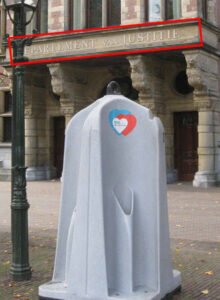
Public urinal in front of the Department of Justice in Den Haag, The Netherlands.
While waiting for the gun to go off at Den Haag, I saw these weird rigid plastic structures. They were on top of a square shaped base, maybe 4 feet to a side, about 7 feet tall, each side bisected with a wall, which created four “cubicles”. Each space had a “V” shaped opening at about 3 feet high at the innermost corner. They looked like… No!!… It can’t be!!!… But they were! They were urinals and weirdest of all, men were actually urinating in them, leaving the port-a-potty facilities for those males with “bigger needs” and women.
As you may imagine, I did not take pictures of people using these artifacts, but I did take a picture of an exact one, at a later date, this one in a square surrounded by restaurants, bars and located right in front of the Department of Justice (See accompanying image). It was there 24/7 for people (men) visiting their favorite watering holes to “take care of business” without resorting to the unsanitary and illegal option of going against the walls, cars, trees or bushes. Very pragmatic, like most Dutch solutions.
I know this may be a weird topic for this forum, but I assume we are all adults and we can discuss the issue with some degree of maturity. And, since every runner has at least a handful of port-a-potty horror stories during their racing career, I wanted to make the case in favor of the use of urinals for races in the United States.
THE MATH
Let’s set up a case study with a mid-size race of 3000 runners. Let’s assume a 50-50 split on the binary genders (1500 each). And let’s assume for this example the race director calculated a port-a-potty for each 75 participants, for a total of 40. If 75% of people use the facilities pre-race (2,250) and let’s say one third of them (563) are in line at any given time before the gun goes off, this means an average line of 19 people per door. Assuming an average time of 3 minutes per use, the average waiting time is 57 minutes per user. We’ve all been there and if not, we haven’t raced enough.
Now, let’s say this same race director decides to be pragmatic and exchange just five traditional port-a-potties with 4-corner urinals placed at an appropriate location in the starting area. For this example let’s say 75% of the male users (844) are using the facilities only for urination. Then, the overall population of runners using the port-a-potties has been reduced from 2,250 to 1,406, which at 35 doors and the exact parameters of usage as before, the average runner will be waiting in line for 40 minutes. Does it sound like still a long wait? I’ll take it. It is 30% shorter. It is a start.
THE SOLUTION
There is a solution to this problem. Do we have the maturity to solve it?
I don’t assume to be speaking for all male runners, but I believe I am for a vast majority. Let’s face it, most of us at some point have found a tree, a bush or a wall to relieve ourselves while waiting at the starting area of a race. And while there, very likely have witnessed females crouching with their shorts half down doing the same and for the same reason as us. And let’s come clear here, there is nothing sexy or sexual about adults exposing themselves to take care of business before a race. I haven’t experienced the first sexual frenzy in such situation. So let’s grow up and find a solution. There is one and it has been in use in Europe for years.
A difference between the Dutch and the Americans is that the former are extremely pragmatic in the solutions to their public issues while the latter are still embarrassedly prudish with anything related to sexual organs, even if they are being used for purposes other than procreation or related fun-driven activities. While the municipality of Amsterdam installed urinals around the bar areas once they figured out a substantial percentage of drowned men in the canals were found drunk and with their fly open, in the USA we would face a “Today Show exclusive investigation on the immorality of urinals in foot races”, reported by non-runners, despite the fact that it will ameliorate a big problem within this industry.
The use of port-a-potties is as part of a race as complaining of nagging injuries with your friends. None of them are going away anytime soon. There is a solution out there. Can we grow up and use it? Or are we to prudish to implement it?