As 2024 approaches (or it is already here depending on when you are reading this post) and we look forward to a blank canvas to fill out with new goals, challenges, and adventures, we quickly turn our heads back to the year that was, to reminisce and reflect on our running year.
We saw marathon world records fall to the point where it seems feasible that 2024 will give us the first sub-2 marathon for men and first sub-2:10 for women. We are just 36 and 114 seconds away from such feats. We saw the 6-star finisher list growing to 8,143 and it is a matter of time before a 7th Major is included. Many of our friends set PRs in their marathons, shorter distances or just lost their 26.2 virginities. But, for many of us, 2023 was a challenging year. One that tested our core as runner beings. I was in that latter group.
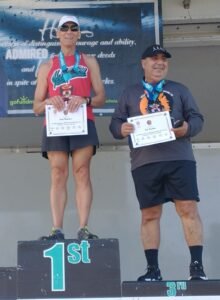
Winning my Age Group at the Plantation F*ck Cancer 5K was one of the few highlight of my 2023 running season.
I completed the 1000-mile challenge with just three days to spare. And sure, it is a nice achievement, but it doesn’t tell the whole story of my 2023. At least I did not get any injury and beyond the normal aches and pains, was able to run throughout the year with no interruption. That alone is a win. Still, it was far from what I expected it to be 12 months ago.
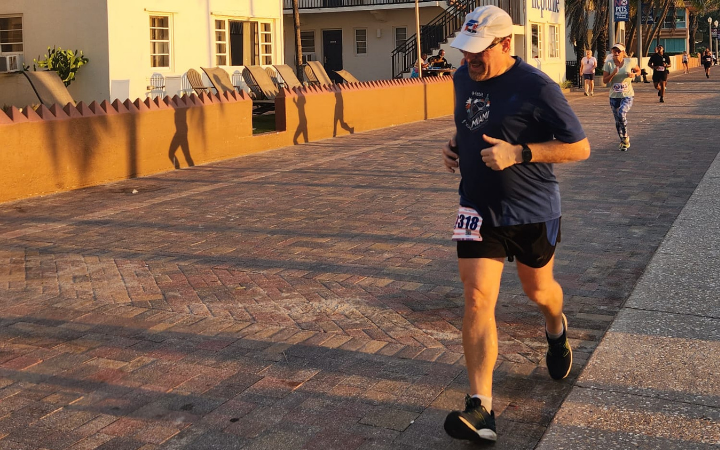
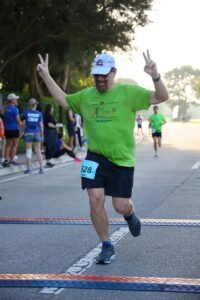
For some reason, it was very difficult to get into the running groove during the year. In my two half marathons early in the season, I was forced to walk after mile 10, finishing in unimpressive times that are embarrassing for me, when compared to what I have done in the recent past. I also had to withdraw from the Marine Corps Marathon because my body could not adjust to the heat and humidity of summer training in South Florida. It was impossible for me to complete more than 8 miles in one run, so I focused on 5 and 10K races until the end of the year. Those are not my favorite distances, as I prefer to go longer, but this was the adjustment that was required, and I am OK with it. I even won my age group in a local 5K, a rare occurrence.
For the first time in the last 15 years if felt little motivation to lace up and run. For the first time in recent memory, I dreaded waking up early on a weekend to go run long. Anxiety from my professional life, which was at an all-time high during the year, crept into my running life and affected me negatively. I gained weight, slowed down and lost the will to dig deep when a run got tough.
My lowest point was one day around September when for the first time ever, or at least that I can recall, I went out for a run and before the first minute was through, I decided I did not want to do this, so I stopped and drove home. Not before stopping at a gas station and stuffing up on cookies and chips. I still look back and can’t believe this happened.
Yet, I kept running. After more than 40 years of being active, I know how you will feel after a good run. The support of my two running groups kept me accountable and sometimes I just forced myself to go out despite not feeling it.
I completed a handful of races with not many results to brag about.
I have tried to pinpoint where the problem lies but I haven’t been able to do so. Maybe it is because I am approaching 60. Maybe two and a half years after my open-heart surgery I must accept I won’t be able to run the same as before. Maybe the anxiety my work life has put me through for the last 18 months is taking a toll on me. Maybe my peak running years are behind me. Maybe it is a combination of everything.
But this difficult year has been an opportunity to analyze life from a different perspective and realize I am still very blessed. My running life is not my life, it is just part of it. My value as a husband, as a father, as a friend, as a son, as a coach or as a professional, is not tied to my marathon PR or my medal rack display at home. I still have a healthy marriage with a wife I adore, a healthy and successful son, both my parents are alive in their eighties and living independently, I have a thriving coaching business, I am part of a phenomenal running community with true friends, and I am injury free. At this stage in my life this is more valuable than running sub-2 in the half once again, or setting up another PR. I call this maturity.
This does not mean I have given up on improvement. I still want to go over 1000 miles in 2024. I still want to run at least 4 or 5 halves and be part of one marathon cycle. I want to get rid of the source of anxiety and lose the extra pounds I added in 2023. I thank God that He is providing me with 12 brand-new, crisp, months to achieve it all.
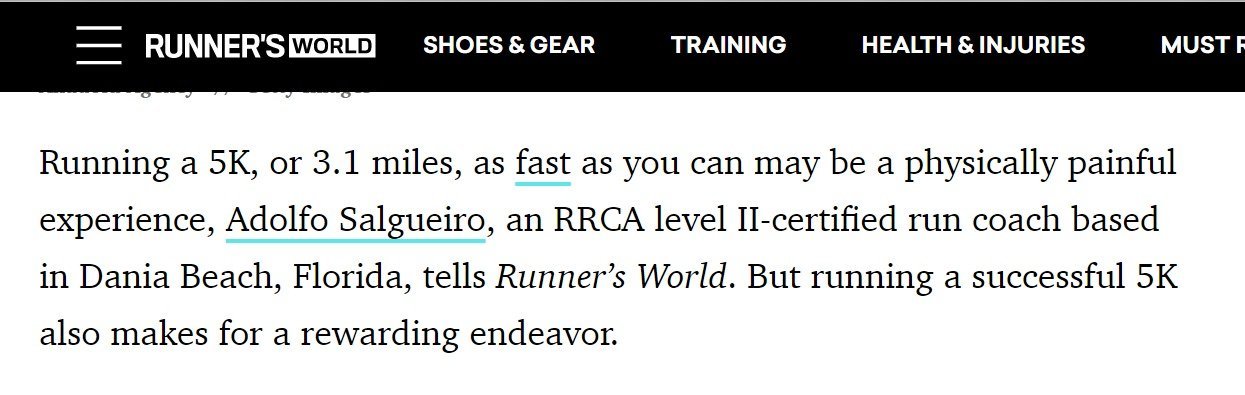
Runner’s World Magazine, the reference media outlet for the running community for over 50 years, ran an article on April 27, titled “How to Pace a 5K So You Can Hit Your PR”. It was written by Stephen Sheehan. The expert quoted throughout the narrative was Coach Adolfo Salgueiro, head coach at Foultips.Run.
“I have been a Runner’s World reader since the early 1980s,” Stated Coach Salgueiro. “Being able to contribute to one of their articles is a dream come true. The fact they wanted my expertise on the subject is a statement to the value of the decades of experience and preparation I’ve put into this passion of mine.”
This is the second time Coach Adolfo has been in Runner’s World. A summary on his running career ran back in March 2021.
To read the full Runner’s World article you may click here.
Be aware that Runner’s World has a limit on the number of free articles non-members can read a month. If you have exceeded such a number, you may have to come back next month to read it. Or contact me and I will send you a PDF version.
As the 2022-23 racing season move towards its end, with just a handful of goal competitions left in the calendar, the time to start planning for the 2023-24 season rapidly approaches. The running season usually goes from November-March, with adjustments depending on your latitude and location. This is time to reflect on what happened, what did not happen and why did or did not happen.
The first question that comes to mind after this intro is: Do runners really need time off?
Rediscover the pleasures of sleeping in on a weekend morning instead of going for a long run (Photo Pexels)
It has been discussed for decades, but based on my years of experience, my answer on the matter is a blunt and unequivocal YES!!!. In all caps and with three exclamation points.
Regardless of your age, level of fitness and commitment to the sport, your body cannot keep its peak level of fitness forever. There is such a thing as an upper limit which cannot be surpassed regardless of how much you run, lift or cross train. So, it is imperative that you provide your body with enough time to rest and relax. This will inevitably decrease your fitness, sure, but you must see it as an investment, a process to go through to continue your path of long-term progress.
The key concept is that once you have recovered and you are ready to restart, given that you haven’t overdone the junk food, alcohol and time off, you will be doing so at a higher level of fitness than where you started last season. This may allow you to achieve an even higher level for the upcoming season.
I will define the off-season as the period between your last race of one season and the first race of the following one. Within that period, I have identified four phases to devote individual attention so you can prepare properly for success.
1 – Rest and recovery – This doesn’t mean you stop all sports activities until next race. Some runners may need a week to a month off just to reset the body and have fun catching up on the pleasures of life that they’ve deprived themselves of during hard training, such as pizza, beer, binging on TV until late or sleeping in. Other runners will want to drastically cut their mileage, or their running days so their bodies can recover and prepare for what is coming up. You must enjoy the process and running’s gotta be fun. Otherwise, a burn out may be on its way and you will no longer run.
2 – Planning – This phase may overlap the previous one, or even with the previous racing season. The time has come to figure out what are your goals for next season. I am a firm believer that having multiple races in your schedule is what will allow you to remain focused so you don’t slack off until you realize the race you were shooting for is around the corner, or it is sold out. You don’t want to plan every workout for the next 6-8 months, but you just need to know when you need to be ready and for what goal.
This is the time to enjoy the pizza and the beer, but obviously, don’t overdo it (Photo Pexels)
3 – Build up – After your recovery time is taken care of, it is time to rebuild your endurance and your speed. This takes time, method and requires patience. Accept you will not start at the same point where you left off. The silver lining is that you will be able to get back there sooner and safer the longer you have been running. Getting back to 50-mile weeks is a quicker process for someone who has been doing it for 10 years than for a runner who just did it last year for the very first time. Put you plan on paper. Block and label the weeks and/months you will need to go through this process. Then, execute.
4 – Training – Everything you did between your last race of the season and the start of this phase is what will determine the success of your next season. A 16-week training plan, especially for a marathon, doesn’t mean you’ll start running again 16 weeks prior to race day. It means that 16 weeks before race day you must be ready to hit the ground running. By then, your aerobic capacity, your core, your strength program and your speed training should be a work in progress. So, in these 16 weeks you just dial in the variables to achieve your goal at the set date.
Other components such as nutrition, sleep, hydration and recovery are year around elements than need to be addressed continuously and are part of all four phases.
If you take the time to plan ahead, even small injuries, periods of sickness, vacation or any other unexpected surprises life will inevitably throw at you, may be fit into the off-season. Prepare yourself with plenty of time and enjoy reaping the benefits of a well-executed plan.
We all run for different reasons, including losing weight, improving our health, making new friends, or competition. I run for all these reasons. As a senior runner (68 years old), one of my motivators is a hope to delay the onset of dementia which is common in my father’s side of my family. I also enjoy the excitement and competition of races.
As we get older, we inevitably slow down. When I do training runs with my old high school buddies up north, we mostly jog. They’ve had more health issues than I have, and although they are still mobile, they don’t have much speed left. For most “serious runners”, getting faster means running and competing with faster people. One of the reasons I enjoy running with younger people when I’m in Florida is that they motivate me to run faster.
John in one of his 27 podium finishes (Photo courtesy of John Mounteer)
Winter in South Florida is a runner paradise, especially compared to the cold, snow and ice in upstate NY where we live in the summers. The humidity is a factor to deal with, but it beats frostbite. The number of fall and winter races here, is extraordinary. Every weekend we have a choice of multiple races at all distances within an hour’s drive. We can choose from very competitive, fast, large races with thousands of participants and thousands of dollars in prize money for the top finishers, to a local Fun Run and Walk. There are benefits to both types of events.
Large competitive races have the benefit of letting you know how you measure up against other serious runners your age. This can have two effects: motivation to train harder or despair that you’ll never get a spot on the podium. You may have to face the fact that you are a small fish in a big sea. I am a small fish. I was never fast. Even in my high school. cross country team, where the first 5 runners count, I was lucky to place 4th or 5th, way behind the fast guys. My “age percentage” (my finish time compared to other runners of my age and sex) is around 60-66%. That means that at least a third of runners my age, are faster than me, and some are much faster.
In comparison, smaller races allow you to be a big fish in a small sea. Some small races still give medals in each five-year age group, although ten-year groups have become more common. The competition does thin out as you move up the age groups. I’ve run in races where almost everyone who showed up and ran was a winner! It feels good to get a place medal even knowing that you’re not the fastest runner in the area, but you were the fastest in that race that day.
You must do some searching to find the local, smaller races. Since we moved to Florida, I’ve run in dozens of small races, so I’m a lot of email lists and get notices for many of them. So can you by searching your local listings online.
John and Coach Adolfo after the 2022 Tamarac Turkey Trot, in Tamarac, Florida
I’ve been running mostly 5k and some 10k races in Florida for about 10 years, and in that time, by cherry picking small races I’ve gotten 27 age group awards – ten 1st place, nine 2nd place, and eight 3rd places. And, in really small races I have a 2nd and a 3rd overall. That’s crazy fun!
I’ve had great luck by searching for a couple of key phrases, “1st Annual” and “fun run”. Another thing to consider is what other competitive races are occurring on the same weekend. It’s likely that the fast runners will be there and won’t rain on your parade.
Some might think that “cherry picking” races is a form of cheating, and maybe it is, but winning medals helps motivate me to keep training. My method also works better in the younger and older age groups where there is less competition to begin with. I don’t recommend that anyone does just easy races. I find that it still important to do the competitive races so that I don’t become complacent, but the feeling of standing on the podium is addicting.
Final words: Pay attention to your body and don’t overdo it while you’re young. I’ve had some injuries, but not as many or as bad as some of my contemporaries who ignored pain and did permanent damage. The secret to being competitive in older age group running is just to make it to next age group. Thanks to all my South Florida running family for keeping me going!
*John Mounteer is a runner who splits time between Upper State New York and Broward County, South Florida. While in Florida, he runs with Hollywood Run Club, Runner’s Depot Run Club and No-Club Runners. He is also a good friend.
A few weeks ago, I participated in a local half marathon. I didn’t feel in the shape I would have wanted, so I decided to join one of the pacers. I found the sign with my desired time (2:15) and introduced myself to a lovely lady named Veronica. And off we went running.
Around mile 5 or so, one of the runners in the group asked something that blew my mind: “When are you taking the walk breaks? Or are you running straight?” I couldn’t believe it! The time to figure that out is not on mile 5 of a race. And thus, this blogpost was born.
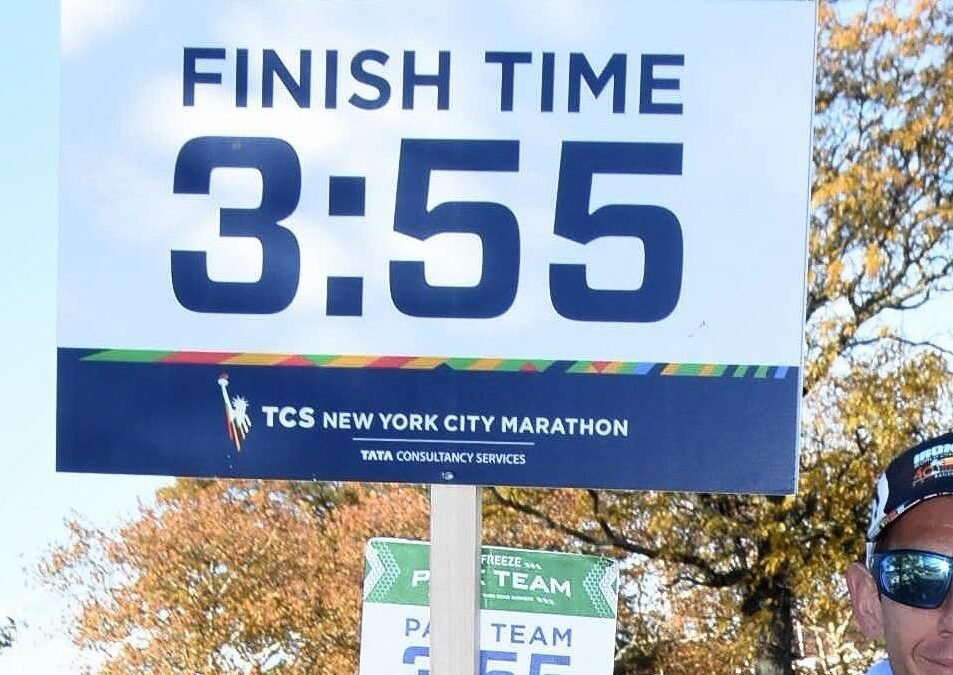
Most halves and marathons have pacing teams. Take advantage of their presence and let them help you achieve your goal.
Pacers have become a ubiquitous part of races. Eliud Kipchoge and his fellow elites use them to set them up for world record pushes. Elite women pushing their limits use male pacers that lead them while doing part of the groundwork. Even Roger Bannister used pacers in 1954 when he became the first human to go sub-4 in the mile.
Regardless of your point of view on pacers, they are here to stay. So, take advantage of them if you can. But running with a pacer requires certain understanding and ground rules. Here are some that I’ve come with:
1 – Let the pacer do the work for you: The pacer is there to set the pace, hence the name. If you are planning to run a sub-2 half, don’t run ahead and spend energy worrying if the pacer is catching up to you. It takes more energy to lead than to follow, so take advantage of the pacer and follow. Run with the pacing group and when you are ready, leave them behind and accomplish and your goal
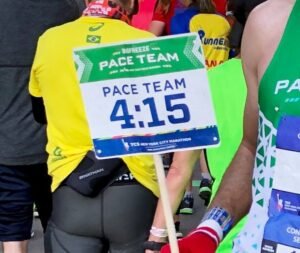
2 – Know your pacer’s plan, ahead of time: Pacers are easy to spot with their signs and/or balloons. In major city races they usually have a booth at the expo so you can meet them and discuss if their strategy suits yours. Some marathons have multiple pacers with different strategies for the same time. At smaller races, they can easily be identified by their signs. Don’t wait until the National Anthem or the starting gun to figure out if the plan fits yours or not. Or mile 5.
3 – Pacers are humans: If you join a pacer, you must understand that regardless of their qualifications to be there, they are human beings. If you join in the 3:30 pacer in a marathon, you can’t expect to be his/her sole responsibility to get you to 3:30 on the dot. They may get dehydrated, need to go to the bathroom, had a bad night or whatever issues that may affect them just as it could happen to you. So, understand they are an aid, not a guarantee.
4 – Be prepared to drop your pacer if needed: Pacers are runners that compete way faster than what they are pacing. This ensures that in normal circumstances they won’t burn out. If you are running with a 4:30 pacer on a marathon, that runner should easily go sub-4. Therefore, it is your responsibility to make sure you are on your pace and be ready to drop the pacer off if they are going too fast or too slow. Do not let them burn you out, and I learned that one the hard way.
Find the sign that works for you and let its carrier do work for you.
5 – Don’t tell the pacer what to do: Pacers have a race plan that you should have discussed before you joined the group. If you feel they are going too fast, bring it up. If you feel they are going too slow, ask why, so you can decide what to do. This is different from demanding they pick up their pace or telling them how to perform their duty. They are there providing a frees service, which you are free not to use.
6 – Make new running friends: There’s usually a nice crowd around the pacers. Runners from all over the place that have similar goals as you. Take the opportunity to meet new friends and make the run more pleasant. If you prefer to keep to yourself, it is your prerogative, just know what to expect and accept you will be part of a social group during the race. It may be the price to pay for being paced.
7 – Thank your pacer: Even if you finish ahead or behind the pacer, if he/she provided a service, you benefited from it and it was free, a thank you is always the right thing to do. You can do so once you decide to go ahead of them or if you see them after the race.
Any other tips on racing with a pacer? Let me know in the comment box, below.