A couple of weeks ago, I was running a local 10K, and approaching Mile 3, I noticed a runner ahead of me, maybe in his early 40s. He caught my eye because of his weird running form. As I got closer, I saw that his left shoelace was undone. So, as I reached him, I did what a normal runner would do: “Hey, your shoelaces are undone”.
This shouldn’t happen. Ever! (Image by ChatGPT)
As I passed him, he replied with some level of exasperation: “Yeah, I know! That’s why I am opening my leg to the left, so I don’t trip.” I shrugged my shoulders and kept running my race. My job was done. The guy thanked me, and that was that. I guess he must not have kissed the ground, since I didn’t see or hear any emergency vehicles on the road.
There are so many wrong things with the scene. I completed the race in a tad over one hour, so it is not like this runner was going for any earth-shattering world records. And even if he was going for a PR, this was not helping. How could someone decide the risk of tripping and falling on the asphalt with 2000 runners behind was not worth 30 seconds of your finishing time? How much saved time is worth getting injured, as you decided to change your mechanics to adjust your unlaced shoe?
I was wondering what kind of runner does not perform the most basic checks on their equipment before a race. And thus, here you are reading a blog post on the subject.
The scope of this post is not to teach you how to tie your shoes properly. There are too many ways to get into the top 10 here. And by now you should know how to tie your shoes.
Unless you have the finish line in plain sight, the right way to approach this situation is to step to the side, stop, redo shoelaces properly, both shoes, and then resume activity.
At the bare minimum, you should verify you have tied a double knot. And if the remaining lace is too long and is jumping all over the place, which will eventually make it looser, take the extra string and place it between the shoe’s tongue and laces. That will keep it secure for the duration of your run.
For every single run, not just a race, it is your responsibility to perform a basic check on all your equipment. How about these situations:
► Imagine a shortstop with broken leather straps in his glove’s pocket when he is fielding a line drive and the winning run is on third base.
► Imagine a referee at a soccer game checking the overtime in a championship match to find the watch has run out of battery.
► Imagine a swimmer in the middle of a 400 combined with her swimming goggles hanging from her neck.
► Imagine yourself in your goal race, pushing for a PR, and your shoelaces are undone.
30 extra seconds will pay off in the long run (Photo: Tirachard Kumtano, Pexels)
And as we talk about shoelaces, understand that this is a generic reference to all your running equipment. All of it.
► The time to realize your shorts’ elastic band won’t hold is not when you are 5 miles away from your car.
► The time to realize you don’t have enough safety pins to attach your bib for tomorrow’s race is not right before you go to bed.
► The time to figure out the sole of your shoe is separating is not when you still have 10 miles to go in your marathon.
► The time to figure out that gel is expired is not when it is in your mouth just when you are counting on those extra calories.
► The time to discover your headlamp has run out of battery is not in the middle of your night run.
We must own it. It is our responsibility to ensure that all our equipment is in good condition to perform the task at hand. And if it is not, assume that the only one to blame is yourself. Learn from it and make sure it never happens again.
Any stories you would like to share about basic equipment failures? Please do so in the comment box below.
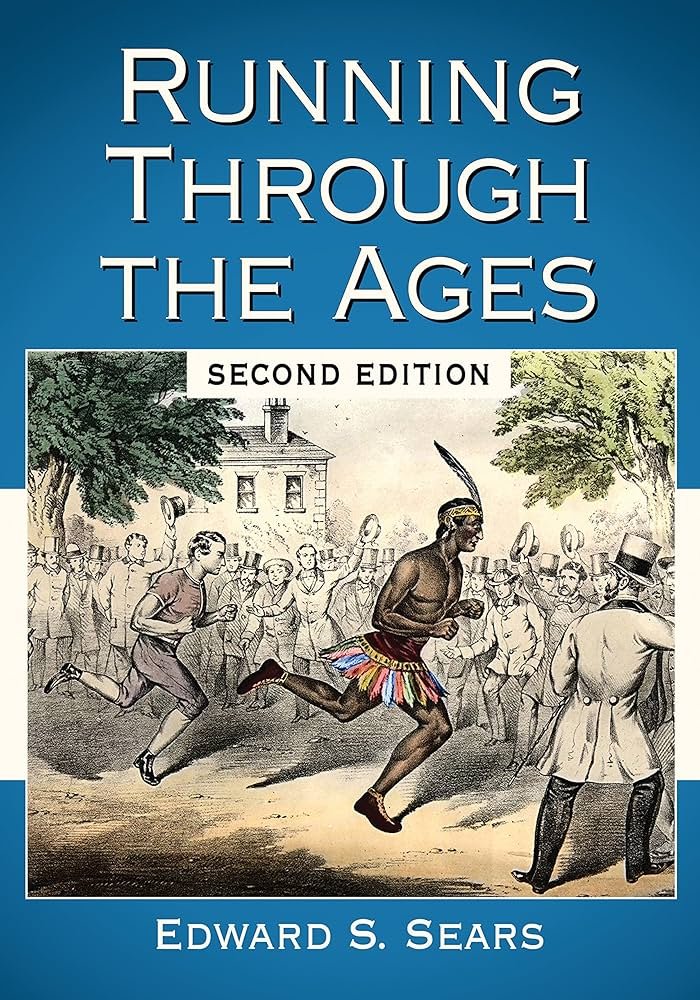
Running Through the Ages surprisingly delivers exactly on its title. It is a history of running since we became humans and had to, as the author states in the first four words of the text: “Eat or be eaten”.
Running has been in our DNA since forever
Between the earliest versions of prehumans, between 7,000,000 and 50,000 BC, our tools of the trade were our legs. The author starts by explaining how, as humans, we are very slow runners and no match for most other species. Yet, we could hunt them and rely on them for subsistence because of our ability to run longer.
Our evolution has gifted us with a cooling system, which he describes as the best on the planet. It has also provided us with the Achilles tendon, which returns about 90% of the work put into stretching it, with the rest provided by the foot arch, another spring.
From there, he continues the journey through the ancient world: Egypt, Ur, the Old Testament, Greek mythology, the Olympic Games, and literature. It is fascinating to see how each culture used running to speed up their development and how running competitions became a staple of each culture.
From there, the journey takes us through the Middle Ages and up to the 19th Century when pedestrianism became the rage.
I enjoyed this part of the book because it was about the history and evolution of running as a sport, about winning races and setting records. At first, there were no time devices to allow records of who was the fastest at a certain distance or how much of it could be covered in a certain segment of time.
Once timing became readily available, all changed dramatically. Chronographs were able to split the second into fifths, which was good for certain distances but insufficient for shorter sprints. The evolution of timing, not just the watch technology but the mechanics of automatization, is fascinating.
As more newspapers started chronicling the sport, records became available and we start learning about the first stars. We see the first local sports heroes looking for greener pastures by running in other countries, taking the first steps into the globalization of the sport and the differentiation between professionals and amateurs.
As we enter the 20th Century, when reliable records and accurate times were kept and athletic achievements easily verified, the book becomes dense with names and figures. It goes into detail on each distance, both for men and women. Not that it is unimportant, but for readers who may be familiar with running in this period, it became too much while adding too little new information.
The 2nd Edition includes an update on 21st-century running
The book was initially published in 2001, with its 2nd edition published in 2015. The 2nd edition has a new chapter on the 21st Century, and it goes deep into doping and cheating, which is a new reality in the sport and worth reading.
The conclusion of the book is about the upcoming world of marathoning (this was written before Eliud Kipcohge’s sub-2 attempt and Kelvin Kiptum’s current world record).
“The men’s marathon record is approaching two hours. Will two hours turn out to be another “barrier” like the four-minute mile? A sub-two-hour marathon requires averaging 4 min 35 sec[onds] per mile, a much tougher challenge than the four-minute mile was in 1954 […] Road races are open to all and the ordinary runner can compete with themselves or against the best in the world. It is a democratic sport. It is also inexpensive compared to other sports. Most sports require specialized, expensive equipment and facilities. All a road runner needs are running shoes and an open road.”
If you want to learn about the evolution of running as we evolved as a species, this book is worth the time and the money. Sure, it gets dense at the end, but that doesn’t mean it is useless information. And you can always skip it if it is not relevant to you.
I welcome your comments about your thoughts on this book in the box below.
When I started running over four decades ago, there was very little literature on the sport. A new book here or there, mostly from runners sharing their own experience; or a subscription to Runner’s World or The Runner magazine, was it for sources of knowledge and inspiration?
Well into the second running boom, with the internet in play and billions of Dollars to be made, companies started investing in science, research, and development. Colleges and Universities began promoting their exercise physiology departments, and suddenly, we have more information than we can digest.
Many bad habits and myths remain from those prehistoric running days. There are still runners who believe that consuming the 7th serving of pasta the night before the marathon will give them an edge. We still have those who prefer collapsing rather than chop a mile from their long run on a mid-summer day.
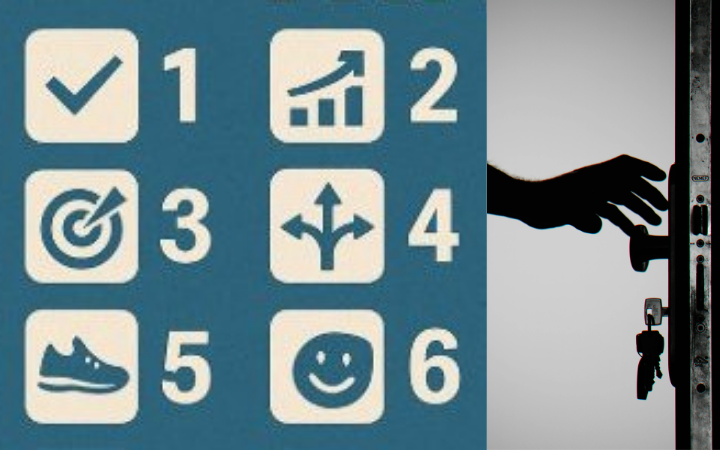
Below you will find six basic strategies to unlock your training, especially now that racing season is almost here.
1 – It is about consistency: Hitting all those splits is awesome, but it is not what’s going to make you better. You hit the splits because you are better. There is no magic workout that will take you over the top. Good and bad workouts are part of the mix, and if you have more good ones than bad ones, you are on the right track. Every time you perform, you get a little bit better. All those little bits eventually fill the bucket. That’s where your PR lies. Not on that PR 400-meter repeat in training. Focus on the long game as you train as often as your body allows. You will see the difference.
2 – Progress smartly: There are no shortcuts in running. Sure, you can run a marathon while untrained, but at what price? Is getting injured through a sufferfest worth a medal? What got you to the marathon will not get you to the 100-miler. What got you to the 5K PR won’t get you to the marathon PR. You must have a plan to get from Point A to Point B and then to Point C. If you plan to keep running for a long time, you must play the long game, and that requires smart progress.
3 – Accept the runner you are and train for it: You are not Eliud Kipchoge, and most likely you won’t be in the leading peloton at the Boston Marathon. Regardless of whether you are a local semi-elite or a back-of-the-pack runner, accept it so you can become the best runner you can be. If you are a 5-hour marathoner, it doesn’t matter how much you train; you will not make it to the Olympics. But you can go sub-5. Focus on what will help you improve your journey, not through the pressure of Instagram make-believe lives. Eliminate external, unnecessary pressures and pursue the big goal that aligns with your reality.
Technology can be great and can be detrimental to your training. It is up to you to use it properly (Photo: Pexels).
4 – Variety is the key: Long-slow running is good. Zone 2 is good. Intervals are good. Cross-training is good. Goal pace runs are good. But you need to mix them up the right way to give your body enough recovery time to adapt to the work. In a recent article I read, Will Lennox wrote in GQ Australia: “Taking a leaf from the Bible and training for 40 days and 40 nights in a row in the hope some biblical-level miracle will happen to you is not going to get you into running heaven.” Rest. Give your body the chance to recover so it can do it again and guarantee your progress.
5 – It is not about gear and technology: While running on the wrong shoe can certainly be detrimental and even harmful to a runner, it is never the shoe that makes you faster. It is all in your preparation. A pair of super-shoes will give you an edge to shave those last few seconds from a 5K, but it’s not what will get you from a 3:30 to a Sub-3 marathoner. The same applies to the GPS watch. Don’t let it rule your life. Turn off all the indicators of parameters you don’t understand and/or distract you. Let them be tools, not the beacon that guides your running.
6 – Don’t forget to have fun: Nothing kills the joy of running more than comparing yourself with friends and influencers. While the reasons for running vary for every athlete, running because you like it makes it easier to stick with it. Rebounding from a bad race or an injury will be easier. Accepting your limits instead of quitting will be a given.
In conclusion, we should simplify our running. This doesn’t mean taking it easy, nor working hard, nor forgoing progress. It means unlocking the running potential you have today, smartly. This is what will keep you running for years to come.
Share your favorite running training strategy in the comments. Which one works best for you?
Back in June, I watched online as Faith Kipyegon unsuccessfully tried becoming the world’s first sub-4 miler woman. The event was one of those multi-million-dollar circus shows put on by Nike to test human physical limitations. It was elaborate enough that, just like Eliud Kipchoge’s Sub-2 in 2019, it would not have counted as a world record should she succeed.
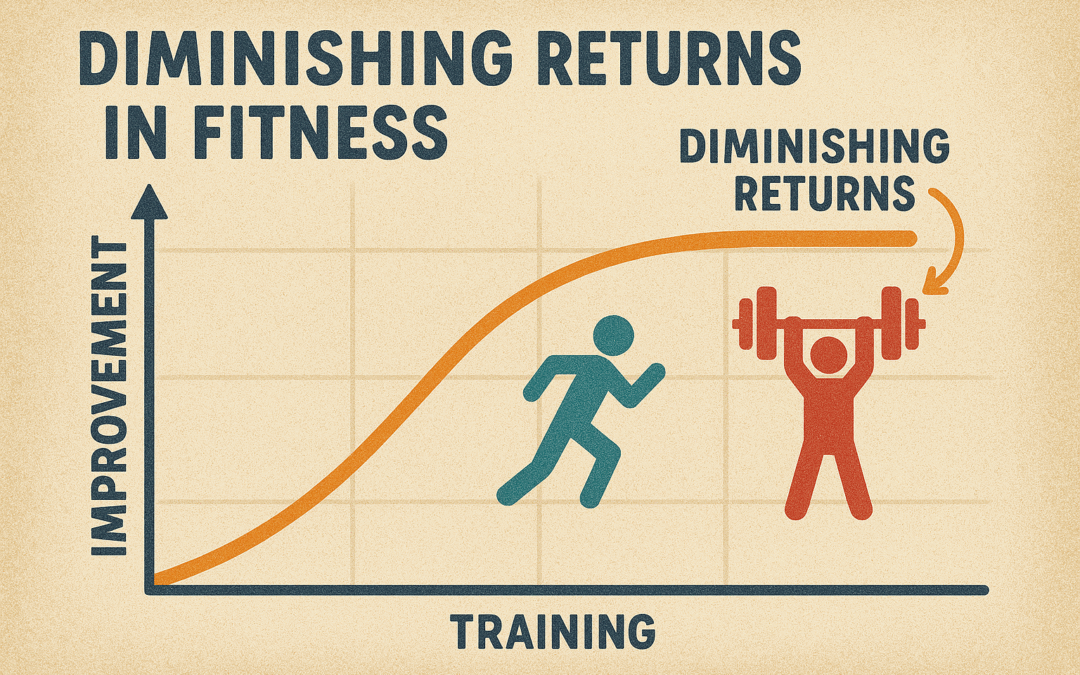
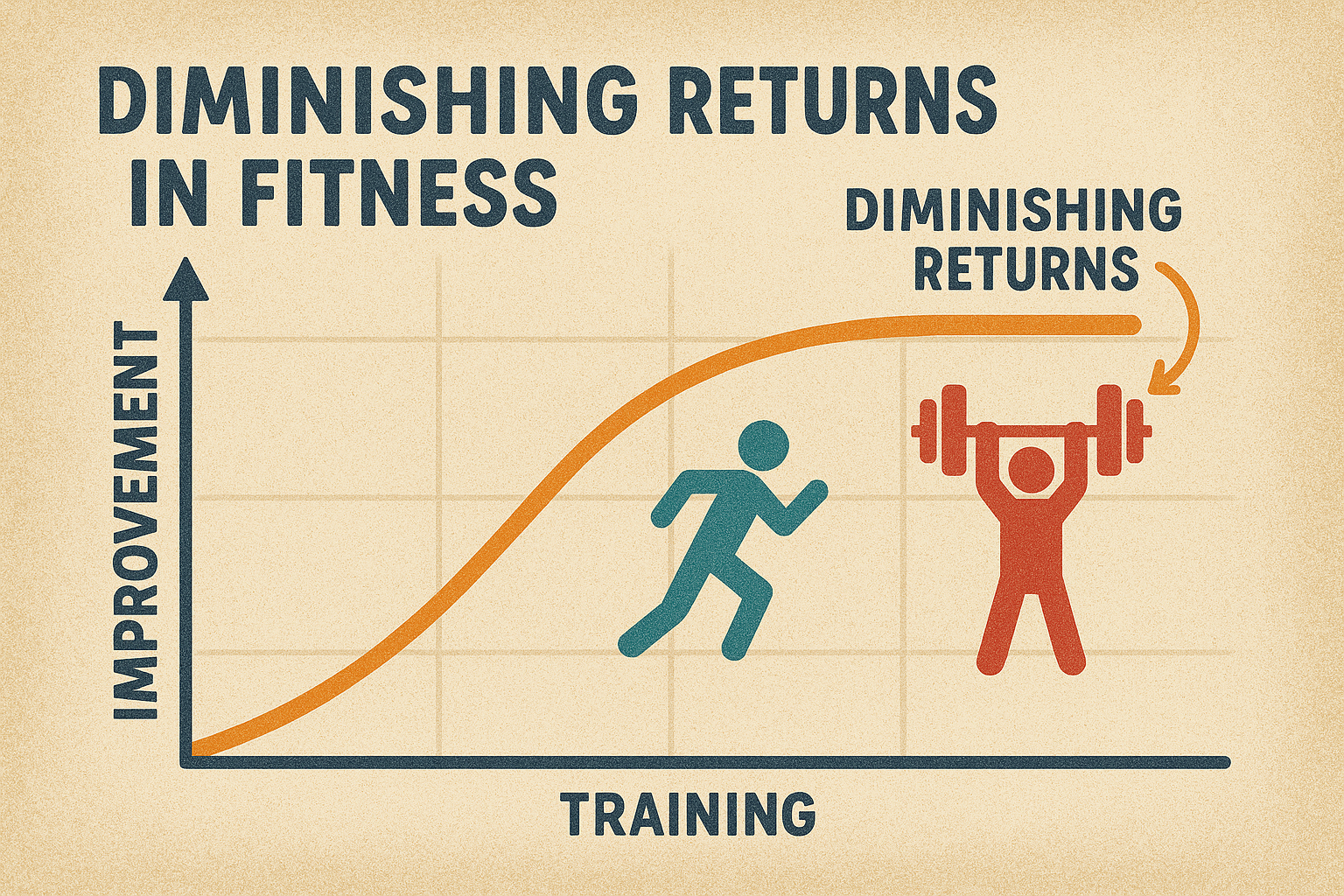
Athletics and the principle of diminishing returns (Image by ChatGPT)
Kipchoge needed to improve his marathon time by 100 seconds, and he did, finishing 19 seconds ahead of his previous record. Kipyegon needed to shave about 8 seconds (7.65) to achieve her goal, but she ended up about 6.5 seconds short. Even with the circus, space technology, support, and male pacing, she couldn’t do it.
The failed attempt got me thinking about a basic concept in economics that easily applies to running: the principle of diminishing returns. In economics, this means that ff you improve one variable while keeping all the others constant, the incremental output gained from each extra unit will eventually fall. In other words, building a skyscraper in one day won’t be solved with more workers.
The same principle applies in athletics. Dr. George Sheehan, one of the greatest running writers, put it this way: “The first mile is the most helpful one as far as conditioning goes. Each succeeding one gives less and less benefit than the one before. Runners who work more and more are working for less and less. […] It doesn’t take much to get 90% fitness, only a few miles a day. But it takes progressively more and more training as you get closer to your ultimate potential. At the highest levels, you are putting in a huge investment for a very small return. It is the small gains what makes the difference between winning and losing.”
Think about it, it’s obvious. If not, it would be a matter of time and more miles before we all became elite athletes and broke world records. We all have a limit, and while reaching it is feasible, it requires a tremendous amount of work.
I recently heard Coach Steve Magness share a story where Shalane Flanagan told him something along the lines of, “The difference between being in 2:30 marathon shape and 2:20 is astronomical.” For you and me, average, mid-to-back-of-the-pack marathoners, a 10-minute improvement may be a diligent training cycle away. For elites in a Marathon Major, this same result guarantees them peeing in a cup to verify cheating.
Nice background, Coach! But how does this apply to me, the average weekend warrior?
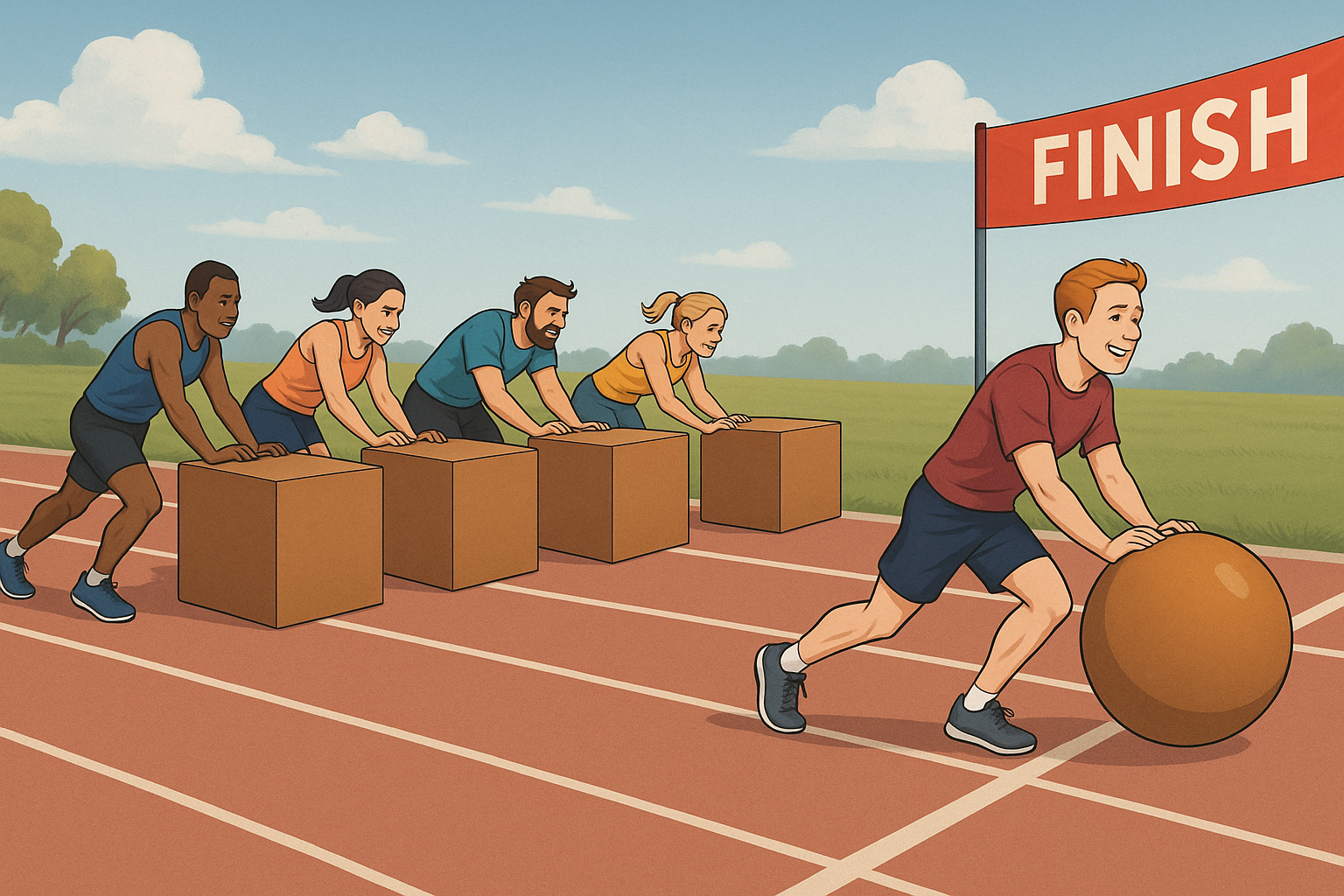
It is about training smarter, not harder (Image by ChatGPT)
I am glad you asked! The point of this introduction is for the reader to understand that the curve of progress in running flattens as we improve. It is a reality we can’t solve with harder training. Progress is not a linear proposition.
And, while achieving the last 10% requires an astronomical effort, it is feasible. It is about figuring out what works for you. Just because Jacob Ingebrigtsen uses the Norwegian double threshold method doesn’t mean it is the solution you’ve been looking for. He is in such shape that this is the only type of training that will extract the extra hundredths of a second needed to break a world record. This training may land you, my dear average-runner reader, on the injury list.
Working around the principle of diminishing returns to reach your apex requires smarter training. Not just harder. As gains slow, finding that sweet spot between effort and recovery is the magic sauce. It may mean varying your workouts, adjusting intensity levels, or prioritizing recovery and nutrition more seriously. As we improve, we must tune into our body’s signals, such as fatigue, soreness, or lack of motivation. These can guide adjustments before you hit a training (or overtraining) wall. If in doubt, a training plan tailored exclusively for you may help you progress without burning out.
In conclusion, In athletics, more is not necessarily better. Most of what elite runners do to squeeze that last sliver of greatness out of their performance does not apply to you. We are all limitless, sure, but not in all areas of our human performance, athletics being one of them. Let’s work hard to reach our goals, but not at the expense of burning out.
What are your thoughts on this principle? I will read and answer your comments.
As long-distance runners, we focus on the long-distance run. Obvious. For marathoners, that 20-miler has been a staple our training for decades. The psychological advantage of having achieved that distance starting with a 2 instead of a 1, when you are about to run 26.2, cannot be overstated.
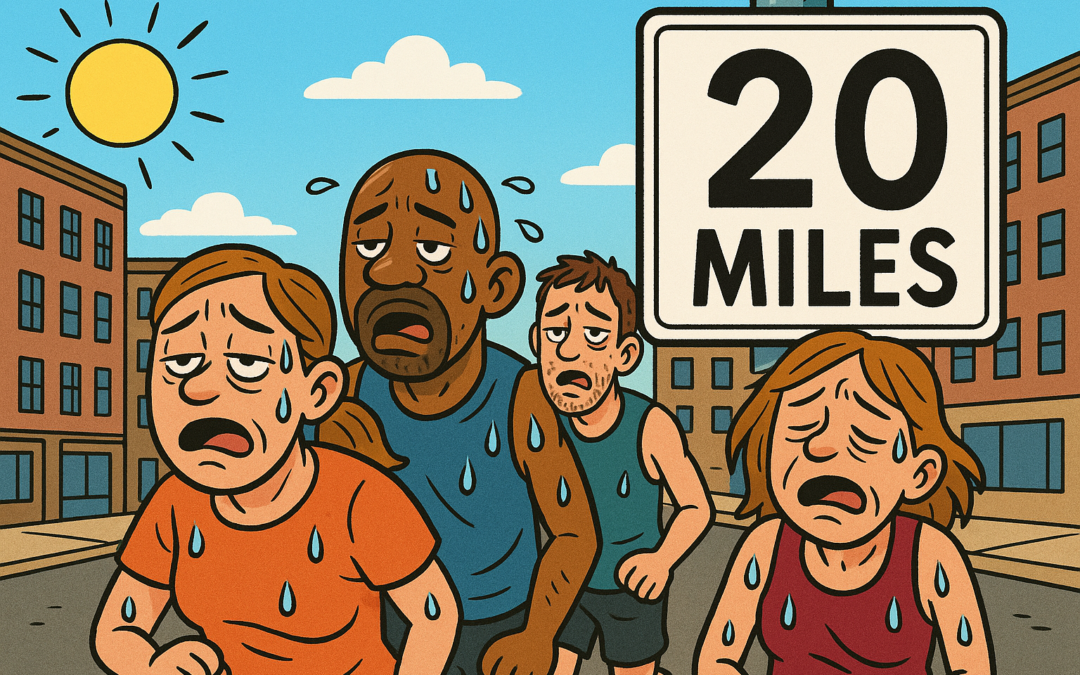
The benefit of that 20-mile run lies in the time it will take you to complete it (Image by ChatGPT)
Yet, there is no magic to be gained at 20 miles. If you train in kilometers, 20 miles is 32.18 Km, far from a round or memorable number. The “magic marker” for those who train in kilometers is 30, for the same psychological reason. This is equivalent to 18.64 miles. Nothing special to that figure either.
But, is there a physiological benefit from running a 20-miler or 30 kilometers, or two or three of them before your marathon? Does it apply to all marathoners? What does science say about this? How does all this apply to you and your training for your next marathon?
Let’s get into it.
While the confidence boost of having a 20 or 22 mile run under your soles is undeniable, its benefits are proven to diminish the longer you are on your feet. The elite Kenyans can cover the distance between less than two hours. The 3-hour runner can do it in 2:30-ish at an easier pace. But the 4-hour marathoner may take 3:45 at an easy pace. You can see the progression.
According to scientific studies: “after running 3 hours the aerobic benefits (capillary building, mitochondrial development) aren’t markedly better than when you run two hours.” This means that a 3-hour run will provide as much aerobic benefit as a 2-hour run. So you will accumulate additional fatigue and need a longer recovery before resuming your normal training.
I’ve read about coaches that do not prescribe 20-mile runs for anyone looking to run over 3:45 in the marathon. Others say 3:30 or even less. Remember that coaching is the intersection between art and science. An art based on science, not a science per se, so trial and error are part of the deal.
In my professional experience, runners that will run their marathons on the slower side than 3:30ish, will benefit from back-to-back runs that will allow accumulated fatigue to do its thing without breaking down the body too much. A long run today followed by a “longish” run tomorrow, where you accumulate from 18-22 miles in a weekend, produces better results than plowing through that mileage in one push.
You can achieve more with less time on your feel and more time to recover (Photo Pexels)
This is not to say that for certain runners, at a certain level of fitness, with a certain goals and with enough time to recover, may not benefit from a 20-miler. And I am not discounting the psychological benefit either. What I am stating is that the 20+ miler is not the key to achieve your marathon goals if you are not on the faster side.
Coach Jeff Gaudette, from Runners’ Connect, wrote recently that one of the two primary reasons why runners get injured is “orogressing their training volume and running speeds at a pace that their body is not ready to handle. Or, as coach Jay Johnson would technically define it, ‘metabolic fitness precedes structural readiness’”.
Before you ask, the other reason is structural imbalances and/or bio-mechanical issues.
Coach John Davis, a PhD in biomechanics at Indiana University’s School of Public Health, provides the following recommendations when it comes to the long run in a marathon training cycle.
Don’t overemphasize the long run, especially when training for the marathon. Not only do aerobic benefits flat line after 2 hours of running, but as this research shows, injury risk increases significantly.
Think prehab rather than rehab. Work on strengthening known or potential weak areas in your running mechanics.
Fix flaws in your running form that become exacerbated during long runs. Improving posture, learning to generate proper hip extension, and fixing overstriding can help prevent many potential injury issues.
In conclusion:
The long run continues to be an essential element of the marathon training. There’s no way around it. But contrary to what has been drilled to us for so many years, the qualifying aspect of the long run is time, not necessarily mileage. It is not the longer the merrier. It is the longer you can run without hindering your recovery, the merrier.