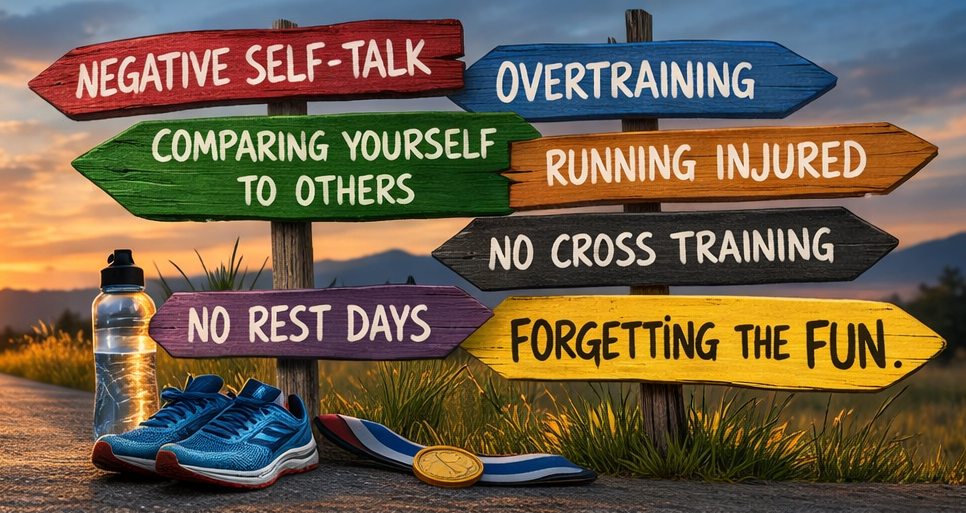
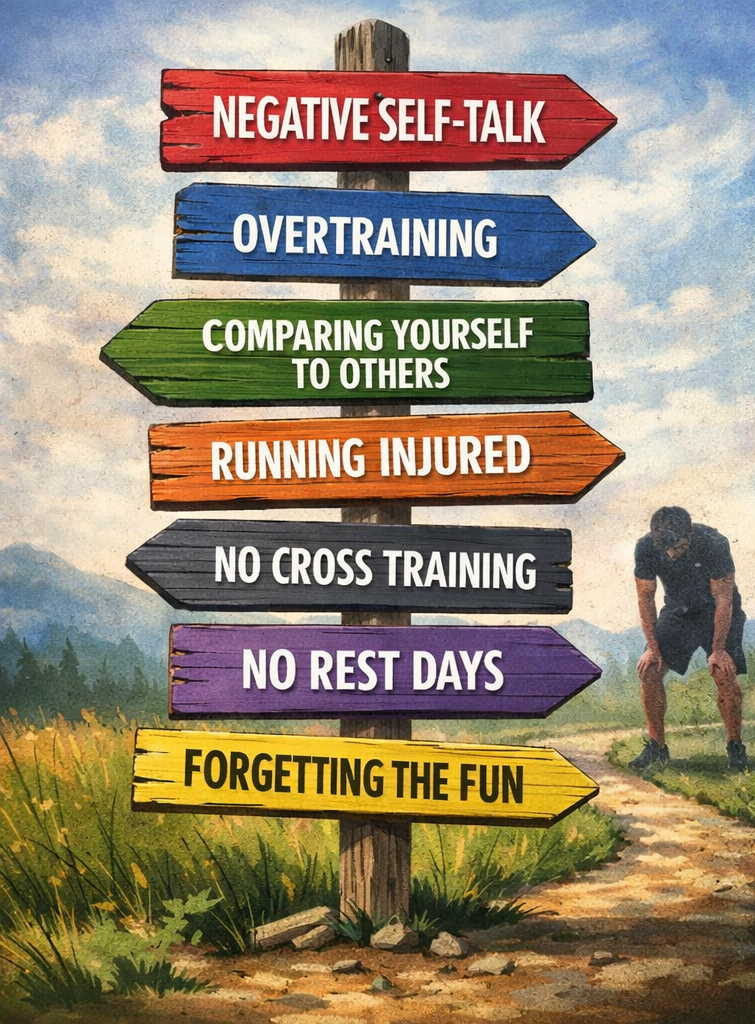
As in every aspect of our functional lives, we pick up bad habits while running. Some are silly or quirky, while others derail important areas of our lives. They become unnoticeable the longer they remain unidentified, so we become immune to them.
Image by ChatGPT
We’ve heard about Major League pitchers getting drilled because a certain move telegraphs their next pitch; or public speakers who get stuck repeating verbal fillers as they deliver a speech; or job interviewees who undermine themselves by constantly apologizing before answering a question. Those are just bad habits, all of which can be overcome.
Runners are no different.
These are seven bad habits to consider and analyze whether they are sabotaging your progress as a runner.
1 – Diminishing your accomplishments: If you are training for a marathon, running “just 10 miles today” is an easy day. But running 10 miles is running a lot of miles. Take your car and drive 10 miles from your house, and see how far it is and how long it takes. It is a matter of presentation. Be proud of your accomplishments, whether the medal is around your neck or you are training to earn it.
2 – Refusing to embrace rest: Working hard is essential to maximize your running potential. Recovering so your body can adapt to the stress of those hard workouts, so you can do it again and get better, is equally important. If you return to grinding while unrecovered, you will overwork an unprepared body and get injured. Never feel guilty for “executing” your day off as written, or for taking an additional one when needed. Resting is not a sign of weakness, but of mental strength.
3 – Believing you are not a real runner: Do you run? Then you are a runner. You are not a marathoner if you don’t complete a marathon, but there is no pre-qualification in terms of time or distance to define you as a runner. The only qualification needed is to run. So, stop feeling guilty because you think you are slow, or because you don’t run what you feel like far enough, or because you take walking breaks. None of that matters. You run; you are a runner. Done!
You must ensure your body remains strong and resilient (Image by Grok)
4 – Comparing yourself to others: If you’ve read my blog before, you have seen this one: Stop obsessing about what your friends are doing. Avoid overthinking what others share on Strava or Instagram. Don’t worry about how fast your friend is running his mile reps. Worry about you, what you can do better, and how you can become the best runner you can be. That last sentence says “you” four times. It is on purpose, because your running is all about you.
5 – Running while injured: This is non-negotiable. If you are injured, you don’t run. I am not talking about aches and pains, or little niggles here or there. I am talking injured. Not all injuries require a bone sticking out of your flesh. If you compensate your mechanics to avoid pain, you change not only the way the body was designed to move but also the way your body is used to move. This guarantees that something else will get out of whack. And then, instead of taking two or three days now, your body will force you to take two or three weeks (if not months) sometime later.
6 – Neglecting Cross Training: Running is a repetitive exercise. A high-impact sport. You won’t have to crash into a 300-lbs defensive lineman, but in a 10K, you are landing about 5000 times per leg at 3-5 times your body weight. Constant repetition leads to overuse, and overuse leads to injury. You must ensure your body remains strong and resilient. Strength training is key. You can also do other sports activities, such as yoga, cycling, or swimming, from time to time. This will provide physical gains without the pounding of running.
7 – Forgetting to have fun: Does your next mortgage payment depend on your next PR? Is the happiness of your marriage dependent on your invitation by Abbott to the next Marathon Major? Is next weekend’s race-pace effort the key to qualifying for the Olympic trials? Most likely no, no, and no. Understand why you run. Sure, some people run to get over a tragedy or to regain control of their health and lives. But most of us weekend warriors run because of the joy it brings us. The post-run high, the outdoors, the sense of freedom and accomplishment, or the social component. Never forget that. If you do, you are in for a short running career.
Running can be a lifelong sport if we diligently strive to do it right and remain injury-free. Don’t overcomplicate it. You have plenty of worries in life to add running to the list. Especially since you are not a professional.
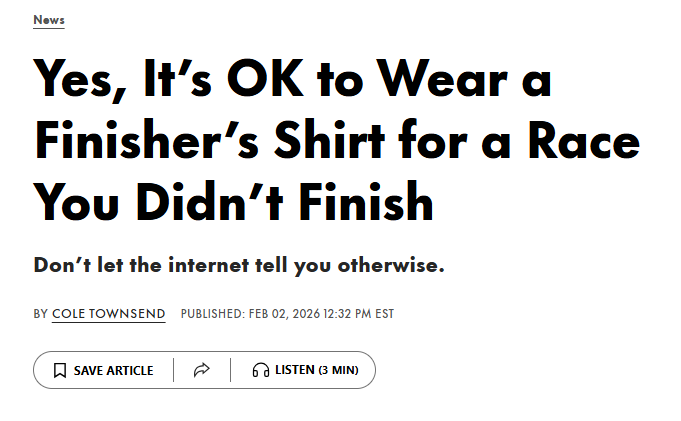
This past February 2nd, a controversy was sparked by an article that ran on the Runner’s World website. It was an opinion piece by a writer named Cole Townsend (whom I don’t know). The piece was titled: “Yes, It’s OK to Wear a Finisher’s Shirt for a Race You Didn’t Finish”. Hence, the rebuttal in the title of this blog post.
If you did not finish the London Marathon in 2025, you should not be wearing this shirt.
Townsend states things as: “I think we need to have an honest conversation about who’s ‘allowed’ to buy finisher tees,” and “Your hard work doesn’t disappear because mile 1 or mile 19 didn’t happen”.
These statements, just as the article’s title, rubbed me the wrong way. Sure, everybody is entitled to their opinion. Sure, wearing a shirt that states you finished the Boston Marathon when you didn’t is trivial compared with what’s happening in Ukraine. Sure, you are not going to ponder what I may think when choosing your wardrobe. Yet, in my book, it is still not right.
Would you wear an Olympic medal you did not win around your neck, just because you own it? You can proudly display it at home, especially if a relative earned it. I display my dad’s marathon medals at home. But they are hung separately from my earned medals. They are my property, but not my achievements.
My beef with the entire affair is two-fold:
1 – How can an entity of Runner’s World’s reputation think that publishing this was OK? I am all pro-First Amendment, but you are not obligated to provide a tribune to someone for just about anything, especially if it is unsound, which it should be for runners. Would you run a story advocating the superiority or inferiority of a certain race, or defending a flat earth, just because it is someone’s opinion?
2 – The article, as the headline clearly states, talks about finisher shirts. A finisher’s shirt is earned when you finish a race, hence the name. Not when you register, not when your boyfriend crosses the finish line, not when you purchase it in a fire sale. This is not a participation trophy. This is between you and your conscience, sure, but in my book, it is still a lie.
I can’t believe Runner’s World ran this article.
Is it OK to wear a military uniform and let people assume you served your country? Would you walk through a mall wearing a priest’s cassock, or scrubs with a stethoscope draped over your shoulders? Exactly. And no, I’m not comparing military service or serving God to finishing a marathon. I’m pointing out something simpler: what you wear creates assumptions about who you are and what you’ve done. Letting those assumptions stand when they aren’t true is plain wrong.
There is a difference between a finisher’s shirt and a race or a souvenir shirt. If you ran London and brought me a hat, I would be grateful and wear it, even though I haven’t run it. When I returned to road racing after a 26-year hiatus, I gave my race shirt to my dad as a tribute, since he inspired me to start running when I was a kid. He wore it proudly. But it only said “2012 Miami Marathon and Half Marathon”; it didn’t state he finished the race, even though he ran the distance hundreds of times.
The author concludes with this statement: “We don’t need to start a ‘stolen valor’ debate. What you wear should reflect what matters to you—not what the internet thinks you’re entitled to. If you care, flip the question: why are you wearing it? If the answer is ‘because it means something to me,’ that’s enough.”
This would be a logical conclusion if the article didn’t state “Finisher’s Shirt”. That’s where, in my opinion, both the writer and the Runner’s World editors went terribly wrong.
Any thoughts? I really want to hear from runners who disagree with me. Please share in the comment box below.
When it comes to the long run, theories abound. A certain influencer says this, scientific research says that (yet somehow you believe the influencer, but that’s another story). Or your buddy swears at a new esoteric formula that allows you to run only twice a week and still improve all your PRs, but then, here comes fill-in-the-blank.
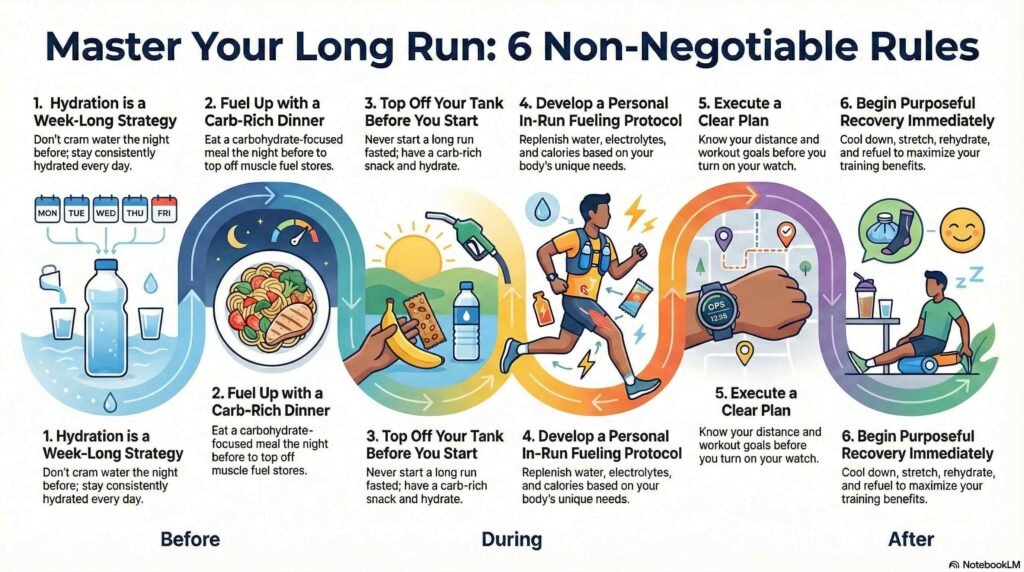
Most theories and formulas have their merit, but some are just quacks. Yet certain non-negotiables can’t be overlooked if you strive to improve your endurance, times, PRs, and enjoyment in running. These are my six non-negotiables:
Hydration – it is not about drinking water during your long run. It is about setting a hydration strategy that goes beyond your time pounding the asphalt. Hydration is a weeklong strategy. You can’t cram hydration the night before or the morning of your long run. A healthy intake of water and electrolytes throughout your day, every day, every week, will ensure you are primed to withstand the sweating rigors of your run, during which you must rehydrate as you go, of course. Don’t start on a deficit. In the best circumstances, it is a recipe for a bad run; in the worst, for disaster.
Night-Before Dinner – A key component to the next day’s long run success. It must be carb-rich, as they will help top off your glycogen (muscle fuel) stores. This is not the time for a big-ass stake or a huge salad. This is not the time to try that new restaurant your family has been dying to go to. This dinner is “me time”. It is about preparing for tomorrow. It’s the time to be a little selfish and make sure your posse understands your nutritional needs. You can please everyone else with their meal choice tomorrow. One more thing: Give yourself plenty of time to digest your dinner.
Pre-Run Fuel – There are plenty of benefits to running in a fasted state, but those do not apply to your long run. Even if you had the perfect meal the night before, your body used glycogen and water to keep you alive through the night. So, even if you feel you can tough it out, hydrate and have a carb-rich snack before you start. There is no reason to start your journey without your tank topped off when the solution is so accessible. Your body will thank you with better performance and less fatigue.
In-run Fueling – Even though your body is designed to perform at a certain level of dehydration and calorie deficit (meaning you don’t need to replace every drop of water as you sweat it or every calorie as you burn it), you must eventually replenish so your body continues performing over the energy demands throughout the workout. For that, you must develop your personalized protocol. Forget what experts say and figure out what is best for you. When do you need water? When do you need a gel? When do you need electrolytes? It is all about your individual needs so that you may keep the engine burning hot.
Execute your plan – When you go out for a long run, be clear about what you want to accomplish from your training, and make sure of that before you turn on your watch. You shouldn’t be surprised by a mile-repeat in the middle of your run. You shouldn’t figure out you are going 12 miles at mile 2. You should have known that yesterday, if not earlier. Being prepared is the key to success, and it’s better to avoid needing a week to recover instead of a day or two.
Purposeful Recovery – You finished your long run. Great! Congrats! Let the Strava kudos and the Instagram likes pour in. What now? Well, if you want your body to benefit from the workout, you must start the recovery process ASAP. This means you should not get in your car 30 seconds after you are done. You should catch your breath, cool down, stretch, rehydrate, ingest protein and carbohydrates (chocolate milk is an excellent way to do so), and make sure that, as your body enters recovery mode, it can recuperate stronger, faster. Eat, hydrate, and sleep so you are ready to use the benefits of that long run as soon as possible.
There are many theories about the long run, some with merits, some without. If you want to build strength, endurance, and confidence, not just for race day, but for years to come, I truly recommend you incorporate your non-negotiables into the long run. These have all been proven.
Please share your thoughts in the comment box below.
If you are reading this post within the first few days of our brand-new year of our Lord 2026, your running goals should already be set and in motion. You shouldn’t need to cram in the later months, nor should you have to adjust because you were caught unprepared. If your goals are not set yet, click here before proceeding. If they are, let’s focus on how to achieve them.
It is all about the way you present it to yourself. Image by ChatGPT
A sure way to keep yourself focused on your goals is to shift certain paradigms in your mindset. Little adjustments that, when applied, should put you in a position to achieve your 2026 goals. Some may apply to you, some may not. Let’s check them out:
1 – Focus on effort, not on pace – Easy pace is not measured in minutes and seconds per mile. It is about effort. An easy effort, hence the name. Sure, there are workouts where specific paces must be maintained. There are speeds and progressions to hit. But that is only in selected training sessions. Most of your training is always at an easy pace. So, keep it easy. Let the pace be a product of your effort, not the other way around. If sharing it on Instagram is embarrassing, keep it to yourself.
2 – Break your training into sections – Every single training has components that must be compartmentalized and distinguished so they can be appropriately executed. A light mobility session and a warm-up should be part of every single run. It is once you’ve taken care of these that your actual training session, where there are benefits to realize, starts. Regardless of what it is. Short intervals, long intervals, fartlek, progressions, you name it, all consist of segments that should be understood, respected, and executed. They are all there for a reason, so don’t rush or skip them. The same applies to the cool-down. There’s no need to jump into your car 30 seconds after turning off your watch.
3 – Running is a privilege, not a chore – Why do you run? Is anyone forcing you? Is the Boogeyman going to catch you if you stop? We run because we have chosen it as our sport, our vehicle for health, or our release valve from the stresses of life. Make it an enjoyable part of your day, not a chore. Make it your “me time” or your “social time” with your buddies. Will there be days when you would rather walk through crushed glass than go for a run? Of course! But those should be few and far between. Our running is not guaranteed. Injuries, time constraints, family demands, weather, work, and so many other distractions conspire against our running time. Understand the privilege of being able to run today and be thankful for it.
4 – Reframe your thoughts – Most runs don’t fall apart because your legs quit, but because of a thought you let go unchallenged. “I’m slowing down.” “This isn’t my day.” “I should back off.” Reframing is stepping in and editing that sentence before it becomes a decision. Not with unquestioning optimism, but with perspective. ‘I’m tired because I’m working.’ This pace still gets me where I need to go. “I don’t need to quit; I need to adjust. Once you start deliberately executing this, you will realize how often your mind jumps to conclusions your body hasn’t made yet. Running becomes less about fighting discomfort and more about managing the dialogue that surrounds it. Change the words, and the experience will often follow.
5 – Running is a journey, not a destination – There is no finish line. Races, PRs, and medals matter, of course, but they are just checkpoints. Accepting running as a lifetime journey changes the measurement of success. It’s no longer about faster times or longer distances, but about what running teaches you along the way. The patience to keep training when progress is slow. The humility of setbacks. The satisfaction of keeping showing up. Goals stop being pressure points and become refueling stations. They give direction without defining your worth as a runner. Miss one, and the journey continues. Hit one, and you keep moving forward. This mindset will keep you running for decades to come. Not because you are chasing one more medal, but because running still has something to teach you.
In 2026, let’s focus on the joy of running. Achievements and setbacks are part of the process, part of what makes running special. Always remember why you chose to run.
We are facing a brand-new year. Twelve clean-slated months ready to be lived. 365 crisp calendar pages waiting to be filled with experiences, memories, and achievements. The time has come not only to have our goals ready but also to set up a plan to realize them.
If you, like most of us procrastinators, are not thoroughly prepared for 2026, please read below to follow a structure and get there before the final countdown of 2025.
► Reflect on what happened in 2025 — To know where you are going, you must know where you are coming from. Understanding what made the previous year a success, less than that, or even a miserable failure, is the key to making the necessary adjustments. Adjustments will be needed to maintain the same trajectory or to find new paths to reach that elusive road to success. So, take your time to look back, reminisce, identify, understand, and realize before you take any steps towards defining what you want from your running in 2026.
► Set up your 2026 goals now — Do not procrastinate. Figure out what you want from your running this year. Goals may be time-related (first 5K under 25), distance-related (finally getting to 1000), social (I want to make like-minded friends), health-related (losing those last few pounds), or a combination of everything. Adjustments and detours are expected, but to adjust and recenter, you must have a clear path to your destination.
► Set up the path to achieve your goals — Antoine de Saint-Exupéry (yes, The Little Prince author) said that “a goal without a plan is just a wish. Right on point! You must know how to get there and how to do so on time. Goals may need steps, checklists, reassessments, checkpoints, rewrites, refinements, and more. For time-related goals, speedwork is essential, but a 5K PR is not the same as a marathon PR. Running your first 100-miler requires a different approach than your local Turkey Trot. So, know what you are doing, why, and when.
► Register for the races — If your goal is performance-related in a specific race, time, or distance, register for a race right now as soon as you are done reading this post. Nothing will get you more focused than having a date with destiny in your calendar. I know of no focusing tool sharper than spending the money on an upcoming race. And if your goal race hasn’t opened registration yet, register for another race so you can stay active and focused until the day comes.
►Venture outside your comfort zone — Running is a sport that, beyond the health and social benefits, can teach us so much about who we are and how the bounds of our limits are far beyond what we thought possible. So, don’t get comfy just on what you know. Set up an extravagant short-term goal to keep your training fresh and varied. If you like marathons and halves, push for the fastest 5K you can. If you like the shorter distances, set up a trial date for your fastest mile ever. The options are endless: run an ultra, venture into a trail, force yourself to run slower, etc. Your imagination is the limit.
► Embrace failure — Failing is part of the process, and eventually, you will fail. You get up, dust off, figure out what happened, reassess, and keep moving forward. If you learned something from it, it is not a failure. And when you don’t get what you originally set out for, you get experience, which could be even more valuable than the original goal.
► Remember you are doing this for fun — Unless your family’s economic survival depends on your running performance, you are just running because you like it. So, make sure everything you do contributes to the enjoyment and extension of your running journey, and the satisfaction of achieving your goals while keeping yourself injury-free.
My sincere wish for you in 2026, my dear reader, is a year of endless, injury-free miles and PRs in all your distances. May you plan properly to accomplish it all.