by Coach Adolfo Salgueiro | Jul 5, 2022 | Coaching, Guest Perspective, Opinion, Reflection
By Coach Nick Bonnedahl
The following is a post I recently read in LinkedIn, from the pen of Coach Nick Bonnedahl. It is short, to the point, and it touches on an issue that affects so many runners. It mirrors the way I think about coaching certain athletes, but Coach Bonnedahl, beat me to it and wrote it first.
Blog post reposted by persmission of Coach Nick Bonnedahl
What he states in the post affects so many runners just looking for a quick solution to their athletic problems. It reflects the reality of those who complain the coach is not doing his job because they are not progressing. It echoes the mindset of those who can’t reach their goals, so it must be somebody else’s fault.
With the author’s permission, I am reproducing his post here.
I do not want to coach you if…
-
You are looking for a quick-fix.
-
You like to cut corners and look for a magical pill.
-
You are unprepared to put down some work and ready to go for it.
-
You are not ready to invest in yourself emotionally.
-
You are not doing it for yourself but for someone else.
-
You come with excuses, not turning up.
-
You blame others or events instead of the real reason (YOU).
-
You are not honest with yourself.
But, if you are someone that wants to get the result and work for it, ready to change habits and routines, prepared to invest in yourself to feel better, younger, and happier. If you want to get into/back to running, want to lose some weight, getting motivated, inspired, having accountability, getting coached in a fun way, physically and mentally for long-term results and changes, drop me a message to see if you are a fit.
Nick Bonnedahl is a qualified running coach, ultra-running coach, personal trainer and weight loss specialist based in Thailand.

by Coach Adolfo Salgueiro | Jan 25, 2022 | Article, Coaching, Personal, Reflection
By Coach Adolfo Salgueiro
On Sunday, January 16th, I participated in the 50th anniversary edition of the Chevron Houston Marathon. I want to start by stating that it was one of the most amazing experiences I’ve had in 40+ years of racing. From the organizational perspective, the race is at the same level of any big-city event. It is up there with any Major. On the personal side, it was uplifting. From the coaching side, it was memorable.
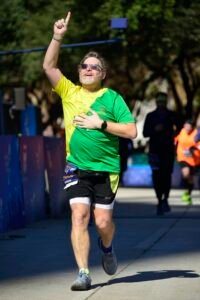
About to cross the finish line with a hand in my heart and the other one thanking The One who made this miracle possible
I knew the event’s center of operations was the George R. Brown Convention Center, which is huge. I never expected it to take the entire place. The execution of the bib pick up was flawless even though a bit more signage would have been welcome for the sake of out of-towners, such as me. I did not visit the expo, though. Friends told me it was a smaller version, given the Covid reality of the world.
Running morning was cold, cold, cold. Thirty-six degrees when we left our Airbnb. But we were able to find refuge, toilets and a place to rest while we waited for our corrals to open. Everything was so well organized and orderly that your only worry was walking to the start. The whole shebang was taken care of for you.
The course was flat, sans an overpass and two, minor underpasses. We ran through beautiful areas of the city and crowd support was solid without being overwhelming. There were so many port-a-pots throughout the race that I never saw a waiting line. There were even urinals at the starting line, first time I’ve seen this in the US. I stopped about mile 14, not because I had to but as a preemptive measure, just because I could and there were no lines.
Last mile, back in downtown, was stunning. Lots of fans and photographers lining up to welcome back the runners. After picking up our spectacular finisher’s medal, we went into the Convention Center to get our finisher’s shirt and food bag. The only unflattering thing I have to say about the race is the shirt. It was a cheapy fabric, fits poorly and the design was nothing to write home about.
I fully recommend this event to anyone interested in a big-city race. This is a Marathon-Major-like organization without the Marathon Major label nor price tag.
COACHING EXPERIENCE
I had a wonderful experience with my four coached athletes in the race. All three marathoners set PRs even though two of them contracted Covid just three weeks before the race. This hindered their expectations and the size of their PRs, but they both achieve their A-Goals through courageous performances. The half marathoner was able to cross the finish line strong, healthy and with a big smile on his face. His goal was finishing after a long hiatus, and that was accomplished, too.
All runners trusted the process, followed their training diligently and executed their race plans to the tee. Thus, the results.
There is nothing more satisfying for a coach than one of your runners telling you: “Thank you. I couldn’t have done it without you”. Even though it sounds (and it is) self-serving, it reminds you that, even though they all had in them the ability to achieve what they just did, your guidance made a difference in this runner’s race. And that is priceless.
MY RACE
On the personal side, I was able to complete the Houston Marathon (my 11th), just 207 days after open-heart surgery. I trained with a race/walk protocol that allowed me to make this a reality, despite having time for just two long sessions (16 and 17 miles). Yet, in just four months, I was able to complete the race in 5:16:45. The time is nothing special, but on my race, time was irrelevant. It was all about crossing the finish line.
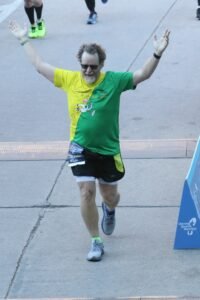
Even though it was my 11th marathon, this finish line was special.
The chilly weather was helpful. I ran the first 7 miles biting an 11 pace, and from there started my walk/run protocol of .18/.82 (weird splits, sure, but it was where, after much practice, I felt more comfortable). I reached miles 16, 18 and 20, tired but strong. Legs started to hurt reaching miles 21 and 22 and after the walking break for Mile 23, the legs just stop firing. I tried to restart the running, but it wasn’t happening. I ran some quick math and realized that if I restarted now, I could go sub-5, but the legs were shot. Then I realized that being at Mile 23, 30 weeks after OHS, was miracle enough and I wasn’t going to let the clock dictate the terms of my happiness or what God was allowing me to do. So I walked most of the last 5K with a big smile, never resenting the time lost or wondering why I didn’t go for the half.
I crossed the finish line with teary eyes and a couple of seconds later, I hear the unmistakable screams of my beautiful wife welcoming me. Unfortunately, she was on the other side of the street, and it would take about an hour for me to hug her. But the fact that she witnessed the miracle of my finish, firsthand, uplifted my spirit.
Houston was a spectacular experience in every sense of the phrase. As a runner, as a coach and as the protagonist of something improbable. Because what I personally accomplished is so unlikely that it can only be explained by the divine intervention of God, through me. This is what proves that it is a miracle. Sharing it with my friends from the No-Club Runners multiplied tenfold the experience.
I can’t wait to see what’s next!
by Coach Adolfo Salgueiro | Oct 26, 2021 | Book Review, Coaching
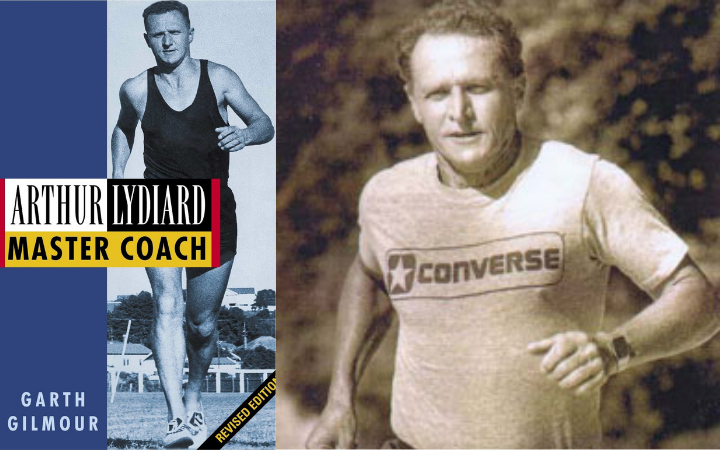
By Garth Gilmour
Reviewed by Coach Adolfo Salgueiro
While names like Frank Shorter, Bill Rodgers, Eliud Kipchoge, Grete Waitz, Haile Gebrselassie or Fred Lebow are known by many as some of the most influential people in the history of contemporary running, Arthur Lydiard’s is less known by the masses. Yet, most of our training plans, including some for the aforementioned runners, are based on Lydiard’s periodization principles. Born in New Zealand in 1917 (passed away in 2004), he is well known among coaching circles and by those curious enough to figure out where the basics of their training plans are coming from.
A well written book worth the time and money for those who care about the history of running.
Arthur was a local running elite who started keeping track of his training and figuring out what worked better for him. He focused on what made him better and discarded that what did not. He was no physiologist, medical doctor, or scientist. He was a shoemaker with a side gig as a milk deliveryman who just loved to run and get better at it.
His main discovery is that gains needed to be obtained slowly over time for the body to adapt and them to stick. That when the body adapts to the stimuli this gains remain and from there you can build on them. He realized that not everybody needs to run 50×400 like Emil Zatopek to become a better runner. The key for any distance from 800 to the marathon is endurance and you could obtain such endurance by developing your cardiovascular system. You do so by taking your time and running a lot of miles while recovering so you can do it, again.
As his New Zealand track and field teams had successful Olympic Games in 1960 and 1964, and Peter Snell, Murray Halberg and Barry Magee became household names in the world stage, coaches from around the world started approaching Arthur. Suddenly, Lydiard was “discovered” and became a coaching guru traveling the world.
Lydiard epitomized the Luke 4:24 biblical verse: “no prophet is accepted in his hometown”. Despite his multiple successes taking many compatriots into the top of the world stage, he kept fighting with the local sporting authorities who refused to accept his methods and ended up spreading his knowledge around the globe while New Zealanders were left behind.
Olympic Committees from Mexico, Finland, and Venezuela trusted him with the training of his athletes, some with better results than others. Japanese coaches and runners visited New Zealand to train with him. During the boom of Japanese world-class marathoners of the early to mid-eighties, Toshihiko Seko and the So twins, Shigeru, and Takeshi, were in part, his success.
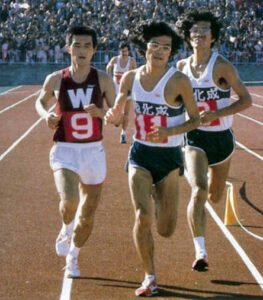
Thet op runners of the Japanese world-class runners boom from the eighties were product of Lydiard’s principles: Toshihiko Seko, Takeshi and Shigeru Soh.
Lydiard’s periodization principles were so effective and revolutionary, that swimmers and horse trainers adopted them with the necessary adjustments and saw results. It has been used for decades by some of the most successful performers in those disciplines.
The March/April 1992 issue of Peak Running Performance magazine said: Lydiard\’s program epitomizes one general, but very critical concept related to exercise and sports physiology. This broad principle is gradual adaptation. While most athletes would call this \”plain old common sense\”, experience tells us that common sense is not so common–especially among runners who have a strong desire to improve their running.
Author Garth Gilmour condensed Arthur’s work in the following paragraph:
“First tested and found successful in the 1950s, the Lydiard system has undergone some subtle refinements through the years. But it remains the same elemental theory that first placed a small handful of ordinary runners, from Lydiard\’s immediate neighborhood in an Auckland, New Zealand, suburb, at the forefront of world middle and distance running for more than a decade and then, as Lydiard advanced from being a coach of runners to an international coach of coaches, spread around the running tracks and training centers of the entire world.”
This is a biography on the subject, not a scientific treaty of his findings or the application of his training theories. Sure, Lydiard may not be the sexiest of subjects for everyday runners, but he was an innovator with a legacy worth knowing about. Arthur Lydiard: Master Coach is well written book, pleasant to read. Well worth your time and money if you care for the creator of the core in which most of our training plans are based on.

by Coach Adolfo Salgueiro | Jun 15, 2021 | Article, Coaching, Opinion
By Coach Adolfo Salgueiro
A few weeks ago I went for a run with one of my trainees. He brought a friend to join in. He knew how beneficial it had been for my trainee to follow a structured, individualized, and supervised training plan. He was very aware of my trainee’s progress during the months we worked together. So, as we ran, he picked my brain with a few poignant questions.
 There was one that caught my attention and kept me thinking for a few days. He was training for a 50-mile race, and he wanted to know: As a coach, what is the weekly mileage I recommend for someone wanting to complete his distance?
As you may imagine by now, there is one and only one answer for such a question: “It depends”.
It was then when I started enumerating the different variables that need to be considered before I answered such a question. There is a whole set of variables that needs to be pondered and expressed in a training plan before a goal may have a chance to be realized. These variables, among others and in no particular order, are:
* Goal – What is it that you are trying to achieve?
* Balance – There must be a reason why miles are prescribed. No junk miles.
* Rest – It is a much part of a training plan as a long run.
* Nutrition – Without being a dietitian, a coach must understand the basics of healthy eating.
* Speed work – has to be balanced between long runs and recovery days.
* Intensity – It is not about how fast but how hard you are pushing.
* Aerobic capacity – For runs over 800 mts, it is the basic measurement of endurance.
* Strength training – core and weight work are key to the success of a runner.
* Cross Training – It can’t be all running. Supplementary activities need to be performed.
* Hydration – Not only about avoiding dehydration but when and how much fluids to consume.
* Fueling – caloric intake that needs to be consumed for the body to complete the task efficiently.
* Race strategy – What will you do on race day with what you have worked so hard to obtain.
* Recovery – What to do once you are done with your training cycle, so you don’t burn out.
 Combining all these and many more variables in a reasonable, achievable, and well-balanced plan, requires knowledge, preparation, and experience, both as a runner and as a coach. But even with all these elements, coaching runners is still not an exact science.
Each body reacts different to the same stimuli, and because life affect every runner in an individual way, it is imperative for a running coach to be openminded, flexible and willing to adjust as weeks go by. This can’t be achieved by cookie-cutter, generic plan downloaded from the internet.
Running a 10K, a half marathon or a marathon is not unachievable. Hundreds of thousands of people do it year in and year out. But as you look to achieve certain distance or time goals, if you want to get the best out of what you have and/or if you want to improve and test your limits, the guidance of a knowledgeable coach, one who can balance art and science, becomes more important, if not indispensable.
by Coach Adolfo Salgueiro | May 25, 2021 | Announcement, Coaching
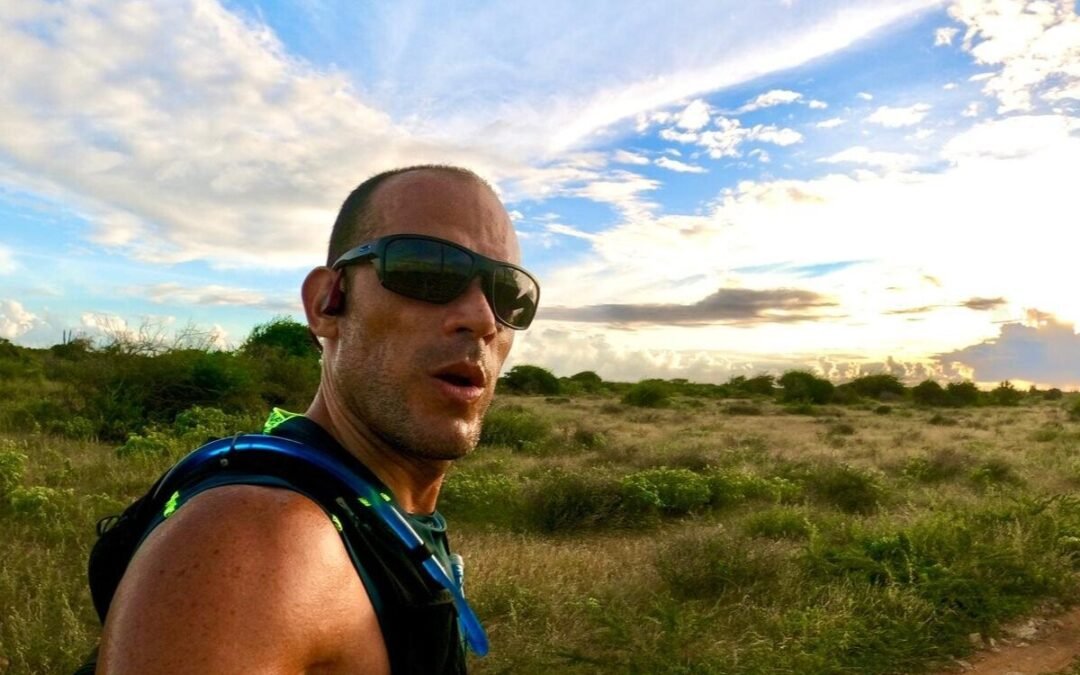
Carlos Coste is a world-class, high-performance athlete, 12-time world record breaker in the disciplines of apnea and free diving. In the last two years, the Venezuelan born athlete has ventured into the running scene with the goal of competing in the Zion 50K Ultramarathon, in Utah. A few setbacks and a bout of Covid forced the cancellation of his plan, twice, yet he still persevered. Last month, he finished a 50K ultra in Bonaire.
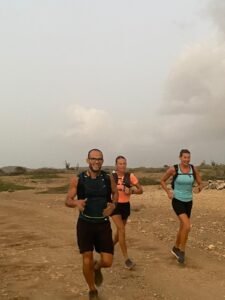
Running 50K in Bonaire, to make up for the Zion 50K Ultra in Utah.
“I am still a beginner in this ultra-running thing”, stated Coste. “In my first year I was coached by a friend who helped me in the transition to trail running and long distances. But then I realized I needed a coach with the experience and technical knowledge to get me to the next level. A common friend recommended Coach Adolfo Salgueiro, from Foutlips.run. I researched his background, certifications, and experience, and decided to give it a go. We connected online and started working right away.”
Coste’s training presented a few challenges from the start. He lives in the Caribbean island of Bonaire, at sea level, and his race was in Utah, starting at 3500 feet and going up from there. Also, Mr. Coste runs a successful apnea school in Bonaire, and he works with his physique on an everyday basis, so, the running is an addition to his body demands. On top of this, it was the thick of the Covid pandemic. A flexible and constantly adjusted training plan was paramount for him to reach his goals.
“During the training season there were issues with timing, small nagging injuries and this Covid thing that has affected us all” continued Coste. Coach Adolfo helped me with a fluid adjustment of the training plan. We were using a phone app that allowed us instant feedback and immediate adjustment of the work when needed. It was the perfect way to work virtually.”
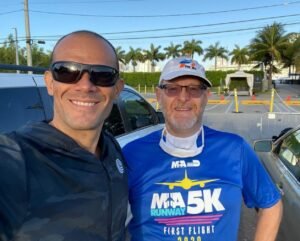
Carlos and Coach Adolfo before a run in Miami Beach, in late May 2021
Amid the training, Coste contracted Covid. A mild case, thankfully, but Covid, nevertheless. Once he was cleared to continue, the focus of his training had a dramatic shift, from “let’s do great” to “let’s just finish”. As if this wasn’t challenge enough, logistics and lockdown prevented him to travel to his race. So, despite the frustration and with the help of the local running community, a 50K ultra was improvised.
“I felt great during the race,” explains Coste. “First 35-40K were exceptionally good. We started at 4 AM and it was amazing to run in the desert through the night. The heat in Bonaire hit me hard after dawn so the last 10K were rough. I had to combine run and walk, but that’s what I was expecting.”
Despite the two cancellations of his Zion 50K Ultra, which was his goal for both 2020 and 2021, and the multiple adversities he had to face during training, this word-record breaker maintains his enthusiasm for running and is ready to give it a go for 2022.
“This was just my 2nd Ultra -he concluded- And for next year I am already looking forward to running in Zion. I am already talking with Coach Adolfo so after I recover, we can start the training cycle as soon as possible.”
You can follow Carlos Coste in Instagram (@carloscoste1) and by Strava . For more information on his athletic achievements, you can visit his website at https://deepseabonaire.com.