In a WhatsApp running group, one of our friends recently shared an article from Men’s Journal Magazine praising the benefits of training in a fasted state. The sub-title alone was promising: The Science-Backed Benefits of Running on Empty, by Spenser Mestel.
I opened it as I thought of how pseudo-science has affected even the most mundane, easy runs lately. Most come from unqualified social media influencers or studies commissioned by companies that will benefit from their results. Dr. Tim Noakes is famous for questioning Gatorade’s science-based recommendations about the benefits of consuming Gatorade. And like that, examples are plenty.
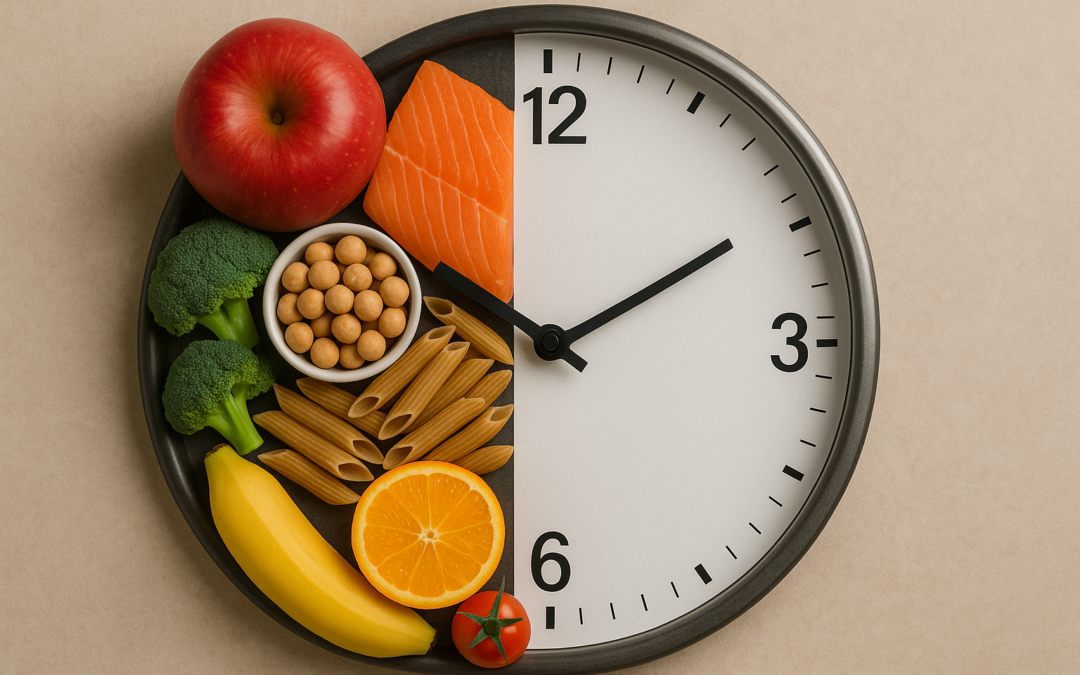
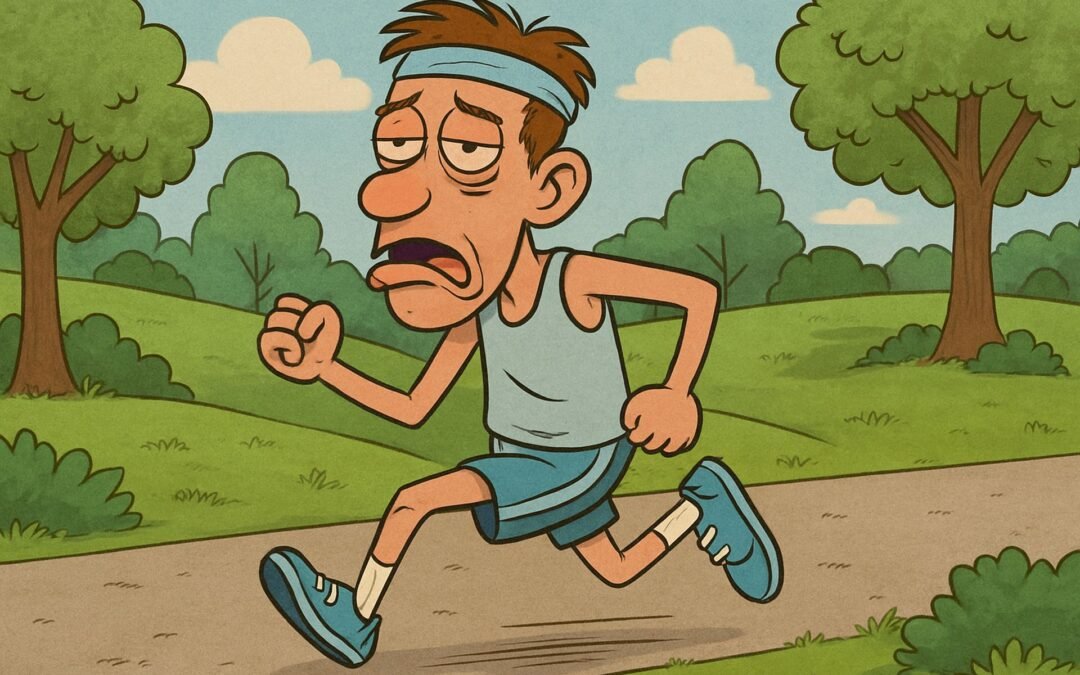
Running on empty has its scientifically proven benefits (Image by ChatGPT)
We tend to forget that humans have been running for thousands of years. Hunted gatherers did so for hours while chasing an animal until it collapsed. Yet, they were able to pick it up and take it home to feed their families. They didn’t carry water packs to replenish every drop of sweat. They didn’t carry chews or gels to replace every calorie they burned.
Sure, we have evolved in those thousands of years. The bushmen of the Kalahari were not used to spending their day under air conditioning, sitting in front of a computer, or wearing shoes before they went hunting. But we haven’t entered devolution either. Our bodies were built to withstand a certain level of dehydration and caloric deficit.
I want to leave no room for doubt that I am not advocating against electrolyte replenishment, chews, gels, or any other product. God knows I could not have finished my last few marathons without the help of Maurten gels. What I am advocating against is their overuse, to the point where our bodies become unable to learn how to use their own resources.
Running on an empty stomach is not a fad passed around by social media influencers. Based on the article in question and the study on which it was grounded, it is a well-rounded premise that “fasted cardio” and “low-glycogen” training are similar but distinct practices that can offer real metabolic advantages if done right.
While skipping breakfast can be beneficial, you don’t have to do it for every run (Photo Pexels)
Mestel brings in Professor Richard J. Bloomer, Dean of the College of Health Sciences at the University of Memphis, to clarify the lingo. According to him, a “fasted state” can simply mean not eating for 10–12 hours, like overnight. But low-glycogen training goes further. It implies depleting your muscle glycogen stores, typically by limiting carbs over a longer period. Both approaches can shift your body’s fuel source away from sugar and toward fat, especially during lower-intensity sessions.
According to the study, these are some of the benefits:
Fat Adaptation: By skipping that pre-run snack or breakfast, your body is nudged into burning fat for fuel. Studies cited in the article showed that both men and women increased fat oxidation after exercising in a fasted state. Simply put, you’re teaching your body to tap into a steadier, more abundant fuel source.
Less Stomach Drama: Fasted runs can reduce gastric discomfort for those with fussy guts. No food means nothing sloshing around in there. It’s a win for morning runners who’d rather not eat at 5:00 AM just to avoid bonking at 6:00.
Convenience: This one isn’t science; it’s life. Rolling out of bed, lacing up, and getting it done before breakfast is just easier sometimes.
The science goes even deeper. In a 2010 study from the Journal of Applied Physiology, Beneficial Metabolic Adaptations Due to Endurance Exercise Training in the Fasted State by Van Proeyen et al., this wasn’t anecdotal evidence; it was a tightly controlled experiment. Two groups trained identically on bikes for six weeks. One ate carbs before and during workouts; the other trained fasted.
The result? While both groups got fitter, the fasted group showed superior metabolic adaptations. Their muscles improved at burning fat, their ability to use stored fat (even deep in the muscle) improved, and they kept blood sugar stable over long workouts. The carb-fed group? They didn’t show those perks.
Conclusion
It is not about skipping breakfast forever or starting every workout on an empty stomach. But if you mix in a couple of easy runs each week without eating beforehand, especially when effort is low and stakes are even lower, your body might thank you. You’ll become more metabolically flexible, able to use fat when needed and carbs when it matters most.
Don’t go overboard. It’s about teaching your body to adapt so it can rise to the occasion, whether chasing a PR or just running for joy.
Curious to try it? Leave a comment and let me know your experience. And don’t forget to subscribe to the Foultips.Run newsletter by clicking the button below.
Talking about our great workouts and spectacular results is a favorite topic of runners’ conversation. “Johnny’s mile repeats are spot on for a 5K PR!”, “Jimmy is crushing his track workouts.”, “Helen swears by her Fartlek sessions.” So, why am I not doing any of this stuff? Why does my coach have me doing boring stuff?
If you are training for long-distance running, your base is the key. The aerobic base, that is. A skyscraper stands on a solid footing for the same reason the pyramids have stood on their wide bases for 4500 years. They both have a solid foundation to bear the load. The same principle applies to a long-distance runner. Your aerobic base is the foundation of your running. It’s what every training block builds upon, and what ultimately supports your ability to perform. What good comes from running 400 meters in 62 seconds if that is all you can hold, but you are racing a 5K?
To understand the importance of an aerobic base for a long-distance runner, know that even the fittest and fastest Kenyan elite runner runs a marathon 99% aerobically. Even Olympic 5000-meter champions require about a 90% aerobic effort to compete at that level. You’ll likely never be there, but this doesn’t preclude you from the reality of human physiology.
In his “Guide to Coaching”, Coach Steve Magness states: “We have a temptation to want to skip to the ‘cool, sexy’ stuff. It’s boring to do endless easy runs or to spend hours working on the starting position in the sprints. But the ‘boring’ work serves as our foundation. We need a firm understanding of the basics before we move on to the next step. And once we have moved on, we must continually go back to the basics to ensure that they are ingrained.”
Is this clear enough?
The Boring Stuff
It is counterintuitive to accept that you must run slow so you can run fast. Yet this is one of those things you must accept, trust the science, and move forward with if you aspire to become a successful long-distance runner.
The slow (boring) stuff is the key to becoming a strong runner (ChatGPT Image)
Training at slower paces is the foundation of endurance because, among other things, it enhances mitochondrial density (improving oxygen delivery to the muscles), enhances capillary development, and increases fat utilization as fuel, which will make you a more efficient athlete. Low-intensity training also stimulates aerobic enzymes without overstressing the body, allowing more consistent training and better recovery. Over time, these physiological improvements will enable you to maintain faster paces with less effort.
Structured properly within your training, slow runs support speed, stamina and contribute to a better race-day performance. And this takes time. It doesn’t happen by running slow for a week or a month. If you trust the process and keep a written record of your workouts, before you know it, you will be running longer, easier and faster with the same effort. What once was your pushing pace, will now be your warmup pace.
The Sexy Stuff
Now that you have a strong base, we build on it.
Do you want to enjoy the runner’s highs? Build a base (Photo Pexels)
I often compare runners with F1 engines. They can do amazing things, but they require a lot of work, constant modifications and adjustments. The engine is the base, which is solid, but it can’t perform at the expected level without testing, tweaking and failures.
Short intervals, long intervals, Fartlek, mile-repeats, track, threshold, VO2Max, progressions, and so many more are part of the arsenal of workouts you have at your disposal to become a faster runner. These workouts will leave you pleasantly exhausted, provide you with that exhilarating feeling we have learned to love, and get you to enjoy the sweets of a runner’s high.
But be warned. These should be just a fraction of your workouts. You shouldn’t do them day after day after day just because you built a solid base. Maintaining and solidifying the base is a lifetime pursuit. The base of the Eiffel Tower has been constantly maintained since 1889, and thus, still stands strong.
Speed work is essential to becoming a faster runner, but easy recovery runs in between hard workouts and the ubiquitous long run should not be skipped. It should all be in balance.
So, next time your coach asks you to slow down, be patient, or play the long game, understand he/she is not doing so because he/she is mean. There are proven scientific and physiological reasons behind it. So, embrace the boring stuff and become a better, faster runner.
Can you share your slow running experience in the comment box below?
For those who have only run one marathon, it is an adventure. For those who have completed the distance more than once, the only thing in common between one and another finish is the 26.2-mile distance. Each one brings a new challenge, a new experience, a new obstacle to overcome, and a new journey.
On January 19, I completed my 12th-lifetime marathon. At 59, I am unsure if I have another one in me, but I am not ruling it out. What I do know is that from each one I can take a life and/or a running lesson. Looking back on 42 years of marathoning, these are my takeaways from each one of them:
Running a marathon is a magnificent experience. Lifechanging. But it is not an easy task. It requires effort, sweat, suffering, and wondering why in the world you chose to impose this on yourself and on purpose. Once you cross the finish line, something wonderful happens. A transformation to last a lifetime. And for some weird and masochistic reason, you start thinking of the next one.
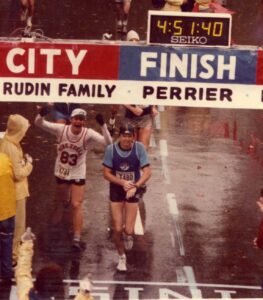
2 – New York 1983 – Age 18 – Time: 4:51:36
I thought I could go sub-4 just because I was close to my previous one. But the stupidity of youth got in the way. Having run one before is no substitute for decent training. Had I trained better, with consistency and dedication, I could have avoided the suffer-fest I endured on this cold and rainy NY morning. I learned the hard way that there is no substitution for preparation. It doesn’t have to be perfect, but it has to be worth the “training” label, at least.
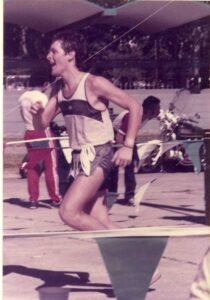
3 – Caracas 1984 – Age 19 – Time 3:32:08
My all-time PR thanks to the guidance of an experienced runner who knew what he was doing and coached me. The difference between this result and the previous one is that I put in the work. At 19 years of age, I sacrificed the partying, the drinking, and the late nights with my friends so I could put forth my best effort. I hit the wall at the 32nd Km (Mile 20) yet still set a solid PR. Looking back, if we knew then what we know now about in-race calorie intake and electrolyte replenishment, I may have a better PR. But that doesn’t matter now. Hard work paid off, even if hitting the wall.
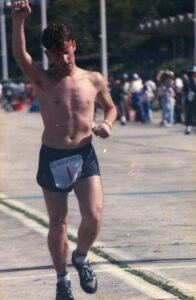
4 – Caracas 1985 – Age 20 – Time 3:35:04
Even with my responsibilities at work, school and trying to fit in some of the fun I sacrificed the previous year, I had a successful race despite missing my PR by 2:56. The experience from the previous year allowed me to manage the race better and even though the last 5 miles were still tough, I did not walk. The years of accumulated effort compounded so a successful race could be achieved despite the hot weather I confronted.
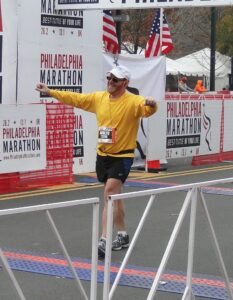
5 – Philadelphia 2012 – Age 47 – Time: 5:41:40
Eight years after my 2nd knee operation and having accepted the doctor told me I could not run anymore, I discovered racewalking and came back to long distances, regimented training and rediscovered the lure of footraces, long distances and runner’s highs. I accepted the days of running at 3:30 were over and trained for what my older body would allow me. So, 26 years after my previous marathon, I racewalked through the City of Brotherly Love and cried while crossing the finish line while F-U-ing the doctor who told me I couldn’t do it. You can do more than you think possible if you adjust to your circumstances.
6 – Chicago 2013 – Age 48 – Time: 5:44:56
Your body can do way more than you expect from it if you train it, fuel it, and take care of it, not just during the 3 or 4 months prior to your marathon, but for many years or for a lifetime. I endured three visits to the emergency room 3 times during my training, and I participated with the prospect of passing a kidney stone at any time. My training was not ideal (but unlike my NYC 1983 experience, I did train some), yet I finished and did so with a grateful smile despite being my personal worst. I did the best I could with what was available for me that day. It is not always about a PR for a marathon to be a success.
7 – Marine Corps 2014 – Age 49 – Time: 5:33:31
With three years of racewalking and two marathons under my soles, I was ready to go for a PR. I got a racewalking expert to write me a training plan; I followed it to the tee; I sacrificed late nights, ate clean, put in the work, and traveled to DC feeling very strong. The work paid off, and an 8-minute racewalking PR was the result. It was a bit hard at the end and I lost my sub 5:30 in the last 6 miles, but there is nothing to regret. Another successful marathon when focusing on the task.
8 – New York 2017 – Age 52 – Time: 4:51:48
In 2015 I realized I was racewalking because the doctor told me not to run, not because I had tried and failed. So, I tried and did not fail and two years later, I was at the Verrazano Narrows bridge, 34 years after my first participation. I trained diligently, and the results reflect my efforts. I was at my desired 4:30 pace until we got back to Manhattan, when my left knee started acting up. As soon as we entered Central Park at mile 23 I realized it was not worth permanent injury, so I mostly walked the last 5K and still finished 12 seconds off my NYC when I was 18. Hard work pays off even if your race gets derailed at the end.
9 – Berlin 2018 – Age 53 – Time: 5:09:03
Sometimes you may be fully prepared; you did everything right, you worked hard, you are at the right weight, and you are mentally there, yet your race totally sucks. So much that you lose the joy of what you are doing, you finish 40 minutes above the time you trained for and then swear you’ll never do this again. Good training is no guarantee of a good race. Sometimes the stars are just not aligned for you.
10 – New York 2020 – Age 55 – Time 5:28:14
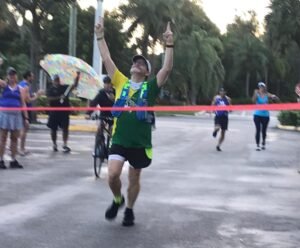
Didn’t I swear I wasn’t going to do this anymore? In the middle of the pandemic, I had been dealing with a congenital heart issue for the last 18 months or so. I was told not to raise my heart rate over a certain threshold. I kept running super easy through the lockdown. So I could keep focused, I took the NYC Marathon virtual challenge. I set up a race/walk protocol; I trained diligently, set up a route and support system, and I completed the distance. As with my knee and racewalking a few years ago, I realized I could adjust to my circumstances and still conquer another marathon.
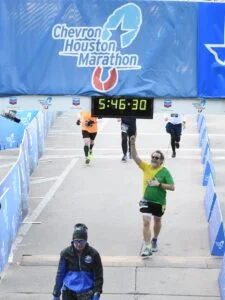
11 – Houston 2022 – Age 56 – Time 5:16:45
I registered for this marathon two weeks before my June open-heart surgery because I wanted to make sure I had something pressing me to get back to work. I was cleared to run in September, and 4 months later, I ran/walked the marathon. This marathon told me that in certain circumstances, time goals are irrelevant because the fact that you can bring your body back to perform the task overshadows any clock. This finish allowed me to, in just 7 months, to pass the page and move on to the rest of my life.
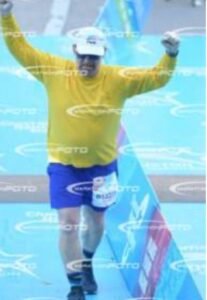
12 – Houston Marathon 2025 – Age 59 – Time 5:16:52
After two difficult years of running, when little went right, when I wondered if my best running days were behind me, and when I had to accept that after my open-heart surgery, I may have lost a step or two, training finally clicked, and I was ready for another marathon. I had the privilege of running side-by-side for 20 miles with two good friends. Then we parted ways and at Mile 23, my left IT band started killing me and forced me to suffer/walk the last 5K. I was happy to finish but unhappy with the result. It happens. Good training never guarantees a good result.
The leitmotif of my marathoning has been overcoming obstacles and learning lessons on the way. Even though my lifetime PR is decent at 3:32, I accept that after 40+ years in action, my best running years are behind me. That doesn’t diminish any accomplishments I may add to my medal rack between now and the day the Lord calls me.
Sharing what I’ve learned with the marathoners I train is what keeps me focused and thankful for the struggles and successes along the way. Even though I crossed the marathon finish line only 12 times, through my athletes, I have crossed it over 100 times.
I recently read Ball Four, the classic baseball book from the 1970s by the controversial major league pitcher Jim Bouton. In it, Bouton discusses the 1969 spring training with the expansion Seattle Pilots and the high expectations management had for their upcoming season: “We may be building ourselves up to that kind of fall with this club. Everybody is saying we’re going to be great. There’s a difference between optimism and wishful thinking.”
Sitting on the couch wishing you were running won’t get you very far in achieving your goals (Image by Windows Copilot)
Don’t we all know a runner who fits into that last sentence? When was the last time we were the runner matching it? I smelled a blog post right away. Thus, here we are.
As runners, we are all about optimism. We must be optimists if we want to look into the future and visualize what we want, how to achieve it, and how to set up a map from where we are to where we anticipate being. Sure, some daydreaming is allowed, and it is even necessary to keep ourselves moving forward, especially through the inevitable periods of difficulty that will show up in every training cycle.
According to the Merriam-Webster dictionary, optimism is “an inclination to put the most favorable construction upon actions and events or to anticipate the best possible outcome.”
If we ran a 1:05 in our last 10K, we dream not just of the 59:59, but why not a 55:00? If we ran a 3:20 marathon, we would know by heart all the mathematical breakdowns needed for that magical Sub-3. These are healthy and within the boundaries of feasibility.
But if you just ran that first sub-20 5K and started focusing on qualifying for the Olympics next year, or if you are eying that marathon PR but haven’t run in three months, then we are entering the realm of wishful thinking.
The same dictionary defines wishful thinking as “the attribution of reality to what one wishes to be true or the tenuous justification of what one wants to believe.”
Optimism is a great tool to keep you engaged and focused. Wishful thinking is a recipe for a letdown and/or injury. Sitting on the couch wishing you were running will not make you a better runner.
Examples of Optimism:
• I am trusting the process my coach has laid out for me. I will follow it up to the best of my ability.
• I’ve seen gradual improvements in my training, and I know I can keep progressing if I stay consistent.
• I didn’t hit my goal in this race, but I know what I need to adjust in training to improve next time.
• I’m excited to tackle the next training cycle because it’s designed to address my weaknesses.
• My pace has been steadily improving, and I know that if I stay disciplined, I’ll reach my target time.
• I’ve learned from my setbacks, and I trust that I’ll achieve my personal best with perseverance.
• I’ve been putting in the work, and I trust that the results will follow with patience and dedication.
Being an optimist and doing something about it is the path to achieve your running goals (Photo Pexels)
Examples of Wishful Thinking:
• When I get off this couch and start training, I will really focus on being the best runner I can be.
• I haven’t trained consistently, but I can still PR in my next race if I push hard on race day.
• I skipped a few workouts this week, but I’ll just make up for it by running harder next week.
• I don’t need a specific training plan; I’ll just wing it and rely on my natural ability.
• I haven’t been doing speed work, but I still can hit my goal pace in my upcoming race.
• I’ve been running the same pace for months, but I’m sure I’ll somehow drop 30 seconds per mile next week.
• I’m planning on hitting a huge PR in my next race, even though I’ve barely trained, and my body feels off.
Let’s focus on our goals and create a solid plan to get from point A to point B, then follow through with discipline to achieve it. It sounds simple, even obvious, but haven’t we all found ourselves stuck in wishful thinking at some point—maybe even recently? Now that we understand the difference, let’s commit to staying on the right side of the line and strive for the best, most realistic performance we can achieve.
Please like the post and share it with someone who may benefit from it.
The way to grow as a coach is through experience, reading, listening to people who know more than you and asking them questions. Obtaining a coaching certification is important, but it is not what makes you a competent one. It is just a steppingstone into a fascinating world of learning and experimentation. Maintaining curiosity alive is what has made the coach I am today.
One of the most influential people in my coaching journey has been Steve Magness. He is knowledgeable, curious, experienced, science based, and a clear communicator. He is also generous, sharing his expertise and experience through many channels.
Steve Magness is one of the most influential people in my coaching journey
Magness is a globally recognized authority on performance and the author of influential books such as \”Do Hard Things\” and \”Peak Performance\”. His work delves into the intricacies of resilience and the science behind true toughness. Beyond his literary contributions, Magness has coached an array of clients ranging from professional sports teams to executives and artists, emphasizing a holistic approach to performance enhancement. His expertise has garnered attention from publications such as The New York Times and The Guardian, reflecting his profound impact on the realms of elite sport and mental performance.
In a social media world filled with shallowness and stupidity, Magness\’ feeds stand out as an oasis of enlightenment. I\’ve curated three of his posts that encapsulate concise running wisdom. May they prove as beneficial to you as they have been to me.
On Greatness
What does it take to be great?
A relentless drive, a fiery competitiveness?
Yes, but the same thing that makes you great can be your downfall.
The greats balance it out:
– Caring deeply but being able to let go
– Harnessing aggression but in a controlled way
– A desire to win, to achieve, but with enough intrinsic motivation to keep them from chasing.
Learn how to become great without falling apart.
Steve Magness
My take: You have a running goal? Great! Focus and work for it. Work hard. Give it the best chance to become reality. It is OK to want it badly. Nothing wrong with it. But you can’t let it rule your life. Especially if running is not your profession. Don’t let a running goal ruin your life. Your family will still love you if you are not a Sub-2 half marathoner. If your friends don’t value you unless you are a Sub-3 marathoner, it is time to change friends. Maintain perspective.
On the training process:
The 5 Rules of Training:
1. The boring stuff is your foundation. Do that consistently for a long time.
2. Let it Come, Don’t Force it.
3. Take the Next Logical Step. Don\’t skip many steps.
4. You lose what you don’t train. You are either building or maintaining something.
5. Train the individual, not the system.
Steve Magness
My take: Endurance training is a journey that demands trust and patience. While the allure of speed may be captivating, it\’s the establishment of a solid foundation what truly matters. Constructing this base entails a methodical yet sometimes monotonous progression through various training stages. Each one is an essential step for improvement. Your coach is not hiding the shortcuts.
On Competitiveness
We’re used to thinking of competitiveness as either you got it, or you don’t.
But research paints a different picture. It depends where that competitiveness comes from.
Hyper-competitiveness is when we try to maintain our sense of self through winning. We seek validation through the external.
Self-developmental competitiveness occurs when the internal matters more than the external. It’s about growing through competing, discovering who we are, what we’re capable of & how to improve.
Steve Magness
My take: We all know that runner whose self-worth is linked to his/her PRs. Most likely you know someone who rather end up assisted by paramedics than not make it to the podium. Unless you are in the Olympics, it is not worth missing your kids’ wedding. It is not about not making sacrifices for what you want, it is about not neglecting your life, health, and family in exchange for a PR.
If you have any thoughts, please share them in the comment box below.



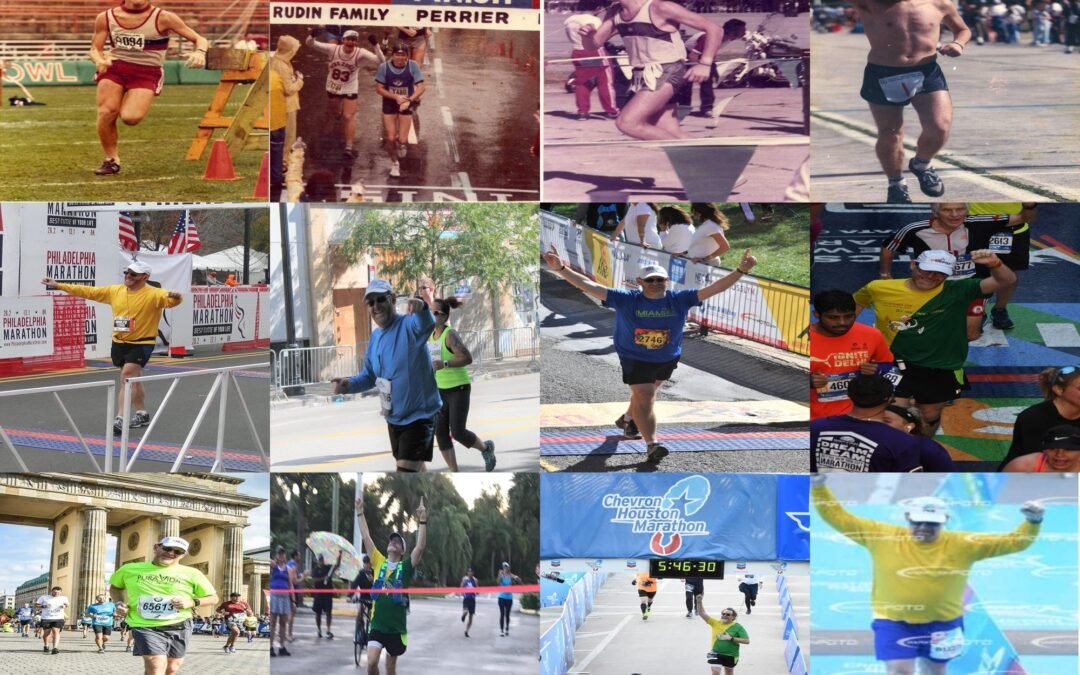


 3 – Caracas 1984 – Age 19 – Time 3:32:08
 4 – Caracas 1985 – Age 20 – Time 3:35:04
 5 – Philadelphia 2012 – Age 47 – Time: 5:41:40
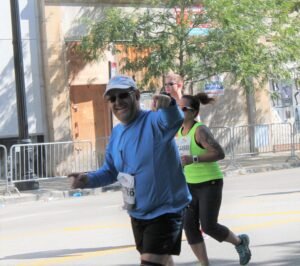 6 – Chicago 2013 – Age 48 – Time: 5:44:56
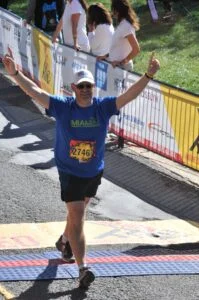 7 – Marine Corps 2014 – Age 49 – Time: 5:33:31
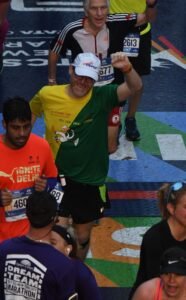 8 – New York 2017 – Age 52 – Time: 4:51:48
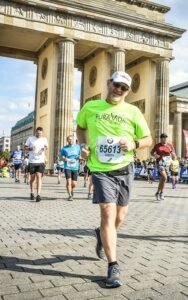 9 – Berlin 2018 – Age 53 – Time: 5:09:03

 11 – Houston 2022 – Age 56 – Time 5:16:45
 12 – Houston Marathon 2025 – Age 59 – Time 5:16:52