Optimism vs. Wishful Thinking

Optimism vs. Wishful Thinking

By Coach Adolfo Salgueiro

I recently read Ball Four, the classic baseball book from the 1970s by the controversial major league pitcher Jim Bouton. In it, Bouton discusses the 1969 spring training with the expansion Seattle Pilots and the high expectations management had for their upcoming season: ā€œWe may be building ourselves up to that kind of fall with this club. Everybody is saying we’re going to be great. There’s a difference between optimism and wishful thinking.ā€

Optimism vs. Realism

Sitting on the couch wishing you were running won’t get you very far in achieving your goals (Image by Windows Copilot)

Don’t we all know a runner who fits into that last sentence? When was the last time we were the runner matching it? I smelled a blog post right away. Thus, here we are.

As runners, we are all about optimism. We must be optimists if we want to look into the future and visualize what we want, how to achieve it, and how to set up a map from where we are to where we anticipate being. Sure, some daydreaming is allowed, and it is even necessary to keep ourselves moving forward, especially through the inevitable periods of difficulty that will show up in every training cycle.

According to the Merriam-Webster dictionary, optimism is ā€œan inclination to put the most favorable construction upon actions and events or to anticipate the best possible outcome.ā€

If we ran a 1:05 in our last 10K, we dream not just of the 59:59, but why not a 55:00? If we ran a 3:20 marathon, we would know by heart all the mathematical breakdowns needed for that magical Sub-3. These are healthy and within the boundaries of feasibility.

But if you just ran that first sub-20 5K and started focusing on qualifying for the Olympics next year, or if you are eying that marathon PR but haven’t run in three months, then we are entering the realm of wishful thinking.

The same dictionary defines wishful thinking as ā€œthe attribution of reality to what one wishes to be true or the tenuous justification of what one wants to believe.ā€

Optimism is a great tool to keep you engaged and focused. Wishful thinking is a recipe for a letdown and/or injury. Sitting on the couch wishing you were running will not make you a better runner.

Examples of Optimism:

• I am trusting the process my coach has laid out for me. I will follow it up to the best of my ability.

• I’ve seen gradual improvements in my training, and I know I can keep progressing if I stay consistent.

• I didn’t hit my goal in this race, but I know what I need to adjust in training to improve next time.

• I’m excited to tackle the next training cycle because it’s designed to address my weaknesses.

• My pace has been steadily improving, and I know that if I stay disciplined, I’ll reach my target time.

• I’ve learned from my setbacks, and I trust that I’ll achieve my personal best with perseverance.

• I’ve been putting in the work, and I trust that the results will follow with patience and dedication.

Optimism vs. Realism

Being an optimist and doing something about it is the path to achieve your running goals (Photo Pexels)

Examples of Wishful Thinking:

• When I get off this couch and start training, I will really focus on being the best runner I can be.

• I haven’t trained consistently, but I can still PR in my next race if I push hard on race day.

• I skipped a few workouts this week, but I’ll just make up for it by running harder next week.

• I don’t need a specific training plan; I’ll just wing it and rely on my natural ability.

• I haven’t been doing speed work, but I still can hit my goal pace in my upcoming race.

• I’ve been running the same pace for months, but I’m sure I’ll somehow drop 30 seconds per mile next week.

• I’m planning on hitting a huge PR in my next race, even though I’ve barely trained, and my body feels off.

Let’s focus on our goals and create a solid plan to get from point A to point B, then follow through with discipline to achieve it. It sounds simple, even obvious, but haven’t we all found ourselves stuck in wishful thinking at some point—maybe even recently? Now that we understand the difference, let’s commit to staying on the right side of the line and strive for the best, most realistic performance we can achieve.

Please like the post and share it with someone who may benefit from it.

Thoughts from a Coaching Role Model

Thoughts from a Coaching Role Model

Ā  By Coach Adolfo Salgueiro

The way to grow as a coach is through experience, reading, listening to people who know more than you and asking them questions. Obtaining a coaching certification is important, but it is not what makes you a competent one. It is just a steppingstone into a fascinating world of learning and experimentation. Maintaining curiosity alive is what has made the coach I am today.

One of the most influential people in my coaching journey has been Steve Magness. He is knowledgeable, curious, experienced, science based, and a clear communicator. He is also generous, sharing his expertise and experience through many channels.

Coaching

Steve Magness is one of the most influential people in my coaching journey

Magness is a globally recognized authority on performance and the author of influential books such as \”Do Hard Things\” and \”Peak Performance\”. His work delves into the intricacies of resilience and the science behind true toughness. Beyond his literary contributions, Magness has coached an array of clients ranging from professional sports teams to executives and artists, emphasizing a holistic approach to performance enhancement. His expertise has garnered attention from publications such as The New York Times and The Guardian, reflecting his profound impact on the realms of elite sport and mental performance.

In a social media world filled with shallowness and stupidity, Magness\’ feeds stand out as an oasis of enlightenment. I\’ve curated three of his posts that encapsulate concise running wisdom. May they prove as beneficial to you as they have been to me.

On Greatness

What does it take to be great?

A relentless drive, a fiery competitiveness?

Yes, but the same thing that makes you great can be your downfall.

The greats balance it out:

– Caring deeply but being able to let go

– Harnessing aggression but in a controlled way

– A desire to win, to achieve, but with enough intrinsic motivation to keep them from chasing.

Learn how to become great without falling apart.

Steve Magness

My take: You have a running goal? Great! Focus and work for it. Work hard. Give it the best chance to become reality. It is OK to want it badly. Nothing wrong with it. But you can’t let it rule your life. Especially if running is not your profession. Don’t let a running goal ruin your life. Your family will still love you if you are not a Sub-2 half marathoner. If your friends don’t value you unless you are a Sub-3 marathoner, it is time to change friends. Maintain perspective.

On the training process:

The 5 Rules of Training:

1. The boring stuff is your foundation. Do that consistently for a long time.

2. Let it Come, Don’t Force it.

3. Take the Next Logical Step. Don\’t skip many steps.

4. You lose what you don’t train. You are either building or maintaining something.

5. Train the individual, not the system.

Steve Magness

My take: Endurance training is a journey that demands trust and patience. While the allure of speed may be captivating, it\’s the establishment of a solid foundation what truly matters. Constructing this base entails a methodical yet sometimes monotonous progression through various training stages. Each one is an essential step for improvement. Your coach is not hiding the shortcuts.

On Competitiveness

We’re used to thinking of competitiveness as either you got it, or you don’t.

But ​research​ paints a different picture. It depends where that competitiveness comes from.

Hyper-competitiveness is when we try to maintain our sense of self through winning. We seek validation through the external.

Self-developmental competitiveness occurs when the internal matters more than the external. It’s about growing through competing, discovering who we are, what we’re capable of & how to improve.

Steve Magness

My take: We all know that runner whose self-worth is linked to his/her PRs. Most likely you know someone who rather end up assisted by paramedics than not make it to the podium. Unless you are in the Olympics, it is not worth missing your kids’ wedding. It is not about not making sacrifices for what you want, it is about not neglecting your life, health, and family in exchange for a PR.

If you have any thoughts, please share them in the comment box below.

Ā 
Balancing Running and Life: Finding Perspective

Balancing Running and Life: Finding Perspective

By Coach Adolfo Salgueiro

A few days ago, I received a phone call from one of my athletes. She’s training for her second marathon, which is fast approaching. My concerns exploded right away, as the first words out of her mouth were: ā€œI have a problem!ā€. Possibilities such as injury, illness, unexplained pains, job loss, etc., started rushing through my mind. In this blog post, we’ll explore the art of balancing running and life, especially when facing unexpected life dilemmas.

ā€œWhat’s happening?ā€, I asked as I tried to contain my uneasiness so I could keep her calm.

ā€œMy husband bought tickets to a comedy show on Friday night, and I won’t be able to do my Saturday long run?ā€. She explained.

Balancing Running and Life

Multiple aspects of your life must be juggled around so your running doesn’t become the ruler of your schedule (Photo Michael Judkins, Pexels)

As the color returned to my face, I told her with the best sarcastic tone I could muster: ā€œWhat an inconsiderate man! Wanting to go out on a Friday night, with his wife, to have fun? That is awful. If you could only move that long run to Sunday.ā€

Then I explained that as important as her marathon is, and as much as she is invested in her running, keeping a balanced life between family, work, and running is essential. This was not the night before her marathon, and it doesn’t happen every Friday night. If she doesn’t allow the necessary flexibility to move some workouts around, then her husband, her kids, and eventually her, will resent her running. That would be disastrous for all the parties involved.

ā€œThank you for the perspectiveā€, she said. And hung up two seconds laterā€.

I guarantee this incident is not an isolated one. I bet every single reader of this blog post has a personal version of this story. I certainly do. More than one. At one time or another, we had to confront this reality. ā€œI want to train. But my—insert relationship here—wants to—insert activity here— What should I do?ā€

Most likely you are not qualifying for the Olympics, lining up side-by-side with Eliud Kipchoge at the Berlin Marathon start, or even considered the favorite to win your local 5K. So, moving things around in your training schedule, or God forbid, skipping a workout, are feasible arrangements to fit in running around your life.

Balancing Running and Life

What to do if you score World Series tickets for the night before your marathon?

In my experience, both personally and as a coach, the newer you are in the sport, the tougher it becomes to keep running in perspective. As you get started on your journey, the improvement curve is so steep that you want to keep the progress for as long as possible. You may not understand the benefits of a day off, or that not one particular session is going to make or break your race or your running career. This is the time when you must check in with your coach or your more experienced running buddies to help you put it into perspective.

Just like the runner at the start of this post, you may be taken aback by tickets to an event at an inconvenient time. It happens. Hopefully, you shared your goal race with your significant other and he/she will time well the invitations. But it could also happen that you get your hands on tickets to something like the World Series when your team is playing but is happening the night before your New York City Marathon. Then it is time to choose between a once-in-a-lifetime event and what you’ve trained for but may certainly do again, later.

My son got married on a Friday night in November. That’s high training season for local racing where I live. Asking my son to get married another day because I run long on Saturdays was not right. Missing his wedding was out of the question. So, what do you do? You attend your son’s wedding, you have fun and you forget about running on behalf of a momentous occasion in the life of an important person in your life. That’s what you do.

Sure, sacrifices must be made. But it is never about having to choose between your running and your spouse, your significant other, your kids, your family, friends, or work. It is about understanding that in life, there are more important things than a rack full of medals.

Have you ever been faced with a dilemma between running and life? Please share your experience in the comment box below.

Ā 
When You Must Withdraw from Your Marathon

When You Must Withdraw from Your Marathon

By Coach Adolfo Salgueiro

A few months ago, I posted on Facebook that I had signed up for the Marine Corps Marathon, which will take place on October 29th. Up until a few days ago, I was training for it. Today I must announce that I am withdrawing from the race. It is a regrettable yet humbling experience that is currently forcing me to reassess where I am with my running, why I got here, and how to get out of it.

Ā 

Withdraw from your marathon

It is not a failure as long as you learn from it so it doesn’t happen again (Photo: Pexels)

It is more than safe for my readers to assume that training was not going as planned. It had become more of a suffer-fest than the enjoyable experience with its usual highs and lows. Things were not clicking. The efforts were mammoth-like. Recovery took too long. I began to dread the long runs. The speed work took so much out of me that I was unable to feel any progress. It was a death spiral.

Maybe I was overtrained or under-recovered. Maybe it was the heatwave currently affecting the entire Northern Hemisphere. Maybe the long runs at 86Āŗ temperatures (30ĀŗC) with 100% humidity, where your sweat doesn’t evaporate, were overtaxing my body. Maybe, as running comes in cycles, I am amid a low instead of a high. Maybe, a month away from 58, I must accept that I am not what I was just a few years ago. Maybe the few extra pounds I haven’t been able to shed off were multiplying my effort. Maybe my body is not the same two years after my open-heart surgery. Maybe it is a combination of everything. Who knows?

It was a tough decision, as I was training with two committed runners I am also coaching. Seeing them thrive while the coach could not keep up was embarrassing. It was difficult when we set out for a long run, and I had to turn around earlier because I knew that I just didn’t have it that day, or the next, and the next, too. As if this wasn’t enough, my left knee, the weakest link in my running life (2 surgeries), started hurting again for the first time in years. Deep inside I believed that if I kept going, everything would eventually click. That my body would magically adapt. I know I hung on longer than I should have just because I felt obligated to my runners. But the time of reckoning was inevitable.

As I was suffering, plenty of friends told me that I shouldn’t worry because October in DC has wonderful weather. As much as I appreciate the thought and encouragement, I still needed to train in the hot and muggy South Florida so I could enjoy the good weather in DC, in October.

Ā 

Withdraw from your marathon

The updated version of this picture will have to wait.

And that’s the other thing. There is no doubt in my mind that I could have finished the race. But with 11 marathons under my belt, just finishing is no longer a worthy goal. I am not willing to suffer to cross the line in 5:30. I wanted to run a marathon at 58 so I could beat my dad’s age of 57 when he ran his last. I also wanted to run it in 4:30, to beat the 4:43 of his last 26.2. So, God willing, I still have plenty of time to achieve those two goals, hopefully while my dad is still alive, so I can brag about them.

The next steps are to reassess where I am at this point and how I got here. I will start by resting my body. I will keep running but won’t push too hard through the muggy days with longer or faster runs. I will work based on effort and run easily to regain the aerobic capacity I feel I have lost. I will focus on running the best half marathon I can next season. Hopefully, three or four of them until I can put together an effort I can be satisfied with. Maybe I’ll try to set new 55+ PRs in the 5K and 10K. Once I feel I am back, then I will figure out what is next and plan for my next marathon. I know I have at least one more in me.

The one thing I know is that I will keep running. Withdrawing from this marathon is a humbling experience that I must learn from. It is only a failure if you don’t learn anything from it and thus, you screw it up again.

I live by my motto: Always moving forward.

Ā 
Coach Adolfo Featured in a Runner’s World Article

Coach Adolfo Featured in a Runner’s World Article

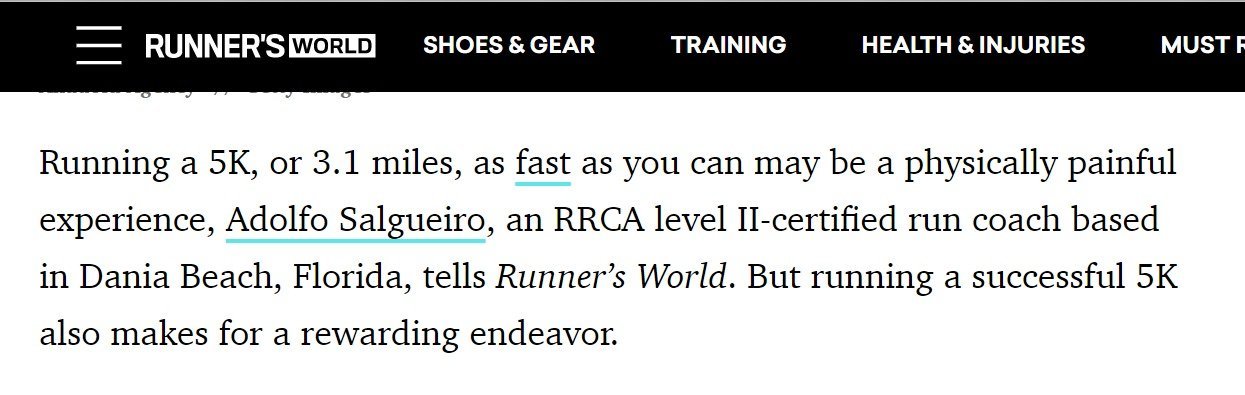
Runner’s World Magazine, the reference media outlet for the running community for over 50 years, ran an article on April 27, titled ā€œHow to Pace a 5K So You Can Hit Your PRā€. It was written by Stephen Sheehan. The expert quoted throughout the narrative was Coach Adolfo Salgueiro, head coach at Foultips.Run.

Ā ā€œI have been a Runner’s World reader since the early 1980s,ā€ Stated Coach Salgueiro. ā€œBeing able to contribute to one of their articles is a dream come true. The fact they wanted my expertise on the subject is a statement to the value of the decades of experience and preparation I’ve put into this passion of mine.ā€

Runner's World

Ā This is the second time Coach Adolfo has been in Runner’s World. A summary on his running career ran back in March 2021.

To read the full Runner’s World article you may click here.

Ā Be aware that Runner’s World has a limit on the number of free articles non-members can read a month. If you have exceeded such a number, you may have to come back next month to read it. Or contact me and I will send you a PDF version.

Ā 

Skip to content