I joke (partially) with my running buddies that the day I ran against Eliud Kipchoge in Berlin (2017), he needed a world record to beat me. Sure, I started in wave 4 and was 15 miles behind when he crossed the finish line, and while I certainly had no chance of beating him, the statement is still 100% true.
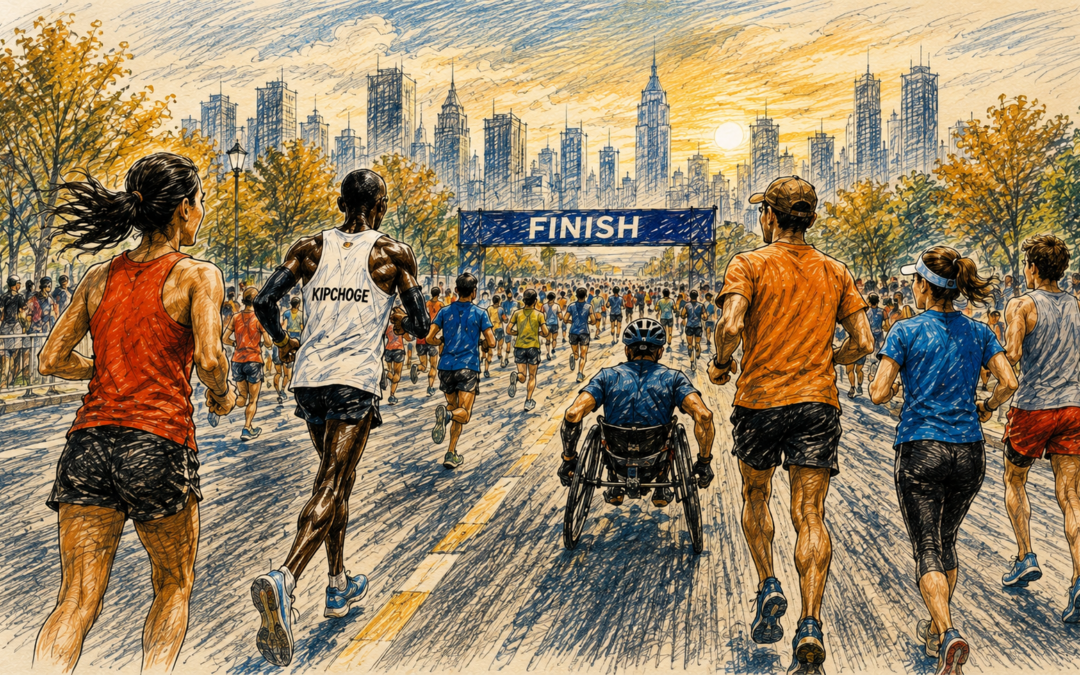
All you need is the will to go for a run. Everything else is additional (Image by Grok)
Consider this: what are your chances of standing in the huddle in a Super Bowl, strategizing the next play? When will you face Shohei Ohtani on an MLB field? How about your odds of standing with or against Lio Messi during the World Cup? Driving in an F1 Grand Prix? US Open. Golf or tennis?… Anyone?
But running is different. When the marathon’s 2-hour mark was broken, a runner I trained was there. When Kipchoge broke his last world record (Berlin 2022), another runner I trained was there. During the epic battle between Alberto Salazar and Rodolfo Gomez at the 1982 NYC Marathon, my dad was there. A close friend crossed the finish line in Boston, 10 minutes before the bombing. The last time the immortal Bill Rodgers won a marathon (Orange Bowl 1983), he had to beat me, too.
So, you get the point. Running is the most democratic of sports. The one with the most open access, equal opportunity to participate, low barriers of entry, and outcomes driven mostly by effort rather than status.
Remember dreaming of running, or lacing your shoes for the first time? Or how you felt after a long hiatus? Remember the struggle to finish that first long run? Have you checked the back of the packers at a race? Have you taken the time to watch the videos of the last finishers at a big-city marathon? Is there any other sport where regular people, even with a variety of disabilities, can beat the odds by finishing the biggest and most iconic races in the world?
Sure, only a selected few will run in the Olympics or the world championships, but even you, dear reader, can run the mythic Boston Marathon, even if you don’t qualify. We know you have a better chance of hitting the Powerball than the London Marathon Lottery, but the chance is there, and you still have charity entries. And if you are not into multitudinous mega races, there are local 5Ks everywhere, every week.
In his book “When Running Made History”, literature professor and former elite runner Roger Robinson said: “Being a runner (this sounds naive but isn’t) gives you direct and unfiltered access to all other runners. That’s one thing that makes running so remarkable; it is an intensely competitive sport that is also an egalitarian community. Just put your shorts and shoes on and if you’re fast enough, you can run with, befriend, and, if so inclined, interview the greatest celebrities on earth.”
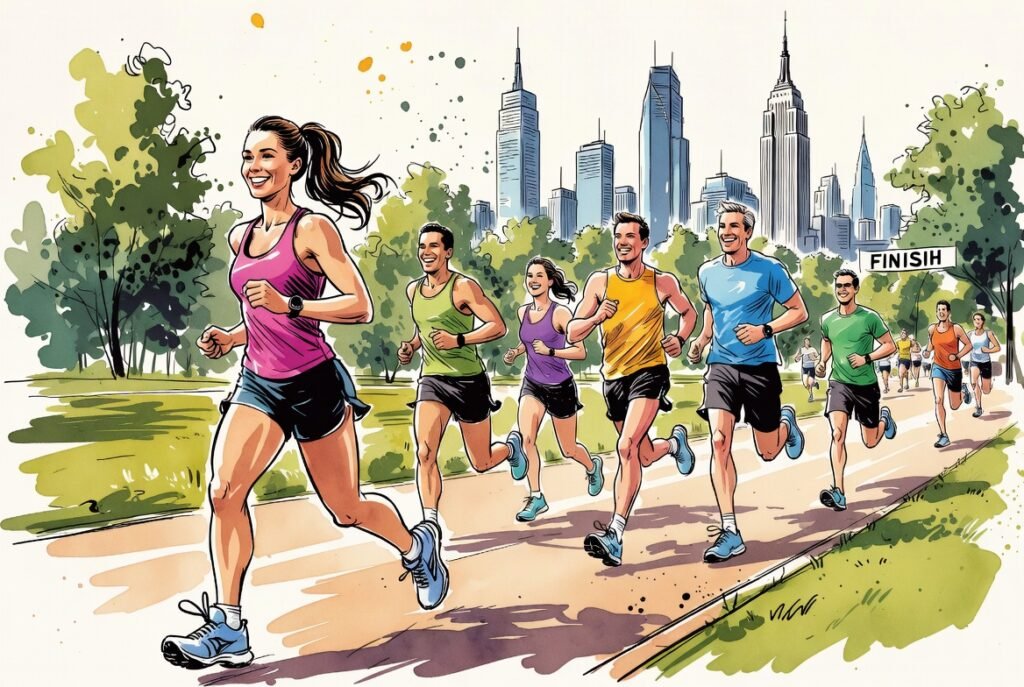
In running, you will only get out what you put into it (Image by Grok)
Think about it: when it comes to running, you don’t need an opposing team or a field. Let alone a golf course. You don’t need a court, like tennis, basketball, or pickleball. You don’t even need a group of friends or a rival. All you need is the will to run. Everything else, everything, is extra.
You can run in the crappiest of shoes, or even barefoot. You can run in jeans and cotton socks if that is all you have. You don’t need a watch, you don’t need company, and you don’t need a dedicated surface or place. The comfort of a good pair of running shoes, a tech shirt/shorts, moisture-wicking socks, and a running path with good friends will surely make it more enjoyable, but as for requirements, none beyond your willingness to go out for a run.
Biologist and 2:22 marathoner Bernd Heinrich wrote in Why We Run: A Natural History: “Running is perhaps the most fundamental of all sports… it is the most democratic and most competitive of all sports because individual merit can prevail despite economic equality. It is a sport for everyone, the whole world over.”
Meritocracy in action. What a beautiful concept!
The great running author and philosopher George Sheehan said, “Life is a positive-sum game. Everyone from the gold medalist to the last finisher can rejoice in a personal victory.”
Fred Lebow, the father of the NYC Marathon, said, “In running, it doesn’t matter whether you come in first, in the middle of the pack, or last. You can say, ‘I have finished.'”
Beyond the health and social benefits, running is a sport where you can only get out as much as you put in. The one sport where we have the chance to participate in the biggest local, national, and international competitions. The one we can practice at a moment’s notice, just when we need it. Yes, need it. The one where the winner and the last one across the finish line get the same medal. The one where we can make friendships to last a lifetime.
Let’s go for a run, then. What are you waiting for?
👇Do you want the key takeaways of this blog post? 👇 👇Click below to watch the video summary 👇
I’ve written about my first marathon in bits and pieces throughout this blog, but I’ve never written anywhere about my entire recollection of that 1983 Orange Bowl Marathon. This upcoming January 22nd will be the 39th anniversary of my race. So, before my memories keep fading away, I better put all I can recall into paper (or digital format).
I was a 17-year-old high school senior living in Caracas, Venezuela. I always kept active by running, practicing karate, baseball, soccer, tennis, hiking, swimming, biking and whatever came along. Running a marathon was a goal somewhere on the backburner, but, thanks to my dad, I got the chance to fulfill it earlier than expected.
I believe we arrived in Miami the day before the Saturday race. We stayed in a hotel in downtown and went to a spacious hotel ballroom nearby, to pick up our bibs. I remember being blown away by the technology of the day, when my bib was printed before my eyes, instead of being ready ahead of time. I don’t recall an expo, but that doesn’t mean it wasn’t there. I read, maybe in that day’s Miami Herald, that none other than the legendary Bill Rodgers was the favorite to win.
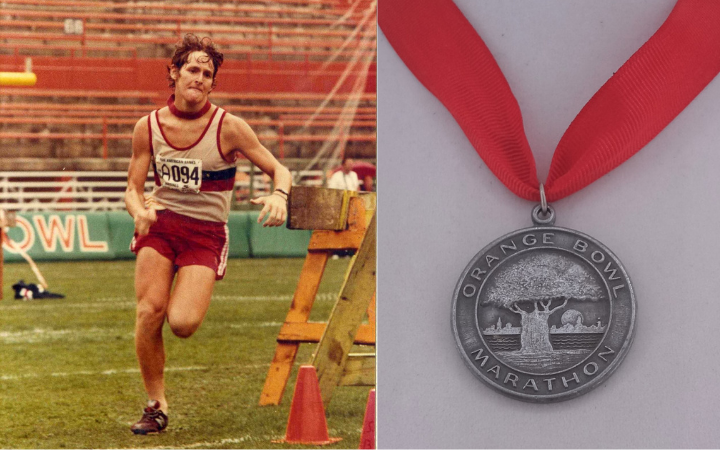
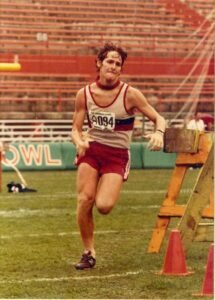
This is the only picture I have from the race, but it is one of the best running pictures ever taken of me. Check out the detail of the untied shoe with no socks, to which I make reference, later in the post.
I also recall my dad buying me a Casio stopwatch, so I could keep track of my marathon time. I had that Casio for years. I don’t remember how I lost it or when it broke, but I’ve seen it in pictures from the early 90s.
On race morning we met with the Venezuelan runners, most of them where my dad’s buddies, at the hotel lobby. The one thing I vividly remember was asking for a coffee at the hotel bar and getting a gigantic cup of black, diluted, disgusting American coffee. At home, a small cup of good coffee with a generous amount of milk would start off the day.
One of the runners had rented a sports car and somehow, more people than was safe crammed inside for a short drive to the majestic (at lease in my eyes) Orange Bowl Stadium. This is where the Miami Dolphins, who were playing the Super Bowl next week, held their home games.
Before time chips, you had to present yourself and your bib to the organizers, so they knew you were at the starting line. Somehow, we could not find the registration table. We were looking for it like crazy until we realized this was going to be based on the honor system.
I recall nothing about the starting gun, crossing the starting line or conversations along the way. I do remember, though, my dad constantly reining me in because I was going too fast. He also reminded me to take water every so often, as the humidity was exceedingly high.
My dad has one indelible memory of the race. After a rainy patch along the way, we found ourselves running next to a woman with a drenched, white outfit that left nothing to the imagination. At 17 and with raging hormones, I couldn’t but get distracted by the magnificent side show. My dad had to bring me back to the race at hand. There is no marathon talk in my household where this story doesn’t come up.
The course had two in-and-out segments (Coral Way and Coconut Grove). Both times, as we were going in, the pack led by Bill Rodgers, was coming out. For a 17-year-old kid from Caracas, seeing the legendary Bill Rodgers, running in the same race within a few meters from each other, was the highlight of the event. It was the equivalent of participating in the same Monaco Gran Prix with Niki Lauda or playing in Veterans Stadium, side-by-side with Mike Schmidt. It was that improbable.
Sometime during the Covid lockdown of 2020, my friend Starr Davis invited me to participate on a Zoom call with Rodgers. At the end, I had the chance to asked him what he remembered form the 1983 Orange Bowl. Surprisingly, he recalled a lot. Starr recorded the interaction with her cellphone. I invite you to check the video, which I have included right here.
Most of my memories of the 1983 Orange Bowl Marathon are from the last 7.2 kilometers (4.5 miles). I recall them vividly because I suffered miserably. My dad and I agreed to run together for 35 kilometers (21.8 miles), and from there, each one would run his own race. By kilometer 35.1 he had already left me in the dust. I slowed down and started walking. I was drenched, tired, hungry, and questioning what the fuck was I doing there, instead of being at home in Caracas, maybe getting ready to play baseball with my buddies.
At one point, it had to be closer to the end, I took my shoes off and started walking on my socks. The shoes were heavy, and I considered just tossing them to the side, but then I thought of my dad getting upset, as they were the shoes he let me borrow, so I decided to keep them. Wise choice.
A friend of my dad, the late Jose Ortega, saw me close to the end and ran a bit with me with words of encouragement. I promised him I would finish so I discarded my socks, put on the shoes, which I did not tie, and started running. The next memory I have is of my dad and some Venezuelan runners at the entrance of the stadium, cheering me on. As I hit the grass, I started sprinting like crazy. To this day I can’t figure out how my shoes didn’t fly off my feet. Check them in the accompanying picture. Not only untied, but open at the top.
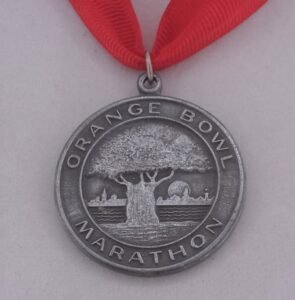
37 years later, I got my hands on a medal from the race
I lifted my arms as I crossed the finish line and, one way or another, I found my dad and collapsed. My first thought was: “When are we doing the next one?”
I knew my time was around 4:11 but I did not know for sure. I wouldn’t find until months later when I got my finisher’s certificate in the mail, that my official time was 4:11:11. I also got a proof of one picture in case I wanted to order it. It is the only image I have from the entire experience. Thank God is one of the best pictures ever taken of me running.
In those days, medals were not ubiquitous or for everybody, and I did not get one. In September 2020 I found one on eBay and jumped on it. If you care to read about the 37-year medal saga you can check the blog post I wrote about it by clicking here.
Sorry if this blogpost ran longer than usual, but I am trying to recall as much as I can. Yes, I could have waited until next year, the 40th anniversary, but by then, I may forget something else. And I can always repost.
In the few years after Frank Shorter won the Olympic gold medal in the 1972 Olympic marathon, officially starting the running boom in the United States, there was no marathoner more famous or more accomplished than Bill Rodgers. A small town, easy going, aloof, simple man, who decided to quit the party, smoking and drinking scene to discover his gift for running and embraced it to the fullest. He won the Boston Marathon four times and is the only man with four victories in the New York City Marathon. He also was an Olympian in 1976.
Rodgers was an above average runner during his high school years. Faster than whatever you or I can run a mile to 5K, but not enough to be a legend or anything close. But in college he happened to room with Amby Burfoot, whose dream was to one day win the Boston Marathon, which he did in 1968. Burfoot was tutored by Young Johnny Kelley, the 1957 Boston champion, who in turn had been tutored by Johnny “The Elder” Kelley, winner of two Bostons plus a record seven second places.
Rodgers trained with Burfoot in 1968 and even kept pace with him in long 20+ milers after a night of drinking and partying. Yet, he never thought of running long distances competitively.
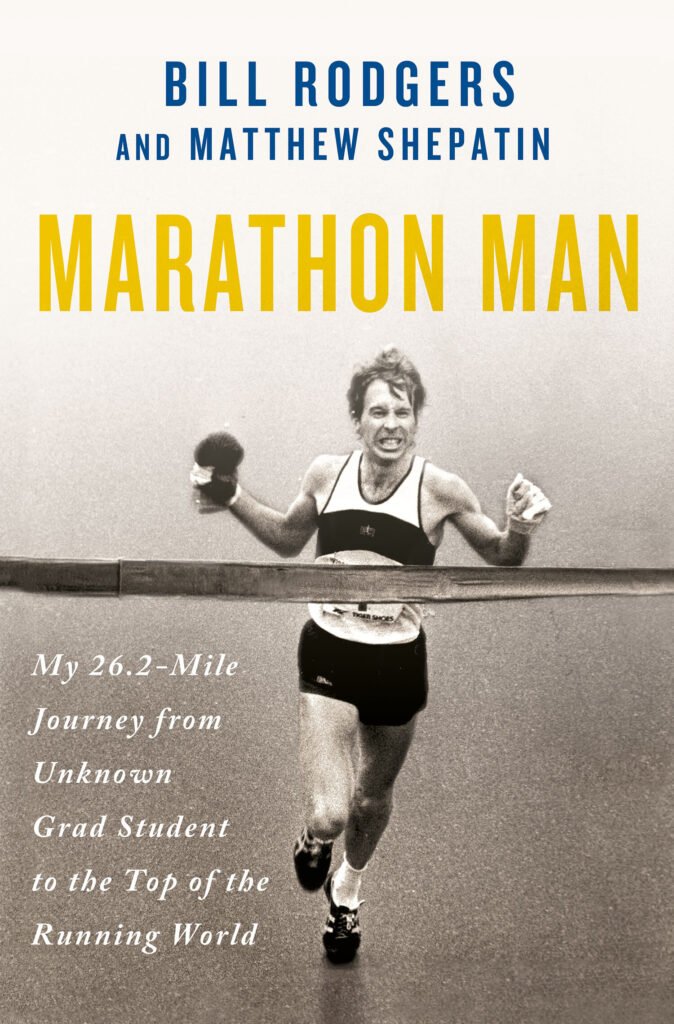
In Marathon Man, Rodgers treats us with a first person account of his journey from an ordinary citizen, a teacher and an ok runner to the most decorated long distance US runner in history. This is not your typical “look-how-great-I-am” biography, it is a journey with many ups and downs; with struggles, both physical and financial; it is a story of both DNFs and breaking finish line tapes.
Most of the book is centered on Rodgers’ win of the Boston Marathon on April 21st, 1975. Fifteen of the 21 chapters start with an exquisitely detailed account of the race, enriched throughout with the lore of this, the most famous footrace in the history of footraces. From there one, the second part each one of those chapters are flashbacks to his life starting eight years before that day and finishing at the start of that particular race. Two chronicles of the same story are happening simultaneously, which provides incredible dynamism to the narrative. Once he wins, he focuses on his Olympic experience and his first New York City win. The latter one was the one that happen to put that marathon in the map.
Bill was not just an airheaded runner. He stood for and by certain political beliefs, becoming a conscientious objector to the Vietnam War and paying consequences. He had clashes with the AAU and voiced his displeasure at them taking away the monies athletes won while not allowing them to make a living off their talents. There are also plenty of insights about the early days of the running boom. This is great stuff for anyone who enjoys or has enjoyed long distance running or followed it 30-35 years ago.
On a personal note, Rodgers has always intrigued me because when I started running as a teenager he was the top dog. He won the very first marathon I ran, (Orange Bowl 1983) and I had the chance to see him fly by twice throughout the course. After my second Marathon (New York 1983), my dad bought me a Bill Rodgers set of short and singlet, which I used only for my top races, including my 3rd and 4th marathons (Caracas 1984 and 1985), where I had my two best times. My 5th Marathon (Philadelphia 2012) was won by Rodgers way back when. So somehow he’s been a presence during most of my long distance endeavors.
This is a fascinating biography about a fascinating character narrated in a fascinating way. Worth not only every penny but also every minute you’ll invest reading it.


 In the few years after Frank Shorter won the Olympic gold medal in the 1972 Olympic marathon, officially starting the running boom in the United States, there was no marathoner more famous or more accomplished than Bill Rodgers. A small town, easy going, aloof, simple man, who decided to quit the party, smoking and drinking scene to discover his gift for running and embraced it to the fullest. He won the Boston Marathon four times and is the only man with four victories in the New York City Marathon. He also was an Olympian in 1976.