I originally published this blog post about three years ago under the title “The Trap of Information Overload”. I have coached many new runners since and one of the constants I’ve observed is how they get sucked into the need to track irrelevant parameters just because their watches display them. This is regardless of whether they understand what such parameters are actually measuring. Thus, I have decided to rerun this post, with a few updates. I hope you find it useful.
Is this you while checking your watch during or after every run?
Let’s start by stating that I see nothing wrong with being on Strava, having an Instagram account to share your runs, or checking Facebook every so often to see what your running buddies are up to. It is great to live in an era where we can be in contact with people we haven’t seen in decades, stay connected with that cousin who moved to another country, or your buddies from elementary school you rarely have the chance to see anymore.
It is great to make social media acquaintances with people you’ve never met in person. I follow a Dutch runner named @mistermarathon on Instagram, who follows me back. When I visited Amsterdam a few years back, he took me for a running tour of the city; we had coffee at the Rijksmuseum and had a great talk. A few years later, he visited Florida, and even though I was injured and couldn’t run, we met for coffee and had another enjoyable conversation. It was great!
But there must be a limit. The data overload from social media, from our watches, from WhatsApp groups, and from measuring up to every stranger who follows our social channels is stealing the joy from many a runner. We should run because we like it. So, if something is stealing our bliss, it must go; or at least, its presence must be adjusted.
Yes, a pre-run picture with your buddies is cool, but if you missed it, you could still run. Skipping the recording of one run because your watch has no battery is not an excuse to miss a scheduled training. Checking your favorite elite runner on Strava and matching their training is a recipe for injury. Thinking that an ultrarunner in Germany, Australia, or Argentina is your buddy because he likes your posts on a regular basis is the prelude for a letdown. Wanting to run from New York to Los Angeles because so-and-so did it, is insanity.
Unless you know what a parameter is measuring, let it go!
It all starts with regulating the consumption of information we get from our GPS watches. It is wonderful to have all the information we could possibly need at a wrist flip. But, with certain exceptions dictated by a specific segment of your training program, the usefulness of such information is relatively innocuous. It is just a reflection of what you are doing, not what you are doing. It is not your worth as an athlete or as a human being. You don’t have to pause the watch because you hit a red light, or because you stopped at the water fountain. You don’t have to check your cadence or vertical oscillation every mile unless you are specifically working on it. And don’t get me started on VO2Max: If you don’t know what it measures, don’t dwell on it. You get the point.
I am amazed by the data that the watch keeps track of. NASA didn’t have such access to astronauts on the Moon. Most of it is great for the analysis of my training, for measuring my progress, or for keeping historical data. But your watch should just serve as a recorder of your performance, not direct it.
The more I use Strava or Garmin Connect, the more I’m impressed by what they can do, but I don’t follow or stalk people I don’t know. If I want to know what a friend is doing, I call him or text her. I don’t need to know what Kelvin Kiptum is doing every day, let alone compare his progress to mine. I don’t need kudos from 50 strangers to validate my run.
Theodore Roosevelt, the 26th President of the United States, once said: “Comparison is the thief of joy”, and I agree 100% with him. Equaling it is part of human nature, and the right dosage of it may be healthy. But if we want to enjoy OUR running, we need to concentrate on what WE are doing and what WE can control. WE must center OUR running life on OUR progress, OUR failures, OUR injuries, and OUR parameters.
Most of the data is useless at the time we are running, anyway. It is afterward that we can learn something from it and make the necessary adjustments. If you list the top 100 reasons why you run, I bet that “to show up Alex in Strava”, “to have more Instagram followers than Maria,” or “to improve my likes on Facebook” won’t make the list. So, get back to basics and take advantage of the exciting tech tools available to you, but don’t become a slave to them.
A year ago, Grace P. had never run before. I am sure she tried to catch a bus or get refuge from the rain at some point, but never what we picture when we think of a runner.
She is friends with my wife and on a fateful October day of last year, we were invited to a small gathering at her house. I wasn’t too keen on spending a Saturday afternoon with people I don’t know but there are certain sacrifices a husband must make. Grace’s husband was wearing Brooks shoes, so to make small chitchat I asked if he was a runner. “I only run when Grace wants to hit me”, he joked back.
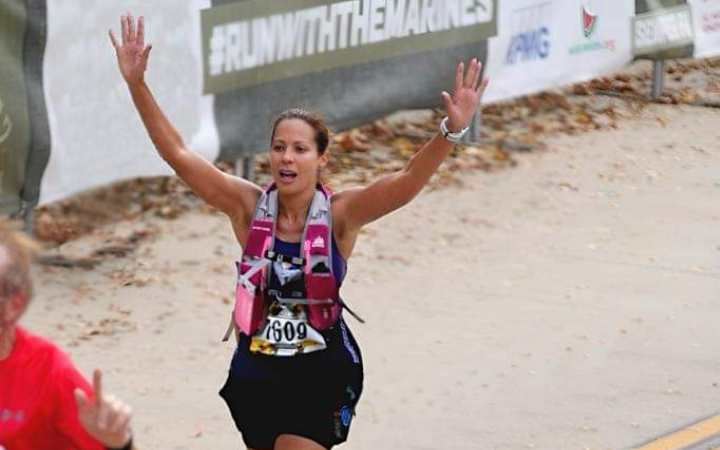
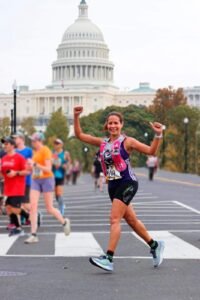
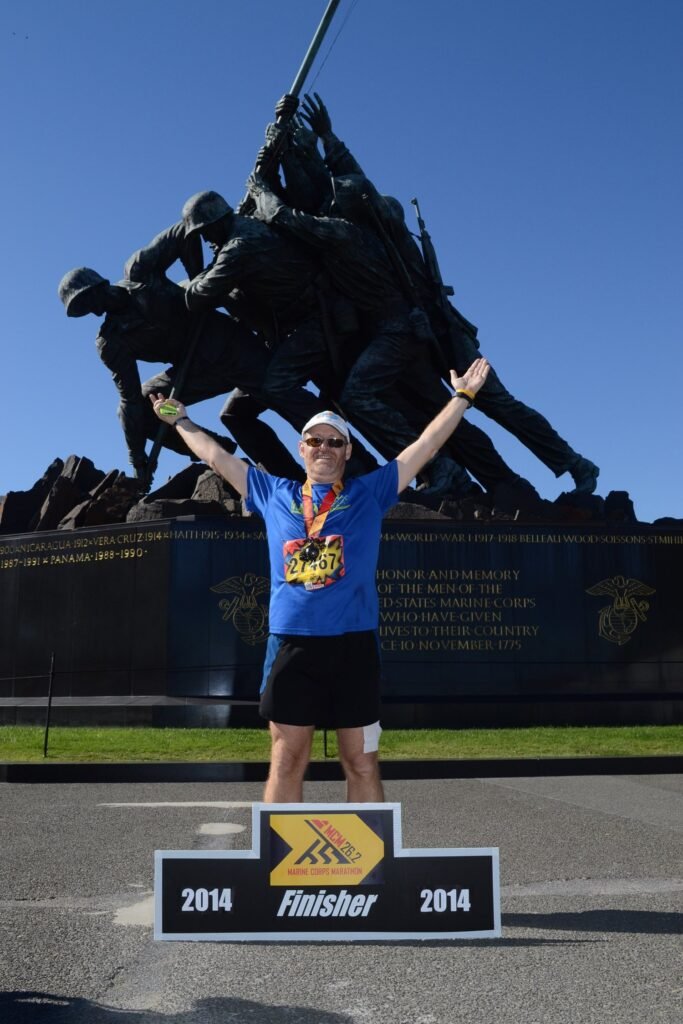
Still looking strong and happy at mile 18 of the Marine Corps Marathon.
Then my wife stated that I was a running coach and Grace jumped in saying something along the lines of: “I’ve always wanted to run, but I can’t get very far without getting tired. I see my neighbor running all the time, but I can’t run like her”. So, I told her I was the head coach for the City of Tamarac Run Club. “If you are at X park at X time on X day, I will get you running”. And she showed up. And kept on showing up. Last October 29th, she became a marathoner.
Three or 4 weeks into the training, on a cold and rainy night, everyone bowed out of the run through our chat. Except Grace. So, I showed up. She was scheduled to run three miles and at two, in the midst of a downpour, I told her it was OK to cut it short. With a huge smile, she told me she was completing her workout. And she did.
That was the specific moment when I realized that she caught the running bug and that she had the talent and drive necessary to achieve great things in this sport. Her training improved so fast that in less than two months of running, she skipped the 5K and went straight to a 10K race, in which she ran 1:00:13. A month later she ran her first 10 miler and another month later her first half marathon in 2:18. Within another month she set two more PRs in the distance, finishing the season with 2:05. That is a minute per mile faster than six weeks earlier. Now she wanted a marathon.
The story escalated quickly from there. As her coach, I wanted to make sure she recovered properly. That she took the necessary time off, that she began a strengthening program, that she learned about nutrition, hydration, recovery, etc. She even took to learn about the story of women in running by reading Marathon Woman, by Kathrine Switzer, who she learned to admire.
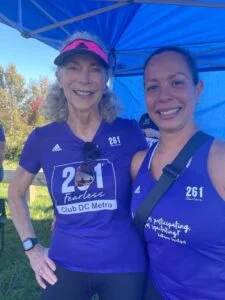
While in DC, Grace had the chance to meet and mingle with the one and only Kathrine Switzer
Then, as the hottest month of July in recorded history dawned in South Florida, Grace and her training partner Luis D. started their marathon preparation. It was brutal. More than once they had to take to the streets at 5 AM under 85-degree temperature and 100% humidity. Yet, they persevered. They kept going until one day… Voila!!! It all kicked in and new distances beyond 13.1 became not only possible but she thrived on them. I can recall her finishing her first 15-miler hooting and jumping with a big smile. Yes, I know. Totally crazy!
Sure, there were setbacks. And those were important, too. There was one time she hit the wall and had to finish walking. In the midst of her disappointment, I taught her to learn from it. To take it as an opportunity. She had progressed so fast she hadn’t experienced much failure. Another time she tried a new gel and it backfired badly. She had to use one of her lifelines and phone a friend to pick her up. She was upset but I told her it was important to learn that this brand doesn’t work for her, now, instead of at mile 22 on race day. And she persevered.
Marathon day arrived on October 29. Grace was ready and excited. But the weather wasn’t as cool as expected. Her training partner was dealing with a leg issue and dropped off the pace from the very beginning. There was a ton of traffic at the start and her first 5k was off by over a minute-per-mile slower than planned. So, she adjusted to her circumstances, picked up the pace to what she trained for and maintained it until Km35 (Mile 22), where she slowed down a little bit. The last mile was very tough, yet she persevered and did not walk at all, finishing in a solid 4:39:07. This, I remind you again, was someone who told me a year ago she wanted to run without tiring, like her neighbor.
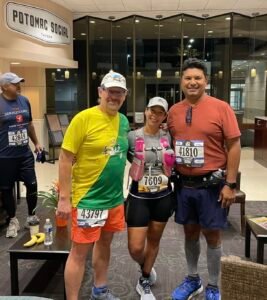
Coach Adolfo, Grace and Norvin (Grace’s husband), on our way to the startng line of the MCM races
If this wasn’t enough of a story, her husband caught the running bug, too. He started walking, then run/walking, and then pursued loftier goals as he felt better and stronger. He lost over 20 Lbs. and started fitting into clothes he hadn’t worn in years. And if that wasn’t enough, he ran the Marine Corps 10K without stopping in a time of 1:16. Now he is eyeing his first half.
From the coaching side, not only it has been a treat to coach a runner as talented and dedicated as Grace P., but she has also become an integral part of our Saturday running group. Moreover, she and her husband have become close friends with my wife and I, which has been a great addition to our lives. Running is the gift that keeps on giving.
Not everyone possesses the hidden talent and drive that Grace demonstrated. Not everyone aspires to become a marathoner. However, everyone has the potential to make the most of their physical capabilities. Just like Grace, it begins with showing up at the park on the appointed date and time, embarking on a personal journey whose destination remains unknown. Who knows where it may lead you?
A few days ago, I received a phone call from one of my athletes. She’s training for her second marathon, which is fast approaching. My concerns exploded right away, as the first words out of her mouth were: “I have a problem!”. Possibilities such as injury, illness, unexplained pains, job loss, etc., started rushing through my mind. In this blog post, we’ll explore the art of balancing running and life, especially when facing unexpected life dilemmas.
“What’s happening?”, I asked as I tried to contain my uneasiness so I could keep her calm.
“My husband bought tickets to a comedy show on Friday night, and I won’t be able to do my Saturday long run?”. She explained.
Multiple aspects of your life must be juggled around so your running doesn’t become the ruler of your schedule (Photo Michael Judkins, Pexels)
As the color returned to my face, I told her with the best sarcastic tone I could muster: “What an inconsiderate man! Wanting to go out on a Friday night, with his wife, to have fun? That is awful. If you could only move that long run to Sunday.”
Then I explained that as important as her marathon is, and as much as she is invested in her running, keeping a balanced life between family, work, and running is essential. This was not the night before her marathon, and it doesn’t happen every Friday night. If she doesn’t allow the necessary flexibility to move some workouts around, then her husband, her kids, and eventually her, will resent her running. That would be disastrous for all the parties involved.
“Thank you for the perspective”, she said. And hung up two seconds later”.
I guarantee this incident is not an isolated one. I bet every single reader of this blog post has a personal version of this story. I certainly do. More than one. At one time or another, we had to confront this reality. “I want to train. But my—insert relationship here—wants to—insert activity here— What should I do?”
Most likely you are not qualifying for the Olympics, lining up side-by-side with Eliud Kipchoge at the Berlin Marathon start, or even considered the favorite to win your local 5K. So, moving things around in your training schedule, or God forbid, skipping a workout, are feasible arrangements to fit in running around your life.
What to do if you score World Series tickets for the night before your marathon?
In my experience, both personally and as a coach, the newer you are in the sport, the tougher it becomes to keep running in perspective. As you get started on your journey, the improvement curve is so steep that you want to keep the progress for as long as possible. You may not understand the benefits of a day off, or that not one particular session is going to make or break your race or your running career. This is the time when you must check in with your coach or your more experienced running buddies to help you put it into perspective.
Just like the runner at the start of this post, you may be taken aback by tickets to an event at an inconvenient time. It happens. Hopefully, you shared your goal race with your significant other and he/she will time well the invitations. But it could also happen that you get your hands on tickets to something like the World Series when your team is playing but is happening the night before your New York City Marathon. Then it is time to choose between a once-in-a-lifetime event and what you’ve trained for but may certainly do again, later.
My son got married on a Friday night in November. That’s high training season for local racing where I live. Asking my son to get married another day because I run long on Saturdays was not right. Missing his wedding was out of the question. So, what do you do? You attend your son’s wedding, you have fun and you forget about running on behalf of a momentous occasion in the life of an important person in your life. That’s what you do.
Sure, sacrifices must be made. But it is never about having to choose between your running and your spouse, your significant other, your kids, your family, friends, or work. It is about understanding that in life, there are more important things than a rack full of medals.
Have you ever been faced with a dilemma between running and life? Please share your experience in the comment box below.
In my last blog post, I wrote about learning the hard way. Within the same theme, today I bring you the story of Javier Mota, a journalist and friend who, despite going out of his way not to consider himself a runner, put together a 1000+ day running streak. Given his accepted stubbornness, he is currently paying the consequences of not listening to his body. With his permission, I am publishing an article he wrote about his experience.
Good and bad consequences after running every day for 3 years and 21 days.
The diagnosis by Dr. Luis Valenzuela from the Meds Clinic in Santiago de Chile, which stopped my 3 years and 21 days of running every day, was forceful:
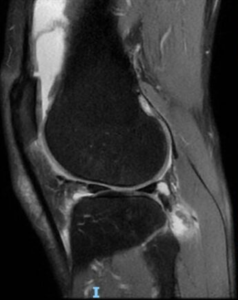
“You obviously have internal femorotibial osteoarthritis, with a degenerative tear of the internal meniscus. Also, chondral lesions in the patella. There is bone edema of the medial femoral condyle and medial tibial plateau due to joint wear and overload.”
Javier Mota is a renowned automotive journalist and a friend. (Photo: courtesy of Javier Mota)
In simple words, the MRI results showed how badly I messed up my left knee, mainly due to a clear case of the fine line between stubbornness and stupidity.
In hindsight, I should have stopped running when the pain and discomfort began on March 15, 2023, but out of my stubbornness, rather than determination or discipline, I ran 5 additional months in pain, first trying to reach the 1,000-day mark and then, 3 years.
The additional 21 days only confirmed my lack of good sense and probably made things worse.
“Pain is not normal”, another orthopedic doctor once told me during a casual conversation in a bar in St. George, Utah, after I insisted on running for a couple of months despite the discomfort.
Long before that, when I reached the 2-year mark, in August 2022, Dr. Scott Lang, University of Central Florida´s Professor of Family Medicine, warned me: “Never run in pain. If you have muscle pain or joint pain when you run, ice it and rest. If the pain persists for more than a week, see your doctor”.
Obviously, I did not pay attention and on August 21, 2023, at the end of my annual ski trip to Chile, I finally decided to have my left knee checked by Dr. Valenzuela, who after a quick visual and tactile examination, immediately determined that an MRI was necessary.
Of course, between the time that passed from the end of the MRI and the time I received the diagnosis, I went out for the last run (2.75 miles in 30:36) because I sensed the end of the streak was approaching, under medical prescription.
The truth is that the discomfort never reached the point of paralyzing me, although, between March 15 and August 21, 2023, I reduced the distance and speed of each run, thinking that the pain would be reduced. That didn’t happen, but it didn’t get worse either.
This is Javier’s messed up left knee (Foto: Courtesy of Javier Mota)
Dr. Valenzuela attributed this to the fact that through constant exercise for 1,115 days in a row, I was able to build enough muscle mass to absorb most of the impact on my knee.
Now, the next challenge is to dedicate myself with the same intensity to a rehabilitation program and incorporate other athletic activities, without impacting the knees to maintain the physical condition and weight (165 pounds).
Those last two were undoubtedly the biggest benefits of the running streak, which began on August 1, 2020, during the Covid pandemic, thanks to a private Facebook group, to get out of lockdown.
In all, I ran 3,257.3 miles, an average of almost 90 miles per month. The equivalent of driving from Miami to Seattle.
All this, despite the fact that I have never felt like a “real runner”. If I was, I would have followed the 3R advice of the experts to replenish, rest, and recover, and not become a “slave to the streak”, as Running Coach Adolfo Salgueiro warned me. But that’s exactly what I did.
I never warmed up before a run, nor did I stretch at the end. I have never undergone a serious training program to achieve a specific goal. Nor did I pay much attention to the advice not to wear old and worn-out shoes or to buy ones specially molded for my feet. As a consequence, I never improved my time or distance in these 3 years.
And as I said before and I repeat now, I don’t like to run. I think it’s boring, so much so that for the last few months of the streak I tried to entertain myself by picking up trash on the road, sometimes at an astonishing rate of 10+ pieces per mile. Thanks to that, and in a very unscientific way, I verified that the Modelo Especial has indeed become the most popular beer in the United States, given the number of empty cans I have found in recent months during my runs.
I also started stopping to say hello to all the dogs I saw on the trail, perhaps to justify my slower pace and to give my knee a rest, until one of them bit me on the left thigh, something unrelated to the injury, which eventually ended the streak.
Now the benefits
I always appreciated what happens when you run every day. You feel better physically and mentally, you sleep and work better, and you can eat and drink more. And you always feel good after every run, unless you get bitten by a dog.
Also, it was great to receive encouragement from other runners, non-runners and even from companies like New Balance and Apple who sent me products as an incentive to keep the streak alive; and from car brands that celebrated some of the streak’s milestones when they coincided with some of their test driving programs around the world.
One of the 1,021 consecutive runs that lead to the devastating injury (Foto: Courtesy of Javier Mota)
It was also a pleasure to run in 16 countries and over 100 cities.
But what I enjoyed the most was the daily challenge of finding the time and place to run every day, despite the complications of constant travel as part of my job as an automotive journalist.
The longest run (almost 9 miles) was in Munich, Germany, on September 2021, not because I wanted to run that distance, but because I got lost. The fastest run was a 10K at a pace of 7:58 minutes per mile, at home.
On December 31, 2022, I checked out at 11:30 p.m. to complete the daily 5k and then did another one starting right at midnight and ending on January 1st. 2023 to start the New Year.
Several times, I landed at an airport and got out of the car on the way to the hotel so I could run before the end of the day. I also ran inside various airports, before and after flights.
So, in the end, it was a good run while it lasted, but I have a few points to consider now that this is all over:
First, I do not recommend it to anyone! It’s easy to become addicted, even a slave to personal achievement like this one.
And most importantly, as I’ve learned the hard way, it’s essential to recognize that running every day for an extended period, not only can, but surely will cause injury sooner or later.
In conclusion, listen to the experts and to your body; take adequate rest when necessary to prevent exhaustion and possible long-term health problems.
Without a doubt, this streak of three years and 21 days was an extraordinary journey, which some have called “an example of determination, discipline and the pursuit of personal goals”, but it is also important to remember that the physical conditioning process of each individual is unique and must be approached with care and respect for one’s own body.
Maybe I will run again someday, but I will never run every day for 3 years and 21 days.
Javier Mota is a renowned automotive journalist and a friend. You can follow him on Instagram @javiermota, or at his website: https://autos0to60.com/. He made a YouTube video with his original post. If you want to check it out, you can do so by clicking here – https://www.youtube.com/watch?v=G8sdfsl0c9w
When it comes to setting running goals, my experience is that there is nothing like having a race on the schedule. One where you have already registered, paid and let everyone in your running circle know about it. It is what keeps me with something to look towards during any period of the year, especially the tough times. It doesn’t matter if the race is in a month or a year down the road. That said, goal setting is way more than spending $35 in your next 5K race or ponying up a few hundred bucks on your next Marathon Major.
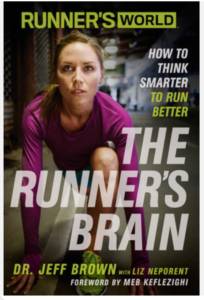
In the realm of sports psychology, extensive research has revealed the profound influence of goal setting on athletes. A prominent figure in this field is Dr. Edwin Locke, a psychology professor at the University of Maryland, whose studies have significantly contributed to our understanding of goal-setting theory. In Chapter 4 of \”The Runner\’s Brain\”, a book by Dr. Jeff Brown and Liz Neporent, the authors explore Dr. Locke’s research, shedding light on how setting goals can transform running performance.
This book is the source of this blog post. A good book well worth the money and time.
They identify four principles for goal setting:
Principle 1: Directed Attention – Goals serve as a compass, directing our attention towards specific aspects of our training. Whether it\’s completing a running loop in under an hour or improving pace, breathing, and form, setting goals sharpens our focus. Additionally, breaking down long-term goals into smaller milestones helps measure progress and brings a sense of achievement to our training.
Principle 2: Motivation – Goals provide the driving force that keeps us pushing forward. When we have a clear objective to work towards, we are more likely to stay enthusiastic and engaged throughout the training process. The pursuit of our goals gives us a purpose and ignites the determination needed to overcome challenges.
Principle 3: Celebrating Success – Viewing our efforts as a series of failures can be demoralizing. Setting long-term goals allows us to establish checkpoints along the way, creating multiple opportunities for success. Celebrating these smaller achievements transforms the feeling of missing the mark into a string of mini triumphs, boosting our confidence and motivation.
Principle 4: Continuous Learning – Goal setting propels us into the learning zone. It encourages us to explore new resources, equipment, and strategies to achieve our desired outcomes. As we seek innovative approaches, we develop new skills and expand our knowledge. Embracing new experiences and novel approaches improves our abilities and stimulates our brains, preparing us for future goals.
Now, as in everything in life, we must set limits. While goal setting plays a pivotal role in not just feeling like but becoming a successful runner, it is crucial to establish balance. Research suggests we should avoid an overemphasis on goals or setting unattainable targets, as they can lead to anxiety and a decline in self-assurance. Resilience and the ability to manage disappointment are integral to the goal-setting process.
We should also include backup goals in our training and recognize our achievements at various levels so you may stay motivated and derive satisfaction from our efforts. Remember, goal setting should be complemented by an appreciation of the journey, listening to your body, and finding joy in the process. When it is no longer fun, you will either stop running or burn out.
In conclusion: goal setting is not New Age mumbo-jumbo; it is a science-backed practice that may enhance your running performance if approached correctly. By embracing it, runners can unlock their full potential and achieve their best while maximizing the benefits of their training.
Join the conversation by commenting in the text box below and share your thoughts on goal setting in running! Every step counts towards greatness.
A few months ago, I posted on Facebook that I had signed up for the Marine Corps Marathon, which will take place on October 29th. Up until a few days ago, I was training for it. Today I must announce that I am withdrawing from the race. It is a regrettable yet humbling experience that is currently forcing me to reassess where I am with my running, why I got here, and how to get out of it.
It is not a failure as long as you learn from it so it doesn’t happen again (Photo: Pexels)
It is more than safe for my readers to assume that training was not going as planned. It had become more of a suffer-fest than the enjoyable experience with its usual highs and lows. Things were not clicking. The efforts were mammoth-like. Recovery took too long. I began to dread the long runs. The speed work took so much out of me that I was unable to feel any progress. It was a death spiral.
Maybe I was overtrained or under-recovered. Maybe it was the heatwave currently affecting the entire Northern Hemisphere. Maybe the long runs at 86º temperatures (30ºC) with 100% humidity, where your sweat doesn’t evaporate, were overtaxing my body. Maybe, as running comes in cycles, I am amid a low instead of a high. Maybe, a month away from 58, I must accept that I am not what I was just a few years ago. Maybe the few extra pounds I haven’t been able to shed off were multiplying my effort. Maybe my body is not the same two years after my open-heart surgery. Maybe it is a combination of everything. Who knows?
It was a tough decision, as I was training with two committed runners I am also coaching. Seeing them thrive while the coach could not keep up was embarrassing. It was difficult when we set out for a long run, and I had to turn around earlier because I knew that I just didn’t have it that day, or the next, and the next, too. As if this wasn’t enough, my left knee, the weakest link in my running life (2 surgeries), started hurting again for the first time in years. Deep inside I believed that if I kept going, everything would eventually click. That my body would magically adapt. I know I hung on longer than I should have just because I felt obligated to my runners. But the time of reckoning was inevitable.
As I was suffering, plenty of friends told me that I shouldn’t worry because October in DC has wonderful weather. As much as I appreciate the thought and encouragement, I still needed to train in the hot and muggy South Florida so I could enjoy the good weather in DC, in October.
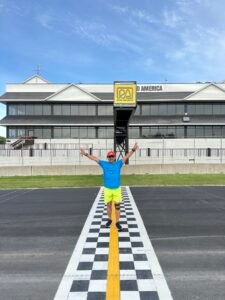
The updated version of this picture will have to wait.
And that’s the other thing. There is no doubt in my mind that I could have finished the race. But with 11 marathons under my belt, just finishing is no longer a worthy goal. I am not willing to suffer to cross the line in 5:30. I wanted to run a marathon at 58 so I could beat my dad’s age of 57 when he ran his last. I also wanted to run it in 4:30, to beat the 4:43 of his last 26.2. So, God willing, I still have plenty of time to achieve those two goals, hopefully while my dad is still alive, so I can brag about them.
The next steps are to reassess where I am at this point and how I got here. I will start by resting my body. I will keep running but won’t push too hard through the muggy days with longer or faster runs. I will work based on effort and run easily to regain the aerobic capacity I feel I have lost. I will focus on running the best half marathon I can next season. Hopefully, three or four of them until I can put together an effort I can be satisfied with. Maybe I’ll try to set new 55+ PRs in the 5K and 10K. Once I feel I am back, then I will figure out what is next and plan for my next marathon. I know I have at least one more in me.
The one thing I know is that I will keep running. Withdrawing from this marathon is a humbling experience that I must learn from. It is only a failure if you don’t learn anything from it and thus, you screw it up again.