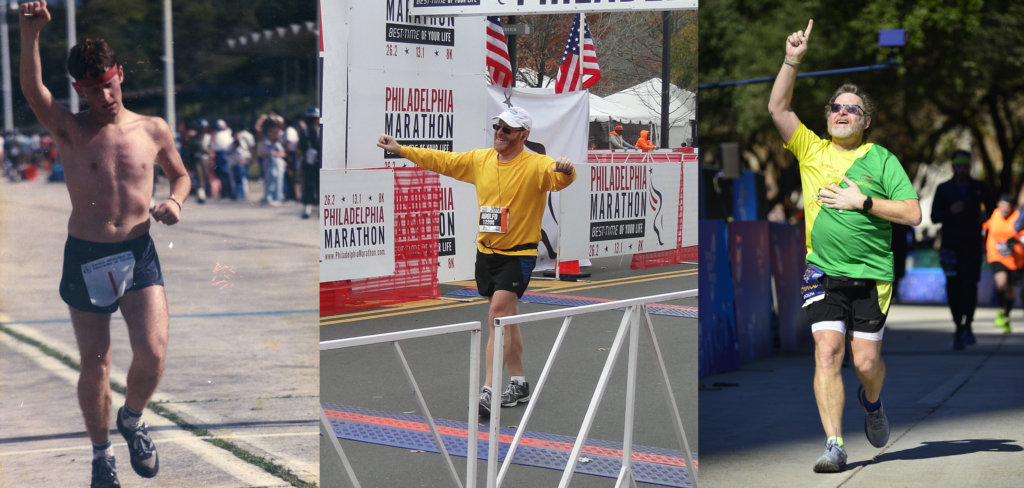
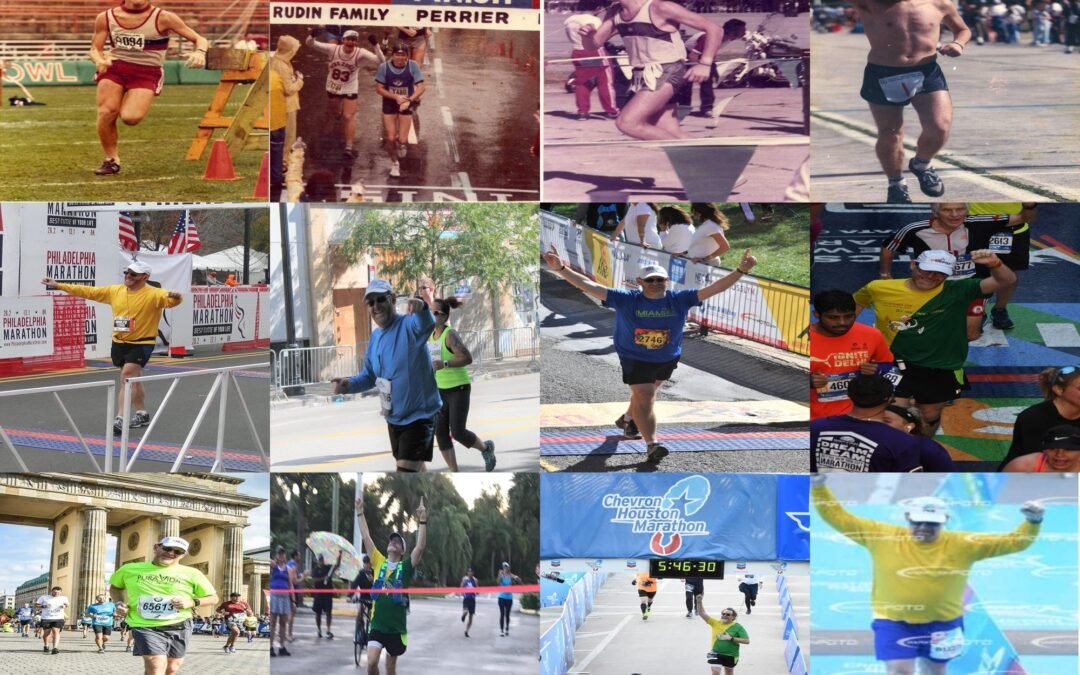
A few of my running buddies have asked me through the years how it is possible that I always look good in the finishing pictures of my races. Even if I don’t have a good race. I don’t “always” look good in my finishing pictures, but do I have many outstanding ones.
Is this a frivolous topic? Sure, it is. But let’s be honest: Do you rather look good in your finishing pictures? Or do you not care if you look like crap?
Yep… I thought so, too.
There is an art to this, and a story behind it, too.
As I have stated in previous writings, my dad was the first person I knew to run a marathon. He ran NYC in 1982. NYC was famous for many things; one of them was that they offered for purchase an image (meaning only one) of your finish. As my dad told me about his marathon experience, I couldn’t wait to see his finishing picture, which came weeks later.
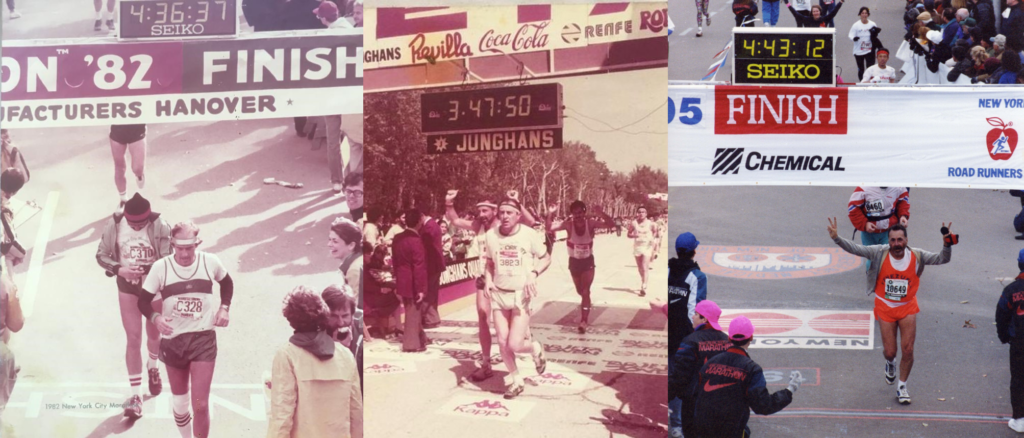
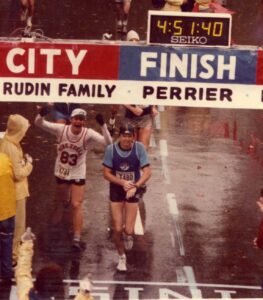
The picture was so underwhelming. Check the image below, and you will think my dad is the runner number C328. But no, he is the guy behind him, looking down at his watch. In those days, you only had one shot per race for a picture. And he screwed it up in his first marathon. Lesson learned for me, as I was certain I would someday run one myself. I wanted to make sure my finishing picture would reflect not just a finish, but that it would be epic. That it would reflect my true emotions.
As you can see, it took many failed attempts for my dad to get a great finishing picture.
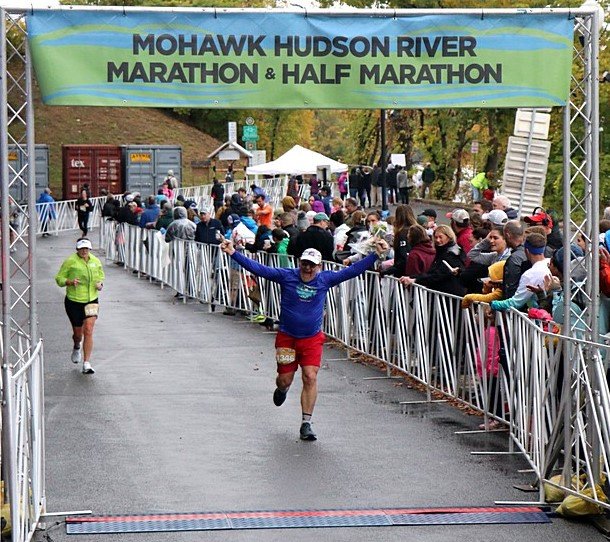
Through my years of racing I have learned how to maximize the opportunities of a good picture, which is not always guaranteed. It is an art, not a science. Sometimes, you finish so happy and exhilarated, but when you look at the race pictures, you don’t feel that they reflect what you were feeling, or you are not even in them. But in general, I have realized that if you let your emotions out and you are aware of the situation, not only will you enhance your chance of amazing images to reminisce your races, sometimes you will even make it to the local paper. Yep, it did happen.
To improve your chances of a great picture at the finish line, I follow these easy guidelines:
1 – Be aware that even in the smallest runs, most likely there is a photographer at the finish line. Big races will have multiple.
2 – Understand that photographers don’t have time to frame you up. They shoot at everything, hoping to catch that great shot. If you help them out, there is a better chance you could be that great shot. How do you help them:
Spot the photographer as you approach the finish line and position yourself in a prime spot.
Find an opening in the crowd (if there is one) so you can enhance the chances of being seen.
If you are not pushing for a PR or have already secured it, look behind and make sure no runner behind you will sprint and block you.
3 – Express your genuine emotions freely. Show your happiness, disappointment, pain, thankfulness, or whatever you are feeling openly and honestly. Don’t fake it, as it will be captured.
4 – Don’t just crash the first inch after the finishing line. Photographers shoot multiple times, and your best image may be a second or two after you are done.
These are three of my marathon finishes. Solid images to celebrate the accomplishments.
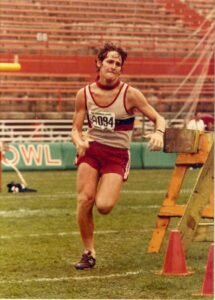
As for my dad’s finishing pictures, they got better with time, but it took a few failed attempts. In the 1985 Madrid Marathon, he finished with a PR and raised his arms, but he was right behind another guy. You can only see his head and arms raised. My brother and I kept coaching him, hoping for a good one. In 1995, he ran his last marathon, and he finally got the finishing picture he deserved after a long and inspiring marathoning career. It only took 13 years and 8 marathons.
In the meantime, I learned so much about how not to do it that I’ve accumulated many awesome finishing images. Enough that my friends ask me how I do it. And if that wasn’t enough, I get to write about it.
What is your experience with race-finishing pictures? Let me know in the comment box below.
For those who have only run one marathon, it is an adventure. For those who have completed the distance more than once, the only thing in common between one and another finish is the 26.2-mile distance. Each one brings a new challenge, a new experience, a new obstacle to overcome, and a new journey.
On January 19, I completed my 12th-lifetime marathon. At 59, I am unsure if I have another one in me, but I am not ruling it out. What I do know is that from each one I can take a life and/or a running lesson. Looking back on 42 years of marathoning, these are my takeaways from each one of them:
Running a marathon is a magnificent experience. Lifechanging. But it is not an easy task. It requires effort, sweat, suffering, and wondering why in the world you chose to impose this on yourself and on purpose. Once you cross the finish line, something wonderful happens. A transformation to last a lifetime. And for some weird and masochistic reason, you start thinking of the next one.
2 – New York 1983 – Age 18 – Time: 4:51:36
I thought I could go sub-4 just because I was close to my previous one. But the stupidity of youth got in the way. Having run one before is no substitute for decent training. Had I trained better, with consistency and dedication, I could have avoided the suffer-fest I endured on this cold and rainy NY morning. I learned the hard way that there is no substitution for preparation. It doesn’t have to be perfect, but it has to be worth the “training” label, at least.
3 – Caracas 1984 – Age 19 – Time 3:32:08
My all-time PR thanks to the guidance of an experienced runner who knew what he was doing and coached me. The difference between this result and the previous one is that I put in the work. At 19 years of age, I sacrificed the partying, the drinking, and the late nights with my friends so I could put forth my best effort. I hit the wall at the 32nd Km (Mile 20) yet still set a solid PR. Looking back, if we knew then what we know now about in-race calorie intake and electrolyte replenishment, I may have a better PR. But that doesn’t matter now. Hard work paid off, even if hitting the wall.
4 – Caracas 1985 – Age 20 – Time 3:35:04
Even with my responsibilities at work, school and trying to fit in some of the fun I sacrificed the previous year, I had a successful race despite missing my PR by 2:56. The experience from the previous year allowed me to manage the race better and even though the last 5 miles were still tough, I did not walk. The years of accumulated effort compounded so a successful race could be achieved despite the hot weather I confronted.
5 – Philadelphia 2012 – Age 47 – Time: 5:41:40
Eight years after my 2nd knee operation and having accepted the doctor told me I could not run anymore, I discovered racewalking and came back to long distances, regimented training and rediscovered the lure of footraces, long distances and runner’s highs. I accepted the days of running at 3:30 were over and trained for what my older body would allow me. So, 26 years after my previous marathon, I racewalked through the City of Brotherly Love and cried while crossing the finish line while F-U-ing the doctor who told me I couldn’t do it. You can do more than you think possible if you adjust to your circumstances.
6 – Chicago 2013 – Age 48 – Time: 5:44:56
Your body can do way more than you expect from it if you train it, fuel it, and take care of it, not just during the 3 or 4 months prior to your marathon, but for many years or for a lifetime. I endured three visits to the emergency room 3 times during my training, and I participated with the prospect of passing a kidney stone at any time. My training was not ideal (but unlike my NYC 1983 experience, I did train some), yet I finished and did so with a grateful smile despite being my personal worst. I did the best I could with what was available for me that day. It is not always about a PR for a marathon to be a success.
7 – Marine Corps 2014 – Age 49 – Time: 5:33:31
With three years of racewalking and two marathons under my soles, I was ready to go for a PR. I got a racewalking expert to write me a training plan; I followed it to the tee; I sacrificed late nights, ate clean, put in the work, and traveled to DC feeling very strong. The work paid off, and an 8-minute racewalking PR was the result. It was a bit hard at the end and I lost my sub 5:30 in the last 6 miles, but there is nothing to regret. Another successful marathon when focusing on the task.
8 – New York 2017 – Age 52 – Time: 4:51:48
In 2015 I realized I was racewalking because the doctor told me not to run, not because I had tried and failed. So, I tried and did not fail and two years later, I was at the Verrazano Narrows bridge, 34 years after my first participation. I trained diligently, and the results reflect my efforts. I was at my desired 4:30 pace until we got back to Manhattan, when my left knee started acting up. As soon as we entered Central Park at mile 23 I realized it was not worth permanent injury, so I mostly walked the last 5K and still finished 12 seconds off my NYC when I was 18. Hard work pays off even if your race gets derailed at the end.
9 – Berlin 2018 – Age 53 – Time: 5:09:03
Sometimes you may be fully prepared; you did everything right, you worked hard, you are at the right weight, and you are mentally there, yet your race totally sucks. So much that you lose the joy of what you are doing, you finish 40 minutes above the time you trained for and then swear you’ll never do this again. Good training is no guarantee of a good race. Sometimes the stars are just not aligned for you.
10 – New York 2020 – Age 55 – Time 5:28:14
Didn’t I swear I wasn’t going to do this anymore? In the middle of the pandemic, I had been dealing with a congenital heart issue for the last 18 months or so. I was told not to raise my heart rate over a certain threshold. I kept running super easy through the lockdown. So I could keep focused, I took the NYC Marathon virtual challenge. I set up a race/walk protocol; I trained diligently, set up a route and support system, and I completed the distance. As with my knee and racewalking a few years ago, I realized I could adjust to my circumstances and still conquer another marathon.
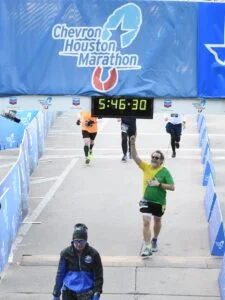
11 – Houston 2022 – Age 56 – Time 5:16:45
I registered for this marathon two weeks before my June open-heart surgery because I wanted to make sure I had something pressing me to get back to work. I was cleared to run in September, and 4 months later, I ran/walked the marathon. This marathon told me that in certain circumstances, time goals are irrelevant because the fact that you can bring your body back to perform the task overshadows any clock. This finish allowed me to, in just 7 months, to pass the page and move on to the rest of my life.
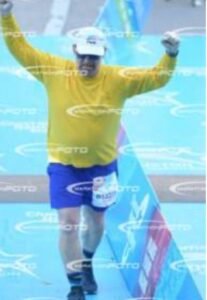
12 – Houston Marathon 2025 – Age 59 – Time 5:16:52
After two difficult years of running, when little went right, when I wondered if my best running days were behind me, and when I had to accept that after my open-heart surgery, I may have lost a step or two, training finally clicked, and I was ready for another marathon. I had the privilege of running side-by-side for 20 miles with two good friends. Then we parted ways and at Mile 23, my left IT band started killing me and forced me to suffer/walk the last 5K. I was happy to finish but unhappy with the result. It happens. Good training never guarantees a good result.
The leitmotif of my marathoning has been overcoming obstacles and learning lessons on the way. Even though my lifetime PR is decent at 3:32, I accept that after 40+ years in action, my best running years are behind me. That doesn’t diminish any accomplishments I may add to my medal rack between now and the day the Lord calls me.
Sharing what I’ve learned with the marathoners I train is what keeps me focused and thankful for the struggles and successes along the way. Even though I crossed the marathon finish line only 12 times, through my athletes, I have crossed it over 100 times.
Running in low-light conditions, especially during fall and winter, even in milder latitudes like in South Florida, can be challenging and potentially hazardous. As runners, our safety is ultimately our responsibility.
Regardless of who might be “in the right,” the goal is to avoid harm. Staying visible, alert, and prepared is critical when running in the dark.
Making sure you are seen while running in the dark is your responsibility (Photo: Alex Fu, Pexels)
Trust your instincts when you are out for a run in a poorly lit area. Treat it the same as if you were in an unfamiliar area or out of your comfort zone while walking out of town. It is always better to end up being overly cautious than to find yourself in a less-than-desirable situation with an on-the-spot decision to make.
Here are ten essential precautions to keep you safe during your nighttime or early morning runs during the shorter daytime months.
1. Prioritize Visibility: Invest in reflective gear or wearable lights. Whether it’s a reflective vest, flashing LED armbands, or clip-on lights for your shoes, making yourself visible to others is non-negotiable and 100% your responsibility. Also, consider visibility at the end of your run, not just the start.
2. Stick to Familiar, Well-Lit Routes: Running in the dark is not the time for exploration and adventure. Choose routes you know, have sufficient lighting, and minimal interfering traffic. Avoid areas with uneven terrain or unexpected obstacles. This is not the time to fall and require help.
3. Face Oncoming Traffic: Run against the flow of traffic so you can see approaching vehicles and they can see you. This allows you to react if a distracted driver veers too close. Always adhere to traffic rules and stay as far from the road as possible.
4. Reconsider Headphone Use: Nighttime running demands heightened awareness. Avoid using headphones to keep your senses sharp. If you can’t run without music or podcasts, opt for bone-conduction headphones, use just one earbud, or use a low-volume setting so you remain alert to your surroundings.
5. Run With a Phone: Always carry your phone. Use it to share your live location with a trusted contact or call for help if needed. Modern running belts or armbands make carrying your phone easy and unobtrusive.
6. Inform Someone About Your Plan: Even if you’re carrying a phone, let someone know your route and the expected return time. This ensures someone is aware should you be delayed or in trouble.
7. Run in Groups When Possible: There’s safety in numbers. A group is easier for drivers to spot, and your collective visibility and awareness increase. Running clubs or friends make excellent night-running companions.
ID in advance the safety spots where you can stop through your route (Image by Windows Copilot)
8. Familiarize Yourself with Emergency Spots: In your route, be aware of the surrounding businesses, police stations, or friends’ homes where you can unexpectedly stop should you feel in danger at any time.
9. Carry Identification: Wear or carry ID (RoadID bracelet, driver’s license) to ensure first responders or good Samaritans can identify you and know who to contact in case of an emergency.
10. Test Your Gear in Advance: The time to realize your headlamp is out of battery is not as you prepare to go out. The time to figure out how the pepper spray safe if disabled is not when you have a threat in front of you. Prepare yourself.
These are by no means all the safety precautions you must take to run safely in the dark. For one, always trust your instincts so you don’t have to second-guess yourself when it is too late. If something doesn’t feel right, get out of there immediately.
Anything else I forgot, or you would like to share with your fellow blog readers? Use the comment box below.
All of us runners have been there. And if you haven’t, keep running, and you will: missing the PR we trained for, walking on a run we thought we were supposed to excel in, being beat by that one person who can’t even keep up with us in training, selling ourselves a valid excuse for what just happened. We have just failed!
Sure, failure sucks. There is no other way to put it or sell it to ourselves or to our friends. But it doesn’t have to be final. It critical to your growth as a runner. And as a person.
It happens, learn your lessons and move forward. (Photo: Polina Zimmerman, Pexels)
There is an excellent quote by Jimmy Dugan, played by Tom Hanks in the movie A League of Their Own, when one of the players tells him she’s no longer enjoying baseball because it has become too hard: “It’s supposed to be hard. If it weren’t hard, everyone would do it. The hard…is what makes it great!”
So, how do we embrace something that sucks, hurts and yet could be beneficial, and make it the cornerstone of our running growth? I suggest these steps:
1 – Accept your feelings: Don’t suppress your emotions after the failure. Don’t put a façade for your buddies. These feelings are normal, healthy and must be worked through your system so they may be processed.
2—Step away from guarded mode: Okay, you failed. So what? Is your wife going to leave you? Are your friends disowning you? You have processed your emotions and accepted what happened. It is time to stop dwelling on it and move forward.
3 – Find the lessons to be learned: What happened? Why? Was it an external factor or was it something under your control? What will you do differently next time? Identify the factors that contributed to the failure and strategize on how not to allow this to happen again. If it was your error, own it.
4 – Embrace the failure: Now that you know what happened, why, and how to avoid it next time, it is time to focus on your next objective. You have accepted that a flop does not reflect your value as a person. Even if you missed the Olympic gold medal, it is an opportunity for growth. The runner who hasn’t failed, just hasn’t run enough.
5 – Enrich yourself by what you’ve learned: A long time ago, I heard someone (I can’t recall who) say that “what you get when you don’t obtain what you originally set out for, is experience”. Make this experience part of your narrative. Share your story with others letting them know that setbacks are a natural obstacle in the path to success.
I have compiled a list of failure-related quotes by people from all walks of life. These quotes corroborate that failure can only become a permanent mark in your life when you keep dwelling on it or learn nothing from it.
Tak advantage of the opportunity (Photo: Brett Jordan, Pexels)
► “I have not failed. I’ve just found 10,000 ways that won’t work” – Thomas Edison.
► “Some sessions are stars, and some are stones, but in the end, they are all rocks and we build upon them” – Chrissie Wellington, four-time World Ironman Champion.
► “A bad run is better than no run” – Unknown.
► “Ever tried. Ever failed. No matter. Try again. Fail again. Fail better” – Samuel Beckett, Playwright, novelist, Nobel laureate.
► “Relish the bad training runs. Without them it’s difficult to recognize, much less appreciate, the good ones” – Pat Teske, Resilience expert, health advocate, coach.
►”We all have bad days and bad workouts, when running gets ugly, when split times seem slow, when you wonder why you started. It will pass”– Hal Higdon, legendary running writer.
► “There will be days you don’t think you can run a marathon. There will be a lifetime of knowing you have” – Unknown.
► “Get over it – If you have a bad workout or run a bad race, allow yourself exactly 1 hour to stew about it, then move on” – Steve Scott, former U.S. record holder in the mile.
► “If you never have a bad day, you’re probably doing something wrong; if you never have a ‘good’ day, you’re definitely doing something wrong” – Mark Remy, Runner’s World.
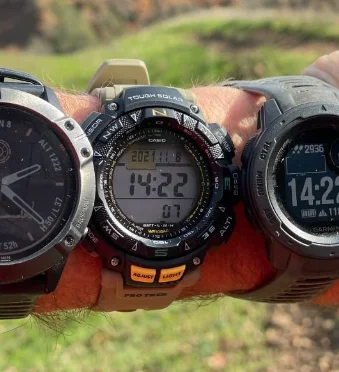
As I write the title of this blog post, I feel like the answer to such silly questions is, ”Duh! Of course, I should run with a GPS watch. How Am I going to know what I’m doing if I don’t.” Yet, there is a reason why I chose this topic for this week’s post. The answer is not so simple.
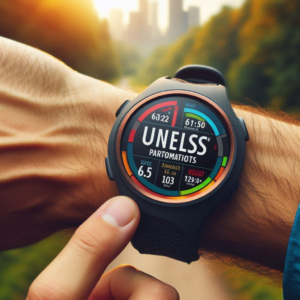
For a few hundred bucks we have more computing power on our wrists thatn what NASA had to land Apollo 11. Let’s use it wisely (Image by WIndows Copilot)
Our GPS Watches, generically called Garmin as it is the dominant brand in the market, are nowadays as ubiquitous as our smartphones. They are an extension of our smartphones, and they can’t work if they are not paired with them.
I’ve written before about not letting our watches become the directors of our runs instead of the recording devices. Also, about the data overload ruining our experience. But this is about what type of runner may benefit or be affected by the use of a GPS device on their wrist.
You should use a GPS Watch if:
► You understand the data you are looking at and know what to do about it should it need adjustment in the middle of the run. Worrying about your right foot oscillation or maximum power is futile if you don’t know what it means, let alone how to fix it or if it even needs fixing.
► You are running on perceived effort. The pace and all the stats will be the result of how hard you are running, not the other way around. With time, the data will allow you to measure progress.
► The first thought when you check your metrics in mid-run is, ”How does this reconcile with my running plan for today?” instead of, ”Wait until my friends see this posted in my social media feeds”.
► You can complete an entire easy run without looking at your watch once, regardless of how many times it beeped to let you know data was available. An easy run is about putting in some easy effort miles (hence the name) regardless of your pace.
► Your self-worth as a runner or as a person is not linked to the number of marathons you ran, your weekly mileage or your average pace.
► You can maintain your running as your primary focus while receiving feedback from your watch. If the feedback impairs your brain function, makes you wish you were a mathematician or makes you unable to enjoy what you are doing, it may be time to give it a break.
There is no need to connect all this stuff to your wrist when you are running (Photo: Obsahovka Obsahovka, Pexels)
You should ditch the GPS Watch if: ► Knowing your pace is a few seconds off makes you anxious. Sure, we all want to hit specific paces and at certain times. But if running that split in 2:02 instead of 2:00 feels like the end of the world, you are better off running watchless.
► You feel the need to stop your watch at a traffic light, or a water stop, or to tie your shoe because it will ruin your averages. Races don’t stop the clocks when you stop at the port-a-potty. The stoppage is part of the deal. It doesn’t matter if it adds a couple of seconds per mile.
► You see your splits, and the thought of seeing it published on Strava for the world to see worries you to the point that you must make up for it. Especially on training runs.
► You feel dodging traffic at an intersection or beating a freight train to avoid extra time is a risk worth taking.
► your need for hyper connection to the world is so endemic that your watch constantly beeps with texts and emails, and you can’t help but check them.
I am not advocating against the GPS watch. I am advocating against it ruling our running. We don’t need another smartphone-type device sucking the joy of something we love and controlling our lives. We are not professional runners. We run because we want to, and if the GPS watch is hindering such enjoyment, why allow it?
The physiological benefits of your training will be realized whether the mileage is posted on Instagram or not. It is not like that last 20-miler won’t help you on the marathon because it doesn’t show on Strava. You can also apply a revolutionary concept: keep the watch running and not look at it. Then you can analyze the data later instead of during. What a revolutionary concept!
A GPS Watch is an extraordinary tool. One that, for a few hundred bucks, provides you with more computing power than what NASA had at its disposal to land Apollo 11 on the Moon. If you can use it as a collector of data to be analyzed at the appropriate time so you can become a better runner, go for it! If not, then rethink its use.
Please like this post and share any recommendations from your previous experiences in the box below. Let’s build a community of informed and prepared runners.
As the racing season for big marathon races picks up, many runners have unique plans in sight. Many runners make it extra special, building an adventure around their race. We may drive or board trains and airplanes to make it either a weekend or a longer vacation.
There is no sense crossing the ocean to go to Berlin or Sydney just to race and come back home. Or you can always make it a nice long weekend if you just need to hit the road for a few hours. The key to a successful out-of-town race is to understand why you are there in the first place: to run a marathon. The fact that it is in Chicago or New York is what makes it a getaway. Most likely, there would have been no trip if you had not been running the marathon. Remember, the running portion of your trip is the priority. Don’t let the allure of tourist activities distract you from your main goal.
Sure, you can visit the Eiffel Tower… after the race (Photo: Rafaelf1, Pexels)
This is an important concept to grasp. I know way too many stories of runners sightseeing too hard, so they reach the starting line tired. On more than one occasion, I’ve met runners (usually younger) who were hungover because they couldn’t resist partying while away from home. A friend shared a story about his family resenting him because they had to wait to visit the Eiffel Tower until after the marathon, which added unnecessary stress to his pre-race routine.
Exploring the world\’s great cities, celebrating for a few days, sipping margaritas at the beach, and discovering the less traveled paths in lesser-known parts of the world is always a bonus for our efforts. But traveling to a race, especially your goal race, doesn’t come without its challenges. It requires additional planning. If you don’t prepare ahead, the chances of fixing a hiccup on the fly diminish considerably.
So, if you worked hard on your marathon training and are setting out on a running/travel adventure, these tips will hopefully help you get to the starting line mentally and physically sharp:
1. Do not check your running gear: If traveling by plane, whatever you are wearing on race day goes in your carry-on. The last thing you need is lost luggage derailing your race plans. You don’t want to run in brand-new shoes you purchased at the expo or with borrowed shorts.
2. Run first, tourist later: The running portion of your trip is the priority. Don’t arrive too much in advance before the race. Save the touristy plans for after. You want to get to the starting line focused, well-rested, mentally and physically ready. Afterward, you may walk all you want or enjoy as much alcohol and crappy food as you can tolerate.
3. Know where your pre-race meals are coming from: Never take your food intake for granted. Make sure you know that what you need to eat is available nearby. It happened to me once. After identifying the restaurant I wanted in Philadelphia, I went on pre-race night only to find I needed a reservation. If you are staying with relatives, make sure you let them know exactly what you must eat and when.
4.Know how to get to the starting line: Do not improvise. Plan for the worst-case scenario. If you are taking a cab, have the phone number and confirm they provide the service at the time you need it. Have a B plan in case there are no Ubers available. If you are taking public transportation, purchase tickets in advance. If a relative is driving you, be aware of road closures and alternative routes.
All the gear you will need during the race goes inside the cabin with you (Photo: Guiirossi, Pexels)
5. Have family and companions understand why you are there: If you are traveling with family or friends, it is imperative they understand that the first few days are all about you and your race. Runners are the protagonists. Everything else can wait. Remind them they wouldn’t be in Amsterdam, or Buenos Aires or DC if it weren’t for the marathon.
6. Adjust for time changes: Never underestimate jet lag and time zone differences, as they can screw your sleep and derail your race. Find out in advance how to adjust to the time zone in which you will be competing. There are plenty of online resources for this. You don’t want to be falling asleep at Mile 10 because it feels like 4 AM for you.
7. Pack for any weather: Remember, you are not home, so you can’t just go back to your closet to pick up something else. Pack for any possible weather change, and don’t rely 100% on your weather app. It is always better to bring back something unused than to need that pair of gloves you left at home.
8. Don’t do anything you wouldn’t do at home: Pre-race is not the time to be adventurous. Trying new, exotic foods, white water rafting, Segway tours, or running a beautiful trail when all you know is the asphalt is for after the race. These could be recipes to guarantee a bad race. Hold the fun stuff for after the finish line.
Please like this post, share any other recommendations from your previous experiences, and let’s build a community of informed and prepared runners.



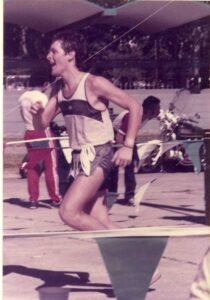 3 – Caracas 1984 – Age 19 – Time 3:32:08
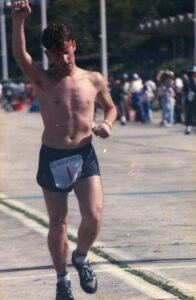 4 – Caracas 1985 – Age 20 – Time 3:35:04
 5 – Philadelphia 2012 – Age 47 – Time: 5:41:40
 6 – Chicago 2013 – Age 48 – Time: 5:44:56
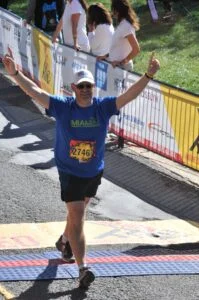 7 – Marine Corps 2014 – Age 49 – Time: 5:33:31
 8 – New York 2017 – Age 52 – Time: 4:51:48
 9 – Berlin 2018 – Age 53 – Time: 5:09:03
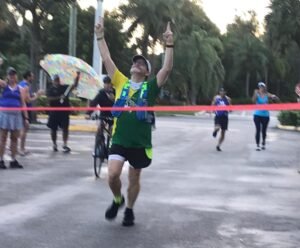

 11 – Houston 2022 – Age 56 – Time 5:16:45
 12 – Houston Marathon 2025 – Age 59 – Time 5:16:52