A Tough, Yet Successful Coaching Day at the A1A Half

A Tough, Yet Successful Coaching Day at the A1A Half

By Coach Adolfo Salgueiro

 The expectations for February 14th were high. It was the first live race for most of us in almost a year. But the South Florida weather was not on our side. The temperature at the start was 77 degrees and the humidity was at 90%. Tough running for conditions any given day, so we adjusted expectations as we walked towards the beach to the starting line of the A1A Publix Half Marathon.

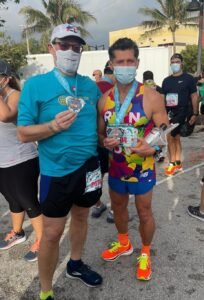
I had three running pupils in the starting corral. They came from different walks of life as well as individual challenges and race goals. Given the trying racing conditions, I am satisfied with the final results, and my runners have expressed the same. This makes for a successful day.

A1A Half

Yolmer G. set up a PR with 1:31:12… Now it is time to focus on his next two, 2021 running goals.

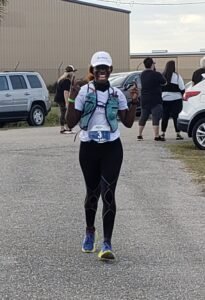
I have been working with Yolmer G (44) for a couple of years now. His goal was to run a sub-1:30 half. He just overcame a broken big toe earlier last year and was back in top shape. The 13.1 miles were not an issue for him. Despite a physically demanding job, he committed to the battery of hard speed workouts prescribed to work towards maintaining the 6:50 pace throughout the race. He came to the race with a PR of 1:32. Unfortunately, he spent the last week keeping a bout of plantar fasciitis at bay. Even though it was a tapering week, it messed up the final tune up process. By Friday he wasn’t sure if he would be able to run.

I crossed paths with Yolmer twice during the race and he looked strong, focused and with good form, which suggested the PF was under control. He passed the 10K mark within range of the goal, but the weather conditions took their toll, and a negative split was not in the books. His final time was a PR of 1:31:12. A success nevertheless, and with plenty of time to make up for those 73 seconds. After a rest period we are focusing on two other goals for 2021.

Sally K (33) is one of the most strong-minded people I’ve ever met. She excels in a high-stress job that demands a lot of her time. Originally, we started working towards a 4:20 for her first marathon. The goal was within range but a trip half around the world, two 2-week work trips, and a sick week, took their toll on her training. I have no doubt she could have ran a 5-hour marathon but at the expense of tremendous suffering through the experience. We talked about it and 10 days before race day she switched to the half.

A1A Half

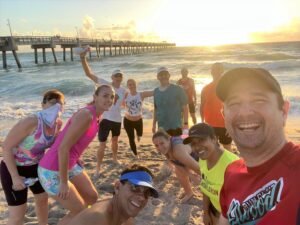
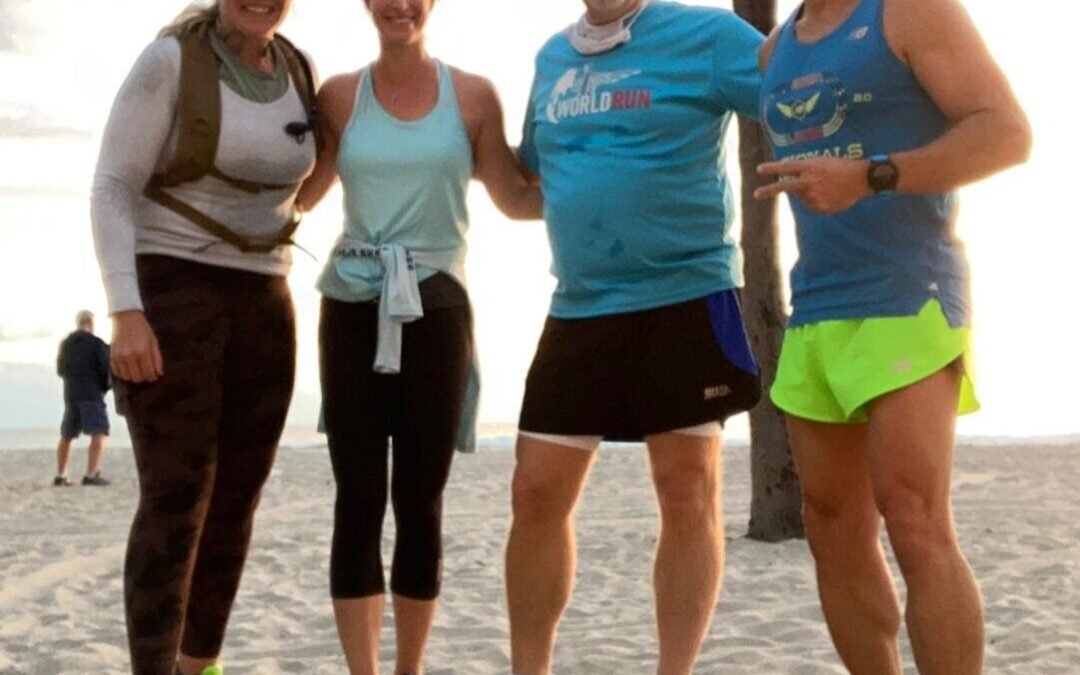
Sam and Sally battled the heat and humidity to reach new heights on their running journeys. This is just the start.

Because of the constant interruptions on her training we could not work much on speed, so she ran on endurance alone. We planned for a 2:12-2:15 finish. The weather took its toll and yet she pushed through. She had a huge smile the two times I crossed paths with her. Finishing time was 2:14:38, ahead of 1099 participants and over half the ladies in her age group. Her 4:20 marathon is one solid training cycle away.

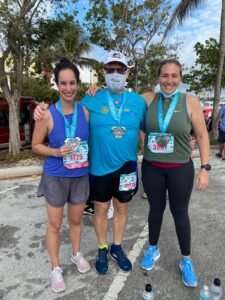
Samantha C. (27) approached me requesting assistance to complete her first half marathon in 20 weeks. She had run a bit here and there but nothing organized or recent. In her first week she struggled to complete 5K. She struggled with side stitches through the first half of the training. But she trusted the plan and followed it as close as possible to overcame self-doubt and realize she is indeed a distance runner. Our original plan was for a 2:30 finish. Two weeks before the A1A, we had a trial run at the Miami Virtual Half, where she surprised everyone with a 2:09:03 finishing time.

Even though an improvement of the previous mark was the A-goal, we knew in advance that weather conditions were playing against it. So the new race plan called for a 2:12ish finish unless there was anything left for a final kick. There wasn’t. At the finish line she told me she had nothing left. She gave her all to finish in 2:12:59. This young lady has such a bright future in running. All she needs is experience, the commitment is already there.

Personally, I couldn’t be prouder with the results of my trainees, especially under such trying weather conditions. So I take the day as a win. As an amazing day for the adventure that is Foultips.run. Thank you Yolmer, Sally and Sam for trusting my experience and guidance. I look forward to taking you all to your next running goals.

Dear New Running Shoes

Dear New Running Shoes

By Michael D’Aulerio*

Dear New Running ShoesYou may not understand what’s about to take place. There’s a great deal of wear and tear coming your way.
Ups and downs, countless miles, and a whole lot of struggle.

However, I can promise you that if you stick with me . . . in the end . . . when you are completely broken, worn down, and beaten . . . when layer upon layer comes off . . . a funny thing happens.

With less, you will feel more.

…and you will experience a profound wholeness that you never knew existed, safe and enclosed, back in your original little box.

It’s going to be a beautiful struggle of a journey, but a journey worth taking.

Will it be easy? No, every step can be a painful step to the finish.

But will it be worth it?

YES, every step of the way . . .

With much love and gratitude,

~The One from Above You, Running with You, Every Step of the Way

Published in this blog with permission from the author.
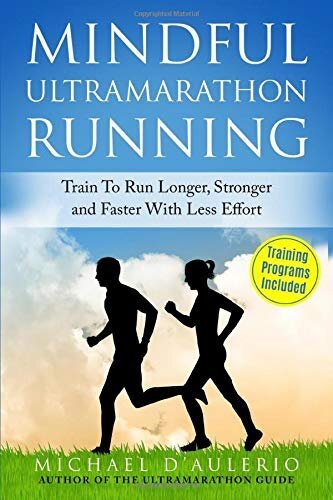
A passage from his new book “Mindful Ultramarathon Running”.

* Michael D’Aulerio is an accomplished ultrarunner and author. A dad, husband, sales professional, a brand ambassador athlete, and has completed over 50 ultras. You can follow him in Instagram at @longrunliving.

5 New Year Running Resolutions

5 New Year Running Resolutions

By Coach Adolfo Salgueiro

 Based on where you are in your running life, your goals for a new year will vary. While for some people, making it to 1000 miles may seem like an insurmountable goal, others have been accomplishing this distance year in and year out. Some athletes break 1:30 in the half marathon on a bad day, others struggle to go sub-3.

Running Resolutions

Making achievable New Year resolutions is the key to keep your athletic goals relevant.

The point here is that to set up your running goal, or goals, for this brand-new year, it must be done in an individual and feasible fashion. These goals can’t be compared with what your friends are doing or what you were able to do when you were a young runner; and they can’t be so out-of-touch that you will be off track at the first sign of trouble or the first day when life gets on the way. Also, you don’t want to get injured because of overstress.

If you haven’t etched in stone your running goals for 2021, or if you haven’t thought about them yet, do so, now. This is what will keep you focused, especially while it is uncertain if and when normal racing will return.

The following goals ideas you may consider:

1 – 1000 Miles – Depending on where you are in your running life, one thousand miles could be a challenging yet achievable Goal. You can also set your eyes on 1500, 2000 or 3000. The key is to break it down in small chunks so you can visualize it. I.E. For 1000 miles, this is just 83.33 miles per month, or 4.8 a day if you run 4 times a week (way less if you include a long run one of those days). Last year, over 1000 members of the 1K Club made it to the 1000 mark. If you have never done it, this may be a great goal for the year.

2 – One more day of activity per week – If you don’t want to focus your running year on counting mileage, adding another day to your training is a good way to increase your activity. If you run only 3 times a week, that 4th day becomes feasible. If you run 5 or 6, this may not be a goal for you, but you can always add a yoga class, a cross training session or an easy, long recovery walk to your week. The key is to increase your activity if you feel you can fit it in without sacrificing your recovery.

3 – Strength training – It is the most neglected part of every training cycle. When we are focused in our training and our work or personal life gets on the way, strength training is the first aspect of the program to be sacrificed. As runners, we pound on our musculoskeletal system on a daily basis. Consider that every in mile you dump 3-4 times your weight into each leg, about 800 times. This is about 2500 times per leg, per 5K. If we don’t prepare our bones, muscles, tendons and ligaments to take on the workload, they will break down, and you will be rehabbing instead of running.

Running Resolutions

Sleeping 7-8 hours a night will improve both your athletic and your personal life (Photo: Pexels.com)

4 – Specific Distance PR – This goal can be handled in two ways. A) You can set up your sights and training on one specific distance where you feel confident performing and go for your best time, ever; or B) you can get out of your comfort zone and pick up a distance where you don’t feel confident and go for it. If you’ve been chasing the elusive Sub-2 half marathon or sub-3:30 marathon, you have a full year to make it happen. Or, if you dislike the 5K because it is too short or too fast; or if you are afraid of what lies beyond the mythical 13.1, then you have a few challenges right there.

5 – Sleep more – It may sound odd that sleeping more is part of a running goals list for a new year, but sleep is one of the most overlooked aspects of recovery, and thus, training. It is also the one that may take you down, if not with an injury, at least by robbing you of your chance of peak performance. In our society, lack of sleep has become a worthless badge of honor, while in reality (and science), our sleeping time is key to our recovery both as athletes and as functional human beings. The benefits of a hard workout are not seen once you finished, the body needs to repair itself and adapt to the stress we just put it through. This doesn’t happen with an easy 5-miler on 5 hours of sleep. The body heals itself and flushes the day’s metabolic waste while we sleep. So, 7-8 hours a night is part of your daily training and a worthwhile running goal for 2021.

Of course, these are not the only athletic goals you may set up for 2021. They are just ideas to help you define what you would like to achieve this year.

What are your running goals for 2021?

The Joy of Barefoot Walking on Grass

The Joy of Barefoot Walking on Grass

By Coach Adolfo Salgueiro

We all know about how important it is to run or walk in the right shoe. Depending on your foot and the way you strike the ground, a shoe may be the right one for you, but this doesn’t mean it is the best option for your running buddy. There are forefoot runners, heel strikers, neutral steps and all the variations in between. But there is one variety where we are all equal: barefoot. We all have the feet we were provided at birth.

Barefoot WalkingLet’s be clear that I am not advocating for barefoot running. It is not for everybody. After the minimalist craze of the early 2000s, lots of people shifted to five-fingers and barefoot without the property transition, assuming it made sense, and a barrage of injuries followed. Some people can handle it, some people don’t.

But what I passionately believe after reading about it and experiencing it, is that barefoot walking on grass is wonderful. The joy of being in direct contact with the earth below you in invigorating and will recharge you for the rest of the day. As I was researching this blogpost, I learned that this practice even has a name, actually two: it is called “grounding” or “earthing”.

I started walking barefoot in my back yard about five years ago. One day, my wife and I decided to go for a barefoot walk around the neighborhood and, surprisingly, it was an invigorating experience. We came back with more energy and more relaxed that than we set out. Since then, I put some 3 to 4 miles out there once every couple of weeks. Getting your feet wet, dirty, stained, and constantly adjusting for the irregularities of the terrain has become a pleasure. I wish I could fit it in more often.

According to an article by Carrie Denner, from The Washington Post, published in July 2018, research suggests physical contact with the Earth’s surface can help regulate our autonomic nervous system and keep our circadian rhythms — which regulate body temperature, hormone secretion, digestion and blood pressure, among other things — synchronized with the day/night cycle. The idea behind it, is that “humans evolved in direct contact with the Earth’s subtle electric charge but have lost that sustained connection, thanks to inventions such as buildings, furniture and shoes with insulated synthetic soles.”

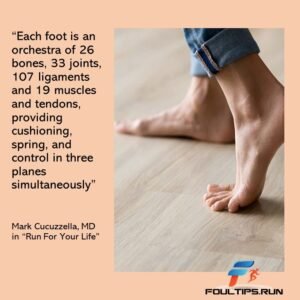
Regardless of what you may think, your feet are ready for the task. In his book Run for Your Life, Dr. Mark Cucuzzella, states that “each foot is an orchestra of 26 bones, 33 joints, 107 ligaments and 19 muscles and tendons, providing cushioning, spring and control in three planes simultaneously”.

I’ve heard people complaining about the possibility of a rock or a piece of trash damaging their feet, but my experience is that, of course you may get a cut or stung by an insect, but in general terms your feet are ready to avoid it. According to Dr. Cucuzzella: “Our feet have 200,000 sensory receptors that are constantly, an unconsciously, appraising our position so that we can make micro adjustments to our balance”. And believe me when I tell you that it works like a charm.

As for where to go for a barefoot walk, it is understandable that not everybody has a backyard where to go even 100 times around if necessary, but most likely there is a park you’re your place where you can set up for this experience.

In their book “Barefoot Walking”, Michael Sandler and Jessica Lee talk of barefoot walking as an experience to free your spirit. They do so in a very poetic way, that, as someone who has experienced it, is not far from reality: “When you go barefoot you’re plugging back into the soil, back into the earth, and back into our global community. As Henry David Thoreau said, ‘Heaven is under our feet at well as over our heads’ […] In essence, by going barefoot, it is as if you are plugging back into the Source—whatever that spiritual connection means to you—because you are going back to the ground from which we came”.

As if this wasn’t benefit enough, you will make your feet stronger by making them work harder without the benefit of shoes. As Dr. Cucuzzella well puts it: “shoes have eased the burden on our feet so that they need to work less. But our feet are designed to work hard. In doing work, they gain strength. Our ancestors did not have golf courses”.

If you don’t believe in the hype I am placing into this barefoot walking on grass thing, find a nice patch of grass at your local park and invest 15 open-minded minutes of your life into giving it a shot. It may not become a transcendental experience, but who knows, it just may. Isn’t it worth finding out? Let me know how it went.

My Virtual NYC Marathon of 2020

My Virtual NYC Marathon of 2020

By Coach Adolfo Salgueiro

When the New York City Marathon decided to go virtual, I received an invitation to participate in it, not sure why since I did not register even for the lottery. I had no interest. Why would I do a virtual New York when I’ve done it in person twice and it is one of the most amazing running experiences, ever? But the more I thought about it, having a 26.2 on my schedule would give me a tangible goal that, otherwise, there is no chance I would even get close to.

Virtual Marathon

A beautiful addition to the collection that I should be getting soon. This will commemorate my 10th Marathon

Sixty dollars was an affordable price, and a spectacular medal a welcomed incentive. Not sure what else is included, but it is irrelevant. You had between October 17 and November 1 to complete the 26.2. This was just between 8 and 10 weeks away depending on the date I ran it. I settled for October 24th so I could have an extra week of training and a spare one should anything go wrong.

Because of an injury some and health issues I went through last year, I hadn’t run more than 10 kilometers straight during the year. I had gone longer when including walking breaks. Run/walk intervals allowed me to get my fitness and aerobic capacity back. I also had to shed a few extra pounds. So I prepared a NYC plan focusing on steady increment of mileage, management of effort and heart rate control based on full recovery. Finishing time for this one was a secondary consideration. Finishing strong and without injury was more than enough reward.

My plan called for a few running miles at the start and from there on, run half mile and walk another half. Yes, a lot of walking, but I didn’t want to get my heart rate so high that that it would become unsustainable and force me to walk the last 10 miles. As I trained and was able to run more miles, I felt the recovery periods were way too long, so I adjusted. My longest training session was 17 miles, my longest non-stop run was 9 miles. My run/walk intervals got set to .6/.4. I was ready to go.

Virtual Marathon

Thanking God as I cross the finish line, surrounded by my running family.

Then, October 24th, 2020 arrived and at 2:26AM I hit the road. I ran the first 6 miles and met with Bill and Rita about 3:30 am for my first water and resupply stop. From there on, I started my run/walk protocol. At first it bothered me to walk when I still felt strong, but I knew it was an investment towards the last miles, and it paid off. At mile 10, I met up with Ted, who accompanied me the next 8 miles. Up to this point my wife followed me in the car, so slow that a cop found it suspicious enough to stop her.

Close to Mile 17, the most amazing thing happened. A caravan of my running buddies passed by with horns, cowbells, yelling and screaming. A shot of adrenaline invaded my body. They were going to our regular Saturday starting spot, where I met them to pick up my last supply cache from Patrick. Once there, I kept going for my last 8.2 miles with a few friends here and there. Ruben stuck with me and ran/walked with me the whole way, sacrificing his training for the day.

I may have missed then entrance to First Avenue from the Queensboro Bridge, but what my buddies from the No-Club Runners had at the finish line was equally impressive. I choked as I ran towards the line through a tunnel of screaming, yelling, cowbells, paparazzi and the support of those who were genuinely elated to share this moment with me. It was not Central Park, but I wouldn’t trade this finish line for it.

Final time accepted by NYRRC was 5:28:14. Almost two minutes below my wildest expectations.

Virtual Marathon

Post-marathon celebration with my buddies from the No-Club Runners. What an amazing bunch of people.

I have been asked if I count this experience as a completed marathon. If I count it as my 3rd time completing NYC? The answer to both questions is yes. The answers are affirmative because this was an established and scheduled race. It did not happen this year because of Covid. This is not a race that popped up to sell you a medal taking advantage of the pandemic. There was a strict time frame on when to do complete the specific distance. This was not a “run what you want, when you want” scheme. On a personal level, it is not like I’ve ran 26.2 so often that I lost count. This is just my 10th time at the distance.

This experience taught me is that I am mentally stronger than I thought. That if I am smart about how to approach certain challenges, adjusting as I work towards them, I can achieve and complete them successfully and safely. That the marathon is still a great adversary, but no unconquerable. And, above all, that I have a running family for which superlative adjectives to qualify them would make no justice to what they mean to me.

Running with a Mask in Times of Pandemic

Running with a Mask in Times of Pandemic

By Coach Adolfo Salgueiro

Before we get started, I must remind everyone that I am not an infectious medicine specialist. If you want scientific advice, I recommend you listen and follow what Dr. Anthony Fauci has to say regarding Covid-19. With this disclaimer out of the way, the following are my thoughts on running with a mask during times of pandemic.

Running with a Mask

By trial-and-error we will find what works best of us individually (Photo by cottonbro from Pexels)

Eight months or so into the Covid-19 pandemic, and four after the economy was inevitably reopened, we’ve returned to our group activities such as work, extended family and exercising with as much caution as possible. Social distancing keeps being the new norm, hugs and kisses have been replaced to fist and elbow bumps, and masks have become a political issue. As runners, we’ve had to adjust to this new reality in order to keep moving forward and to keep the social aspect of our sport alive. The uncomfortableness of wearing a mask is a small price to pay.

According to Certified Personal Trainer Timothy Lyman in a recent article in Runner’s World Magazine,  “Running with a mask, or any other type of face covering, is inherently more difficult because you have to work harder to get the same amount of air into your lungs”. Of course this will vary depending on the type of are wearing.

Getting used to running covering your nose and mouth requires time, commitment and training. Figuring out what mask works better for you, when is the best time to have it on or just available for immediate use, are part of such training. Knowing in what situations you should or should not wear it has also been a trial-and-error endeavor.

The same article in Runner’s World states that: As a general rule, a mask is necessary if you’re running in a populated area where you’re likely to encounter other people. If you’re running alone in an area where you won’t encounter others or come within 6 feet (at a minimum) of others, it’s likely not necessary. But keep in mind that wearing a face covering is not a substitute for physical distancing—make sure to still keep at least six feet of distance between yourself and others while running.

Through my personal experience running over 600 miles during the pandemic, what I’ve figure out is that even though I may not need a mask when I run alone, I rather have one because inevitably I will cross paths with strangers that either do not care to help you create the safe distance or, you meet them in places where it is just impossible to separate. Therefore, I always run with a cloth mask on my chin or neck, which I can immediately access to cover my face when required. It has worked so far for me and I recommend it.

Running with a Mask

It is important to keep your social distance even if you are running with your buddies (check how I have a mask on my neck ready to be used at a moment’s notice) – Photo by Ted Sassi.

In my two running groups, we all use face coverings until we start. As for running together, we try to stay close enough to keep the social aspect of running alive but separate enough to adhere to the protocols. The post-run cafĂŠ-con-leche or beers, are strictly held outdoors.

For group running, Dr. Jennifer Marin, from @Obesalud, recommends not running one behind the next but keeping a diagonal formation with 5-meter (15 feet) of separation. This is an interesting, overcautious suggestion, worth looking into.

An important consideration is that, regardless of the type of mask you wear, you need to go out of your way to keep it clean and disinfected. The constant breathing will dampen it and thus less effective. I you don’t wash it; it will attract microorganisms that you will be breathing in and may negate the benefits of wearing a mask in the first place. So make sure you keep several of them in your running bag so you can rotate them appropriately.

Yes, running with a mask is a pain in the ass. No questions about it. But a worse option is having Covid-19. So suck it up, get used to the discomfort, wear a mask like a good citizen and keep on running with your buddies.

Skip to content