What Motivates Runners

What Motivates Runners

By Coach Adolfo Salgueiro

 I was recently having a conversation with a group of friends regarding the reasons we lace up our shoes three, four, or five times a week. It became obvious that even though most of us may have the same basic reasons, if we dig deeper and list the top five things that motivate us to engage in this sport, the lists will be as unique as the uniqueness of each runner.

What Motivates RunnersWhen it comes to running, we all have a main reason why we do it. The answers can fit into a wide spectrum ranging from “because I like it” through “I just can’t stop”, with infinite shades in between.


As I was recently re-reading “The Science of Running” (a book by Steve Magness, which I highly recommend to anyone wanting to delve very deep into the subject of the title), I was surprised to see a section with an array of scientific studies that classify runners according to their motivations.

Three of them caught my attention, and thus, I share them with you here, so you can find where you fit based on each one of them.

According to a paper titled “Motives for Participation in Recreational Running”, published in The Journal of Leisure Research by Peter Clough, John Shepherd and Ronald Maughan, back in 1989, runners’ motivations could be divided into six groups:

a.    Well-Being
b.    Social
c.    Challenge
d.    Status
e.    Fitness/Health
f.     Addiction

According to this study, while most leisure activities include one or many aspects of the first four aforementioned reasons, the last two separate running from other activities. Interesting to me is the last one. I am sure we all know someone we consider “addicted to running”, but to realize there are scholarly studies that actually classify addiction as a real motivation for the sport, puts such compulsion in a new light. At least for me.

In his latest book, “A Runner’s High”, Dean Karnazes states: “If running is a drug that threatens my life, let me have it”.

Magness also cites a study titled “Motivations for running and eating attitudes in obligatory versus nonobligatory runners”  by Heather Slay, Jumi Hayaki, Melissa A. Napolitano and Kelly D. Brownell, published in 1998 in the International Journal of Eating Disorders.

As the title suggests, runners were separated in two groups based on the reasons they participate in our sport. This study separated those who run because they want from the ones who run because they must. The “Obligator” group is motivated by negative or external factors. These are the runners that if they take a week off will start thinking they are letting themselves down or the pounds will start creeping in by tomorrow. On the opposite side are the ones who just run because they want to. That is where I fit in, and I just prefer it this way.

The third study that caught my attention is a paper titled “A typology of marathon runners based on cluster analysis of motivations”, published in 2003 in the Journal of Sports Behavior by B.M. Ogles and K.S. Masters. In this one, marathoners are separated into five categories based on their motivation:

a.    Running Enthusiasts
b.    Lifestyle Managers
c.    Personal Goal Achievers
d.    Personal Accomplishers
e.    Competitive Achievers

What Motivates Runners

Runners train in Ngong, Kenya, in 2012. The country has produced the world’s best distance runners for decades, and most belong to the Kalenjin people.

Of course, there are many more motivations for running. According to a study by Professor Vincent Onywera in 2006, the main motivator for Kenyan Elite Runners is financial gain. Lower in their list are talent and national tradition.

If you read the recently published book “Out of Thin Air”, by anthropologist Michael Crawley, you will realize that Ethiopian runners have the same financial motivation, even those who are still far of the “elite” label but working towards it.

Financial is not a motivation for 99.9% of the readers of this blogpost. If anyone fits into the 0.1% remaining, please identify yourself.

This blogpost ended up a bit denser on science than I what I originally intended, but I found this subject fascinating. Somehow, I am sure we can all find ourselves in each one of these studies and understand a bit more why we do this. Because if you are a runner, it doesn’t matter what motivates you, as long as it keeps you moving forward.

Any thoughts? Leave me a comment, below.


Heat Exhaustion Vs. Heatstroke

Heat Exhaustion Vs. Heatstroke

By Coach Adolfo Salgueiro

Once again, the usual disclaimer: I am not a doctor, so please do not take medical advice from me. If you have any questions on what you are about to read, please consult a professional, which, yet once again, it is not the author of this blogpost. Now, let’s proceed.

Heat Exhaustion vs. Heatstroke

Running in the summer heat requires a certain level of preparation to avoid heat related issues, including death (Jonas Ferlin, pexels.com)

As we enter the Summer months in the Northern Hemisphere and the coolness of the spring weather turns into a combination of heat and humidity that can make even the most motivated runner miserable, the time has come to refresh our knowledge on two important concepts. It is extremely important to understand and differentiate the signs and symptoms of heat related illnesses, such as heat exhaustion and heatstroke. They are both serious conditions, but one can lead to death.

According to the Mayo Clinic’s website, there are three heat-related syndromes that may affect your body depending on your exposure to extreme heat conditions. In order of severity, they are: heat cramps, heat exhaustion and heatstroke.

Heat Exhaustion is caused by exposure to high temperatures, particularly when combined with high humidity and strenuous physical activity. Without prompt treatment, it can turn into a heatstroke, a life-threatening condition that can be prevented by avoiding entering in the heat exhaustion zone in the first place.

Heatstroke is a condition caused by your body overheating, usually as result of prolonged exposure to physical exertion in high temperatures. This most serious form of heat injury, it can occur if your body temperature rises to 104 F (40 C) or higher.

Certain conditions and medicines can enhance your risk of a heat-related illness. Ask your doctor if any of your medical history or current prescriptions can make you more susceptible to these diseases considering your level of physical activity during the warmer months.

I can’t state enough how important to know and understand the symptoms of each one of these syndromes. Not only it could help you prevent them, but it can avert a tragedy.


Heat Exhaustion

The evaporation of your sweat regulates your body temperature. However, when you exercise strenuously or otherwise overexert yourself in hot, humid weather, your core temperature (body\’s heat combined with environmental heat) fails to regulate, preventing your body to cool itself. A normal core temperature is around 98.6 F (37 C).

 If you don’t deal with this situation immediately, it may develop into a dreaded heatstroke.

The symptoms of Heat Exhaustion are:

  • Cool, moist skin with goose bumps

  • Heavy sweating

  • Faintness

  • Dizziness

  • Fatigue

  • Weak, rapid pulse

  • Low blood pressure upon standing

  • Muscle cramps

  • Nausea

  • Headache

Should you feel these symptoms, stop your activity immediately, move to a cooler place, drink cool water and/or sports drinks and rest. If these symptoms don’t get better within in an hour, contact your doctor. Remember you are avoiding at all costs to have this escalate into a heatstroke.

Heatstroke

Heatstroke not only requires immediate treatment, but it can quickly injure the brain, heart, kidneys, and muscles. Damage can get worse the longer treatment is delayed and lead to serious complications and, once again, even death.

The symptoms of Heatstroke are:

  • High body temperature (over 104 F or 40 C),

  • Altered mental state or behavior (Confusion, agitation, slurred speech, irritability, delirium, seizures),

  • Alteration in sweating (skin feels hot and dry to the touch),

  • Nausea and vomiting,

  • Flushed skin. (Skin may turn red as the body temperature increases),

  • Rapid breathing (rapid and shallow),

  • Racing heart rate (Pulse may significantly increase),

  • Headache (Throbbing).


Prevention

  • It is imperative to be proactive, both for ourselves and on behalf of our running mates, in the avoidance of situations that may trigger heat exhaustion during the hot summer months. The Mayo Clinic recommends the following:

  • Wear loose-fitting, lightweight clothing,

  • Protect against sunburn,

  • Drink plenty of fluids,

  • Take extra precautions with certain medications (ask your doctor),

  • Take it easy during the hottest parts of the day,

  • Get acclimated to the new weather conditions.

Last year we wrote a blog post on Training Adjustments for the Summer Months, which may be worth revisiting as we prepare for the upcoming weather conditions.

Let’s take a little bit of time and learn about heat exhaustion and heatstroke so we can prevent a tragedy.

 
2 Breathing Techniques to Improve Your Running

2 Breathing Techniques to Improve Your Running

By Coach Adolfo Salgueiro

A few months ago I bumped into a challenge with one of my coached runners. As soon as she reached mile 3 or 4, she got a side stitch. It didn’t matter what we tried with the timing on her nutrition or her fluid intake. Come that point, boom! Stitch! We needed to attack this problem and fast. Before it became a psychological issue.

I consulted with a few coaches I know, and they gave me their suggestions and home remedies. While we found a couple of things to temporarily remedy the nagging stitch, they were not the permanent solution we were looking for.

While researching the issue I came across a book from 2013 called “Running on Air: The revolutionary Way to Run Better by Breathing Smarter”, by Bud Coats and Claire Kowalchik. This was a publication of Runner’s World Magazine, published by Rodale.

The book goes into details about many things that are not necessarily related to breathing. So, since this is not a book review, I am skipping them. But it does go into detail on the science and mechanics of breathing and breathing while running in layman terms. To my trainee, there were two specific aspects that not only made the difference, but solved the problem:


Breathing Techniques

Breathing from the belly and doing in in an add-number pattern may help you improve you running. Worth giving it a try (image from pexels.com)

1-   DIAPHRAGMATIC BREATHING

Known colloquially as “belly breathing”, involves engaging the stomach, abdominal muscles, and diaphragm, which means actively pulling the diaphragm down with each inward breath. Compared with coastal breathing, it helps the lungs fill more efficiently.

I cannot teach you diaphragmatic breathing in a few paragraphs, but I can tell you that I’ve been doing it for over 20 years, and it has worked for me beautifully. It also helps you strengthen the diaphragm, located beneath your lungs, which is the major muscle of the respiration process. It contracts and flattens when you inhale, creating a a vacuum effect that pulls air into the lungs. A stronger diaphragm means more air, more air means more oxygen for your body to burn, and less side stitches.

Regardless of your preferred type of breathing, a strong diaphragm will help you breath better, relax, meditate, improve digestion, and provide you the obvious running benefits that more oxygen in your system can offer.

If you want to learn more about diaphragmatic breathing, its benefits and strengthening exercises, click here for a YouTube video from the UCLA Integrative Digestive and Health Wellness Program, which can help you get started.

2 – RHYTHMIC BREATHING

I have been breathing on a 3/2 count (inhale for 3 steps and exhale for 2) for about 5 years, and the benefits have been tangible. I don’t even think about it anymore, it just happens. In my personal experience, it works better than the 2/2 I did for years. Once I got my hands on this book, I understood why, and it made sense.

It is because “the greatest impact stress of running occurs when the foot strikes the ground at the beginning of exhalation and also that core stability is at its lowest during exhalation”.

Based on this, it is easy to understand that by breathing on an odd count, you will be alternating sides each time you are at your weakest while hitting the ground. Think of it this way: In one mile, you will be hitting about 750 times on each side instead of 1500 on the same one. Multiply this by the number of miles you run in a week, a month, or a year, and if you are not breathing on an odd number count, my suggestion is you better start thinking about it, today.

How do you do it? Just do it. Three in, two out. It will be weird at first, but with time, it will feel more natural and within a couple of weeks you won’t even notice it anymore.

As for rhythmic breathing, there is plenty more to learn than what four paragraphs can tell you. So, if you are interested, this is a good book where to get started.

As for my trainee, she read the book, she started strengthening her diaphragm, breathing in a 3/2 pattern, and finished not one but two half marathons with a time beyond our wildest expectations. Oh! And no more side stitches.


One Year Without Missing a Day

One Year Without Missing a Day

By Patrick O’Dea

EDITOR’S NOTE: Patrick is a 66-year-old runner who participates in both of my running groups in the Fort Lauderdale area. Last year he decided to extend his running into an everyday activity, putting together a streak that now covers 365 days and counting. What follows, below, is his own account of his start in the sport and how he became a streaker. As someone who has ran hundreds of miles with him, I can attest on how much he has improved during this last year, proving that a well-managed life can allow for this type of endeavors.


Hello from a fellow runner who has not missed one day of running in the last 365 days.  My name is Patrick O\’Dea and South Florida has been my home since 1979. I grew up in Ireland and graduated from college there.  I followed my brother Stephen to Miami, and I am still here.  Why? You can only handle so much wind and rain in one lifetime.  Ireland may have 40 shades of green according to Johnny Cash, but it takes lots of rain to keep it that way. 

One Year Without Missing A Day

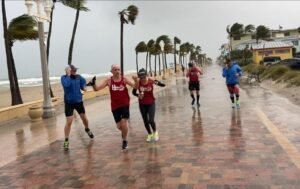
Back in November 2020, Patrick, Nohra and Ted (all in the red singlets) ran the Virtual Marine Corps Marathon during a Hurricane Watch.

I came in search of sunshine and adventure and I\’m glad I did.  I spent most of the last 40+ years as an educator, especially at St. Thomas Aquinas High School, here in Fort Lauderdale.

Now I am enjoying a slower pace, learning a little Spanish and Irish, serving on my condo board, and on the board of two Irish cultural organizations. I volunteer at St. Sebastian Church and I just finished a Leadership program with the City of Fort Lauderdale. I also run every single day.

I got seriously involved in running about eight years ago.  Three factors got me going: 

1 – My friend and school colleague Orestes, needed runners for a faculty team for the Mercedes Benz Corporate Run. 
2 – Orange Theory just opened a gym in my backyard. 
3 – New Year\’s resolution.

All three kicked in at the same time, and I am still running. 

What has kept me going is the wonderful community of runners that I am privileged to be a part of four times a week.  Every Tuesday and Thursday, we meet at Runners Depot, our local running store, for a 5-mile run, or we run bridge-repeats over the 17 Street Causeway Bridge, “our local hill” in a flat area.  On Saturdays and Sundays, we meet at our favorite Colombian bakery and we run the Hollywood Broadwalk. I have also run with several local groups, which motivates me to run faster.

So far, I have finished 3 marathons including the Marine Corps virtual last year with Norha and Ted, during a Hurricane Watch, no less.  Yes, we are crazy!  I also ran the Marabana, with Orestes and a handful of buddies, during a torrential downpour in La Habana, Cuba. Maybe the rain is following me from Ireland.  Both are memorable events in my running career.  I would love to run the real Marine Corps Marathon, one day. It’s a cool way to see a great city.

One Year Without Missing A Day

Patrick with his 2020 1K Medal at his favorite Saturday Morning post-run breakfast joint.

I have met my 365 goal, already but I want to achieve 1,000 miles this year ASAP. I am amazed by runners who have already done it in 2 or 3 months!  Unbelievable! 

What really keeps me running every day is my local running family, where we are there for each other in good times and bad.  I appreciate their support and encouragement and I am blessed to be part of an amazing group of people who talk the talk and walk the walk.  That is what gets me up before dawn every Saturday and Sunday.

During my 365-day streak, I felt a great sense of accomplishment, and I am proud of my achievement.  I never felt like quitting as I had come too far to throw in the towel.  Even now, I run every day and want to continue as long as I feel good.  I am blessed that I have no pains and aches as I run to keep up with my younger friends.  I have no special diet and I take a handful of vitamins every day.  My advice to aspiring runners:  Just do it!  Lace up your sneakers, put one foot in front of the other and let’s go!  See you on the asphalt. 

Let\’s run! 

 
Tears and Running

Tears and Running

By Coach Adolfo Salgueiro

Tears are the reflection of the extreme emotions of our lives. We shed them out of love when our kids are born but also when a loved one passes away. We shed them out of joy over a personal accomplishment or when we enjoy someone else’s triumph, graduation or wedding; but also when we share our frustrations, failures, or broken hearts with those closest to us. Tears of joy are so ubiquitous that they even have their own emoji.

When it comes to running, it is no different. Why would it be?

Tears and Running

Crying on the last few meters of the 2022 Houston Marathon, 7 months after open-heart surgery.

When I was 17, I went to Kilometer 30 (Mile 19) of the 1982 Caracas Marathon, where my dad was going to run in a friend. What I experienced there was so overwhelming, that on a whim, I jumped in and ran the last 12 Km (about 7.5 miles) to the finishing area. The tears I witnessed, changed my life.

I saw grown-up men crying out of frustration when they could not run any longer and had to walk. I saw every type of emotion reflected in the faces and bodies of those I passed. And I saw tears of joy as runners approached the finish line with smiles covering their faces. I was hooked. I had to experience those extremes. I didn’t know when, but I knew that one day I would run a marathon myself. That day came sooner than later, when I finished my first marathon a few weeks later, but that is a story for another day.

If I teared up or cried during my first life as a runner, I honestly don’t remember. Maybe since I was still a teenager, I thought I was invincible, and running marathons in the 3:30 range, or better in the near future, would last forever. Who knows? My first knee operation, in 1986, gave me a reality check.

I was training for the 1986 Caracas Marathon, trying to approach the 3-hour mark, when I hit my knee and ended up under the knife just 6 weeks prior to the race. I cried out of frustration when I saw my two training partners finishing in 2:56 and 3:04. But that is life.

The first time I vividly remember crying while running, was as I crossed the finish line of the 2012 Philadelphia Marathon. It was my first marathon since December 1985. A 26-year hiatus. Since then, not only I had two left-knee surgeries, but after the one in 2004, at age 39, I asked the doctor if he thought I could ever complete another marathon. He told me, in no uncertain terms, to forget it. It was not going to happen.

So, as I approached the finish line through the Benjamin Franklin Parkway, on that cold November day in Philadelphia, as I was praying in thanks to God for giving me this remarkable opportunity, I started feeling a knot in my throat. Once I was able to distinguish the finish line in front of me, tears started running down my cheeks. When I hugged my wife a few yards after the end, I was openly sobbing. This feeling was beyond anything I could have ever imagined.

I have cried again on the asphalt. I did so at the finishing of the Den Haag Half marathon, my first running half after three years of racewalking. I also cried at the start of the New York City Marathon in 2017, still trying to grasp that I was there again after 32 years, ready to absorb the experience. I shed some tears at a small 5K in late 2019, my first competition after a heart procedure. And I hope I can cry some more, soon. It can only mean I am alive, overcoming obstacles and still running.

I would love to hear your crying-while-running-stories. You can share them in the comment section, below.

My Case on Behalf of Glucosamine

My Case on Behalf of Glucosamine

By Coach Adolfo Salgueiro

 Before we get started, I am disclosing I am not a doctor, and I am not giving medical advice. What you are about to read is just my personal experience mixed with light internet research.

Glucosamine

Glucosamine and chondroitin are popular supplements used to treat osteoarthritis. About 6.5 million adults, or 2.6 percent of the population, have used one or both products

I’ve had issues with my left knee for a long time. It kept me from running for many years. It has always been my weakest link. But just like millions of runners, upon the recommendation of someone who I can no longer remember, I started taking glucosamine many years ago, and somehow, it kept the pain at bay and allowed me to keep running consistently for many years. This is my story, and I am sticking to it.

When I decided to give marathoning another try, as I was eyeing the New York City Marathon, I asked my doctor about Glucosamine. He told me there were no conclusive studies proving that it worked or that it didn’t. His professional recommendation was that if I thought it was beneficial to me, to keep taking it. If not, then don’t bother.

Glucosamine is not cheap. A bottle of the good stuff can go from $40-$50 for a few months’ supply. So, when it was time to replenish the stash, with cash in short supply at that particular time of the month and with the recent lecture from my doctor, I decided to skip it. A couple of weeks later, my knee started to hurt and other joints felt stiffer. How could this be? There was no proof! I ran to the drugstore, got my glucosamine and a week later, the pain was gone. This is all the research I need.

Glucosamine

This is the brand I use and the results have been stellar. I don’t need much more research than that.

Then I thought: Of course! Why in the world would a drug company invest time, effort and millions of dollars researching the benefits of glucosamine when every drug store carries ten over-the-counter options from which you can purchase as many as you want, whenever you want? This is no moneymaker. No reason to invest just for the pure pursuit of knowledge. It works for me, and this is all I need to know. I am the research paper my doctor was unable to quote.

Glucosamine has been around since 1876. It is manufactured by processing a polymer from the shells of shellfish, shrimp, lobsters and crabs. It also comes from other animals such as cows and pigs. Newer versions made from fungi and fermented corn have been brought to market to cater the needs of vegetarian consumers.

Glucosamine is a dietary supplement, not a prescription drug. Because of regulations, in the US it is marketed as a supplement to support the structure and function of the joints. It is also directed to people with osteoarthritis. Tests have shown that you can consume up to 1500 mg per day with no adverse effects.

Glucosamine pills usually include a compound named chondroitin. According to WebMd, chondroitin is a substance that occurs naturally in the connective tissues of people and animals. As a supplement in higher doses than is found naturally, chondroitin is also a popular treatment for osteoarthritis.

Arthritis.org states that “glucosamine and chondroitin are popular supplements used to treat osteoarthritis. According to one estimate, 6.5 million adults, or 2.6 percent of the population, have used one or both products”.

Both glucosamine and chondroitin are usually found in healthy cartilage and have anti-inflammatory properties. “They also have some cartilage-protecting effects through a variety of different mechanisms,” says Chris D’Adamo, PhD, director of Research & Education at the University of Maryland School of Medicine Center for Integrative Medicine.  

Glucosamine and chondroitin protect cells called chondrocytes, which help maintain cartilage structure. In theory, these supplements have the potential to slow cartilage deterioration in the joints, and to reduce pain in the process. 

Sounds good to me!

I take the Kirkland brand with 1500 mg of glucosamine with 1200 mg of chondroitin, and it has worked for me. If I ever forget to take it for a few days or if my resupply delays, my body promptly reminds me. Once again, what additional research do I need?

Please don’t take medical advice from me. I am not a doctor, nor I wish to be one. Glucosamine with chondroitin works for me. If you have joint issues, I suggest you check with a real doctor and then give it a try.

Skip to content