The Case for Urinals at Starting Lines

The Case for Urinals at Starting Lines

By Coach Adolfo Salgueiro

I visited The Netherlands for my birthday, a few years ago, and of course I looked for a race. I was going to be in The Hague, and God smiled at me with the Den Haag Marathon on the exact same weekend I planned to arrive. I ran the half. It was an unbelievable experience. The most beautiful course in one of the prettiest and quaintest cities I’ve ever visited.

But one of the memories that has endured from my experience in the Den Haag race is kind of weird. The urinals at the starting area, which was in a public park. Yes, urinals. And not just at the starting line but also in many public places around town and as permanent structures throughout several cities in The Netherlands.

Urinals at starting lines

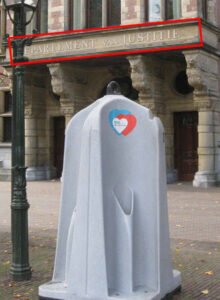
Public urinal in front of the Department of Justice in Den Haag, The Netherlands.

While waiting for the gun to go off at Den Haag, I saw these weird rigid plastic structures. They were on top of a square shaped base, maybe 4 feet to a side, about 7 feet tall, each side bisected with a wall, which created four “cubicles”. Each space had a “V” shaped opening at about 3 feet high at the innermost corner. They looked like… No!!… It can’t be!!!… But they were! They were urinals and weirdest of all, men were actually urinating in them, leaving the port-a-potty facilities for those males with “bigger needs” and women.

As you may imagine, I did not take pictures of people using these artifacts, but I did take a picture of an exact one, at a later date, this one in a square surrounded by restaurants, bars and located right in front of the Department of Justice (See accompanying image). It was there 24/7 for people (men) visiting their favorite watering holes to “take care of business” without resorting to the unsanitary and illegal option of going against the walls, cars, trees or bushes. Very pragmatic, like most Dutch solutions.

I know this may be a weird topic for this forum, but I assume we are all adults and we can discuss the issue with some degree of maturity. And, since every runner has at least a handful of port-a-potty horror stories during their racing career, I wanted to make the case in favor of the use of urinals for races in the United States.

THE MATH

Let’s set up a case study with a mid-size race of 3000 runners. Let’s assume a 50-50 split on the binary genders (1500 each). And let’s assume for this example the race director calculated a port-a-potty for each 75 participants, for a total of 40. If 75% of people use the facilities pre-race (2,250) and let’s say one third of them (563) are in line at any given time before the gun goes off, this means an average line of 19 people per door. Assuming an average time of 3 minutes per use, the average waiting time is 57 minutes per user. We’ve all been there and if not, we haven’t raced enough.

Now, let’s say this same race director decides to be pragmatic and exchange just five traditional port-a-potties with 4-corner urinals placed at an appropriate location in the starting area. For this example let’s say 75% of the male users (844) are using the facilities only for urination. Then, the overall population of runners using the port-a-potties has been reduced from 2,250 to 1,406, which at 35 doors and the exact parameters of usage as before, the average runner will be waiting in line for 40 minutes. Does it sound like still a long wait? I’ll take it. It is 30% shorter. It is a start.

 THE SOLUTION

Urinals at starting lines

There is a solution to this problem. Do we have the maturity to solve it?

I don’t assume to be speaking for all male runners, but I believe I am for a vast majority. Let’s face it, most of us at some point have found a tree, a bush or a wall to relieve ourselves while waiting at the starting area of a race. And while there, very likely have witnessed females crouching with their shorts half down doing the same and for the same reason as us. And let’s come clear here, there is nothing sexy or sexual about adults exposing themselves to take care of business before a race. I haven’t experienced the first sexual frenzy in such situation. So let’s grow up and find a solution. There is one and it has been in use in Europe for years.

A difference between the Dutch and the Americans is that the former are extremely pragmatic in the solutions to their public issues while the latter are still embarrassedly prudish with anything related to sexual organs, even if they are being used for purposes other than procreation or related fun-driven activities. While the municipality of Amsterdam installed urinals around the bar areas once they figured out a substantial percentage of drowned men in the canals were found drunk and with their fly open, in the USA we would face a “Today Show exclusive investigation on the immorality of urinals in foot races”, reported by non-runners, despite the fact that it will ameliorate a big problem within this industry.

The use of port-a-potties is as part of a race as complaining of nagging injuries with your friends. None of them are going away anytime soon. There is a solution out there. Can we grow up and use it? Or are we to prudish to implement it?

Any thoughts?

 
The Power of Being Constant

The Power of Being Constant

By Anthony Reed *

Editor’s Note:  This is a posting from Mr. Reed in our RCAA Coaches Group. I requested, and obtained, his permission to repost it here. I believe it shows the power of remaining constant and relentlessly moving forward towards your lifetime goals and its compounding results.


Life-Long Goal Setting: Maintaining a three miles per day in average.

 
Being Constant

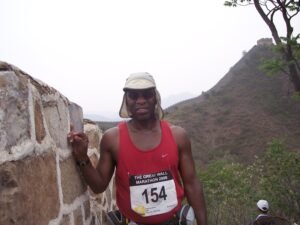
The Great Wall Marathon, China (Photo courtesy of Anthony Reed)

Many runners focus on various goals, such as running 100 miles per month. Today (6/6/21), during a 15-mile run, I finally logged over 47,000 miles over 42 years.

 In 1976, I set a lifetime goal to average three miles of running per day as a way of avoiding insulin. My primary goal was to run about 90 miles/month and the secondary goal was at least 100 miles per month. Also, I only wanted to run only three or four days per week. I’m a very firm believer in “everything in moderation”.

 I was diagnosed as pre-diabetic in 1963 and was told that I’d be on insulin by the 1970’s. I started running as a way to avoid this prediction. In the mid-1970’s, a co-worker lost his sight due to glaucoma, had his foot and leg amputated, and died to complications from diabetes. I don’t believe he was more than 50 years old. I was scared to death.

 I’ve maintained a handwritten running journal since 1979. The detailed, monthly data is summarized in an Excel workbook. Here’s a brief analysis of 509 months of running.

RUNNING DATA

 – Averaged 3.03 miles/day over 509 months.

Being Constant

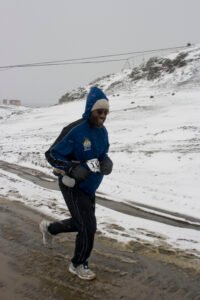
Antarctica Marathon (Photo courtesy of Anthony Reed)

– Ran 5,359 days (34.6%) out of a possible 15,496 days. As a father and husband, I wanted to keep running simple, fun, flexible, and injury-free. Thus, I felt that running everyday would put undue pressure on me. So, I opted to run only 3 or 4 days a week.

 – I was not perfect. I failed to reach my primary monthly goal 40% of the time, including 29 months of not running a single mile. However, I never lost sight of my goal AND my reason for achieving it. I wanted to live past 50, keep my eyesight, not have any limbs amputated, and not be on insulin. The money saved from paying for insulin was used to travel around the world and finish marathons on seven continents (completed in 2007) and fifty States (completed in 2013).

 – Longest streak of reaching at least 100 miles per month was 21 months; from June 1985 through February 1987. Averaged 148.7 miles/month.

 – Longest streak of not reaching primary goal was 29 months; from August 1990 through December 1992. Averaged 60.74 miles/month.

 – Maximum miles in one month: 200.13 in January 1986 over 17 days of running.

RACING DATA

 – Fastest races: Marathon – 3:36:45 (1984); 20-Miler – 2:35:54 (1987); Half marathon – 1:34:11 (1985); 10K – 41:31 (1983) [BTW – These PB’s were run while weighing about 195 pounds at six feet tall, which wasn’t easy.]

 – Completed 226 races between 1979 and 2018 (averaged 5.3 races/year).

 – Averaged 2.3 marathons/year between 1982 and 2000. Only one marathon (Chicago) of my first 42 marathons was outside of Texas, which included 15 Cowtown Marathons (Ft. Worth) and 15 Dallas Marathons (formerly White Rock). You have an entire lifetime to run marathons, so take it easy on the racing, especially if you\’re just beginning.

 – Completed 131 marathons between 1982 and 2018 (averaged 3.5 marathons/year).

 – Longest monthly streak: 15 marathons between February 2012 and January 2013.

 By keeping focused on a lifetime AVERAGE, it took the stress off everyday living and goal setting. Next month, I’ll turn 66 and am still not on insulin.


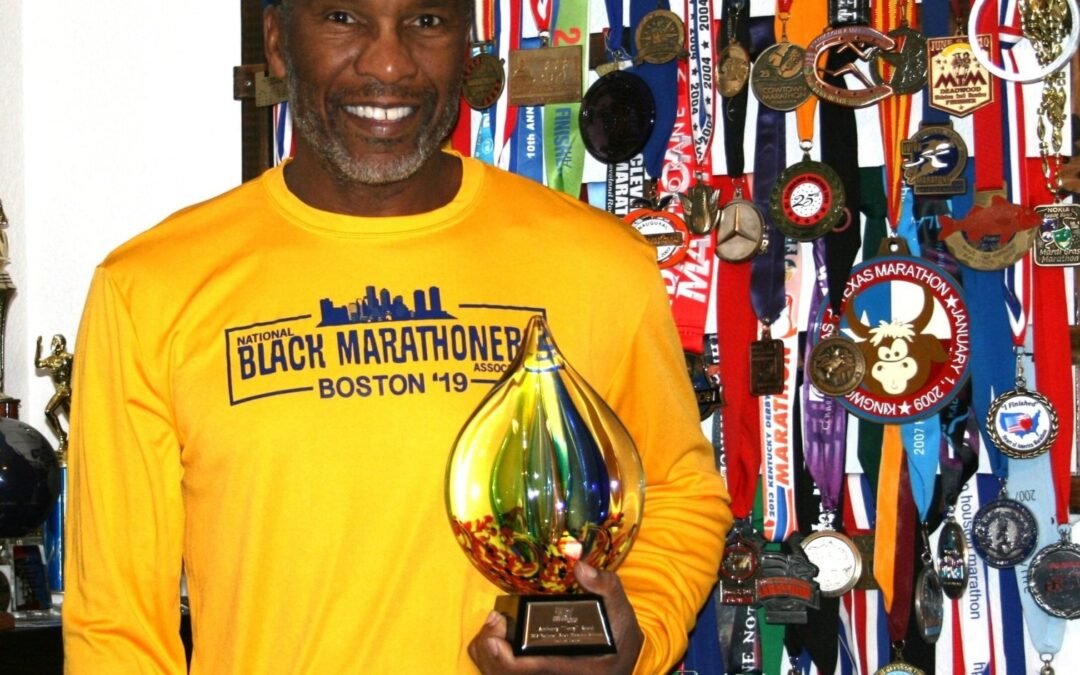
* Anthony Reed is the National Black Marathoners Association Co-Founder & Executive Director. He is the author of the book “From the Road Race to the Rat Race” which was published in September 2020.

 The National Black Marathoners’ Association (NBMA) is the country\’s oldest and largest, not-for-profit organization of Black American distance runners. It is open to everyone, regardless of athletic ability or previous marathon experience. Objectives are to:
¡       Encourage Black Americans and others to pursue a healthy lifestyle through long distance running and walking.
¡       Serve as a vehicle for Black American distance runners across the nation to meet in mass at a single marathon.
¡       Recognize the accomplishments of Black American distance runners.
¡       Provide scholarships to deserving high school boy and girl distance runners.

For more information about the National Black Marathoner’s Association, you can click here.


The Art and the Science of Coaching Runners

The Art and the Science of Coaching Runners

By Coach Adolfo Salgueiro

A few weeks ago I went for a run with one of my trainees. He brought a friend to join in. He knew how beneficial it had been for my trainee to follow a structured, individualized, and supervised training plan. He was very aware of my trainee’s progress during the months we worked together. So, as we ran, he picked my brain with a few poignant questions.

Coaching RunnersThere was one that caught my attention and kept me thinking for a few days. He was training for a 50-mile race, and he wanted to know: As a coach, what is the weekly mileage I recommend for someone wanting to complete his distance?

As you may imagine by now, there is one and only one answer for such a question: “It depends”.

It was then when I started enumerating the different variables that need to be considered before I answered such a question. There is a whole set of variables that needs to be pondered and expressed in a training plan before a goal may have a chance to be realized. These variables, among others and in no particular order, are:

* Goal – What is it that you are trying to achieve?
* Balance – There must be a reason why miles are prescribed. No junk miles.
* Rest – It is a much part of a training plan as a long run.
* Nutrition – Without being a dietitian, a coach must understand the basics of healthy eating.
* Speed work – has to be balanced between long runs and recovery days.
* Intensity – It is not about how fast but how hard you are pushing.
* Aerobic capacity – For runs over 800 mts, it is the basic measurement of endurance.
* Strength training – core and weight work are key to the success of a runner.
* Cross Training – It can’t be all running. Supplementary activities need to be performed.
* Hydration – Not only about avoiding dehydration but when and how much fluids to consume.
* Fueling – caloric intake that needs to be consumed for the body to complete the task efficiently.
* Race strategy – What will you do on race day with what you have worked so hard to obtain.
* Recovery – What to do once you are done with your training cycle, so you don’t burn out.

Coaching RunnersCombining all these and many more variables in a reasonable, achievable, and well-balanced plan, requires knowledge, preparation, and experience, both as a runner and as a coach. But even with all these elements, coaching runners is still not an exact science.

Each body reacts different to the same stimuli, and because life affect every runner in an individual way, it is imperative for a running coach to be openminded, flexible and willing to adjust as weeks go by. This can’t be achieved by cookie-cutter, generic plan downloaded from the internet.

Running a 10K, a half marathon or a marathon is not unachievable. Hundreds of thousands of people do it year in and year out. But as you look to achieve certain distance or time goals, if you want to get the best out of what you have and/or if you want to improve and test your limits, the guidance of a knowledgeable coach, one who can balance art and science, becomes more important, if not indispensable.

Tears and Running

Tears and Running

By Coach Adolfo Salgueiro

Tears are the reflection of the extreme emotions of our lives. We shed them out of love when our kids are born but also when a loved one passes away. We shed them out of joy over a personal accomplishment or when we enjoy someone else’s triumph, graduation or wedding; but also when we share our frustrations, failures, or broken hearts with those closest to us. Tears of joy are so ubiquitous that they even have their own emoji.

When it comes to running, it is no different. Why would it be?

Tears and Running

Crying on the last few meters of the 2022 Houston Marathon, 7 months after open-heart surgery.

When I was 17, I went to Kilometer 30 (Mile 19) of the 1982 Caracas Marathon, where my dad was going to run in a friend. What I experienced there was so overwhelming, that on a whim, I jumped in and ran the last 12 Km (about 7.5 miles) to the finishing area. The tears I witnessed, changed my life.

I saw grown-up men crying out of frustration when they could not run any longer and had to walk. I saw every type of emotion reflected in the faces and bodies of those I passed. And I saw tears of joy as runners approached the finish line with smiles covering their faces. I was hooked. I had to experience those extremes. I didn’t know when, but I knew that one day I would run a marathon myself. That day came sooner than later, when I finished my first marathon a few weeks later, but that is a story for another day.

If I teared up or cried during my first life as a runner, I honestly don’t remember. Maybe since I was still a teenager, I thought I was invincible, and running marathons in the 3:30 range, or better in the near future, would last forever. Who knows? My first knee operation, in 1986, gave me a reality check.

I was training for the 1986 Caracas Marathon, trying to approach the 3-hour mark, when I hit my knee and ended up under the knife just 6 weeks prior to the race. I cried out of frustration when I saw my two training partners finishing in 2:56 and 3:04. But that is life.

The first time I vividly remember crying while running, was as I crossed the finish line of the 2012 Philadelphia Marathon. It was my first marathon since December 1985. A 26-year hiatus. Since then, not only I had two left-knee surgeries, but after the one in 2004, at age 39, I asked the doctor if he thought I could ever complete another marathon. He told me, in no uncertain terms, to forget it. It was not going to happen.

So, as I approached the finish line through the Benjamin Franklin Parkway, on that cold November day in Philadelphia, as I was praying in thanks to God for giving me this remarkable opportunity, I started feeling a knot in my throat. Once I was able to distinguish the finish line in front of me, tears started running down my cheeks. When I hugged my wife a few yards after the end, I was openly sobbing. This feeling was beyond anything I could have ever imagined.

I have cried again on the asphalt. I did so at the finishing of the Den Haag Half marathon, my first running half after three years of racewalking. I also cried at the start of the New York City Marathon in 2017, still trying to grasp that I was there again after 32 years, ready to absorb the experience. I shed some tears at a small 5K in late 2019, my first competition after a heart procedure. And I hope I can cry some more, soon. It can only mean I am alive, overcoming obstacles and still running.

I would love to hear your crying-while-running-stories. You can share them in the comment section, below.

My Case on Behalf of Glucosamine

My Case on Behalf of Glucosamine

By Coach Adolfo Salgueiro

 Before we get started, I am disclosing I am not a doctor, and I am not giving medical advice. What you are about to read is just my personal experience mixed with light internet research.

Glucosamine

Glucosamine and chondroitin are popular supplements used to treat osteoarthritis. About 6.5 million adults, or 2.6 percent of the population, have used one or both products

I’ve had issues with my left knee for a long time. It kept me from running for many years. It has always been my weakest link. But just like millions of runners, upon the recommendation of someone who I can no longer remember, I started taking glucosamine many years ago, and somehow, it kept the pain at bay and allowed me to keep running consistently for many years. This is my story, and I am sticking to it.

When I decided to give marathoning another try, as I was eyeing the New York City Marathon, I asked my doctor about Glucosamine. He told me there were no conclusive studies proving that it worked or that it didn’t. His professional recommendation was that if I thought it was beneficial to me, to keep taking it. If not, then don’t bother.

Glucosamine is not cheap. A bottle of the good stuff can go from $40-$50 for a few months’ supply. So, when it was time to replenish the stash, with cash in short supply at that particular time of the month and with the recent lecture from my doctor, I decided to skip it. A couple of weeks later, my knee started to hurt and other joints felt stiffer. How could this be? There was no proof! I ran to the drugstore, got my glucosamine and a week later, the pain was gone. This is all the research I need.

Glucosamine

This is the brand I use and the results have been stellar. I don’t need much more research than that.

Then I thought: Of course! Why in the world would a drug company invest time, effort and millions of dollars researching the benefits of glucosamine when every drug store carries ten over-the-counter options from which you can purchase as many as you want, whenever you want? This is no moneymaker. No reason to invest just for the pure pursuit of knowledge. It works for me, and this is all I need to know. I am the research paper my doctor was unable to quote.

Glucosamine has been around since 1876. It is manufactured by processing a polymer from the shells of shellfish, shrimp, lobsters and crabs. It also comes from other animals such as cows and pigs. Newer versions made from fungi and fermented corn have been brought to market to cater the needs of vegetarian consumers.

Glucosamine is a dietary supplement, not a prescription drug. Because of regulations, in the US it is marketed as a supplement to support the structure and function of the joints. It is also directed to people with osteoarthritis. Tests have shown that you can consume up to 1500 mg per day with no adverse effects.

Glucosamine pills usually include a compound named chondroitin. According to WebMd, chondroitin is a substance that occurs naturally in the connective tissues of people and animals. As a supplement in higher doses than is found naturally, chondroitin is also a popular treatment for osteoarthritis.

Arthritis.org states that “glucosamine and chondroitin are popular supplements used to treat osteoarthritis. According to one estimate, 6.5 million adults, or 2.6 percent of the population, have used one or both products”.

Both glucosamine and chondroitin are usually found in healthy cartilage and have anti-inflammatory properties. “They also have some cartilage-protecting effects through a variety of different mechanisms,” says Chris D’Adamo, PhD, director of Research & Education at the University of Maryland School of Medicine Center for Integrative Medicine.  

Glucosamine and chondroitin protect cells called chondrocytes, which help maintain cartilage structure. In theory, these supplements have the potential to slow cartilage deterioration in the joints, and to reduce pain in the process. 

Sounds good to me!

I take the Kirkland brand with 1500 mg of glucosamine with 1200 mg of chondroitin, and it has worked for me. If I ever forget to take it for a few days or if my resupply delays, my body promptly reminds me. Once again, what additional research do I need?

Please don’t take medical advice from me. I am not a doctor, nor I wish to be one. Glucosamine with chondroitin works for me. If you have joint issues, I suggest you check with a real doctor and then give it a try.

The Journey of “The Fat Runner”

The Journey of “The Fat Runner”

By Coach Marci Braithwaite

 I am Marci Braithwaite. I am a runner. I am a marathoner who has also completed many halves as well as nearly a hundred races of many distances, both virtually and in-person, over the last twelve years. I am an elementary school teacher, and I am a mother of two teenagers. I am a chapter leader of my local, 900-member She Runs This Town running group. I am the leader of a virtual community of new runners, and a USATF certified coach.

 I am also fat.

The Fat Runner

I use that word to describe myself because it is simply that – a descriptor (Photo by Patrick Krohn Photography.)

I use that word to describe myself because it is simply that – a descriptor. The word itself often causes an immediate reaction. When I use it, the occasional person will smile and say I’m brave. More often, people cringe and ask why I use that term: it’s an insult used by many to demean and diminish. To them I ask, “Why is fat demeaning? Does the fat on my body make me lesser than you? Does it diminish my accomplishments in any way? What about my fat makes you better than me?”

 Twelve years ago I started my running journey the way so many of us do, to lose weight. I thought my weight was the cause of my back pain at the time. It wasn’t (two pregnancies producing ten-pound babies tend to mess up your lower back). I did lose weight back then, but in the time since, and even through marathon training, running more than 40 miles per week, I gained it back. I’m at the same weight I was 12 years ago. I no longer have that back pain, which I attribute to strengthening my core and cross training. After more than a decade of consistent running and literally thousands of miles on my feet, I’m still fat.

 Through all that time, I started to notice something. People seemed to think that what I was doing was revolutionary. Running while fat? That’s not allowed. Fat people are sent that message every time someone yells, “Go faster, fatty!” when they’re on a run or walk, or made to feel uncomfortable, or that they don’t belong at the gym. The prevailing message is that fat people shouldn’t show themselves in the fitness arena, because you should only be visible if you’re thin and have an “acceptable” body type.

The Fat Runner

“I want people who look like me to realize that they do belong. That the shape of our bodies does not define us or our abilities (Photo: Marci Braithwaite)

Then I discovered Mirna Valerio. She is an ultrarunner and public speaker, a blogger, and the head of her own FatGirlRunning online community. One day I discovered a video she had made for REI, about an email she read while she was running a multi-hour endurance event. The email accused her of lying, that she wasn’t really running, that she didn’t actually finish the ultramarathons that she claimed to have finished. As I watched this video, which, again, was filmed while she was completing an endurance event, I realized that what she was doing, simply existing and doing incredibly badass things in her fat body, was exactly what I wanted to do, too.

 We don’t see fat runners on the roads and trails very often, do we? Why do you think that is? It’s definitely not because they don’t want to be there. Nor is it because fat people are inherently lazy. It’s a matter of access. When people like Mirna, a fat black woman, receive criticism and accusations of dishonesty for simply participating in an event that many thin people joined without a second thought, it should give you pause about the inclusivity of the running and outdoor community.

 I want to change that. I want people who look like me to realize that they do belong, both in the outdoors and in the running community. That the shape of our bodies does not define us or our abilities. That there is no definition of the word “runner” beyond “someone who completes a movement that involves both feet in the air at once during a stride.” There is no weight requirement, no speed requirement, or any definition that anyone must fit into for someone to be able to enjoy the outdoors and the running community.

 I’m Marci. I’m a fat runner and a fat running coach. I want you to join me on my running journey.

 For more information:
Facebook: Request an add to the group Fat Athletes
Instagram: @The_Fat_Athlete
Website: http://www.thefatathlete.biz
Email: coach.thefatathlete@gmail.com

EDITOR’S NOTE: The day before this entry was scheduled to post, Mirna Valerio, plus-size ultrarunner, author, and spokeswoman (mentioned earlier in this post), announced her partnership with Lululemon clothing, using the slogan, \”Running is for everyone who has a body and wants to run.\” Click here to see the announcement.


Skip to content