by Coach Adolfo Salgueiro | Mar 30, 2021 | Article, Guest Perspective, Opinion, Reflection
By Coach Marci Braithwaite
I am Marci Braithwaite. I am a runner. I am a marathoner who has also completed many halves as well as nearly a hundred races of many distances, both virtually and in-person, over the last twelve years. I am an elementary school teacher, and I am a mother of two teenagers. I am a chapter leader of my local, 900-member She Runs This Town running group. I am the leader of a virtual community of new runners, and a USATF certified coach.
I am also fat.
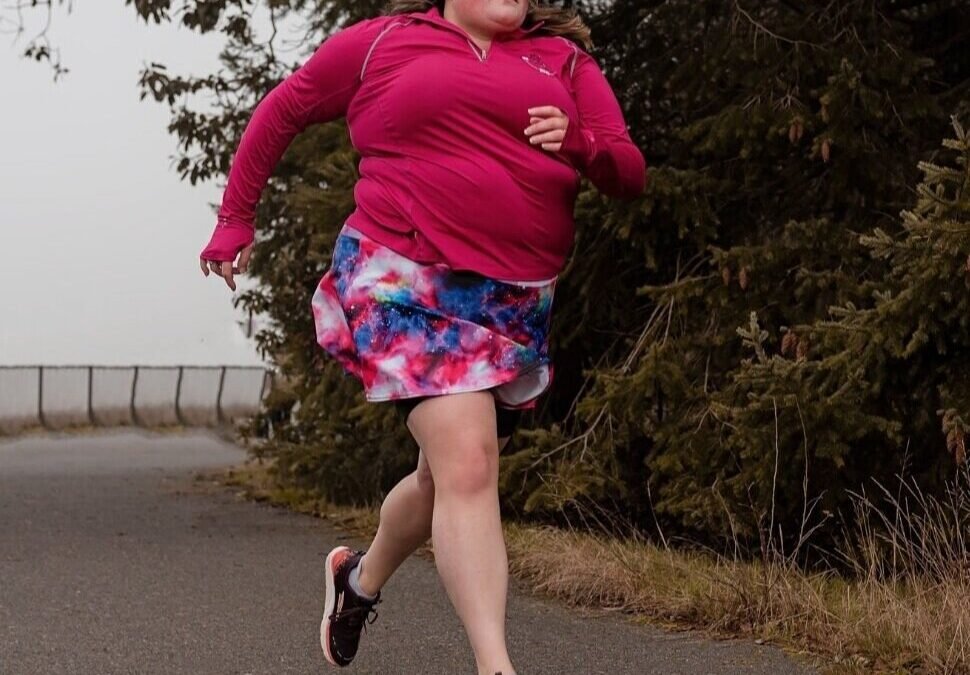
I use that word to describe myself because it is simply that – a descriptor (Photo by Patrick Krohn Photography.)
I use that word to describe myself because it is simply that – a descriptor. The word itself often causes an immediate reaction. When I use it, the occasional person will smile and say I’m brave. More often, people cringe and ask why I use that term: it’s an insult used by many to demean and diminish. To them I ask, “Why is fat demeaning? Does the fat on my body make me lesser than you? Does it diminish my accomplishments in any way? What about my fat makes you better than me?”
Twelve years ago I started my running journey the way so many of us do, to lose weight. I thought my weight was the cause of my back pain at the time. It wasn’t (two pregnancies producing ten-pound babies tend to mess up your lower back). I did lose weight back then, but in the time since, and even through marathon training, running more than 40 miles per week, I gained it back. I’m at the same weight I was 12 years ago. I no longer have that back pain, which I attribute to strengthening my core and cross training. After more than a decade of consistent running and literally thousands of miles on my feet, I’m still fat.
Through all that time, I started to notice something. People seemed to think that what I was doing was revolutionary. Running while fat? That’s not allowed. Fat people are sent that message every time someone yells, “Go faster, fatty!” when they’re on a run or walk, or made to feel uncomfortable, or that they don’t belong at the gym. The prevailing message is that fat people shouldn’t show themselves in the fitness arena, because you should only be visible if you’re thin and have an “acceptable” body type.
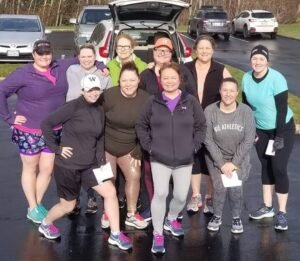
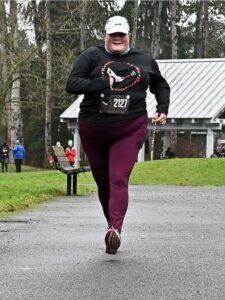
“I want people who look like me to realize that they do belong. That the shape of our bodies does not define us or our abilities (Photo: Marci Braithwaite)
Then I discovered Mirna Valerio. She is an ultrarunner and public speaker, a blogger, and the head of her own FatGirlRunning online community. One day I discovered a video she had made for REI, about an email she read while she was running a multi-hour endurance event. The email accused her of lying, that she wasn’t really running, that she didn’t actually finish the ultramarathons that she claimed to have finished. As I watched this video, which, again, was filmed while she was completing an endurance event, I realized that what she was doing, simply existing and doing incredibly badass things in her fat body, was exactly what I wanted to do, too.
We don’t see fat runners on the roads and trails very often, do we? Why do you think that is? It’s definitely not because they don’t want to be there. Nor is it because fat people are inherently lazy. It’s a matter of access. When people like Mirna, a fat black woman, receive criticism and accusations of dishonesty for simply participating in an event that many thin people joined without a second thought, it should give you pause about the inclusivity of the running and outdoor community.
I want to change that. I want people who look like me to realize that they do belong, both in the outdoors and in the running community. That the shape of our bodies does not define us or our abilities. That there is no definition of the word “runner” beyond “someone who completes a movement that involves both feet in the air at once during a stride.” There is no weight requirement, no speed requirement, or any definition that anyone must fit into for someone to be able to enjoy the outdoors and the running community.
I’m Marci. I’m a fat runner and a fat running coach. I want you to join me on my running journey.
For more information:
Facebook: Request an add to the group Fat Athletes
Instagram: @The_Fat_Athlete
Website: http://www.thefatathlete.biz
Email: coach.thefatathlete@gmail.com
EDITOR’S NOTE: The day before this entry was scheduled to post, Mirna Valerio, plus-size ultrarunner, author, and spokeswoman (mentioned earlier in this post), announced her partnership with Lululemon clothing, using the slogan, \”Running is for everyone who has a body and wants to run.\” Click here to see the announcement.

by Coach Adolfo Salgueiro | Mar 16, 2021 | Article, List, Opinion, Reflection
By Coach Adolfo Salgueiro
After years of running, 100+ races and thousands of miles under my soles, I have all developed my very personal running habits. Just as you have developed yours. Some good, some bad, some questionable. At the same time, we have all established our running pet peeves.
Even though there is nothing written, there are some basic guidelines that every runner must keep to be part of an ever-improving running community. One where friends and strangers can be proud of being a part of. Some are to keep us safe, some to make the running experience more fulfilling and some to have more enjoyable races.
These are my 10 basic guidelines on running etiquette:
-

Slow runners are no less of an athlete than fast runner. Each group needs to be aware and respectful of the other (Photo Pexels)
Be mindful of other runners around you: It doesn’t matter if you are fast, slow, walker or if you are so tired you are crawling. Most of the time you are not the only person on the road, so you need to be aware of other runners. The last thing you want is to get injured, so make sure you are not the one responsible for someone else getting injured.
-
Respect slower runners: Both in training and in races, you will cross paths with slower runners. The fact they can’t run as fast as you, doesn’t make them less of an athlete. No need to be rude or discourteous. Be aware and respectful of the fact they are also putting their best effort forward.
-
Respect faster runners: Just as you expect to be respected as a slow runner, if you are in this category you must respect the presence of runners faster than you. Don’t crowd the corners, don’t take the inside lane on the track, don’t clog the path by running side-by-side with too many people and be aware of your surroundings when stopping to walk.
-
Acknowledge other Runners: Nobody expects you to stop what you are doing or change your pace to say hi to a stranger. But as runners, I think we all agree that acknowledging each other’s presence is the most basic form of good running etiquette. Tip your hat, make eye contact, nod, grunt, lift your arm or say an audible “hey”.
-
Don’t interfere while taking selfies: They have become ubiquitous in running. If there is no selfie, it didn’t happen. We get it! You can take all the running selfies you want as long as it doesn’t interfere with other runners, especially during a race. Go to the side of the road, get out of the way and then knock yourself out with as many selfies your phone can handle. But always remember that your selfie is not another moving runner’s priority.
-
Just because you isolate with your headphones doesn’t mean I am not there: it is your prerogative to run with headphones. If it provides you with a better experience, go for it. But it is your responsibility to be aware of your surroundings, not mine. I don’t know if you are wearing them or not so don’t expect anyone to be on the lookout for you while isolated.
-
Do not stop abruptly at water stations: I am not sure where this walk-break at water stops trend began. This is a place where lots of moving people congregate simultaneously, many eyeing the same cup of liquid, and it is usually very slippery. If you need to stop, take your water, move out of the way, check your surroundings, and then stop. It is basic, common sense.
-
Carry your own trash: Even when running we usually produce trash. At races, your entry fee includes trash pick up at water stop, but when training, it is not the case. Just as you carried your gel or your water bottle with you, make sure you carry their byproduct trash until you find the proper way to dispose of it. During a race, this is the water stop.
-
Act like an adult when it comes to bodily functions: They are inevitable when you are running. Burping, snot rockets, spitting and farting are commonplace and a normal part of a healthy functioning body, especially when running. Don’t make anyone feel bad. Be mature and just let it go. Because it is a matter of time before it is your turn.
-
Respect your membership in WhatsApp and Facebook groups: Most runners are in more than one social media group, and most groups have way too many people to keep track of multiple conversations. Limit your interactions to group related postings so your group can become relevant. I bet you are member of plenty of other groups where you share your non-running memes, jokes and political commentary.
Anything I missed? What is your running pet peeve?

by Coach Adolfo Salgueiro | Mar 2, 2021 | Article, Exercises, Reflection
By Coach Adolfo Salgueiro
Back in December of 2020, something called The Barefoot Mailman 5K Virtual Race popped up in the South Florida racing calendar. We talked about it among my peeps from No-Club Runners and decided we would make an adventure of it. Not only that, but we would also run it barefoot, so we could emulate the 19th Century mail carriers who took the 100-mile mail route down the beach from what today we know as Palm Beach to the little fisherman’s village we now know as Miami.
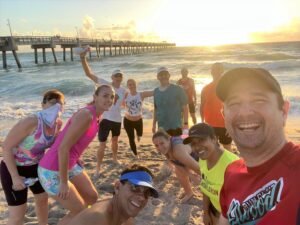
If you have access to a beach and an appetite for a running adventure, gather your running buddies and go for a barefoot run. The smiles of all the people in this photo should give you an idea of what a cool experience this is.
We were not sure what to expect. We ran about 1.5 miles to the beach as a warm-up, left our shoes and started running. It was an overcast day, with choppy waters and the start resembled the opening scene of Chariots of Fire. The rest of the 5K was even better. Running on the packed sand, waves coming in and sometimes splashing water up to your knees… Magic!
It was so freaking cool, that we decided to make it a regular occurrence. On February 27th, a larger group met at the same place in Dania Beach to run the 5K to The Pier and back. This time we were in for a surprise. Sand was not as hard-packed as we remembered it, and each step required additional efforts. It didn’t take much for most of us to start walking. Once we got back, with burning legs, exhausted and sweaty, we still decided we had to do it again, sometime in the near future.
A couple of months ago I wrote about the wonderful experience of running barefoot on grass. Most of the benefits of grounding yourself are perfectly transferrable to doing it on the sand. But the sand offers a few extra challenges and benefits, that running on the smooth grass doesn’t.
The first requirement to enjoy your sand run and do it safely, is to forget about your watch. Your time, cadence, VO2Max, etc., are irrelevant. You must switch off your data-driven brain. This is about fun, not about PRs.
Nicolas Vitale, Coach with Club 10K, stated in a recent article that running on sand could provide benefits in the areas of agility, equilibrium, strength, power, joint strength, adaptivity to effort and endurance. After your first mile on the sand you will agree with all seven of these items. The variability of terrain the sand offers from step to step will force you to make many adaptations, sometimes simultaneously.
To get the most out of your run in the sand, you can always move from the hard-packed sand on the shore to other areas of the beach where the sand is looser. This will help you use other muscles, go through a harder effort, get less return from the ground, and adjust on the fly to adverse conditions. All at the same time.
By the way, the fact that No-Club Runners runs it barefoot doesn’t mean it is the only way to do it. If it works better for you in shoes, nothing is stopping you. Personally, I enjoy the multiple advantages that direct contact with the ground provides. We have plenty of opportunities to run in shoes.
My recommendations for running on the sand include:
1 – Regardless of the instability of the terrain, work on maintaining correct running posture.
2 – Start with a shorter distance or time until your body gets used to it. Don’t overdo it.
3 – Shorten your stride if the sand is too loose and you feel you are overworking.
4 – Don’t forget hydration, especially on hot or humid days.
5 – Focus on having fun and recharging from the direct contact with the ground. Forget you have a watch.
6 – Take advantage of the water and jump in once you are done.
If you have access to a beach and appetite for a different running adventure, grab your running buddies and meet at the shore. You won’t regret it.

by Coach Adolfo Salgueiro | Jan 19, 2021 | Article, Science
By Coach Adolfo Salgueiro
One of the rituals of my running group after our regular Saturday long run, is to have a coffee at a local Colombian bakery, located right in front of where we park to meet. We specifically chose that spot because of the great coffee this bakery serves. This is how we kick start the social side of our weekend and one of the elements that keep bringing our runners back. A couple of weeks ago I ran with a friend and the end I offered to buy her coffee, but she said she was detoxing from caffeine, so she would pass.
This had me thinking about the relationship between running and caffeine. Is it good? Is it bad? How much is too much? When should we consume it, or not?
I found an article by Pamela Misevich Bede, from March 2015, in the Runner’s World archives. The author’s credentials in dietetics seemed solid enough to take her word on the issue.

Caffeine is the most widely available stimulant of the central nervous system in the world. It is legal and unregulated almost everywhere.
Before we get started, I want to state that while researching for this post I did not find any studies or articles by experts stating caffeine and running don’t mix. Quite the contrary, they pair pretty well. As usual, you need to follow your doctor’s instructions. If you shouldn’t be consuming caffeine for any reason, do not change that indication just because you are going for a run.
Caffeine is the most widely available stimulant of the central nervous system in the world. It is legal and unregulated almost everywhere. It is naturally found in the leaves and fruits of plants such as coffee, cacao and tea. You can also find it in soft drinks, energy drinks, gels, pills and many other products.
The benefits of consuming caffeine before and during your run go beyond just a jolt of energy to get you started and/or keep you moving. “Caffeine has a number of physiologic effects that can help improve athletic performance” says Misevich Bede. “It is rapidly absorbed in the gastrointestinal tract and is a mild stimulant that affects multiple organ systems”.
The benefits of using caffeine to stimulate your run include improvement of mental alertness, boosting of pain tolerance, enhancement of fat use as fuel (which extends the use of your finite storage of glycogen), and a possible increment in speed, among others.
But beware. You need to know how this additional stimulus affects your systems before you go overboard, especially during a race. Caffeine consumption can also cause gastrointestinal issues, headache, jitters, heartburn and increased urination, among others. So trial-and-error to figure out what works for you is a must. And, as always. what works for your friends is not necessarily what works for you.

An 8 Oz cup of black tea has 30-80 mg of caffeine while a Starbucks espresso shot has about 75 mg. A cup of green tea has about 35-60mg/8oz.
According to the aforementioned article, 3-6 6mg/kg body weight (1.3-2.75 mg/lb.) is recommended for endurance exercise. It is important to note that with caffeine, more is not necessarily better. A higher dose does not correlate with better performance. Also, it is more effective if you abstain from caffeine consumption a few days before your running activity, but don’t forego your morning cup of coffee if you can’t function without it.
Since the mg/kg measuring unit is difficult gauge, put it in perspective by knowing an 8 Oz cup of black tea has 30-80 mg, depending on the brand and type, while a Starbucks espresso shot has about 75 mg. A cup of green tea has about 35-60mg/8oz.
Many runners depend on a mid-run consumption of caffeinated products to maintain their performance. Fortunately for them, running consumable products such as gels, gummies, beans and sports drinks, all have “spiked” options. They usually carry from 25-100 mg per serving. It is key to understand how much a serving is, so you don’t overdose, and thus, end up running for the bushes or with gastrointestinal discomfort.
There is nothing shady or illegal with a mid-run pick-me-upper. Most, if not all professional runners, openly use it. If you are not used to consuming caffeine but still want to reap its benefits with a mid-run pick-up, make sure you start with the smallest dose available, so you know how your body will respond. Once your body gets used to it, then figure out how much is enough. What works best for you, not for your friends.
And then, if you want to enjoy your post-run coffee with your buddies on a Saturday morning, I know of a great Colombian bakery in Dania Beach, Florida, and an amazing running group that I can recommend you.
by Coach Adolfo Salgueiro | Jan 5, 2021 | Article, List, Reflection
By Coach Adolfo Salgueiro
Based on where you are in your running life, your goals for a new year will vary. While for some people, making it to 1000 miles may seem like an insurmountable goal, others have been accomplishing this distance year in and year out. Some athletes break 1:30 in the half marathon on a bad day, others struggle to go sub-3.

Making achievable New Year resolutions is the key to keep your athletic goals relevant.
The point here is that to set up your running goal, or goals, for this brand-new year, it must be done in an individual and feasible fashion. These goals can’t be compared with what your friends are doing or what you were able to do when you were a young runner; and they can’t be so out-of-touch that you will be off track at the first sign of trouble or the first day when life gets on the way. Also, you don’t want to get injured because of overstress.
If you haven’t etched in stone your running goals for 2021, or if you haven’t thought about them yet, do so, now. This is what will keep you focused, especially while it is uncertain if and when normal racing will return.
The following goals ideas you may consider:
1 – 1000 Miles – Depending on where you are in your running life, one thousand miles could be a challenging yet achievable Goal. You can also set your eyes on 1500, 2000 or 3000. The key is to break it down in small chunks so you can visualize it. I.E. For 1000 miles, this is just 83.33 miles per month, or 4.8 a day if you run 4 times a week (way less if you include a long run one of those days). Last year, over 1000 members of the 1K Club made it to the 1000 mark. If you have never done it, this may be a great goal for the year.
2 – One more day of activity per week – If you don’t want to focus your running year on counting mileage, adding another day to your training is a good way to increase your activity. If you run only 3 times a week, that 4th day becomes feasible. If you run 5 or 6, this may not be a goal for you, but you can always add a yoga class, a cross training session or an easy, long recovery walk to your week. The key is to increase your activity if you feel you can fit it in without sacrificing your recovery.
3 – Strength training – It is the most neglected part of every training cycle. When we are focused in our training and our work or personal life gets on the way, strength training is the first aspect of the program to be sacrificed. As runners, we pound on our musculoskeletal system on a daily basis. Consider that every in mile you dump 3-4 times your weight into each leg, about 800 times. This is about 2500 times per leg, per 5K. If we don’t prepare our bones, muscles, tendons and ligaments to take on the workload, they will break down, and you will be rehabbing instead of running.

Sleeping 7-8 hours a night will improve both your athletic and your personal life (Photo: Pexels.com)
4 – Specific Distance PR – This goal can be handled in two ways. A) You can set up your sights and training on one specific distance where you feel confident performing and go for your best time, ever; or B) you can get out of your comfort zone and pick up a distance where you don’t feel confident and go for it. If you’ve been chasing the elusive Sub-2 half marathon or sub-3:30 marathon, you have a full year to make it happen. Or, if you dislike the 5K because it is too short or too fast; or if you are afraid of what lies beyond the mythical 13.1, then you have a few challenges right there.
5 – Sleep more – It may sound odd that sleeping more is part of a running goals list for a new year, but sleep is one of the most overlooked aspects of recovery, and thus, training. It is also the one that may take you down, if not with an injury, at least by robbing you of your chance of peak performance. In our society, lack of sleep has become a worthless badge of honor, while in reality (and science), our sleeping time is key to our recovery both as athletes and as functional human beings. The benefits of a hard workout are not seen once you finished, the body needs to repair itself and adapt to the stress we just put it through. This doesn’t happen with an easy 5-miler on 5 hours of sleep. The body heals itself and flushes the day’s metabolic waste while we sleep. So, 7-8 hours a night is part of your daily training and a worthwhile running goal for 2021.
Of course, these are not the only athletic goals you may set up for 2021. They are just ideas to help you define what you would like to achieve this year.
What are your running goals for 2021?

by Coach Adolfo Salgueiro | Dec 29, 2020 | Article, Opinion, Science
By Coach Adolfo Salgueiro
As runners, we often enjoy a beer as a post-run reward when we finish a training run with friends. A post-race beer is the perfect excuse for having alcohol at 8 in the morning without having to worry if you’ve become an alcoholic. As ubiquitous as the beer/runner relationship is, there is no definite answer on the conundrum if both can coexist.
There is no binary answer to this dilemma. Scientists and science writers differ on the value and placement of this elixir in the running scene.
Finishing a race is the perfect excuse for downing a beer at 9AM without feeling like an alcoholic.
In the in-favor camp, we find Christie Aschwanden, author of the best-selling book Good to Go: What the Athlete in All of Us Can Learn from the Strange Science of Recovery. During a recent interview in the Run Smarter Podcast she stated:
“Beer and running go hand-in-hand. Together it can be a reasonable recovery drink. No one who does not drink beer should start drinking beer because it will help with their recovery. […] Where I think beer can be a nice thing is that it is a nice sort of ritual for groups that gather after a run and have beer as a social thing, in a way for unwinding. […] Where beer becomes problematic is when you haven’t had food and the alcohol goes to your head. A little bit is fine. The evidence is not there to say that one beer or a beer-and-a-half is going to wreck your recovery. There is evidence that knocking 6 or 7 beers in a row is not good for you. Hangovers are not good for recovery.”
They key to Ms. Aschwanden point is that beer per se has no magical powers as a recovery drink. The fact we do it as a social ritual after we put the mile in, is what makes it a positive stimulus. “The social aspect of relaxing with your friends is helpful”, she stated. The key, as usual, is moderation.
But not everyone is in favor of a post-race cold brew. According an article by Holy Martin, a San Francisco-based running coach and personal trainer, in the Run to The Finish blog: “After a training session, our body utilizes protein to rebuild itself, and to adapt to what we’re demanding of it while training. Alcohol can impede that process and make it much harder for our muscles to rebuild. Similarly, alcohol freezes muscle growth if you’re consuming it on a regular basis. So, if you’re working hard to build speed or strength, or to make any real changes in the gym, be mindful of your alcohol consumption.”
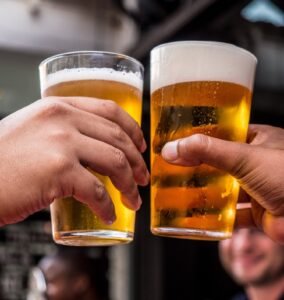
The social aspect of the post-run beer alone, has its positive recovery effects
When you think of it from the scientific point of view, this makes sense. But she also states at the end “be mindful”, not necessarily “refrain”. So it comes, once more, to moderation.
In an article published by Runner’s World in August of this year (2020), author Heather Mayer Irvine said that:” Experts agree that beer, which is considered a diuretic—thus dehydrating—isn’t the best recovery drink and should be paired with water when consumed after a workout. Still, a 2015 study published in the Journal of the International Society of Sports Nutrition found that when runners drank a moderate alcoholic beer (roughly 4.5 percent ABV) along with water after a workout, their rehydration was no worse than those who drank only water.”
Since we are discussing alcohol consumption, it is imperative that you understand that drinking right before or while running is a definitely no-no. You don’t want your liver using the glucose needed to propel you forward, processing the alcohol you are consuming. This is a recipe for a crash. If you can’t wait until the training or race is over, maybe it is time to make an appointment with an addiction specialist.
My Personal Conclusion
I am not a scientist or a doctor, so I speak from the experience of a runner who has indulged in the post-run cold one with his buddies for a few years. Sure, we can enjoy a post-run libation without ruining what we just gained, but at the same time, beer doesn’t have any esoteric powers in our recovery. The social aspect of it is what brings us joy while we are in a runners’-high state. It is this feeling what will bring us back to do more running so we can experience the ritual again. Of course, in moderation, and only after drinking enough water first, so we don’t rehydrate with alcohol.