The Post-Run Beer

The Post-Run Beer

By Coach Adolfo Salgueiro

 As runners, we often enjoy a beer as a post-run reward when we finish a training run with friends. A post-race beer is the perfect excuse for having alcohol at 8 in the morning without having to worry if you’ve become an alcoholic. As ubiquitous as the beer/runner relationship is, there is no definite answer on the conundrum if both can coexist.

There is no binary answer to this dilemma. Scientists and science writers differ on the value and placement of this elixir in the running scene.
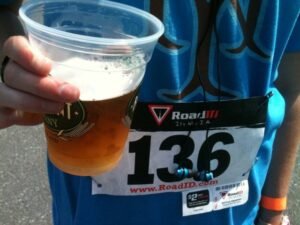
Post-Run Beer

Finishing a race is the perfect excuse for downing a beer at 9AM without feeling like an alcoholic.

In the in-favor camp, we find Christie Aschwanden, author of the best-selling book Good to Go: What the Athlete in All of Us Can Learn from the Strange Science of Recovery.  During a recent interview in the Run Smarter Podcast she stated:

“Beer and running go hand-in-hand. Together it can be a reasonable recovery drink. No one who does not drink beer should start drinking beer because it will help with their recovery. […] Where I think beer can be a nice thing is that it is a nice sort of ritual for groups that gather after a run and have beer as a social thing, in a way for unwinding. […] Where beer becomes problematic is when you haven’t had food and the alcohol goes to your head. A little bit is fine. The evidence is not there to say that one beer or a beer-and-a-half is going to wreck your recovery. There is evidence that knocking 6 or 7 beers in a row is not good for you. Hangovers are not good for recovery.”

They key to Ms. Aschwanden point is that beer per se has no magical powers as a recovery drink. The fact we do it as a social ritual after we put the mile in, is what makes it a positive stimulus. “The social aspect of relaxing with your friends is helpful”, she stated. The key, as usual, is moderation.

But not everyone is in favor of a post-race cold brew. According an article by Holy Martin, a San Francisco-based running coach and personal trainer, in the Run to The Finish blog: “After a training session, our body utilizes protein to rebuild itself, and to adapt to what we’re demanding of it while training. Alcohol can impede that process and make it much harder for our muscles to rebuild. Similarly, alcohol freezes muscle growth if you’re consuming it on a regular basis. So, if you’re working hard to build speed or strength, or to make any real changes in the gym, be mindful of your alcohol consumption.”
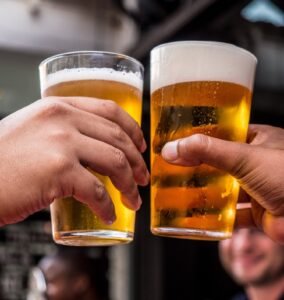
Post-Run Beer

The social aspect of the post-run beer alone, has its positive recovery effects

When you think of it from the scientific point of view, this makes sense. But she also states at the end “be mindful”, not necessarily “refrain”. So it comes, once more, to moderation.

In an article published by Runner’s World in August of this year (2020), author Heather Mayer Irvine said that:” Experts agree that beer, which is considered a diuretic—thus dehydrating—isn’t the best recovery drink and should be paired with water when consumed after a workout. Still, a 2015 study published in the Journal of the International Society of Sports Nutrition found that when runners drank a moderate alcoholic beer (roughly 4.5 percent ABV) along with water after a workout, their rehydration was no worse than those who drank only water.”

Since we are discussing alcohol consumption, it is imperative that you understand that drinking right before or while running is a definitely no-no. You don’t want your liver using the glucose needed to propel you forward, processing the alcohol you are consuming. This is a recipe for a crash. If you can’t wait until the training or race is over, maybe it is time to make an appointment with an addiction specialist.  

My Personal Conclusion

I am not a scientist or a doctor, so I speak from the experience of a runner who has indulged in the post-run cold one with his buddies for a few years. Sure, we can enjoy a post-run libation without ruining what we just gained, but at the same time, beer doesn’t have any esoteric powers in our recovery. The social aspect of it is what brings us joy while we are in a runners’-high state. It is this feeling what will bring us back to do more running so we can experience the ritual again. Of course, in moderation, and only after drinking enough water first, so we don’t rehydrate with alcohol.

 
8 Steps to Kickstart Your Recovery

8 Steps to Kickstart Your Recovery

By Coach Adolfo Salgueiro

Recovery. What a concept!! Who doesn’t love to pull off a hard workout feeling strong, ready to PR on that upcoming race? But at the same time, we know that if we had to do this same workout, tomorrow, we would not be able to do it, again. Why? Because we haven’t recovered.

Kickstart Your Recovery

Recovery starts even before you are done with your current workout. That’s what the cool down is for

Recovery, according to an article by Erin Strout in Runner’s World Magazine, “is the restoration of energy-producing enzymes inside the muscles, functional proteins, fat and carbohydrate stores, and the regeneration of the endocrine and immune systems. […] Recovery comes down to repairing, resting and refueling—while still allowing the body to adapt to the training workload and reap fitness gains”.

In other words, it is allowing your body to heal from the stress you just put it through, so you can do it again, soon, without stretching its abilities to the point where it can’t repair itself, thus, becoming injured.

The following are eight quick tips to kickstart your recovery so you can keep working hard on your training plan, pursuing that elusive PR and avoiding injuries.

1 – Cool Down: Either by dropping off the pace on the final mile or two; or walking the last mile back, or taking the time for your body to calm down, the idea es to reduce your heart rate, breathing rate, and core body temperature in order assist your body to return to its pre-exercise condition.

2 – Stretch: This is not for everybody and it doesn’t have to be a long process. But you should develop a personal routine that works for you while your muscles are warm so you can aid the start of recovery. You may feel much better once you’ve done so.

3 – Change clothing: If you are not planning to take a shower right away, make sure you change off your wet clothing. Your body needs to go back to its normal core temperature as soon as possible and your sweaty shirt, hat and socks are not helping.

4 – Hold that beer: A cold one with your buddies after a run is an amazing reward after a good workout. But make sure you hydrate yourself with water and electrolytes before gulping down your prize. Remember alcohol will dehydrate you, so don’t overdo it.

Kickstart Your Recovery

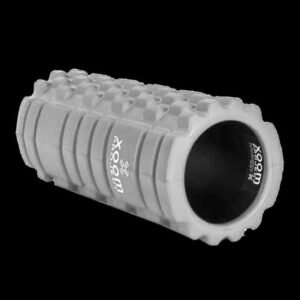
Owning a foam roller is not enough. You have to use it!

5 – Refuel your body: After you submit your body and its natural reserves to a stress consuming from its resources, it is essential to start renourishing it as soon as possible. This way it can start repairing itself right away and, you can do it again, sooner. Especially if you have gone through a 90-minute effort or longer, make sure you ingest a 3:1 ratio of complex carbohydrates and protein. Chocolate milk is a great option. Personally, I’ve had successfully experienced Recoverite, by Hammer Nutrition.

6 –Self-Massage: It is not enough to own a foam roller or a massage stick. You must use it and learn how to do so properly. These can foster blood circulation to enhance recovery speed as well as decreasing muscle tension while increasing flexibility, both good options to avoid injury.

7 – Do not sacrifice your sleep: Having no time to sleep as a badge of honor is a recipe for disaster. During our time asleep, the body repairs itself and the brain flushes away the waste byproducts built up throughout the day. Doesn’t it sound important enough?

8 – Days off: A training plan consists of work and rest. With very few exceptions and only by seasoned athletes, scheduled days off are must. You can’t be afraid of taking a day off to socialize, drop off your kid at college, attend your daughter’s recital, take care of personal business, or simply vegetate. Your body will thank you for it. And never eb afraid of taking an extra day off if you need it. Your body will thank you for it.

Anything else to ad?

The Joy of Barefoot Walking on Grass

The Joy of Barefoot Walking on Grass

By Coach Adolfo Salgueiro

We all know about how important it is to run or walk in the right shoe. Depending on your foot and the way you strike the ground, a shoe may be the right one for you, but this doesn’t mean it is the best option for your running buddy. There are forefoot runners, heel strikers, neutral steps and all the variations in between. But there is one variety where we are all equal: barefoot. We all have the feet we were provided at birth.

Barefoot WalkingLet’s be clear that I am not advocating for barefoot running. It is not for everybody. After the minimalist craze of the early 2000s, lots of people shifted to five-fingers and barefoot without the property transition, assuming it made sense, and a barrage of injuries followed. Some people can handle it, some people don’t.
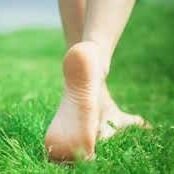
But what I passionately believe after reading about it and experiencing it, is that barefoot walking on grass is wonderful. The joy of being in direct contact with the earth below you in invigorating and will recharge you for the rest of the day. As I was researching this blogpost, I learned that this practice even has a name, actually two: it is called “grounding” or “earthing”.

I started walking barefoot in my back yard about five years ago. One day, my wife and I decided to go for a barefoot walk around the neighborhood and, surprisingly, it was an invigorating experience. We came back with more energy and more relaxed that than we set out. Since then, I put some 3 to 4 miles out there once every couple of weeks. Getting your feet wet, dirty, stained, and constantly adjusting for the irregularities of the terrain has become a pleasure. I wish I could fit it in more often.

According to an article by Carrie Denner, from The Washington Post, published in July 2018, research suggests physical contact with the Earth’s surface can help regulate our autonomic nervous system and keep our circadian rhythms — which regulate body temperature, hormone secretion, digestion and blood pressure, among other things — synchronized with the day/night cycle. The idea behind it, is that “humans evolved in direct contact with the Earth’s subtle electric charge but have lost that sustained connection, thanks to inventions such as buildings, furniture and shoes with insulated synthetic soles.”

Regardless of what you may think, your feet are ready for the task. In his book Run for Your Life, Dr. Mark Cucuzzella, states that “each foot is an orchestra of 26 bones, 33 joints, 107 ligaments and 19 muscles and tendons, providing cushioning, spring and control in three planes simultaneously”.

I’ve heard people complaining about the possibility of a rock or a piece of trash damaging their feet, but my experience is that, of course you may get a cut or stung by an insect, but in general terms your feet are ready to avoid it. According to Dr. Cucuzzella: “Our feet have 200,000 sensory receptors that are constantly, an unconsciously, appraising our position so that we can make micro adjustments to our balance”. And believe me when I tell you that it works like a charm.

As for where to go for a barefoot walk, it is understandable that not everybody has a backyard where to go even 100 times around if necessary, but most likely there is a park you’re your place where you can set up for this experience.

In their book “Barefoot Walking”, Michael Sandler and Jessica Lee talk of barefoot walking as an experience to free your spirit. They do so in a very poetic way, that, as someone who has experienced it, is not far from reality: “When you go barefoot you’re plugging back into the soil, back into the earth, and back into our global community. As Henry David Thoreau said, ‘Heaven is under our feet at well as over our heads’ […] In essence, by going barefoot, it is as if you are plugging back into the Source—whatever that spiritual connection means to you—because you are going back to the ground from which we came”.

As if this wasn’t benefit enough, you will make your feet stronger by making them work harder without the benefit of shoes. As Dr. Cucuzzella well puts it: “shoes have eased the burden on our feet so that they need to work less. But our feet are designed to work hard. In doing work, they gain strength. Our ancestors did not have golf courses”.

If you don’t believe in the hype I am placing into this barefoot walking on grass thing, find a nice patch of grass at your local park and invest 15 open-minded minutes of your life into giving it a shot. It may not become a transcendental experience, but who knows, it just may. Isn’t it worth finding out? Let me know how it went.

20 Book Recommendations for Runners (Part 2)

20 Book Recommendations for Runners (Part 2)

By Adolfo Salgueiro

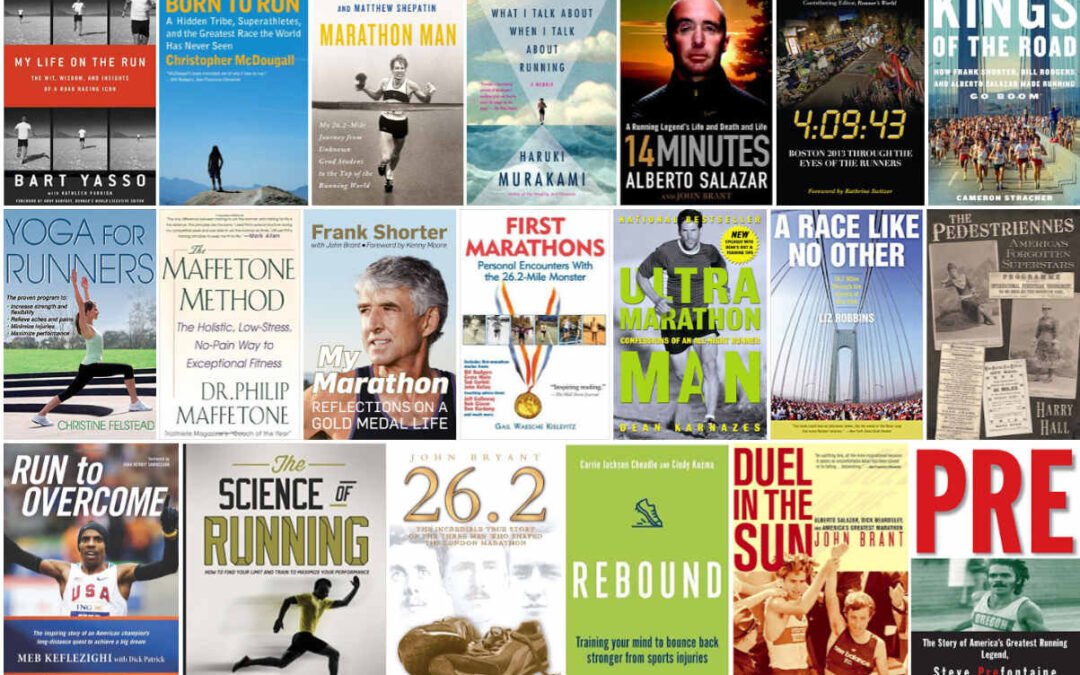
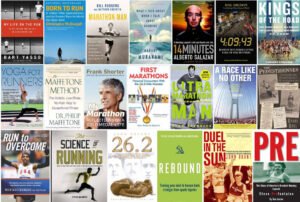
As a compliment of last week’s post, today I conclude my list of 20 book recommendations for runners. If you haven’t read Part 1 of this blogpost, please click here to do so. This way you won’t miss half of this list.


Book recommendationsIt is important to note that this is a very person list and at no time I am claiming it to be a comprehensive. I  have not read everything there is to read about running and I am aware there are very important books, such as Kathrine Switzer’s Marathon Woman, or The Lore of Running, by Tim Noakes, which is still on my “to read” list.

But if you are looking to learn more about our sport, its history, how to get better, and its most relevant figures and events, this list could be a good tool to get you started.

My 11 through 20 recommendations are as follows:

11 – Ultramarathon Man, by Dean Karnazes – The classic book that launched Karnazes celebrity runner career. You will finish the book inspired to lace up and run 100 miles into the horizon.

12 – Duel in the Sun, by John Brant: A detailed recap of the phenomenal 1982 Boston Marathon, where Alberto Salazar and Dick Beardsley fought step-by-step until the final yard.

13 – My Marathon, by Frank Shorter: The inspirational autobiography of a running icon, how he became an Olympic champion and the inspiration for the first running boom.

14 – A Race Like No Other, by Liz Robins: A must read for anyone about to run the New York City Marathon or even if you already ran it. The best book on the subject.

15 – Marathon Man, by Bill Rodgers: An autobiography of one of the most influential runners in history. His triumphs, defeats, personal struggles and legacy, told in a first-person detailed account.

16 – 4:09:23, by Hal Higdon: a blow-by-blow account of the 2013 Boston Marathon bombing, the perpetrators, the runners, the heroes, the scarring and redemption from a tragedy.

17 – What I Talk About When I Talk About Running, by Haruki Murakami: A successful and world-renowned writer tells us about his relationship with running and how it has influenced his life.

18 – First Marathons, by Gail Waesche Kislevitz: A collection of accounts of runners facing the 26.2 monster for the very first time. Inspiring reading even if you are a veteran of the distance.

19 – The Maffetone Method, by Phil Maffetone: The quintessential book to understand the concept of running slow so you can run fast.

20 – Yoga for Runners, by Christine Felstead: I firmly believe in the benefits of yoga for all runners, thus, the title states everything else you need to know.

20 Book Recommendations for Runners (Part 1)

20 Book Recommendations for Runners (Part 1)

By Coach Adolfo Salgueiro

We all run because we love it. If not, we would be doing something else. But there is always a secondary reason why we do so, which is usually as powerful as the aforementioned “because we love it”. It could be health, weight control, self-improvement, social interaction, test against yourself, getting away from a chaotic life, not murdering your boss, etc.

Book RecommendationsRunning is as simple as it gets: one foot in front of the other… Go! But in order to realize that secondary reason, an inquisitive and relentless mind should be always on the lookout for additional knowledge. Information that will allow for understanding of what is happening within the body, the story of those who came before us, the newest training techniques, the latest gear improvements, etc. Even if you have a coach to guide you through the process, it is always good to be prepared, to be inquisitive and ask the right questions. Problem solved: grab a book.

Through my years as an avid reader I have consumed scores of running books. I am aware I haven’t read everything and still have important books that are still in my “to read” pile.

I compiled a list of 20 running books that I have read, and, in no particular order, I recommend to my readers. Here are the first ten. The remaining 10 will be published next week. Click here to check them out.

1 – Born to Run, by Christopher McDougall: An indispensable read for anyone interested in understanding how the human body was built to run, told through superb storytelling.

2 – Kings of the Road, By Cameron Stracher: How the first running boom came to be after Frank Shorter’s Olympic gold medal in 1972 and the birth of the New York City Marathon as we know it.

3 – The Pedestriennes, by Harry Hall: Before the Boston Marathon and ultrarunning, long distance walking was the craze. This book captures the uniqueness of this story.

4 – Pre, by Tom Jordan: A basic biography of the amazing Steve Prefontaine and his short, yet intense life. Not the definitive biography but a good one for getting to know the man behind the legend.

5 – Run to Overcome, by Meb Keflezighi: Meb’s first autobiography guides you from his early life in Eritrea though his Olympic medal and other triumphs. It doesn’t include the latter portion of his career.

6 – My Life on the Run, Bart Yasso: An autobiography of one of the most influential runners of the last 50 years. Lots of cool and weird stories from a running icon.

7 – 26.2, by John Bryant: The story of the London 1908 Olympic Games, its protagonist and how the marathon distance was finally established.

8 – Rebound, by Carrie Jackson Cheadle & Cindy Kuzma: Eventually, most runners get injured. This book is an important read both before or during and injury.

9 – 14 Minutes, By Alberto Salazar: Regardless of what you may think of him after his suspension, his place in running history is undeniable and his story of life, death and life again is amazing.

10: The Science of Running, by Steve Magness: If you want to geek out and dig deep into the science of what happens inside your body when you train, this is the book for you.


Skip to content