My Case on Behalf of Glucosamine

My Case on Behalf of Glucosamine

By Coach Adolfo Salgueiro

 Before we get started, I am disclosing I am not a doctor, and I am not giving medical advice. What you are about to read is just my personal experience mixed with light internet research.

Glucosamine

Glucosamine and chondroitin are popular supplements used to treat osteoarthritis. About 6.5 million adults, or 2.6 percent of the population, have used one or both products

I’ve had issues with my left knee for a long time. It kept me from running for many years. It has always been my weakest link. But just like millions of runners, upon the recommendation of someone who I can no longer remember, I started taking glucosamine many years ago, and somehow, it kept the pain at bay and allowed me to keep running consistently for many years. This is my story, and I am sticking to it.

When I decided to give marathoning another try, as I was eyeing the New York City Marathon, I asked my doctor about Glucosamine. He told me there were no conclusive studies proving that it worked or that it didn’t. His professional recommendation was that if I thought it was beneficial to me, to keep taking it. If not, then don’t bother.

Glucosamine is not cheap. A bottle of the good stuff can go from $40-$50 for a few months’ supply. So, when it was time to replenish the stash, with cash in short supply at that particular time of the month and with the recent lecture from my doctor, I decided to skip it. A couple of weeks later, my knee started to hurt and other joints felt stiffer. How could this be? There was no proof! I ran to the drugstore, got my glucosamine and a week later, the pain was gone. This is all the research I need.
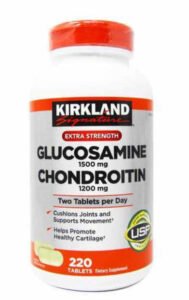
Glucosamine

This is the brand I use and the results have been stellar. I don’t need much more research than that.

Then I thought: Of course! Why in the world would a drug company invest time, effort and millions of dollars researching the benefits of glucosamine when every drug store carries ten over-the-counter options from which you can purchase as many as you want, whenever you want? This is no moneymaker. No reason to invest just for the pure pursuit of knowledge. It works for me, and this is all I need to know. I am the research paper my doctor was unable to quote.

Glucosamine has been around since 1876. It is manufactured by processing a polymer from the shells of shellfish, shrimp, lobsters and crabs. It also comes from other animals such as cows and pigs. Newer versions made from fungi and fermented corn have been brought to market to cater the needs of vegetarian consumers.

Glucosamine is a dietary supplement, not a prescription drug. Because of regulations, in the US it is marketed as a supplement to support the structure and function of the joints. It is also directed to people with osteoarthritis. Tests have shown that you can consume up to 1500 mg per day with no adverse effects.

Glucosamine pills usually include a compound named chondroitin. According to WebMd, chondroitin is a substance that occurs naturally in the connective tissues of people and animals. As a supplement in higher doses than is found naturally, chondroitin is also a popular treatment for osteoarthritis.

Arthritis.org states that “glucosamine and chondroitin are popular supplements used to treat osteoarthritis. According to one estimate, 6.5 million adults, or 2.6 percent of the population, have used one or both products”.

Both glucosamine and chondroitin are usually found in healthy cartilage and have anti-inflammatory properties. “They also have some cartilage-protecting effects through a variety of different mechanisms,” says Chris D’Adamo, PhD, director of Research & Education at the University of Maryland School of Medicine Center for Integrative Medicine.  

Glucosamine and chondroitin protect cells called chondrocytes, which help maintain cartilage structure. In theory, these supplements have the potential to slow cartilage deterioration in the joints, and to reduce pain in the process. 

Sounds good to me!

I take the Kirkland brand with 1500 mg of glucosamine with 1200 mg of chondroitin, and it has worked for me. If I ever forget to take it for a few days or if my resupply delays, my body promptly reminds me. Once again, what additional research do I need?

Please don’t take medical advice from me. I am not a doctor, nor I wish to be one. Glucosamine with chondroitin works for me. If you have joint issues, I suggest you check with a real doctor and then give it a try.
Running with Lymphoma

Running with Lymphoma

By Coach Annamarie McCormick-Howell

 I’ve been a distance runner for years, so when lockdown started in 2020, I was still in my element, as running outdoors in Germany was still allowed and encouraged. I found myself kind of tired as the year went on. I attributed it to the pandemic fatigue so many of us were experiencing, as I was unexpectedly homeschooling my 4-year-old twins and confined to our tiny neighborhood. I completed my birthday run in July, starting my 32nd year with 32 miles and a renewed attitude.

Running with Lymphoma

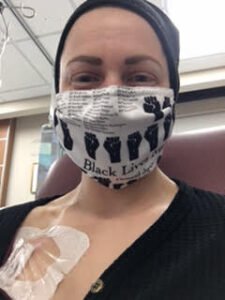
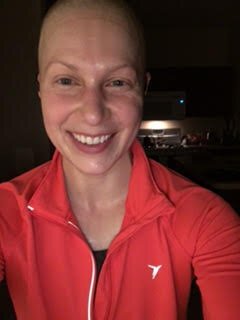
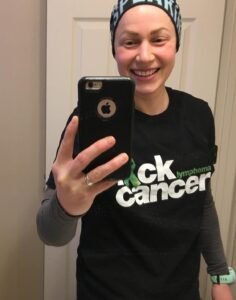
Before her last cycle of chemo, Annemarie set out to complete a half marathon.

Shortly after that, I started having some mid-back pain. Within a few weeks, I noticed my toes were numb. I was having ascending weakness when I was exercising, and then I began to fall. I went to see a German physiotherapist, thinking I had a herniated disc.

He did an assessment, and then sat me down and said: “Annamarie, do you ever have night sweats?” I knew then that there was a chance something bigger was going on. He helped me navigate the German hospital system, and I was able to get an MRI in early October. The radiologist came to get me afterwards and broke the news that I had a tumor on my spinal cord. He recommended I have surgery immediately, or risk permanent lower limb nerve damage.

I went to the American hospital at Landstuhl but was told they were not comfortable performing the surgery. I would need to take the next medevac flight to Walter Reed Army Medical Center. In one of the hardest days of my life until that point, I left my husband and children and flew to back to the US for a hemilaminectomy.

The surgery was a wild success. I woke up and was walking with full feeling in my legs and feet within the hour. I was elated and asked my neurosurgeon when I’d be able to run again. He laughed, but was supportive of my enthusiasm and, when I left the hospital a few days later, while I waited for the pathology results, he told me I could walk as much as I wanted and to be as active as I could without putting direct pressure on my scar.

The next week, despite feeling good enough to be walking 8-10 miles per day, my world was turned completely upside down. I was diagnosed with lymphoma. The next few days felt like I was in a wind tunnel of information, learning everything I had never wanted to know about cancer. My oncology team was wonderful, and incredibly supportive, from day one.

Running with Lymphoma

Within an hour of her surgery, she asked her neurosurgeon, when would she be able to run again.

I underwent a series of invasive and painful tests and then got a port placed to start chemotherapy. My doctor told me that his patients that manage chemotherapy the best are those able to be the most active throughout.

Feeling beat up, alone, and nearly unrecognizable, I had my first chemotherapy infusion the day before Thanksgiving. I knew that the person I was before cancer was gone, but that I could hang onto the elements that made me feel most like myself, so I got up and walked a Turkey Trot on Thanksgiving morning. I started counting down the days (30 more) until I would be allowed to resume running, rotating among long walks, bodyweight strength training, and indoor cycling.

A few days after Christmas, and in the middle of my second cycle of chemotherapy, I got out and did a 3-mile run/walk. This felt as big as any other running accomplishment I had achieved—however small and inconsequential it seemed to anyone else. I began running every other day, not worrying about my pace, just focusing on how my back and tibia felt. I enjoyed the movement and the normalcy. Within a few weeks, I was running almost daily, free of any post-op discomfort.

I set a secret goal to run a half marathon before my last cycle of chemotherapy, scheduled for the first week of March. I found that, no matter how tired or sore I felt, running gave me relief. I felt normal, I forgot that I was bald and bloated and nauseous and a shell of myself. I felt normal, alive, even powerful.

On March 6, 2021, the Saturday before my final cycle of chemo, I set out to run a Chemotherapy Half Marathon. Just over 2 hours later, I finished in front of our new house, smiling and sweaty (such a familiar, proud feeling), noticing that the light in my kids’ room was on, knowing that I had managed to exceed my own expectations, and that I would get to walk inside, a finisher of my first and only Chemotherapy Half Marathon, and be a mom to my kids. A mom who been carried through chemotherapy on a pair of running shoes and a lot of endorphins.

Coach Annamarie McCormick-Howell is an RRCA Certified Running Coach and an ACSM Certified Personal Trainer . She lives in Fort Meade, Md. You can follow her at @amcchowell on Instagram or reach out to her via email at amccormickhowell@yahoo.com.

 
7 Additional Bad Running Habits to Quit

7 Additional Bad Running Habits to Quit

By Coach Adolfo Salgueiro

Back in September of 2020, we published a post titled “7 Bad Running Habits to Quit”. I was surprised by the response it got, but especially how so runners identified themselves, including myself, as being guilty of one or more of these bad habits.

The more I thought about the list, and the more feedback I got, the more I realized there were plenty of missing bad habits that were not mentioned in the previous posting. Of course, neither that list nor this one, or the combination of both, is meant to be a comprehensive one, nor the final word on the subject.

So these are 7 additional bad running habits to quit:

Bad Running Habits

No runner is immune to bad habits. We always have to be on the lookout to avoid them

1.      Allowing fear of failure to derail your goals: Failure is inevitable. If we learned something from it, it will always be worthwhile. Always remember that when we don’t obtain what we originally were looking for, we gain experience, which can be used in the future, making future goals attainable, feasible and possible. Coach Steve Magness puts it this way: “Making failure something that isn’t big and scary, but something that leads to growth, goes a long way in helping dissipate the fear surrounding it”.  So, never fear failure. Embrace it.


2.      Running too hard on easy days: This is the cardinal sin of running. For some reason, most runners have a Superman complex that make them (or us, since I am included) believe that they are indestructible. An easy recovery run is not scheduled because your coach hates you. It is there to get the oxygen/nutrient rich blood circulating through your muscles so they can recover quicker, and you can then go for another enjoyable, hard session sooner while avoiding injury.

3.      Pushing for Results instead of letting them happen: When your program states 8×800 at 3:45; or a 30 -minute tempo run at 9:30/mile; these are guidelines. Nothing else. Of course, we all want to hit our targets and they are there for a reason. But we need to know when to quit. There is nothing to gain on a bad day by pushing on the last couple of repeats and needing a week to recover. We must know our bodies enough to understand where the fine line between being a badass and doing something stupid, lies.

4.      Controlling every parameter through your watch: Science fiction writers from just 25-years ago could not even imagine what wrist watches can do, today.  We still call them watches only because they are on our wrist. They are advanced computers. They measure pulse, oximetry, quality of sleep, recovery, resting heart rate, route, etc. And if that wasn’t enough, they can even tell us time. As great as all this is, we can’t become slaves to the graphs and let them overtake our training. They are but guidelines to consider, not the Gospel of running.


Bad Running Habits

Complicated graphics you can’t even understand are not going to make you a better runner. Concentrate on a few parameters you can control and understand.

5.      Thinking the unsexy stuff is worthless: Our training program will often call for easy recovery miles, or for an easy long run on a day we know we can push, or a foam rolling session, or a day off when we are still feeling strong. But never underestimate the importance of the boring stuff. It is there for a reason. To help you recover, to make you stringer, to make you versatile, to make you patient, to avoid injuries. All worthy qualities in a runner.

6.      Focusing on a system instead of the whole person: Anaerobic work, hill repeats, tempo runs, the weekend long run, or lactate threshold runs are staples of a well-balanced training program. But none of them work individually and this is not the time to look for personal bests. All parts all need to work as a well-tuned machine to provide the results you are training for. It is not in your best interest to set up a 5K PR in a tempo run when you are training for a marathon. Remember that the whole is always better than the sum of the parts.

7.      Believing that only running can make you a better runner: Cross training is basic for our running. If the only thing you do is run, you will most likely suffer overuse injuries.  If running is our main sport, such cross training needs to be in support of our running. Yoga, strength training, core workouts, stretching, biking, swimming, etc., can be beneficial by providing aerobic capacity, strength, flexibility or core stability. If you want to be the CrossFit champion in your gym, a marathon may not the best option at this point.

In the future I will most likely publish “7, Even More, Bad Running Habits to Quit”. Let me know if you want to contribute with one of them by leaving a comment, below.

The Mechanics of the Arm Swing

The Mechanics of the Arm Swing

By Coach Adolfo Salgueiro

Last week I wrote about the first aspect of arm swing biomechanics, which is pushing your elbows back. If you haven’t read that one yet, I invite you to do so by clicking here, before returning to this post. You will find the link back to this one at the end of that post.

US runners usually keep their arms in a 90-100 degree angle and do not cross their bodies as they swing. East Africans use a different technique. This is US Marathon record holder, Ryan Hall.

Pushing backwards is just the first part of the equation and by no means its only part. Many pieces need to be coordinated so the best biomechanical and energy-saving results can be reaped. As with everything else in our sport, it starts with a good posture. There is nothing to gain when you have a beautiful arm swing motion if you are not running upright, leaning forward at the correct angle, and not bending from your waist.

When it comes to arm swing, there are many components that need to work in a coordinated fashion. It must be a seamless symphony of motion between the upper and lower body. One where the arms will complement and enhance what is happening with your legs and feet.

Check what Coach Steve Magness has to say on this subject in his book The Science of Running: “it goes beyond just the arms and legs working in opposition; when they both stop, forward and backward motion is also coordinated. When the arm stops moving forward and is about to reverse direction the opposite leg should reach its maximum knee height before starting its downward movement. Similarly, when the arm reaches its maximum backward movement before switching directions and coming forward, the opposite leg and hip should be at their maximum extension backwards”.

Arms should be relaxed and that starts at the fingertips. When you tighten them in a fist, the rest of the muscles follow the trend upward until you reach the shoulders. This refrains the free flow of the arm swing. The best way to relax that kinetic chain is with the “potato chip technique”.

Pretend you are holding a potato chip between your thumb and index fingers. They are very fragile and will break if you press too hard. As you do this, the remaining three fingers will be forced to relax and easily positioned below the potato chip. This relaxation on your hands will start creeping upwards and relaxing your arms, as long as you are positioned properly. Avoid having your wrists parallel with the road, as it will make the relaxed wrists sag down. They should be perpendicular to the road.

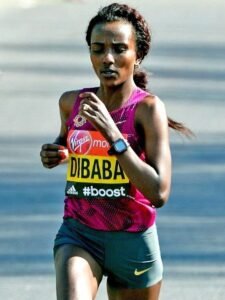
East African runners hold their hands closer to the heart and cross their bodies as they swing. US runners have a different technique. This is Tirunesh Dibaba, from Ethiopia, winner of the 2017 Chicago Marathon, who also has two seconds in London.

Regardless of your arm swing technique, the movement begins at the shoulder, like a pendulum and not from the elbows. From there down, what I like to teach my athletes is to have forearms below the elbow at an angle from 90-100 degrees, with the relaxed hands at the end. As you push back your elbows, the relaxed knuckles should reach the hip, before changing directions. As you began to run faster or sprint, they will automatically start reaching further back.

In his book Run for Your Life, Dr. Mark Cucuzzella goes through his Five Principles of Running. Number 3 is “Use your arms and hands to set your rhythm”. The key here is that when you swing your arms from your shoulders using the strong lower trapezius muscles “your knuckles stay close to your sternum but should not cross your center line”.

As in everything, there is no one-size-fits-all technique when it comes to arm swinging. Elite East African athletes run with their arms tucked closer to their bodies, in an acute angle (about 45 degrees) and with their hands very close to their hearts. They also cross their torsos on the swing. In the US we carry our arms lower and we don’t cross. Regardless of what style you use, they both have relaxed arms, and they both push elbows back.

I tried this East African arm-swing style for myself and I did feel a change in my stride. It became shorter and started falling closer to my center of gravity. But it was exceedingly difficult to keep my arms relaxed in that position and it required extra effort to push my elbows back. My arms became automatically tense. But it works for Eliud Kipchoge and his running buddies, so we can’t discount it.

As for the many benefits of the proper arm swing technique, Dr. Cucuzzella adds that the arm swing will help also in providing stability, counterbalancing the movement of the opposite leg, balancing the pelvis, and helping maintain forward momentum. This alone should be enough for any runner to start paying attention to their arm swing technique, right away.

Please understand this is not a comprehensive research paper on arm swing. There are entire books and studies on this subject. It is just a review on the basics biomechanics and technique so you can understand how important this is in your running form. If you start being aware of your arm swing, you can make your running way more efficient.


The Key to the Arm Swing

The Key to the Arm Swing

By Coach Adolfo Salgueiro

 As a running coach, one of the most common issues I see in running form has nothing to do with heel striking or lack of cadence. It has to do with one of the most important, yet neglected, parts of our running biomechanics: the arm swing.

Key to the Arm Swing

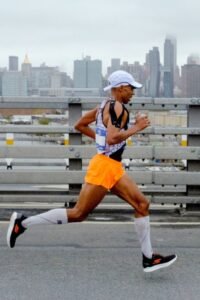
Check that triangle between Meb Keflezighi’s left arm and his torso.

Gordon Pirie, British 3-time Olympian and a 1958 medalist in the 5000, says that “there is a lot more to running correctly than just getting your legs and feet working properly. What you do with your hands and arms is equally important”.

Arm movement balances our running form and usually is the culprit of many of the issues that happen below the waist. Fortunately, arm swing issues are way easier to correct that leg mechanics. A few basic exercises should assist you, unless you have skeletal issues that will prevent you to move your arms in the optimal way.

Grant Robison, a 2004 US Olympian in the 1500, observes that that is easier for runners to adjust their arm motion instead of their legs because arms are always in front of you, thus, they can be seen constantly, so you can really focus on them.

I read about a fascinating series of experiments led by Dr. Rodger Kram starting in 1999, which determined that about 39% of the energy used in running is dedicated to moving forward. Subsequent studies determined that 20% was used to the swing of your legs. When you include supporting your body’s weight and moving forward, you are talking about 90% of your energy use. Interestingly, he also found that the arm swing motion can provide an energy saving effect of 4% compared to not swinging your arms at all. Imagine what you can do with 4% extra energy.

The Key is Pushing Backwards

All the articles and books I’ve read about the biomechanics of running, and racewalking for that matter, agree that the key in the arm swing movement is pushing your elbow backwards. Robison says that “A powerful arm drive is 100 percent backwards. It is just the recoil that brings it forward. The stronger you can drive your arm back, the quicker your turnover will be, and the more reaction your feet will have in relation to that”.

Translation to that last statement: You want more cadence? Swing your arms faster.

I read in a book, but unfortunately, I couldn’t find exactly where so I could quote it and credit it accurately, that the great Meb Keflezighi, in order to find out if his arm swinging mechanics are working, he looks at his shadow. If he sees a triangle of light between his arm and torso, then he knows he is swinging back far enough. I’ve tried this and it works. Most likely you will only see the triangle in one arm, so to see the other one, turn your direction 180 degrees.

Of course there are other aspects of arm swinging that go beyond pushing backwards. For one, your arms need to be loose and your hands relaxed, starting at your fingertips. There can’t be any tension so they can swing back and forth and be part of the symphony of coordinated movement needed to achieve a good and energy efficient stride.

All this cannot be covered in the few hundred words of this blogpost. We will revisit this topic, next week for some additional biomechanical recommendations. In the meantime, start pushing those elbows back and reap the benefits.

If you want to read the follow up post, please click here.

 
Skip to content