I joke (partially) with my running buddies that the day I ran against Eliud Kipchoge in Berlin (2017), he needed a world record to beat me. Sure, I started in wave 4 and was 15 miles behind when he crossed the finish line, and while I certainly had no chance of beating him, the statement is still 100% true.
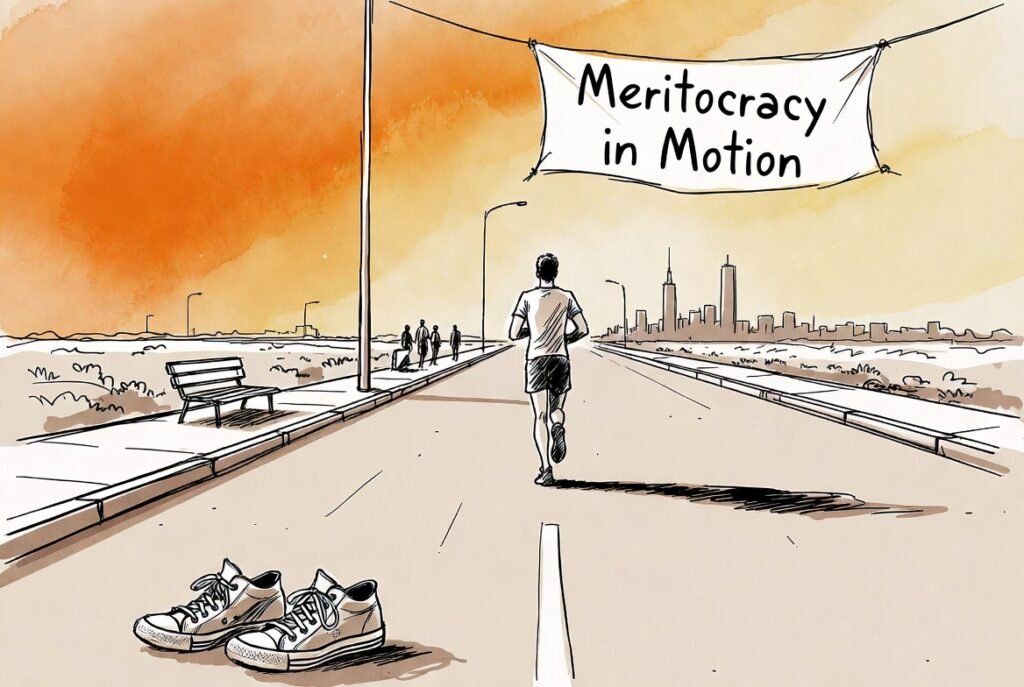
All you need is the will to go for a run. Everything else is additional (Image by Grok)
Consider this: what are your chances of standing in the huddle in a Super Bowl, strategizing the next play? When will you face Shohei Ohtani on an MLB field? How about your odds of standing with or against Lio Messi during the World Cup? Driving in an F1 Grand Prix? US Open. Golf or tennis?… Anyone?
But running is different. When the marathon’s 2-hour mark was broken, a runner I trained was there. When Kipchoge broke his last world record (Berlin 2022), another runner I trained was there. During the epic battle between Alberto Salazar and Rodolfo Gomez at the 1982 NYC Marathon, my dad was there. A close friend crossed the finish line in Boston, 10 minutes before the bombing. The last time the immortal Bill Rodgers won a marathon (Orange Bowl 1983), he had to beat me, too.
So, you get the point. Running is the most democratic of sports. The one with the most open access, equal opportunity to participate, low barriers of entry, and outcomes driven mostly by effort rather than status.
Remember dreaming of running, or lacing your shoes for the first time? Or how you felt after a long hiatus? Remember the struggle to finish that first long run? Have you checked the back of the packers at a race? Have you taken the time to watch the videos of the last finishers at a big-city marathon? Is there any other sport where regular people, even with a variety of disabilities, can beat the odds by finishing the biggest and most iconic races in the world?
Sure, only a selected few will run in the Olympics or the world championships, but even you, dear reader, can run the mythic Boston Marathon, even if you don’t qualify. We know you have a better chance of hitting the Powerball than the London Marathon Lottery, but the chance is there, and you still have charity entries. And if you are not into multitudinous mega races, there are local 5Ks everywhere, every week.
In his book “When Running Made History”, literature professor and former elite runner Roger Robinson said: “Being a runner (this sounds naive but isn’t) gives you direct and unfiltered access to all other runners. That’s one thing that makes running so remarkable; it is an intensely competitive sport that is also an egalitarian community. Just put your shorts and shoes on and if you’re fast enough, you can run with, befriend, and, if so inclined, interview the greatest celebrities on earth.”
In running, you will only get out what you put into it (Image by Grok)
Think about it: when it comes to running, you don’t need an opposing team or a field. Let alone a golf course. You don’t need a court, like tennis, basketball, or pickleball. You don’t even need a group of friends or a rival. All you need is the will to run. Everything else, everything, is extra.
You can run in the crappiest of shoes, or even barefoot. You can run in jeans and cotton socks if that is all you have. You don’t need a watch, you don’t need company, and you don’t need a dedicated surface or place. The comfort of a good pair of running shoes, a tech shirt/shorts, moisture-wicking socks, and a running path with good friends will surely make it more enjoyable, but as for requirements, none beyond your willingness to go out for a run.
Biologist and 2:22 marathoner Bernd Heinrich wrote in Why We Run: A Natural History: “Running is perhaps the most fundamental of all sports… it is the most democratic and most competitive of all sports because individual merit can prevail despite economic equality. It is a sport for everyone, the whole world over.”
Meritocracy in action. What a beautiful concept!
The great running author and philosopher George Sheehan said, “Life is a positive-sum game. Everyone from the gold medalist to the last finisher can rejoice in a personal victory.”
Fred Lebow, the father of the NYC Marathon, said, “In running, it doesn’t matter whether you come in first, in the middle of the pack, or last. You can say, ‘I have finished.'”
Beyond the health and social benefits, running is a sport where you can only get out as much as you put in. The one sport where we have the chance to participate in the biggest local, national, and international competitions. The one we can practice at a moment’s notice, just when we need it. Yes, need it. The one where the winner and the last one across the finish line get the same medal. The one where we can make friendships to last a lifetime.
Let’s go for a run, then. What are you waiting for?
👇Do you want the key takeaways of this blog post? 👇 👇Click below to watch the video summary 👇
When it comes to running, cadence is one of those parameters everyone can relate to, as the concept is straightforward. Yet, upon deeper inspection, most people have no idea what to do with it. It’s a bit like BMI (body mass index): Okay, it’s 29.6. Great! Now what?
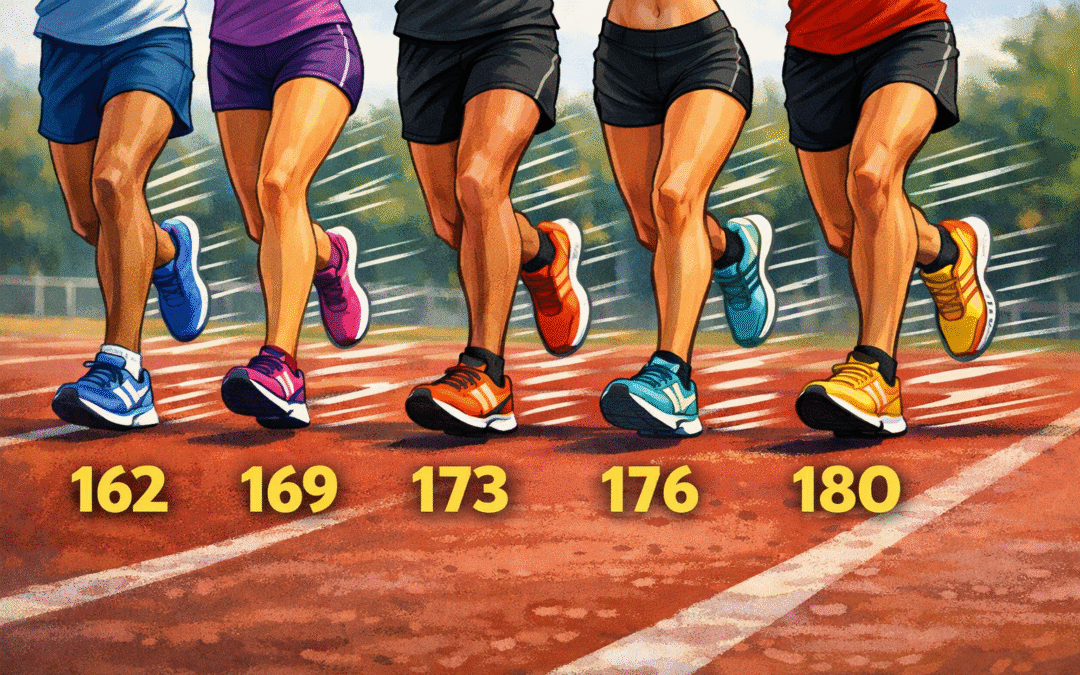
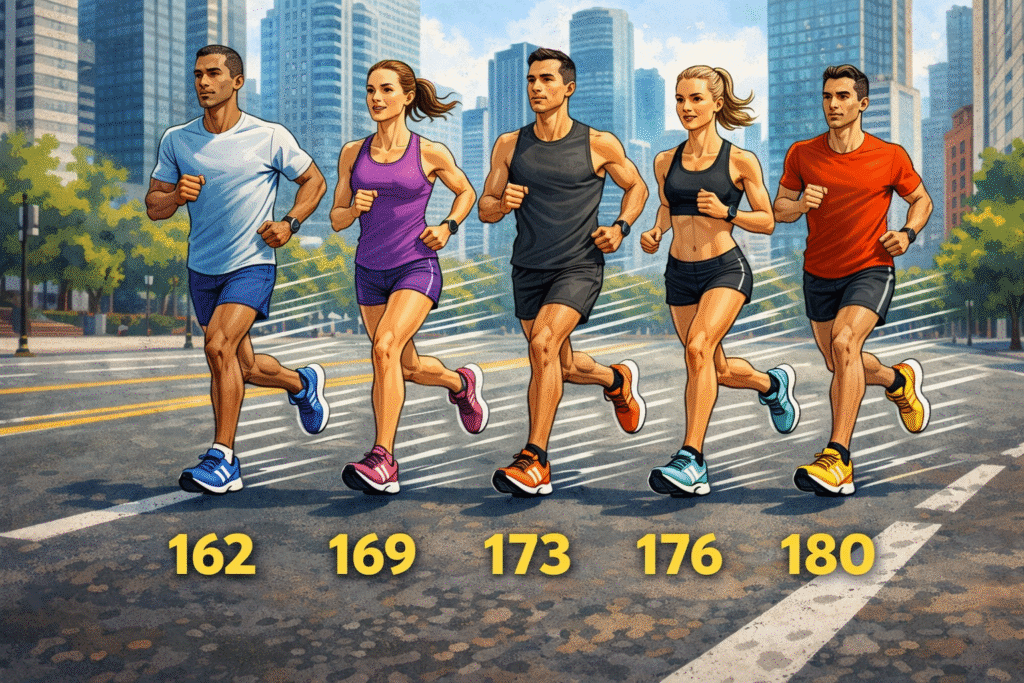
Cadence is not a one-size-fits-all parameter (Image by Chat GPT)
The right running cadence can help reduce fatigue, become a more efficient runner, avoid injuries such as shin splints, and thus allow you to run longer. And while higher cadence can be beneficial, it is not the secret sauce that is missing from your training. And, if you don’t know what you’re doing, cutting your stride indiscriminately is not without its consequences.
Cadence is a simple, straightforward concept: the number of steps you take per minute. Each step starts when one leg touches the ground and ends when the other does. It measures both sides, and most running watches quantify it as a standard function. While most everyday runners’ cadence is around 160-170ish, it is usually higher for elite and track athletes. There’s even a myth about the “magic 180 cadence.”
The idea that all runners should aim for 180 steps per minute for maximum efficiency is traced back to observations by exercise physiologist and coach Jack Daniels during the 1984 Olympics. Daniels counted the cadence of elite distance runners and found that most were running at about 180 steps per minute, or slightly higher. His observation was descriptive, not a universal prescription. However, as the finding spread through coaching circles, books such as Daniels’ Running Formula, and running watches that track cadence, the nuance was lost. What began as an observation of elite runners gradually became gospel among many recreational runners.
The problem with 180 is that only a tiny fraction of runners will ever become Olympians. So, while 180 is indeed a great cadence, it depends on factors such as height, weight, leg length, structural issues, and now even shoes. The runner pushing a sub-3 marathon, wearing carbon-plated shoes, has different mechanical requirements than one aiming for his first sub-30 5K. You can’t expect both to run at a 180 turnover.
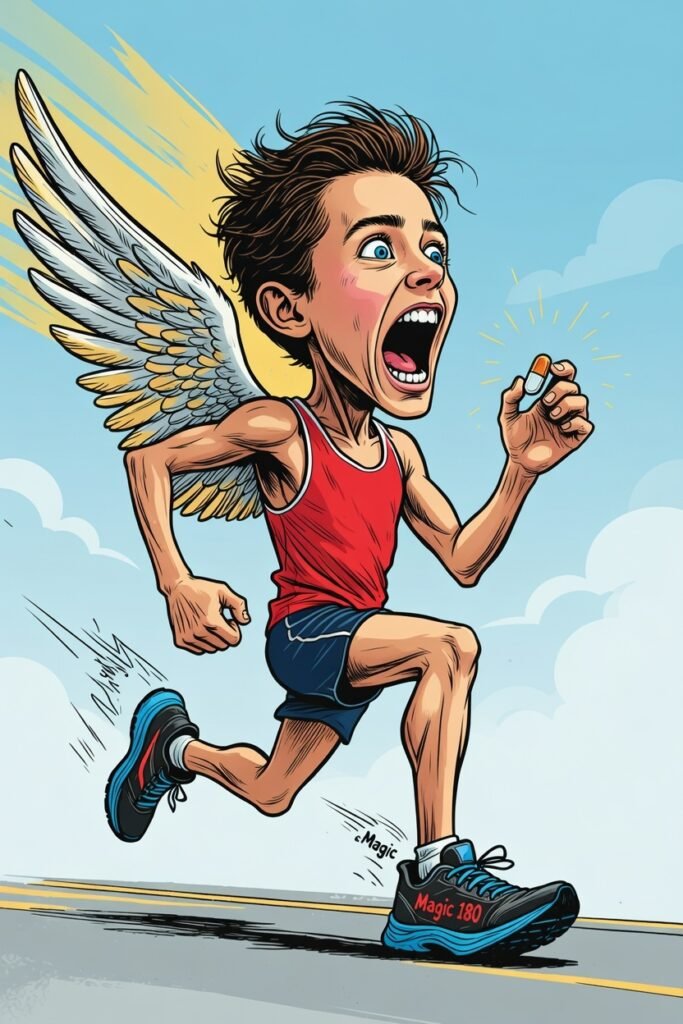
If you take away one thing from this post, may it be getting rid of that 180 myth. While it is a great cadence, it is not a magic pill that will have you winning marathons next year. Past and present elite distance runners have succeeded without 180. Meb Keflezighi, Galen Rupp, and Frank Shorter won Olympic marathon medals and were all most efficient in the low 170s. Bill Rodgers won four Bostons and four New Yorks between 160 and 170. Paula Radcliffe set the marathon world record, also around 170.
Cadence is not a magic pill to solve all your running problems and have you set world records (Image by Grok)
Varying your cadence must have a clear intention; it is not just upping the number for the sake of more-is-better. Changing your mechanics without a purpose is a recipe for injury.
Bryan Heiderscheit, PhD, Director of the Runners’ Clinic at the University of Wisconsin Sports Medicine Center, explains: “Research shows that when runners increase their turnover, they reduce the impact on their knees and hips and often improve their stride mechanics. Increasing turnover will help the chances of your foot landing closer to or underneath your pelvis, reducing overstriding tendencies, and increasing your lower extremity stiffness with less bounce and braking in your steps.”
That said, reducing your stride to increase your cadence while still overstriding won’t help you at all. Quite the contrary. You will be overstriding more often, speeding up your breaking point, and thus increasing your risk of injury.
“If you’re going to increase your step rate, also try to land with your foot closer under your hips,” Heiderscheit says. “You don’t want to keep reaching in front of yourself.” Jonathan Beverly compliments the idea by stating: “My experience as a runner and coach confirms this: A faster cadence comes, in fact, as you learn to run tall, land closer, and push back-all part of the same process.”
In conclusion: Even though cadence is a simple concept, and the benefits of adjusting it are real, not every runner needs to do it, and not every leg malady gets solved by it. Assessing it and making a few adjustments is a good place to start, but if the issues don’t subside quickly, you may want to check with a physical therapist before continuing to adjust your cadence indiscriminately. You don’t want to end up with a stride that is too short for your frame, which will result not only in discomfort but in injury.
There are plenty of exercises and techniques to work properly on your cadence, but they are beyond the scope of this post. But beware: When researching online, make sure the author’s background and credentials are legitimate. Don’t just do what the flavor-of-the-month influencer recommends. They may know what they’re talking about, sure, but they may not.
👇Do you want the key takeaways of this blog post? 👇 👇Click below to watch the video summary 👇
As the subtitle of this book clearly defines, this is the story of “the incredible journey of Kenya’s legendary coach Patrick Sang and the fastest runners on Earth.” Author Sarah Gearhart had unprecedented access to Sang and his Global Sports Communications training camps, located in Kaptagat, a small town nearly 8,000 feet above sea level in Kenya’s Great Rift Valley. From there, she reports through short chapters, kind of small essays, about what happens there and how some of the best runners the world has ever seen train and interact within and outside those walls.
Patrick Sang may not be a household name to most running fans. Maybe a handful of the most knowledgeable historians remember his steeplechase silver medal in the 1992 Barcelona Olympics when Kenya swept the podium. But for sure, most casual fans must have heard about some of Sang’s top trained athletes: Geoffrey Kamworor, Faith Kipyegon, and the one and only Eliud Kipchoge.
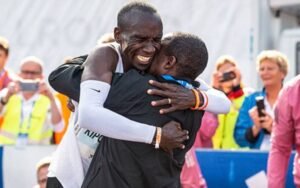
When Eliud Kipchoge broke the marathon World Record in Berlin, the first thing he did was hug Patrick Sang
Sarah Gearhart goes into detail about Sang’s life story, from his early days in rural Kenya to his Olympic glory, going through his competitive years as part of the University of Texas and then his years competing in Europe. Then, his beginnings, establishment, and apotheosis as a running coach.
The book reviews a handful of Sang’s top pupils. The likes of Victor Chumo, Laban Korir, Jonathan Korir, and their triumphs are well-detailed. But she centers Sang’s impact on three of the top runners ever. There’s Geoffrey Kamworor, a two-time winner of the NYC Marathon, 3-time half-marathon world champion, and former world record holder in the distance, who overcame a nasty injury after being hit by a car during a training run to return to the top of his game. He finished 2nd in the 2023 London Marathon.
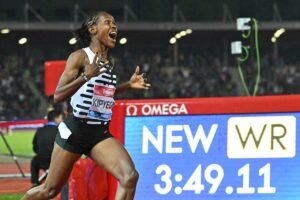
There’s also Faith Kipyegon, who, after winning gold in the 1500 at the Rio Olympics in 2016, had a daughter and had to juggle motherhood and world-class athletics to repeat the feat in Tokyo 2020. Her sacrifices in family and parenthood, and her determination to succeed where few women of her origin can, become inspiring through Gearhart’s pen. As a corollary, which comes after the book was published, in June 2023, she broke two world records (1500 and 5000) at the Diamond League Meeting in Paris.
After motherhood, Faith Kipyegon came back to win olympic gold and set new world records
And then there is this skinny teenager who once approached Sang asking for workouts. He graciously gave him a couple of weeks of work and forgot about it. The teenager kept returning for more and, through constant and hard work, became the Eliud Kipchoge we all know and who needs no introduction.
There are no earth-shattering revelations in this book. It is not about what gives Kenyans the edge in long-distance running. It is an intimate look inside the walls of the Global Sports Communications camp, which happens to have the best in the world. It is about a running unsung hero and the essence of what it takes to be a member of his elite Global Sports Communications running group, which happens to bring out the best of the best out of the most talented Kenyan runners and has produced some of the top runners, of both sexes, the world has ever seen. It is about Patrick Sang’s personality and kindness. Can you imagine what would have happened if he had not been kind to Eliud Kipchoge when he approached him?
I don’t want to finish this book review without sharing the introduction to Chapter 23, titled “Pushing.” It is not attributed to anyone, so it is not clear to me if this was written by the author or picked up from someone else. Regardless of its origin, there is not a wasted word. I hope you enjoyed it as much as I did.
“He can quit anytime. When his muscles tighten, leaving his body uncomfortably numb. When his lungs plead for more air. When cramps pinch with arresting tension.
He can quit anytime. When a blister balloons on his feet, the friction a piercing pain. When his body boxes with his mind.
He can quit anytime. When his competitor pulls ahead, the speed unmatched. When the finish line seems to stretch. When the last mile is more punishing than the others.
He can quit anytime. When his legs begin to lose the fight. When his goal slips out of sight.
He can quit anytime. But he keeps going.”
NOTE: Since the writing of this article, Eliud Kipchoge is no longer the world record holder in the marathon. Kelvin Kiptum broke the record in the 2023 Chicago Marathon.