
Speedwork: Track or Road?

Speedwork: Track or Road?

By Coach Adolfo Salgueiro

Should I run my speedwork on a track or on the road? While it is one of the building blocks of any training plan, for any race and at any distance, no one size fits all. Especially when the label “track” precedes the workout.

Before GPS-integrated tracking devices, monitoring real-time pacing and stats during runs was difficult unless running on a standard track. Tracks allowed runners to measure workouts and check progress while road runs were measured with a car odometer. This is why many runners still prefer running speed workouts in this setting. Running on a track facilitates precise pacing and distance measurement.\”

Speedwork on track or road

Today’s tech allow us to run speework off the track, but track still has its merits (Photo by Markus Spiske, Pexels)

I want to note that there is nothing physiologically magical about the 400-meter length of a standard track. Running a 393-meter or a 405-meter rep won’t mess up your physiology or your recovery. And no, tracks are not mismeasured because your GPS watch said so.

Though I haven\’t researched it, I believe that the 400-meter track became the standard because it is a convenient measure to be fitted around a soccer field, and thus into a stadium, so it ended up becoming the standard. And no, it\’s not because it is a quarter mile. A quarter mile is 402.33 meters, not 400.

Running your speed workouts on tracks has its benefits, but these are not negated if you run them on the road. Both options have their advantages and merits, no doubt. These are some of them:

Why on track

• A premeasured distance allows you to focus on hitting time splits by providing awareness on where you are on the rep just by understanding your location on the track.

• Provides the ability to measure progress by comparing previous performances on the same surface and the same distance. This removes subjectivity.

• No roads to cross, no cars to dodge, no red lights to wait for, and your hydration and supplies are available every 400 meters

• The geometry of the standard 400-meter track grants your coach or running buddies a full view throughout the entire length, allowing for better and immediate feedback.

• For group settings, it is easier to start a new rep together, regardless of when each runner finishes the previous one. It\’s also easier for the coach to keep track of different paces.

Why on Road

• Unless your race is on a track, the road is the closest you will practice on the same terrain on which you will be racing. There is value in that.

• It will provide you with a better opportunity to visualize your next competition.

• You are not held to the counterclockwise direction track etiquette dictates, so you won’t have the extra strain on your left leg.

• Variability of terrain and elevation are now available to you. Variety is now limited only by your creativity.

• It adjusts better for reps based on time rather than distance, since you don’t have to stop at an awkward place within the measured track.

Why do I prefer the road?

I have trained on a track and it does have its merits. But I prefer the road for many reasons. Unless you have access to a private track, public ones are congested with people doing lots of activities that are not track related. At Plantation Central Park, which is near where I live and used to train, there are kids with bikes and skateboards. People walking 3 or 4 side by side on the inside lane, etc. And simultaneously, you have soccer and football practices happening on the inside pitch.

Speedwork on track or road

The open road still allows plenty of fexibility to build a “track workout” (Photo by Bohle Media, Pexels)

I haven’t worked out on a track in over 10 years because of an incident. I was running an interval at all my might on the inside lane while some youth soccer activities were happening on the infield. Suddenly, a kid of about 7 or 8, crosses the lane not 5 yards in front of me. Instead of panicking, I grabbed him firmly by the shoulders and using my momentum, swung him to the side and left him standing and in one piece. I was so proud of my quick thinking. Five minutes later the kid’s father confronted me yelling at me for “touching his son” and jumped to beat me up. Yes, physically. Bystanders intervened and pulled the guy off me. It was the last time I trained on track.

I am sure there are plenty of tracks where that doesn’t happen, but after that experience I lost my interest in finding one of those. These days with my GPS watch and a few routes I’ve mapped out, I can run up to mile-repeats and more without aggravation. And 100% of my racing is on the road.

Whether you do it on the track or on the road, make sure to include speedwork as part of your weekly training. It is a must if you are training for a PR or just looking for progress.

Share your preferences in the comment box below!
End of a Challenging Running Year

End of a Challenging Running Year

By Coach Adolfo Salgueiro

As 2024 approaches (or it is already here depending on when you are reading this post) and we look forward to a blank canvas to fill out with new goals, challenges, and adventures, we quickly turn our heads back to the year that was, to reminisce and reflect on our running year.

We saw marathon world records fall to the point where it seems feasible that 2024 will give us the first sub-2 marathon for men and first sub-2:10 for women. We are just 36 and 114 seconds away from such feats. We saw the 6-star finisher list growing to 8,143 and it is a matter of time before a 7th Major is included. Many of our friends set PRs in their marathons, shorter distances or just lost their 26.2 virginities. But, for many of us, 2023 was a challenging year. One that tested our core as runner beings. I was in that latter group.


Challenging Running Year

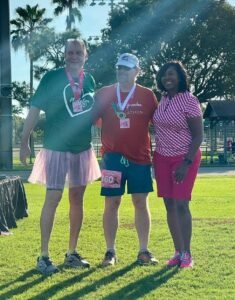
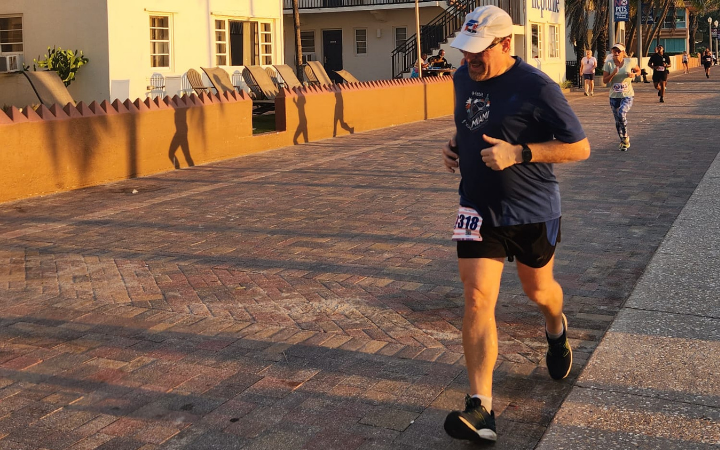
Winning my Age Group at the Plantation F*ck Cancer 5K was one of the few highlight of my 2023 running season.

I completed the 1000-mile challenge with just three days to spare. And sure, it is a nice achievement, but it doesn’t tell the whole story of my 2023. At least I did not get any injury and beyond the normal aches and pains, was able to run throughout the year with no interruption. That alone is a win. Still, it was far from what I expected it to be 12 months ago.

For some reason, it was very difficult to get into the running groove during the year. In my two half marathons early in the season, I was forced to walk after mile 10, finishing in unimpressive times that are embarrassing for me, when compared to what I have done in the recent past. I also had to withdraw from the Marine Corps Marathon because my body could not adjust to the heat and humidity of summer training in South Florida. It was impossible for me to complete more than 8 miles in one run, so I focused on 5 and 10K races until the end of the year. Those are not my favorite distances, as I prefer to go longer, but this was the adjustment that was required, and I am OK with it. I even won my age group in a local 5K, a rare occurrence.

For the first time in the last 15 years if felt little motivation to lace up and run. For the first time in recent memory, I dreaded waking up early on a weekend to go run long. Anxiety from my professional life, which was at an all-time high during the year, crept into my running life and affected me negatively. I gained weight, slowed down and lost the will to dig deep when a run got tough.

My lowest point was one day around September when for the first time ever, or at least that I can recall, I went out for a run and before the first minute was through, I decided I did not want to do this, so I stopped and drove home. Not before stopping at a gas station and stuffing up on cookies and chips. I still look back and can’t believe this happened.

Yet, I kept running. After more than 40 years of being active, I know how you will feel after a good run. The support of my two running groups kept me accountable and sometimes I just forced myself to go out despite not feeling it. 

Challenging Running Year

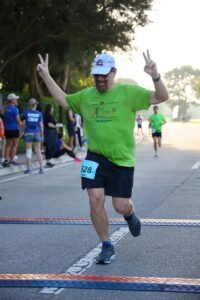
I completed a handful of races with not many results to brag about.

I have tried to pinpoint where the problem lies but I haven’t been able to do so. Maybe it is because I am approaching 60. Maybe two and a half years after my open-heart surgery I must accept I won’t be able to run the same as before. Maybe the anxiety my work life has put me through for the last 18 months is taking a toll on me. Maybe my peak running years are behind me. Maybe it is a combination of everything.

But this difficult year has been an opportunity to analyze life from a different perspective and realize I am still very blessed. My running life is not my life, it is just part of it. My value as a husband, as a father, as a friend, as a son, as a coach or as a professional, is not tied to my marathon PR or my medal rack display at home. I still have a healthy marriage with a wife I adore, a healthy and successful son, both my parents are alive in their eighties and living independently, I have a thriving coaching business, I am part of a phenomenal running community with true friends, and I am injury free. At this stage in my life this is more valuable than running sub-2 in the half once again, or setting up another PR. I call this maturity.

This does not mean I have given up on improvement. I still want to go over 1000 miles in 2024. I still want to run at least 4 or 5 halves and be part of one marathon cycle. I want to get rid of the source of anxiety and lose the extra pounds I added in 2023. I thank God that He is providing me with 12 brand-new, crisp, months to achieve it all.

 
From Zero to Marathoner in One Year

From Zero to Marathoner in One Year

By Coach Adolfo Salgueiro

A year ago, Grace P. had never run before. I am sure she tried to catch a bus or get refuge from the rain at some point, but never what we picture when we think of a runner.

She is friends with my wife and on a fateful October day of last year, we were invited to a small gathering at her house. I wasn’t too keen on spending a Saturday afternoon with people I don’t know but there are certain sacrifices a husband must make. Grace’s husband was wearing Brooks shoes, so to make small chitchat I asked if he was a runner. “I only run when Grace wants to hit me”, he joked back.


Marathoner in a year

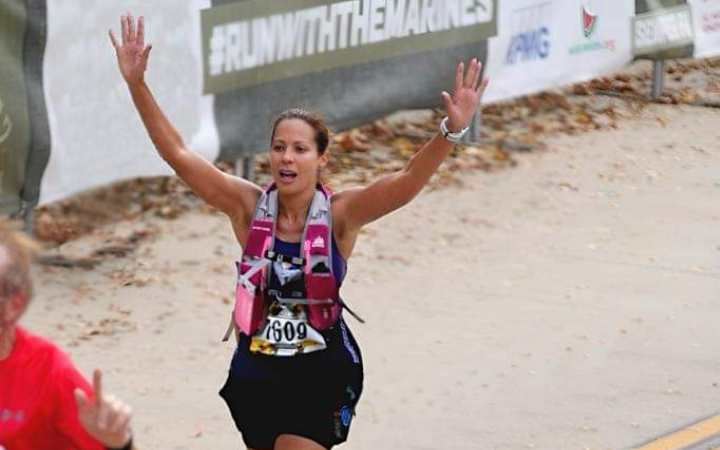
Still looking strong and happy at mile 18 of the Marine Corps Marathon.

Then my wife stated that I was a running coach and Grace jumped in saying something along the lines of: “I’ve always wanted to run, but I can’t get very far without getting tired. I see my neighbor running all the time, but I can’t run like her”. So, I told her I was the head coach for the City of Tamarac Run Club. “If you are at X park at X time on X day, I will get you running”. And she showed up. And kept on showing up. Last October 29th, she became a marathoner.

Three or 4 weeks into the training, on a cold and rainy night, everyone bowed out of the run through our chat. Except Grace. So, I showed up. She was scheduled to run three miles and at two, in the midst of a downpour, I told her it was OK to cut it short. With a huge smile, she told me she was completing her workout. And she did.

That was the specific moment when I realized that she caught the running bug and that she had the talent and drive necessary to achieve great things in this sport. Her training improved so fast that in less than two months of running, she skipped the 5K and went straight to a 10K race, in which she ran 1:00:13. A month later she ran her first 10 miler and another month later her first half marathon in 2:18. Within another month she set two more PRs in the distance, finishing the season with 2:05. That is a minute per mile faster than six weeks earlier. Now she wanted a marathon.

The story escalated quickly from there. As her coach, I wanted to make sure she recovered properly. That she took the necessary time off, that she began a strengthening program, that she learned about nutrition, hydration, recovery, etc. She even took to learn about the story of women in running by reading Marathon Woman, by Kathrine Switzer, who she learned to admire.

Marathoner in a year

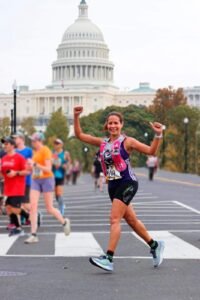
While in DC, Grace had the chance to meet and mingle with the one and only Kathrine Switzer

Then, as the hottest month of July in recorded history dawned in South Florida, Grace and her training partner Luis D. started their marathon preparation. It was brutal. More than once they had to take to the streets at 5 AM under 85-degree temperature and 100% humidity. Yet, they persevered. They kept going until one day… Voila!!! It all kicked in and new distances beyond 13.1 became not only possible but she thrived on them. I can recall her finishing her first 15-miler hooting and jumping with a big smile. Yes, I know. Totally crazy!

Sure, there were setbacks. And those were important, too. There was one time she hit the wall and had to finish walking. In the midst of her disappointment, I taught her to learn from it. To take it as an opportunity. She had progressed so fast she hadn’t experienced much failure.  Another time she tried a new gel and it backfired badly. She had to use one of her lifelines and phone a friend to pick her up. She was upset but I told her it was important to learn that this brand doesn’t work for her, now, instead of at mile 22 on race day. And she persevered.

Marathon day arrived on October 29. Grace was ready and excited.  But the weather wasn’t as cool as expected. Her training partner was dealing with a leg issue and dropped off the pace from the very beginning. There was a ton of traffic at the start and her first 5k was off by over a minute-per-mile slower than planned. So, she adjusted to her circumstances, picked up the pace to what she trained for and maintained it until Km35 (Mile 22), where she slowed down a little bit. The last mile was very tough, yet she persevered and did not walk at all, finishing in a solid 4:39:07. This, I remind you again, was someone who told me a year ago she wanted to run without tiring, like her neighbor.

Marathoner in a year

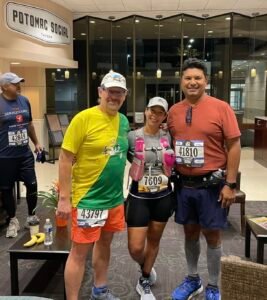
Coach Adolfo, Grace and Norvin (Grace’s husband), on our way to the startng line of the MCM races

If this wasn’t enough of a story, her husband caught the running bug, too. He started walking, then run/walking, and then pursued loftier goals as he felt better and stronger. He lost over 20 Lbs. and started fitting into clothes he hadn’t worn in years. And if that wasn’t enough, he ran the Marine Corps 10K without stopping in a time of 1:16. Now he is eyeing his first half.

From the coaching side, not only it has been a treat to coach a runner as talented and dedicated as Grace P., but she has also become an integral part of our Saturday running group. Moreover, she and her husband have become close friends with my wife and I, which has been a great addition to our lives. Running is the gift that keeps on giving.

Not everyone possesses the hidden talent and drive that Grace demonstrated. Not everyone aspires to become a marathoner. However, everyone has the potential to make the most of their physical capabilities. Just like Grace, it begins with showing up at the park on the appointed date and time, embarking on a personal journey whose destination remains unknown. Who knows where it may lead you?

 
Learning the Hard Way

Learning the Hard Way

By Coach Adolfo Salgueiro

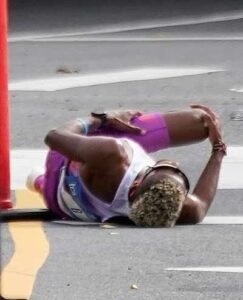
When it comes to us runners, sometimes experience goes out the window, and we make stupid, rookie mistakes that derail our training, fitness, and/or goal races. Who can forget Daniel Do Nascimento, an Olympian and 2:04 marathoner, going so fast during the 2022 NYC Marathon and collapsing at Mile 21 on a hot and humid day? He also collapsed during the Tokyo Olympics. If he screws up monumentally in the biggest stages, what’s left for us mere aficionados?

Learning The Hard Way

Daniel Do Nascimento collapsed in both Tokyo and NYC. Lesson not learned

Failure must be embraced as an opportunity to gain experience, sure, but it doesn’t make it any easier when we screw up and are forced to learn a lesson at an inconvenient time. So, here are eight areas of your running where you could avoid learning the hard way:

1.    Starting too fast: The equation is straightforward. The faster you go, the less endurance you have. Racing a half marathon at 5K pace will end in disaster. Starting faster than your race plan is not conducive to PRs but to bonking. Don’t fall for the “I-feel-awesome” fallacy at mile 8 of a marathon. You’d better feel formidable there if you trained for 26. Execute your race plan as designed. The chances of a satisfactory race will multiply exponentially.

 2.    Expecting linear and/or unlimited improvement: Because the curve of progress is so steep at the beginning of a training cycle, especially for beginners with little to no historical reference, it becomes imperative to understand that each body has a performance ceiling. If we didn’t, we would all eventually be setting world records. The apex of our curve can still move up as we get better, more experienced, and in better shape. But that process may take years, which requires patience. Too much, too fast, too soon is the cardinal sin of running and a sure path to injury.

3.    More mileage is not necessarily better: If you are planning to run long distances, you must run a lot of miles. It is inevitable. Now, what “a lot of miles” implies is very personal. It may mean 120 miles for Olympians but just 30 for a newbie looking to finish strong in their first half marathon. If you run beyond your body’s capability, recovery will be affected, and injury, overtraining, cumulative exhaustion and burnout will derail your goal. Figure out what works best for you and apply it.

 4.    Bad races are part of the deal: You may have done everything right. You were dedicated to your training, you slept enough, hydrated properly, strength trained, didn’t miss a day, and rested. And yet, you had a bad race. Well, nobody can guarantee you a solid performance. That’s why we compete on race day and not just pick up our medals and trophies by showing our training logs. Sometimes it happens, sometimes it doesn’t. Accept it and don’t let it be the measurement of your worth as a person.

 5.    Not practicing race strategy during training: The place to figure out you can’t stomach that 5th gel shouldn’t be mile 20 on marathon day. Discovering that you don’t have enough pockets to carry all your needs should not be realized on race morning. And so on. Be smart. Go for more than just one dry run during the training cycle.

Learning The Hard Way

Not taking care of your rest will inevitably lead to burnout or injury (Photo: Nataliya Vaitkevich, Pexels)

6.    Rest days are an integral part of any plan: Even elites take rest days. At the height of their training for a Marathon Major, it may mean 10 easy miles at a pace that would be a PR for you or me. But we are not training to win Boston or London. So, let’s put our goals in perspective and understand what we want to carry out. Let’s not compare ourselves to other runners, and make sure we rest properly, enough so our body doesn’t have to choose a rest day for us, which I may bet would come at an inconvenient time.

 7.    Squeezing in one more long run: The body usually takes from 10-14 days to adapt to the stress of a particular training session. This is why we taper. Not much of what we do in the two weeks prior to the race will help us. Yet, it can harm us. So, refrain from squeezing in one more long run or an added speed session in during taper. Follow your plan.

 8.    Trying new things on race day: Is the cardinal sin of racing. This is not the day to find out how these shorts fit, if this brand of gel upsets your stomach, or the responsiveness of this brand-new pair of shoes. You’ve been training for this day. You have sacrificed sweat, time, money, and emotion into this project. Don’t screw it up at the time to see it through.

 We would love to hear your advice for fellow runners. Leave a comment below; we appreciate every contribution!


5 Tips to “Train Like Kipchoge (Sorta)”,

5 Tips to “Train Like Kipchoge (Sorta)”,

By Coach Adolfo Salgueiro

 The most recent print edition of Runner’s World Magazine (2023/3) was Eliud Kipchoge centered. It had 8 stories that told us from his humble origins to his monastic lifestyle to a dissection of every detail of his record-setting running shoes to Evans Chebet as his most likely successor. It is the most detailed account I’ve seen of Kipchoge related info in one place.

Train like Kipchoge

Runner’s World magazine cover for the issue with the 8 Eliud Kipchoge related stories

The story that caught my attention is titled “Train Like Kipchoge (Sorta)”, by Sarah Gearhart, in which she shares five key aspects of Eliud’s training. My first thought was: how can we transfer them to us, simple mortals, to improve our running results. The article talks about how the greatest of all time (GOAT) does it, which doesn’t mean we must apply it in the exact same way. The key is to harness the key lesson of each one and make it part of our current circumstances.

These are the five principles, as per Runner’s World, with a personal commentary on how to apply it to our recreational runner training repertoire:

1 – Sleep like your run depends on it: Kipchoge sleeps 9 hours a night and takes naps. Most of us don’t have the time for that, but neither we are professionals, nor do we run 120 miles per week. The point is to be purposeful about your sleeping habits. Sleep as much as your body needs and don’t brag about your lack of sleep as a badge of honor. Our body recovers and rebuilds while we sleep, which is more valuable than all other recovery tools in your arsenal put together.

2 – Revive Sore Muscles with an Ice Bath: He takes 10-minute ice baths twice a week “to aid his post run recovery.” As recreational runners we may not have the facilities, the time or will tolerate this uncomfortable activity. But the point is that it works for him and despite the pain and inconvenience, he does it anyway because he works diligently on his recovery. Remember that you don’t become a better runner just as you finish your hard workout. You become a better runner once your body has recovered and adapted to the stress it just went through. So, be as diligent as Kipchoge in your recovery.

3 – Upgrade Your Diet with Protein: Kipchoge’s high-carb diet is essential for his training and performance, yet in 2017 he upgraded his protein intake “to aid his recovery as well as help to build and maintain his lean muscle.” The point here is that diet is key to training, performance and recovery. It is not a matter of how many calories we take in but the quality of those calories. If we fuel with a dozen donuts and a pint of ice cream, our weekly milage or our daily nap won’t really provide the benefit they should.

Train like Kipchoge

Stationary biking is one of the multiple options to enhance your aerobic capacity without overtaxing your system (Photo: William Adams, Pexels)

4 – Meditate to Build Mental Strength: Kipchoge is a “mindful runner” says his coach Patrick Sang. “While training and racing, he focuses on his breath and his movements, and aims to minimize outside distractions.” While not all of us can or want to live Kipchoge’s spartan life nor we have the will to perfecting the art of mindfulness, we can separate 10 minutes for daily meditation, we can read a book on mental toughness or practice the visualization of our goals without becoming Zen masters.

5 – Build Bonus Endurance on a Bike: Interesting to note that to add to his training volume “without increasing his risk of a running injury, Kipchoge rides a stationary bike for an hour twice a week after his runs.” For mere running aficionados like us, this is what we call cross training. Participating in a non-running activity once or twice a week to enhance our strength or aerobic training while resting our muscles and soft tissues from the pounding of running. Biking, rowing, weight training, yoga, elliptical, etc. Make sure you do something other than running to complement your training.

If these techniques work for the GOAT, scaling them down to our level would be beneficial. Don’t just think about it, do something about it and don’t take too much time getting started. Marathon season is around the corner.

To read the full Runner’s World article, you may click here.

 
Skip to content