
Should I Run Through Pain?

Should I Run Through Pain?

By Coach Adolfo Salgueiro

 This is a broad question that all runners have asked themselves at one point or another. Running and pain have a complex relationship. It is a rare occasion when there’s not a little pain here or a kink there that worries us after a hard workout, or as a race approaches. Most of these come with the territory of being a runner. Comedian Dana Carvey wisely said: “If I only ran when nothing hurts, I would never run”.

By the way: I am stating here that I am not a medical doctor, nor a physical therapist, nor a practitioner of any of the medical sciences. These are just suggestions based on 40+ years of experience as a runner. Consult your physician before making any health decision. Don’t base them on what you read here. With that out of the way, I continue.

Running through pain

Be smart when dealing with pain and you will avoid injuries (Photo Pexels: Kindel Media)

Most of our daily aches and pains are usually a product of the normal wear and tear from practicing our sport, and many times it is OK to run through them. But beware. The era of the “no pain, no gain” approach to running is long gone. The “nothing can stop me” macho attitude is not conducive to a long or a healthy running career. It is not the same to finish a marathon when you started limping at mile 25, than running through that same limp since mile 7. Aches and pains can be red flags and we must be able to identify them on the fly.

Most running injuries happen from a combination of repetitive movement and/or not enough recovery. When we approach this place in our training, our body usually provides us with warning signs. The more in tune we are with our bodies, the clearer we receive such communications. And the only way to be in tune with your body’s signals is to acquire more experience by running more.

 When can we run through pain?

1 – When your pain is a product of basic muscle soreness: By running we put an extraordinary amount of stress into our musculoskeletal structure. Muscle soreness is a natural byproduct of it. The more experience you gain as a runner, the more you will be able to discern on the source and type of your pains. Some muscle soreness if normal. If you don’t have to compensate and/or change your form, you should be ok by running through minor discomfort.

2 – If pain subsides or decreases as you warm up: It is normal to feel some pain and discomfort as you initiate your run. If you just woke up or spent an extended period sitting down, this is normal. Muscles, tendons and ligaments need to get back into shape to carry you through. Resetting your range of motion with exercises such as the lunge matrix, and/or warming up properly should help you accomplish this, and allow you to have a good session.

If you have determined that you will run through the pain and discomfort, don’t be afraid to adjust your training session to the current situation. Don’t be afraid to go slower, cut the run short, or dial back the intensity if needed. Always have in mind that no one training session will make you or break you. It is the small, consistent gains what’s will make you better. And you won’t be able to compile them if you are out of commission with a preventable injury.

When should we not run through pain?

1 – If there is excessive fatigue: It is normal to be tired from training, especially when you are increasing your mileage, add weight training, or you approach the peak portion of your race program. What is not normal is to wake up so beat up that you are not sure if you can complete your session for the day. This is a clear sign that it is time to dial back and recover before you get overtrained or injured.

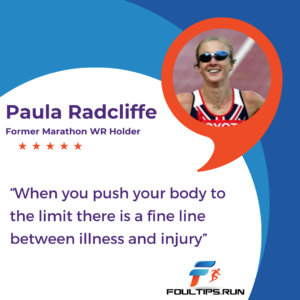
Running through pain2 – When it forces you to alter your form: Minor aches or discomfort is one thing, altering and adjusting your form because pain is too severe is a red flag and you should stop immediately. If you keep going, you could damage something else by moving in a way your body wasn’t designed for or by adding stress to structures unprepared to sustain it at the time.

3 – If it gets worse as you run: If whatever you feel increases as you go through your training session, stop immediately. It is not going to get better by running further. Assess the situation and figure out if it needs professional consultation.

4 – Through intense pain: Regardless of how seasoned you are as a runner, you should be able to discern what intense pain is. You know what a normal nuisance is. Use common sense to identify the types and levels of pain you are not supposed to run through. If it hurts that bad, something must be wrong. Stop. Assess. Consult a professional.

Have in mind that running is an impact sport. You are hitting the ground with about 300% of your body weight about 800 times per leg, per mile. This causse muscle and soft tissue damage. So, something is usually going to ache or be sore. It is when the body repairs itself from that stress that you become fitter and stronger.

Be smart. Make sure you live to run another day.
Heat Exhaustion Vs. Heatstroke

Heat Exhaustion Vs. Heatstroke

By Coach Adolfo Salgueiro

The Summer can make even the most motivated runner miserable. Currently we don’t need to wait until the Solstice on June 21st to start experiencing the weather getting hotter. And if you live in certain areas of the geography, getting unbearably humid. And, if you want to maintain yourself running, either you adjust to the climate reality or you hibernate with your running shoes until September or October, when things should start cooling off again.

Heat Exhaustion Vs. Heatstroke

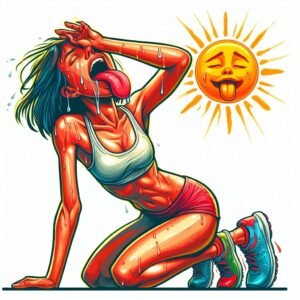
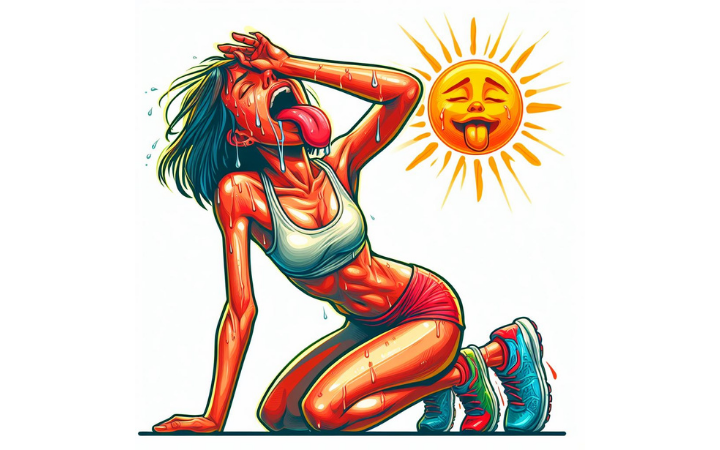
Image by Dall-e (she has three shoes, I guess it is still a work in progress)

It is imperative that runners become intentional about their safety running during these hot months. Being able to identify the symptoms of heat exhaustion and heat stroke will be able to keep you and your running friends safe. So please, pay attention to the content below.

Once again, the usual disclaimer: I am not a doctor, so please do not take medical advice from me. If you have any questions on what you are about to read, please consult a professional.

It is extremely important that you as a runner understand and differentiate the signs and symptoms of heat related illnesses, such as heat exhaustion and heatstroke. They are both serious conditions, but the latter can lead to death. This is no joke. A close friend of mine ended up in the hospital and her family was told to make final preparations. It is a miracle she survived her heat stroke.

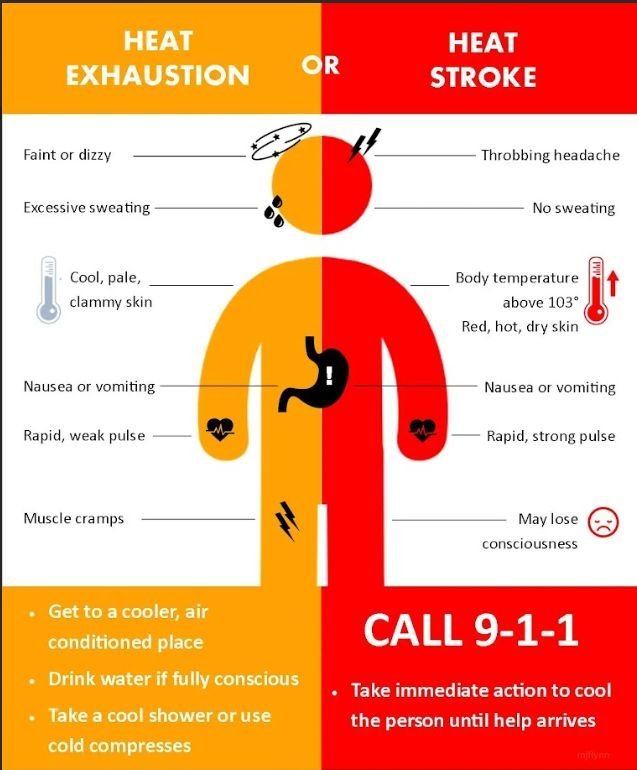
According to the Mayo Clinic’s website, there are three heat-related syndromes that may affect your body depending on your exposure to extreme heat conditions. In order of severity, they are: heat cramps, heat exhaustion and heatstroke.

Heat Exhaustion is caused by exposure to elevated temperatures, particularly when combined with high humidity and strenuous physical activity. Without prompt treatment, it can turn into a heatstroke, a life-threatening condition that can be prevented by avoiding entering the heat exhaustion zone in the first place.

Heatstroke is a condition caused by your body overheating, usually as result of prolonged exposure to physical exertion in hot temperatures. It is the most serious form of heat injury. It may occur if your body temperature rises to 104Âș F (40Âș C) or higher.

Certain conditions and medicines can enhance your risk of a heat-related illness. Ask your doctor if any of your medical history or current prescriptions can make you more susceptible to these conditions considering your level of physical activity during the warmer months.

I can’t state enough how important it is to know and understand the symptoms of each one of these syndromes. Not only it could help you prevent them, but it can avert a tragedy.Heat Exhaustion Vs. Heatstroke

Heat Exhaustion

The evaporation of your sweat regulates your body temperature. However, when you exercise strenuously or otherwise overexert yourself in hot, humid weather, your core temperature (body\’s heat combined with environmental heat) fails to regulate, preventing your body from cooling itself. A normal core temperature is around 98.6Âș F (37Âș C). If you don’t deal with this situation immediately, it may develop into a dreaded heatstroke.

The symptoms of Heat Exhaustion are:

  • Cool, moist skin with goose bumps

  • Heavy sweating

  • Faintness

  • Dizziness

  • Fatigue

  • Weak, rapid pulse

  • Low blood pressure upon standing

  • Muscle cramps

  • Nausea

  • Headache

Should you feel any of these symptoms, stop your activity immediately, move to a cooler place, drink cool water and/or sports drinks and rest. If these symptoms don’t get better within an hour, contact your doctor. Remember you must avoid this escalating into a heatstroke.

Heatstroke

Heatstroke not only requires immediate treatment, but it can quickly injure the brain, heart, kidneys, and muscles. Damage can get worse the longer treatment is delayed and lead to serious complications and, once again, even death. Yes. Seriously: Death.

The symptoms of Heatstroke are:

  • High body temperature (over 104Âș F or 40Âș C),

  • Altered mental state or behavior (Confusion, agitation, slurred speech, irritability, delirium, seizures),

  • Alteration in sweating (skin feels hot and dry to the touch),

  • Nausea and vomiting,

  • Flushed skin. (Skin may turn red as the body temperature increases),

  • Rapid breathing (rapid and shallow),

  • Racing heart rate (Pulse may significantly increase),

  • Headache (Throbbing).

Prevention

It is imperative to be proactive, both for us and on behalf of our running mates. We must avoid getting into a situation that may trigger heat exhaustion during the scorching summer months. We must err on the side of caution. The Mayo Clinic recommends the following actions:

  • Wear loose-fitting, lightweight clothing,

  • Protect against sunburn,

  • Drink plenty of fluids,

  • Take extra precautions with certain medications (ask your doctor),

  • Take it easy during the hottest parts of the day,

  • Get acclimated to the new weather conditions.

Last year we wrote a blog post on Training Adjustments for the Summer Months, which may be worth revisiting as we prepare for the upcoming weather conditions.

Let’s take our time and learn about heat exhaustion and heatstroke so we can prevent a tragedy.

Have you or one of your running mates ever suffered from a heat-related illness? Please share your thoughts and experiences in the comments box below.


Heat Exhaustion Vs. Heatstroke (Repost)

Heat Exhaustion Vs. Heatstroke (Repost)

By Coach Adolfo Salgueiro

As we are about to enter officially into the summer season, for all runners training in the Northern Hemisphere it is time to adjust their running to the new weather patterns. I am reposting this article I wrote a couple of years ago because it could save your life. Make sure you read it and understand it.

Once again, the usual disclaimer: I am not a doctor, so please do not take medical advice from me. If you have any questions on what you are about to read, please consult a professional, which, yet once again, it is not the author of this blogpost. Now, let’s proceed.

Heat Exhaustion Vs. Heatstroke

Running in the summer heat requires a certain level of preparation to avoid heat related issues, including death (Jill Wellington, pexels.com)

As we enter the Summer months in the Northern Hemisphere and the coolness of the spring weather turns into a combination of heat and humidity that can make even the most motivated runner miserable, the time has come to refresh our knowledge on two important concepts. It is extremely important to understand and differentiate the signs and symptoms of heat related illnesses, such as heat exhaustion and heatstroke. They are both serious conditions, but one can lead to death.

According to the Mayo Clinic’s website, there are three heat-related syndromes that may affect your body depending on your exposure to extreme heat conditions. In order of severity, they are: heat cramps, heat exhaustion and heatstroke.

Heat Exhaustion is caused by exposure to high temperatures, particularly when combined with high humidity and strenuous physical activity. Without prompt treatment, it can turn into a heatstroke, a life-threatening condition that can be prevented by avoiding entering in the heat exhaustion zone in the first place.

Heatstroke is a condition caused by your body overheating, usually as result of prolonged exposure to physical exertion in high temperatures. This most serious form of heat injury, it can occur if your body temperature rises to 104 F (40 C) or higher.

Certain conditions and medicines can enhance your risk of a heat-related illness. Ask your doctor if any of your medical history or current prescriptions can make you more susceptible to these diseases considering your level of physical activity during the warmer months.

I can’t state enough how important to know and understand the symptoms of each one of these syndromes. Not only it could help you prevent them, but it can avert a tragedy.


Heat Exhaustion

The evaporation of your sweat regulates your body temperature. However, when you exercise strenuously or otherwise overexert yourself in hot, humid weather, your core temperature (body\’s heat combined with environmental heat) fails to regulate, preventing your body to cool itself. A normal core temperature is around 98.6 F (37 C).

 If you don’t deal with this situation immediately, it may develop into a dreaded heatstroke.

The symptoms of Heat Exhaustion are:

  • Cool, moist skin with goose bumps

  • Heavy sweating

  • Faintness

  • Dizziness

  • Fatigue

  • Weak, rapid pulse

  • Low blood pressure upon standing

  • Muscle cramps

  • Nausea

  • Headache

Should you feel these symptoms, stop your activity immediately, move to a cooler place, drink cool water and/or sports drinks and rest. If these symptoms don’t get better within in an hour, contact your doctor. Remember you are avoiding at all costs to have this escalate into a heatstroke.

Heatstroke

Heatstroke not only requires immediate treatment, but it can quickly injure the brain, heart, kidneys, and muscles. Damage can get worse the longer treatment is delayed and lead to serious complications and, once again, even death.

The symptoms of Heatstroke are:

  • High body temperature (over 104 F or 40 C),

  • Altered mental state or behavior (Confusion, agitation, slurred speech, irritability, delirium, seizures),

  • Alteration in sweating (skin feels hot and dry to the touch),

  • Nausea and vomiting,

  • Flushed skin. (Skin may turn red as the body temperature increases),

  • Rapid breathing (rapid and shallow),

  • Racing heart rate (Pulse may significantly increase),

  • Headache (Throbbing).


Prevention

It is imperative to be proactive, both for ourselves and on behalf of our running mates, in the avoidance of situations that may trigger heat exhaustion during the hot summer months. The Mayo Clinic recommends the following:

  • Wear loose-fitting, lightweight clothing,

  • Protect against sunburn,

  • Drink plenty of fluids,

  • Take extra precautions with certain medications (ask your doctor),

  • Take it easy during the hottest parts of the day,

  • Get acclimated to the new weather conditions.

Last year we wrote a blog post on Training Adjustments for the Summer Months, which may be worth revisiting as we prepare for the upcoming weather conditions.

Let’s take a little bit of time and learn about heat exhaustion and heatstroke so we can prevent a tragedy.

Getting Rid of Old School Thinking

Getting Rid of Old School Thinking

By Coach Adolfo Salgueiro

Last week I was talking to a friend who is helping his brother train for his first half marathon. He told me the toughest part of the process is making him understand that the “no pain, no gain” old-school mentality no longer applies to running. The days of alchemy are over. The collective thought has evolved and adjusted to new science studies or discoveries, thus, we understand matters in a new way, one that 5, 10 or 50 years ago was unheard of.

In 1968 Kathrine Switzer had to finagle her way into the Boston Marathon because back then women were thought to be so fragile, they could not endure such physical punishment. The carb depletion pre-marathon protocol was the rage in the mid-1980s, today we know it makes no sense. The “I run through pain” approach that showed bravado 20 years ago, displays recklessness, today. And like that, many more running ideas that once we thought gospel, today are barely gimmicks.

Old School Thinking

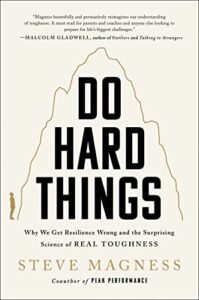
A good book worth the time and the money. Highly recommended.

In his book “Do Hard Things” author Steve Magness, one of my coaching role models, talks in depth about getting over of this old-school thinking. He explains how toughness is navigating through your training, not bulldozing through it. This how we avoid overtraining, and even worse, injuries. It is about being smart.

He goes through eight strategies to develop real toughness as a runner. I am not going to go through all of them, of course. If you want to go in depth into them, that’s what the book is for. But I will briefly touch on three that caught my attention and that I now teach my coached athletes.

A – Our alarms are adjustable: “Being tough gets easier the fitter you are.”

What an avant-garde concept! Think about it this way: If you spent the last 10 years on the couch watching TV and eating Doritos but decide to go for a 5K run, most likely you will suffer through it, regardless of your commitment or toughness. But, if you got the running bug, you trained smartly, diligently, and two years later you complete a marathon, it is not because you have multiplied your toughness. You reaped the benefits of your work and got better at it. Just like the first time Bruce Springsteen picked up a guitar, which these days is an extension of his body.

B – We need hope and control: “The key to improve mental toughness doesn’t lie in constraining and controlling individuals. It doesn’t lie in developing harsh punishments to teach a lesson. It doesn’t lie in screaming at the person to complete the task in front of them.”

The era of “I am not done when we are tired, I am done when I am done”, is done (pun intended). If you are training for a marathon, you need to run 18 miles but you are feeling unwell, stressed at work, just had a fight with your spouse last night, didn’t sleep well, it is a hot/humid summer morning and you are beat up at mile 15
 what’s best? Calling it a day and be happy you completed 80% of your workout despite the circumstances, or pushing through while destroying yourself, to prove your machismo and then having to take 7-10 days to recover from the effort? 
 Exactly!

Old School Thinking

Finishing exhausted after a training session could lead to injury. Be smart and always live to run another day. (Photo: Pexels)

C – Feelings and Understanding need interpretation: “The power through mantra only makes sense if you take stock in what you are powering through.”

I want to make sure my readers understand I am not saying you need to be complacent when training gets difficult. We need to learn how to power through difficult trainings, races, cross training and life. The key is to understand why we are doing what we are doing. If we are trying to run at race pace, then race pace sessions will be difficult. But we need to push through them if we want to understand and teach our bodies how to run at that pace. When we start strength training, or add yoga to our plan, everything will hurt, but there’s a good reason to keep going despite the aches and pains. It is not about suffering for fun; it is about reaping benefits in the near future.

These is my take on three of these principles, I fully recommend the book. “Do Hard Things” is a good investment of time and money for any runner out there. And it is not just for runners, but for every person wanting to get better at leaving their comfort zone behind and actually going for what they want, for their life goals, not just the athletic ones.

Please leave me your thoughts nn this blogpost, in the box below.

 
American Runners are Slower than Ever

American Runners are Slower than Ever

By Coach Adolfo Salgueiro

A couple of weeks ago I came across a statistical mega study that confirmed what the title of this blog post states. Using over 34.6 million results from over 28 thousand races, researchers Jakob Andersen and Vania Andreeva Nikolova, sliced and analyzed the data in multiple ways to reach their conclusion.

American Runners

The statistical analysis concludes slowing down in males and females in all distances (Photo: Pexels)

As I glanced through the research, I realized I started reading with preconceived notions on what they would find. More runners, unhealthier athletes, aging, gender gaps. The usual. Back in my youth, when I ran marathons in the 3:30s in the mid-1980s, I finished around the 50 percentile of finishers. A stat I just read from the Chicago Marathon stated that 18% of runners finished sub-3:30 this year. An obvious shift. I must say all my biases were addressed in the study and the conclusion still holds.

If after reading my take on this study you want to delve into the minutiae and the data, you can find the research paper in its entirety by clicking here.

This thorough study includes racing in the four most popular distances (5K, 10K, half and marathon), and races with more than 2000 finishers between 1996 and 2016. The reasons why this data was selected, the terminology and methodology of its handling, is detailed in the study, if you are interested. One more thing, researchers state this study took place because the deteriorating health of the American population is an important topic to be studied, and they wanted to find if this reality is reflected in the finishing times of races.

The study could have been a great episode of Discovery Channel’s Mythbusters TV show, as it takes time to disprove many of our preconceived notions about these numbers. These are:

1 –        The proportion of women participants is increasing, and women are slower in general: Men speed is decreasing at a faster rate than the women increment in participation. If this trend continues, by 2045 both sexes will be at an equal average pace.

2 –        People with inappropriate fitness level just walk the races: The study found the proportion of participants finishing races on every distance, at a slower than the average brisk walking pace is rather consistent throughout the years, so there is no statistical difference.

3 –        Just the slow are getting slower: An easy idea to assume but the study measured the average final time for the 100th, 1000th, 2000th and 5000th finisher on each race throughout the years of the study, on both sexes, and concluded the fastest females have slowed down 9.87% while males have done so at a 9.94% clip.

4 – The average age of the participants is increasing and older equals slower: The average participant age has increased from 37 to 41, so the study analyzed not just the finishing times for these 4-year gap, but for every 4-year gap on all ages as well as every single age and concluded this could not be the sole reason of the slow down.

American Runners

The study found a direct correlation between the slowing down and Americans getting heavier and unhealthier (Photo Andres Ayrton, Pexels)

So, if these are myths, what are is slowing down American runners?

The study considered the parameters of adult obesity, teenage obesity, diabetes and hypertension, and average annual medical expenditure. It found an across-the-board direct correlation with the slowdown. The authors make sure to emphasize that these are just correlations and by no means they can infer the condition of each runner, yet the numbers are very clear on what is happening as the population is getting heavier and unhealthier.

The study concludes the following:

1 – The average American runner has never been slower (across gender and distance).

2 – This effect is not due to the increase in female participants or people who run slowly or walk the race.

3 – Signs of poor health are highly correlated to the decrease in speed, though they cannot with certainty say that these are the causes for the slowdown. And if they have causal nature that they show the full picture.

The study was led by Jens Jakob Andersen and assisted by Vania Andreeva Nikolova. Andersen is a former competitive runner and statistician from Copenhagen Business School. Nikolova holds a Ph.D. in Mathematical Analysis.

 
Skip to content