As marathon training season arrives, you may be gearing up for the autumn Marathon Majors. Or perhaps you’ve chosen a less hyped, but equally fulfilling, 26.2. So, I invite you to reflect: why do you subject yourself to this fun—yet masochistic—activity? For 99% of the world’s population, it’s the equivalent of self-flagellation.
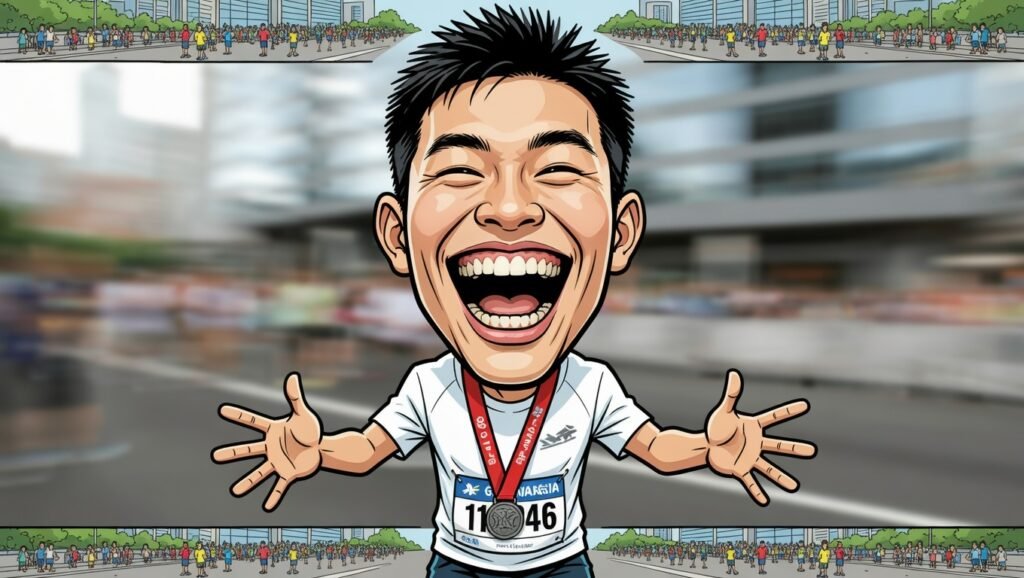
Running a marathon is way more than an Instagram post with a medal and a goofy smile (Image by Grok)
Some run a marathon to challenge their limits. Others just for bragging rights. Some want to fulfill a personal journey: 6-Star, 50 States, or something only you know. Regardless of your reason, it won’t define your legacy, affect your paycheck, or change the respect of your loved ones. Keep it in perspective. Enjoy the process. Suffer through with a smile. Embrace the suck.
Enjoying the process so you avoid burnout is the key to any successful marathon training cycle. Sure, it will be hard, and at some point, you will suffer. Absolutely, you will have to sacrifice certain events because you must train the next day. It is a given that something will eventually hurt. And somewhere during the process, you will question your sanity. But it won’t be a fulfilling process if you burn out. If you do, it will be miserable. Not worth pursuing and easily abandoned. So, let’s avoid that. Here’s how?
Remember why you started ► This is a personal journey, whether it’s your first or your 100th marathon. Make the training a connection to the personal reasons that brought you here. No one is forcing you to do this. Embrace failure (it will happen), grow through the struggle, and own the process.
Trust the Process, not just the pace ► While time goals are worthy and valid and marathon pace training is a key component to the puzzle, trusting the process is more important. Remember that training is about a multitude of stimuli; it is not about perfection. Hit the effort, learn from the session, don’t obsess over splits. If you trust the process, you should hit the pace.
It is your race ► Focus on your progress and don’t let other runners define you. Beating your friend or earning a BQ are legitimate goals. But if you focus only on those, you’ll drain your joy, push too hard, or skip recovery. This is your experience, and nobody else’s.
It is about consistency ► Consistency beats perfection every time. Miss a workout? Move forward. Focus on the next one. Flexibility is important, but don’t mistake it for complacency. Obsessing over a missed long run is stressful and unproductive, especially if you did complete the other 14 of 16 in your program. Life happens.
Fueling for a marathon goes beyond race day (Image by Grok)
Fuel your body properly ► Running a marathon requires a ton of fuel, not just on race day, but throughout training. This is not the time to lose weight, try a new detox fad, or fear carbs. Make sure your body has enough energy to perform and repair, so you can keep moving forward.
Remain resilient through strength training ► Strength training supports running. It protects your muscles, improves durability, and reduces the risk of injury. What more do you need to be convinced? Don’t think you can skip legs just because you’re already running. You don’t want to find out why the hard way.
Respect and prioritize recovery as part of training ► Rest days and easier weeks bring adaptation. Fitness grows when training and recovery are combined. Massage and therapies are a waste if you don’t prioritize sleep. Recovery gadgets are useless if you think they can replace the rest day you need. Be smart. You are not a machine. You are not indestructible.
Make sure to have fun ► As I said at the start, remember the reason you started. Don’t let social pressures take over the fun and fulfillment of the journey. Don’t be afraid to go easy on easy days. Run with friends and laugh. Give yourself permission for that post-run beer. Remember, your finish time is not what defines you as a human being.
Running a marathon is a formidable achievement. The 26.2 is a remarkable adversary. The challenge of training is what makes it special. So, be present, be purposeful, and above all, enjoy the process. Finishing a marathon is way more than an Instagram post showing a medal and a goofy smile.
Please share your thoughts on this subject in the comment box below.
As in every aspect of our functional lives, we pick up bad habits while running. Some are silly or quirky, while others derail important areas of our lives. They become unnoticeable the longer they remain unidentified, so we become immune to them.
Image by ChatGPT
We’ve heard about Major League pitchers getting drilled because a certain move telegraphs their next pitch; or public speakers who get stuck repeating verbal fillers as they deliver a speech; or job interviewees who undermine themselves by constantly apologizing before answering a question. Those are just bad habits, all of which can be overcome.
Runners are no different.
These are seven bad habits to consider and analyze whether they are sabotaging your progress as a runner.
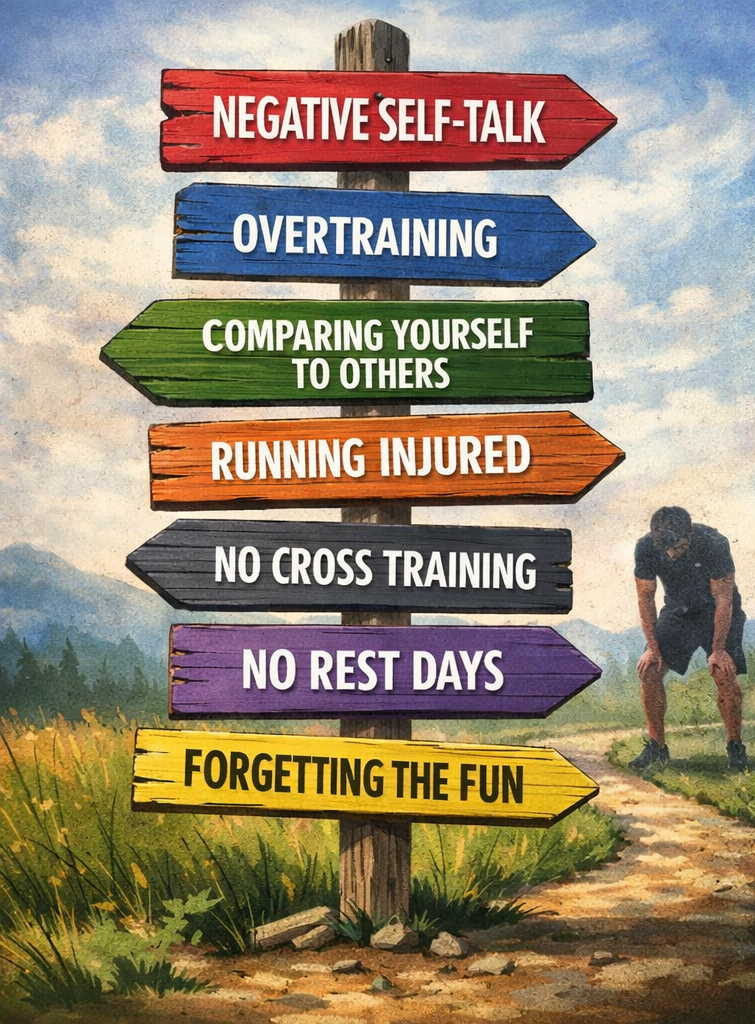
1 – Diminishing your accomplishments: If you are training for a marathon, running “just 10 miles today” is an easy day. But running 10 miles is running a lot of miles. Take your car and drive 10 miles from your house, and see how far it is and how long it takes. It is a matter of presentation. Be proud of your accomplishments, whether the medal is around your neck or you are training to earn it.
2 – Refusing to embrace rest: Working hard is essential to maximize your running potential. Recovering so your body can adapt to the stress of those hard workouts, so you can do it again and get better, is equally important. If you return to grinding while unrecovered, you will overwork an unprepared body and get injured. Never feel guilty for “executing” your day off as written, or for taking an additional one when needed. Resting is not a sign of weakness, but of mental strength.
3 – Believing you are not a real runner: Do you run? Then you are a runner. You are not a marathoner if you don’t complete a marathon, but there is no pre-qualification in terms of time or distance to define you as a runner. The only qualification needed is to run. So, stop feeling guilty because you think you are slow, or because you don’t run what you feel like far enough, or because you take walking breaks. None of that matters. You run; you are a runner. Done!
You must ensure your body remains strong and resilient (Image by Grok)
4 – Comparing yourself to others: If you’ve read my blog before, you have seen this one: Stop obsessing about what your friends are doing. Avoid overthinking what others share on Strava or Instagram. Don’t worry about how fast your friend is running his mile reps. Worry about you, what you can do better, and how you can become the best runner you can be. That last sentence says “you” four times. It is on purpose, because your running is all about you.
5 – Running while injured: This is non-negotiable. If you are injured, you don’t run. I am not talking about aches and pains, or little niggles here or there. I am talking injured. Not all injuries require a bone sticking out of your flesh. If you compensate your mechanics to avoid pain, you change not only the way the body was designed to move but also the way your body is used to move. This guarantees that something else will get out of whack. And then, instead of taking two or three days now, your body will force you to take two or three weeks (if not months) sometime later.
6 – Neglecting Cross Training: Running is a repetitive exercise. A high-impact sport. You won’t have to crash into a 300-lbs defensive lineman, but in a 10K, you are landing about 5000 times per leg at 3-5 times your body weight. Constant repetition leads to overuse, and overuse leads to injury. You must ensure your body remains strong and resilient. Strength training is key. You can also do other sports activities, such as yoga, cycling, or swimming, from time to time. This will provide physical gains without the pounding of running.
7 – Forgetting to have fun: Does your next mortgage payment depend on your next PR? Is the happiness of your marriage dependent on your invitation by Abbott to the next Marathon Major? Is next weekend’s race-pace effort the key to qualifying for the Olympic trials? Most likely no, no, and no. Understand why you run. Sure, some people run to get over a tragedy or to regain control of their health and lives. But most of us weekend warriors run because of the joy it brings us. The post-run high, the outdoors, the sense of freedom and accomplishment, or the social component. Never forget that. If you do, you are in for a short running career.
Running can be a lifelong sport if we diligently strive to do it right and remain injury-free. Don’t overcomplicate it. You have plenty of worries in life to add running to the list. Especially since you are not a professional.
As you prepare to reap the benefits of your hard weeks of training. Or you may be wondering if you have done enough to hit the starting line in PR shape. Or as you realize you have screwed up your training and will have to wing it. If you plan to race hard, or long, you will need to taper.
Taper (or tapering) is the label commonly used to identify the short training cycle between the end of our race-focused training cycle and race day. The word taper is an intransitive verb. According to the Merriam-Webster Dictionary, it means “to become progressively smaller toward one end. To diminish gradually.” In running, that’s exactly what we are referring to. We start reducing our workload as race day approaches. But why?
Our bodies usually take 14-20 days to adapt to whatever we do in training. If we ran 20 miles today, we are not better for it tomorrow. As our body recovers, it adapts to the benefits of such stressful events and thus becomes stronger. This is why whatever we do in the last two, maybe three weeks before race day, will be of little or no benefit.
There is nothing to gain during taper, but everything to lose. Many races have been ruined by not taking the taper seriously. Don’t become a victim.
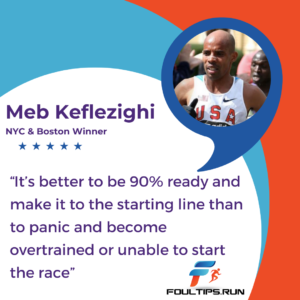
Meb Keflezighi has a great quote that epitomizes the last few paragraphs: “It is better to be 90% ready and make it to the starting line than panic and become overtrained or be unable to start the race.”
According to Jess Movold, in a 2024 article in Runner’s World magazine: “Tapering is one of the most critical parts of any marathon training plan, but in many cases, it’s also one of the hardest to implement. Ever heard of the taper tantrums?”
In my personal experience, I’ve felt better with a 2-week taper. But if the fatigue accumulation really beats you up and feel like another long run will destroy you more than help you, an additional week is beneficial.
Theories abound about how to handle the taper, but the scope of this blog post does not include analyzing any models. It wants to point out a handful of errors and misconceptions you may incur that will eventually negate your training gains.
While on taper, be on the lookout for the following so you don’t ruin your race:
I know I picked this up from Instagram, but I don’t know the source I should credit.
1. Follow the original plan: If you got here with your plan, then this is not the time to improvise, regardless of how confident you are or not about attaining your goal.
2. Don’t try one more long run: There is no place for it. It will add to the fatigue, hinder your recovery, and won’t produce adaptations in time for race day.
3. Focus on nutrition: Avoid detoxes, new supplements, weight-shedding schemes, carb unloading/loading protocols, and indulgent eating. Eat clean and enough.
4. Tapering means you are still training: You shouldn’t think you can stop because it’s tapering. It is still part of the training program, and it requires work.
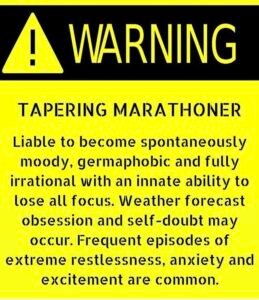
5. Manage your excess energy: With the decrease in activity, as your body rests and recovers, you will bounce off the walls. Expect it and control it.
6. Take the extra sleep: Your body is repairing itself, so it may ask for more sleep than usual. Don’t skimp on sleep. It is the best recovery tool.
7. Control your training effort: Because you’ll feel energized, compared with the last few months, it is easy to push harder and even perform your race effort before the actual race. Don’t!
8. Focus on the main goal: Everything you do must serve your race. This is not the time to try new stretches, foods, gels, shoes, or routines. Stick to what has worked so far.
9. Strengthen your immune system: Your body is working overtime to repair itself, so your immune system is low. Be proactive. It is no time to get sick.
10. Tread carefully: Be extra cautious as you transit through life. Don’t take unnecessary risks. Don’t climb ladders, jump the sidewalks, text while walking, or rearrange furniture. All that can wait.
Please like this post and share any recommendations from your previous experiences in the box below. Let’s build a community of informed and prepared runners.
👇Do you want the key takeaways of this blog post? 👇 👇Click below to watch the video summary 👇
When it comes to us runners, sometimes experience goes out the window, and we make stupid, rookie mistakes that derail our training, fitness, and/or goal races. Who can forget Daniel Do Nascimento, an Olympian and 2:04 marathoner, going so fast during the 2022 NYC Marathon and collapsing at Mile 21 on a hot and humid day? He also collapsed during the Tokyo Olympics. If he screws up monumentally in the biggest stages, what’s left for us mere aficionados?
Daniel Do Nascimento collapsed in both Tokyo and NYC. Lesson not learned
Failure must be embraced as an opportunity to gain experience, sure, but it doesn’t make it any easier when we screw up and are forced to learn a lesson at an inconvenient time. So, here are eight areas of your running where you could avoid learning the hard way:
1. Starting too fast: The equation is straightforward. The faster you go, the less endurance you have. Racing a half marathon at 5K pace will end in disaster. Starting faster than your race plan is not conducive to PRs but to bonking. Don’t fall for the “I-feel-awesome” fallacy at mile 8 of a marathon. You’d better feel formidable there if you trained for 26. Execute your race plan as designed. The chances of a satisfactory race will multiply exponentially.
2. Expecting linear and/or unlimited improvement: Because the curve of progress is so steep at the beginning of a training cycle, especially for beginners with little to no historical reference, it becomes imperative to understand that each body has a performance ceiling. If we didn’t, we would all eventually be setting world records. The apex of our curve can still move up as we get better, more experienced, and in better shape. But that process may take years, which requires patience. Too much, too fast, too soon is the cardinal sin of running and a sure path to injury.
3. More mileage is not necessarily better: If you are planning to run long distances, you must run a lot of miles. It is inevitable. Now, what “a lot of miles” implies is very personal. It may mean 120 miles for Olympians but just 30 for a newbie looking to finish strong in their first half marathon. If you run beyond your body’s capability, recovery will be affected, and injury, overtraining, cumulative exhaustion and burnout will derail your goal. Figure out what works best for you and apply it.
4. Bad races are part of the deal: You may have done everything right. You were dedicated to your training, you slept enough, hydrated properly, strength trained, didn’t miss a day, and rested. And yet, you had a bad race. Well, nobody can guarantee you a solid performance. That’s why we compete on race day and not just pick up our medals and trophies by showing our training logs. Sometimes it happens, sometimes it doesn’t. Accept it and don’t let it be the measurement of your worth as a person.
5. Not practicing race strategy during training: The place to figure out you can’t stomach that 5th gel shouldn’t be mile 20 on marathon day. Discovering that you don’t have enough pockets to carry all your needs should not be realized on race morning. And so on. Be smart. Go for more than just one dry run during the training cycle.
Not taking care of your rest will inevitably lead to burnout or injury (Photo: Nataliya Vaitkevich, Pexels)
6. Rest days are an integral part of any plan: Even elites take rest days. At the height of their training for a Marathon Major, it may mean 10 easy miles at a pace that would be a PR for you or me. But we are not training to win Boston or London. So, let’s put our goals in perspective and understand what we want to carry out. Let’s not compare ourselves to other runners, and make sure we rest properly, enough so our body doesn’t have to choose a rest day for us, which I may bet would come at an inconvenient time.
7. Squeezing in one more long run: The body usually takes from 10-14 days to adapt to the stress of a particular training session. This is why we taper. Not much of what we do in the two weeks prior to the race will help us. Yet, it can harm us. So, refrain from squeezing in one more long run or an added speed session in during taper. Follow your plan.
8. Trying new things on race day: Is the cardinal sin of racing. This is not the day to find out how these shorts fit, if this brand of gel upsets your stomach, or the responsiveness of this brand-new pair of shoes. You’ve been training for this day. You have sacrificed sweat, time, money, and emotion into this project. Don’t screw it up at the time to see it through.
We would love to hear your advice for fellow runners. Leave a comment below; we appreciate every contribution!
In the last post I dissected the phases of the racing off-season. Through these you can properly prepare for next season and be ready in time to achieve your goals. If you haven’t read the post yet, you can do so by clicking here.
The nature of the post didn’t allow me to go in depth, so this week I want to dig deeper into the first phase: Rest and Recovery. I firmly believe this phase is the key for whatever goals you may set forth the next racing season. It is what will allow you to reset and restart working towards them. It is what will make them achievable.
A great time to hit the gym and start working on your strength training. Not having enough time is no longer an excuse (Photo: Andrea Piacquardio, Pexels)
I have identified six areas in which to focus during your Rest and Recovery phase. These will allow you to decompress, rest, recover, prevent burnout and make you tougher against injuries. It is not a complete list, just a handful of suggestions on which you may want to focus for a month or two (or three) so you can reset all the systems.
1 – Focus on life balance: We all love running. We chose this sport. There’s no PT teacher timing us on the mile. We run because we want to. Even if you are doing it on doctor’s orders, you have other exercise options. For most of us, running is an essential part of our lives. Our therapy, our steam relief valve, our social time outside home/work. Yet, unless we are professionals or we are planning to qualify for the Olympics Trials, it is not what brings home the bacon. Our families, jobs, other hobbies and home responsibilities require our attention and presence. An elite Kenyan runner may not be able to take two weeks off if a child gets sick, because winning his marathon is not just payday but “pay-year”. I am sure 99.9% of my readership are not in the same boat. So, keep life balanced.
2 – Work on your running form: There is not one way of doing it right. Your form is unique to you and you alone. Changing form is not needed unless it’s getting you injured but it doesn’t mean there’s no room for improvement. There is always an adjustment or two that may get you more efficient, less injury-prone, improve your breathing, avoid aches and pains or make your joints stronger. Figure out the tweaks you need and take advantage of this time to work on them. Four weeks prior to your goal marathon is not the time to work on your overstriding.
I can’t stress enough how important it is to catch up on your sleep as a recovery tool (Photo: Ketuf Subiyanto, Pexels)
3 – Catch up on your sleep: If you are one of my recurrent readers, you read this advice plenty of times. But if you can grasp the concept that humans have been on this earth for 200-300 thousand years and have not yet evolved to stop sleeping, then you will understand that sleep is a non-negotiable activity to keep yourself healthy. If that wasn’t enough, there is no number of massages, compression socks, percussion guns or cold plunges that match sleep as recovery tool. And I don’t mean one individually. I mean all combined. This is science. It is not open to debate.
4 – Partake in other physical activities: Since you may (and should) be running less than during training season, you could take a yoga class, go for a swim, a bike ride, a hike, or whatever else will complement your physical activity requirements. Running is a highly repetitive, high-impact activity. A 10K alone will have each leg hitting the surface about 5000 times at 2.5-4 times your weight load. Getting your movement benefits from other sources will not only help you heal and get stronger but will facilitate your brain to vary from the same moving patterns, which also provides neurological benefits.
5 – Run at a low heart rate: Running slow so you can run fast is one of the toughest concepts for a runner to comprehend. Hopefully, now that you don’t need to run fast for some months, you may take time to apply this concept and verify its benefits. When you run at a slow heart rate, and thus pace, your body will learn to burn more fat as fuel, will increase your aerobic capacity, increase your mitochondrial density and your fuel consumption economy. None of this is possible when running fast, because your body requires so much energy, and it needs it right now, that all these benefits are negated. Sure, you can run faster, but there’s a cost to that. Your body will be invoicing you for it later, during race training.
6 – Of course, strength training: Yes, I know. It is boring, challenging and takes time. I don’t like it either, it is one of the weakest points of my training. But I do it anyway. You don’t need to spend 3 hours in the gym 5 times a week. Start easily and increase from there. Thirty minutes sessions, 3 times a week during the off-season will make you stronger, more resistant to injury, increase your power and your speed. As you increase your running mileage, once you are strong, you can decrease it to two times a week. I can’t stress enough the importance and the benefits of a strengths training program. The the time to implement it is now.
Any thoughts? Please let me know in the comment box, below.







 Our bodies usually take 14-20 days to adapt to whatever we do in training. If we ran 20 miles today, we are not better for it tomorrow. As our body recovers, it adapts to the benefits of such stressful events and thus becomes stronger. This is why whatever we do in the last two, maybe three weeks before race day, will be of little or no benefit.