If you are reading this post within the first few days of our brand-new year of our Lord 2026, your running goals should already be set and in motion. You shouldn’t need to cram in the later months, nor should you have to adjust because you were caught unprepared. If your goals are not set yet, click here before proceeding. If they are, let’s focus on how to achieve them.
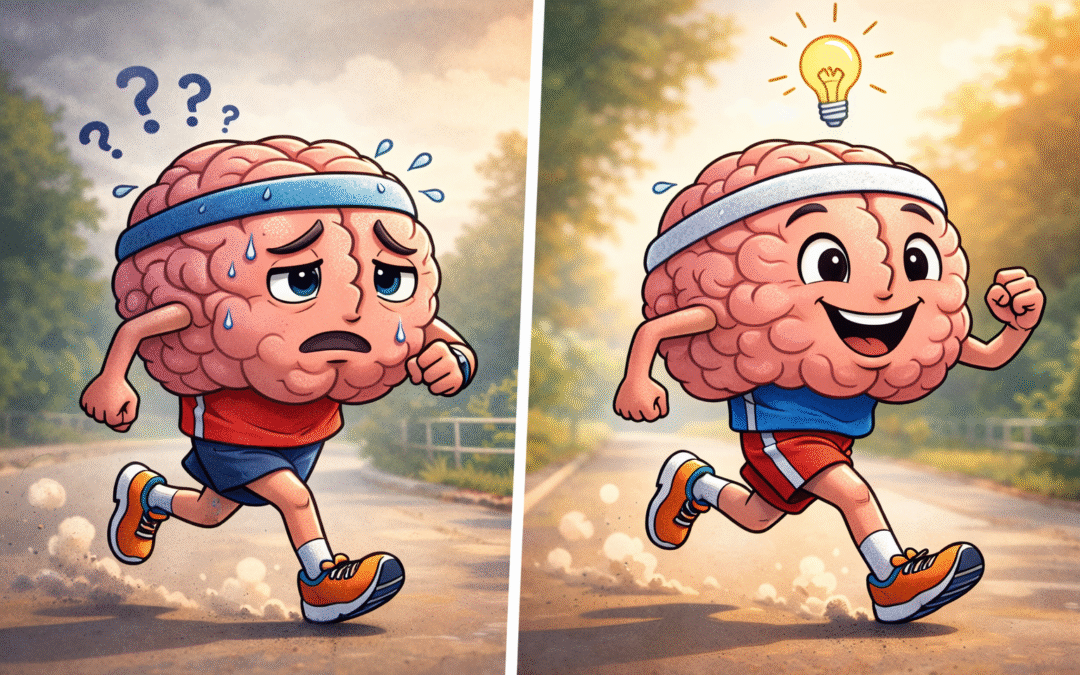
It is all about the way you present it to yourself. Image by ChatGPT
A sure way to keep yourself focused on your goals is to shift certain paradigms in your mindset. Little adjustments that, when applied, should put you in a position to achieve your 2026 goals. Some may apply to you, some may not. Let’s check them out:
1 – Focus on effort, not on pace – Easy pace is not measured in minutes and seconds per mile. It is about effort. An easy effort, hence the name. Sure, there are workouts where specific paces must be maintained. There are speeds and progressions to hit. But that is only in selected training sessions. Most of your training is always at an easy pace. So, keep it easy. Let the pace be a product of your effort, not the other way around. If sharing it on Instagram is embarrassing, keep it to yourself.
2 – Break your training into sections – Every single training has components that must be compartmentalized and distinguished so they can be appropriately executed. A light mobility session and a warm-up should be part of every single run. It is once you’ve taken care of these that your actual training session, where there are benefits to realize, starts. Regardless of what it is. Short intervals, long intervals, fartlek, progressions, you name it, all consist of segments that should be understood, respected, and executed. They are all there for a reason, so don’t rush or skip them. The same applies to the cool-down. There’s no need to jump into your car 30 seconds after turning off your watch.
3 – Running is a privilege, not a chore – Why do you run? Is anyone forcing you? Is the Boogeyman going to catch you if you stop? We run because we have chosen it as our sport, our vehicle for health, or our release valve from the stresses of life. Make it an enjoyable part of your day, not a chore. Make it your “me time” or your “social time” with your buddies. Will there be days when you would rather walk through crushed glass than go for a run? Of course! But those should be few and far between. Our running is not guaranteed. Injuries, time constraints, family demands, weather, work, and so many other distractions conspire against our running time. Understand the privilege of being able to run today and be thankful for it.
4 – Reframe your thoughts – Most runs don’t fall apart because your legs quit, but because of a thought you let go unchallenged. “I’m slowing down.” “This isn’t my day.” “I should back off.” Reframing is stepping in and editing that sentence before it becomes a decision. Not with unquestioning optimism, but with perspective. ‘I’m tired because I’m working.’ This pace still gets me where I need to go. “I don’t need to quit; I need to adjust. Once you start deliberately executing this, you will realize how often your mind jumps to conclusions your body hasn’t made yet. Running becomes less about fighting discomfort and more about managing the dialogue that surrounds it. Change the words, and the experience will often follow.
5 – Running is a journey, not a destination – There is no finish line. Races, PRs, and medals matter, of course, but they are just checkpoints. Accepting running as a lifetime journey changes the measurement of success. It’s no longer about faster times or longer distances, but about what running teaches you along the way. The patience to keep training when progress is slow. The humility of setbacks. The satisfaction of keeping showing up. Goals stop being pressure points and become refueling stations. They give direction without defining your worth as a runner. Miss one, and the journey continues. Hit one, and you keep moving forward. This mindset will keep you running for decades to come. Not because you are chasing one more medal, but because running still has something to teach you.
In 2026, let’s focus on the joy of running. Achievements and setbacks are part of the process, part of what makes running special. Always remember why you chose to run.
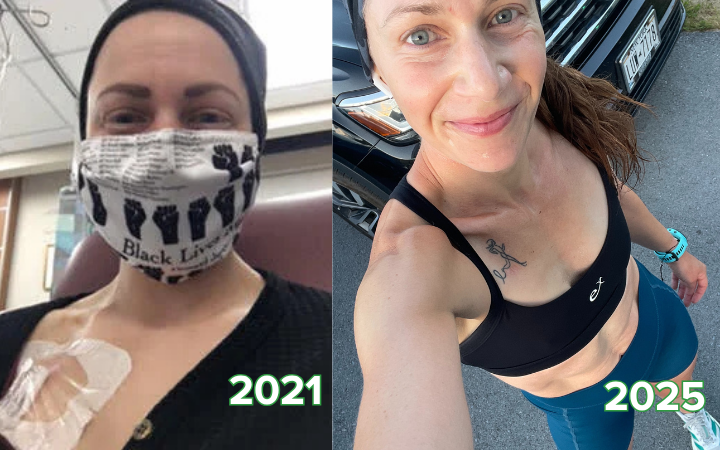
Back in April 2021, I published a guest blog post titled “Running With Lymphoma”, written by Annamarie McCormickHowell. The content is self-explanatory. Ten days ago, I received an email from Jen M, a runner with lymphoma who found the post and asked if I could put her in contact with the author. This made me wonder about Annamarie’s journey since then, so I invited her for an update.
Thank you again for the opportunity! Jen told me how long and hard she searched to find a person, a study, any data on people who run through lymphoma or R-CHOP, and the article you published is the only tangible thing she was able to find. I had no idea there wasn’t a larger body of humans doing precisely what I did, so I appreciate you connecting us!!
Life looks different than it did back on the day of my Chemotherapy Half Marathon, though some things remain the same, primarily, the daily morning run.
After cancer, nothing returns to normal, though I did notice a few weeks after R-CHOP, I had the sensation that I imagine to be akin to blood doping—having the appropriate number of white and red blood cells again made me feel unstoppable, as the chemo drugs slowly exited my system. I was able to run more, sustain paces, and even dabble in a few local races! After a few months, the novelty wore off a bit when I plateaued. I felt disappointment, followed by immediate guilt: I was alive, and my cancer wasn’t. How could I possibly be dissatisfied with something as trivial as running when I had managed to survive such an experience?
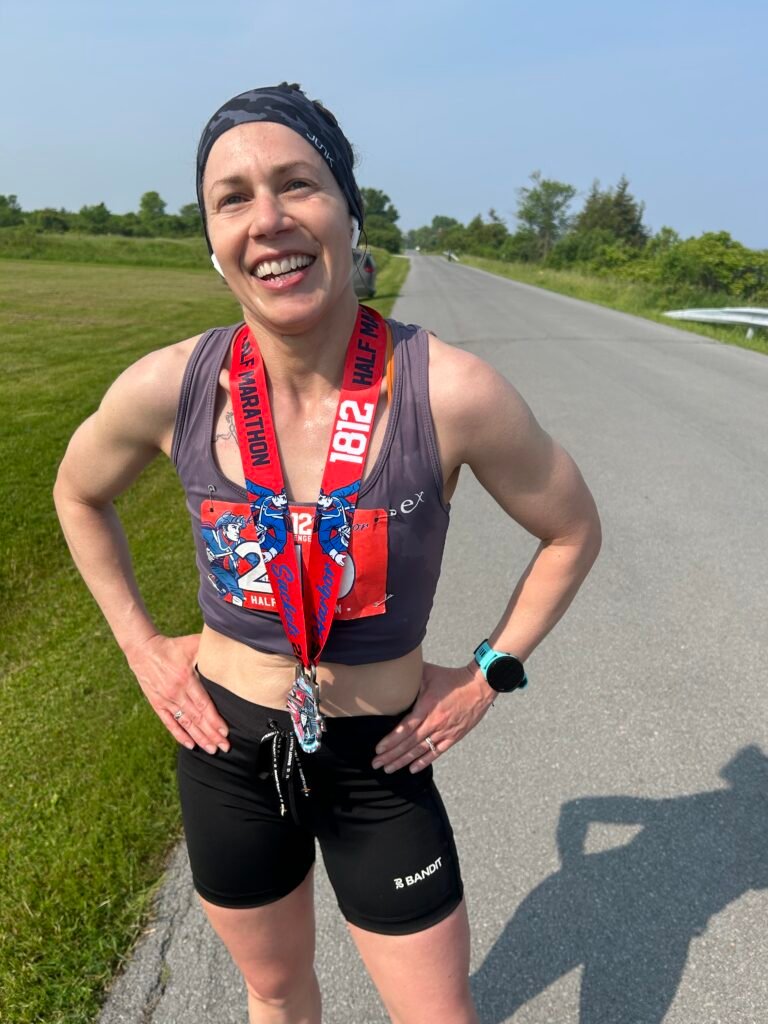
Winning the women’s race and 2nd overall at the 18.12 Challenge earlier this summer!
It was then that the universe gave me the greatest gift: a coach who saw not who I was in that moment, but who I could be. The indomitable April approached my training with expertise, confidence, and solidarity. Her lack of doubt in my abilities and body made up for ALL the doubt I was feeling. She literally ran into my life and began to push me in the most loving, challenging, unforeseen ways.
We started focusing on macronutrients, as I had lost a good amount of muscle mass to the chemo, and started training for short distances— specifically the 5K, with repeats like I had never performed before in my life. A few months later I felt like a new person, not the person I was before cancer, but someone who had transformed all those brand new “baby cells” after chemo into an athlete I didn’t know I could become. I began lifting heavy and loading my muscles and tendons as much as I could handle. I ran every workout April wrote for me, even the ones I looked at and thought “There is NO way…”
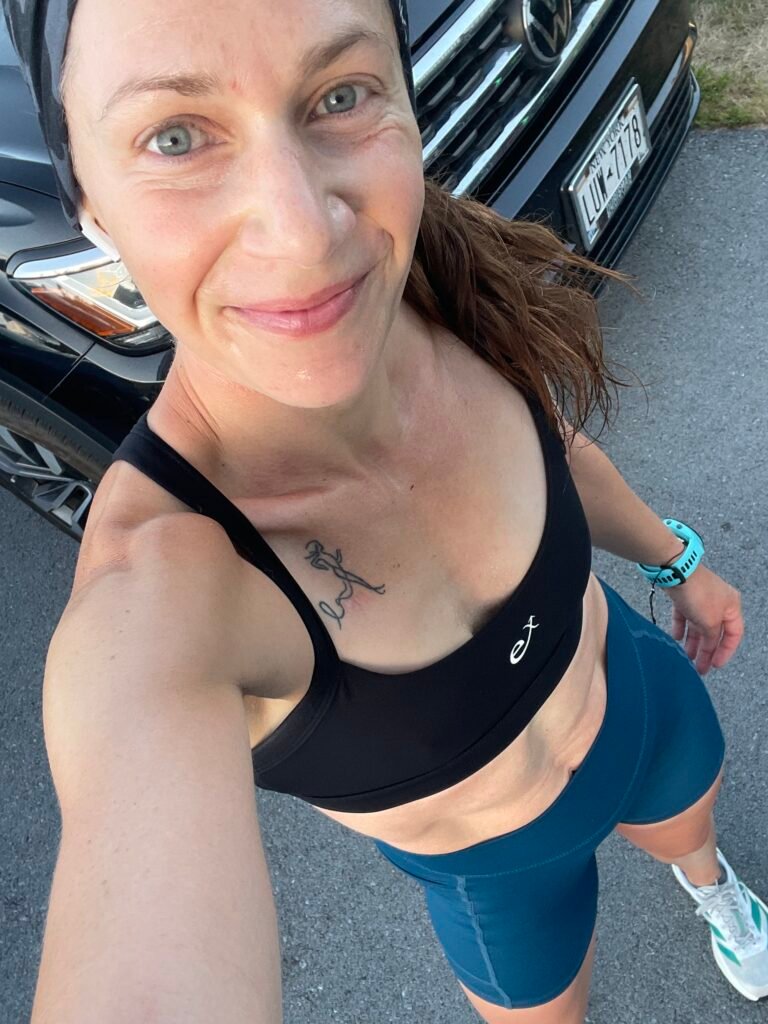
Since then, I have run a multitude of races and distances, including a marathon PR at Chicago in 2022, surprised and shocked by the amazing community support I received, spearheaded by my incredible coach. Today I am a stronger runner than I have ever been- before or after cancer. It hasn’t been easy, linear, or without setbacks, but no one’s running journey is predictable.
My previous blog post about cancer started with my 32nd birthday run, and this one will close with my 37th birthday run: this year I ran 37 happy, healthy, strong miles in this post-cancer body.
Coach Annamarie McCormick-Howell is an RRCA Certified Running Coach and an ACSM Certified Personal Trainer. She lives in Sackets Harbor, NY. You can follow her on Instagram at @amcchowell or reach her via email at amccormickhowell@yahoo.com.
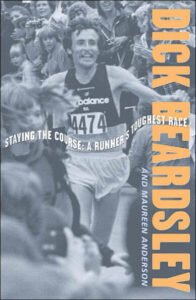
Book Authors: Dick Beardsley and Maureen Anderson Review by Coach Adolfo Salgueiro
When you examine the greatest runners from the First Running Boom, names like Frank Shorter, Alberto Salazar and Bill Rodgers, dominate the conversation, as they should. A name that is usually left out yet should be at least part of the discussion is Dick Beardsley. A 2:08:53 runner when running 2:08 made you a world class athlete, which Beardsley was.
Born in 1956 in Minnesota, started running in high school and then a little bit in college. He grew up in a home with alcoholic parents and had a knack for running, which always gave him the natural and addictive runner’s high. He jumped into his first marathon and just like that ran a 2:48. Little by little he realized there was some talent to work with and started getting better as he competed more. He holds a Guinness record of setting PR in his first 13 marathons.
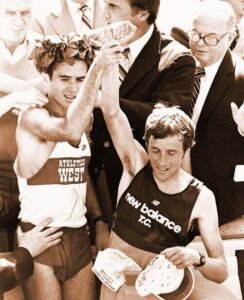
In this well-crafted memoir, Beardsley takes the reader through his trials and tribulations of going from a good runner to world class in just a few years. He takes you through every race and every triumph in a way that any runner will not only enjoy but also relate, regardless of their marathon PR. The stories of looking at his old racing outfit hung by the hotel window at mile 25 of his 1981 Grandma’s Marathon win, or how he got his first sponsorship deal with New Balance and how he stood by them when another company tried to poach him the day before the 1982 Boston Marathon, are uplifting stories from someone who came from nothing to a household name.
Duel in the Sun in Boston 1982
His 1982 battle with Alberto Salazar, known as “The Duel in the Sun” is considered by many not just one of the best Boston Marathons but one of the best marathons ever. The detail on his preparation and the perspective from the front of the pack takes you right in there, as if almost 40 years later, you were spectating from the press truck.
But the sweet life, fame and fortune, were not to last. After holding the fourth-best time ever in the marathon, in Boston, none the less, a farm accident almost killed him opened the door to the world of painkillers and addiction. A series of accidents and misfortunes kept sending him back to the emergency and operating rooms where more and more drugs kept him hooked. Suddenly, obtaining painkillers became the focus and center of his life. Until he got caught forging prescriptions.
In the second part of the book, Beardsley and his coauthor go in extreme detail on how difficult it was to go through this phase of his life. The strain it caused on his family, his finance, his running, his relationships and his life. How big is the fall when you are coming from the top.
Years later, Beardsley has dedicated his life to working with people hooked on the grip or drugs, alcohol and painkillers. His perennial upbeat personality has been a perfect fit to his new mission. He is constantly making appearances and giving interviews about overcoming his toughest battle in life.
Staying the Course is a good book for anyone interested in learning about one of the great runners for the First Boom and in addition you can get an inspirational story about overcoming addiction and becoming a useful member of society once again.
The book was published in 2002, so it doesn’t cover part of his remarkable story and heartbreaks, like the divorce from Mary, who went through so much while staying by his side; or the suicide of his son, who was a veteran from the Iraq war. It is remarkable to see he hasn’t relapse. If ever comes a revised edition of this book, I am interested in knowing in more detail what has happened since 2002.
With the cancellation or postponement of three races in my calendar, as activities all over the world came to a halt because of the Covid-19 pandemic, my 2019-20 running season comes to an abrupt end. I understand the reasons behind it, and they are justified. Yet, on a personal level, this is a reflection on how rough the season was for me.
Season best at the 305 Half Marathon in Miami Beach
I had a couple of non-running related injuries, which took me twice to the operating room, and had me limited in my athletic activities since May 2019. I have been able to keep myself active, first by walking and then going back to my old friend racewalking. I racewalked from 2012-15 and really enjoyed it. It was my way back into the sport after a long hiatus. But then on 2015 I started running again and improved plenty through the seasons despite the almanac doing its thing.
For the 2019-20 season I was already registered in three half marathons, which is by far my favorite distance, so rather than skipping them I trained to racewalk them. After flirting with the sub-2 last season, I had to settle to see if I could go sub-3 this season. It was a struggle to find myself towards the end of the pack after being in the middle of it no so long ago. It was a struggle to ask my friends to wait for me at the finish line party when I was arriving an hour after most of them. It was a struggle at times to reach mile 9 around two hours knowing you had another full hour to go.
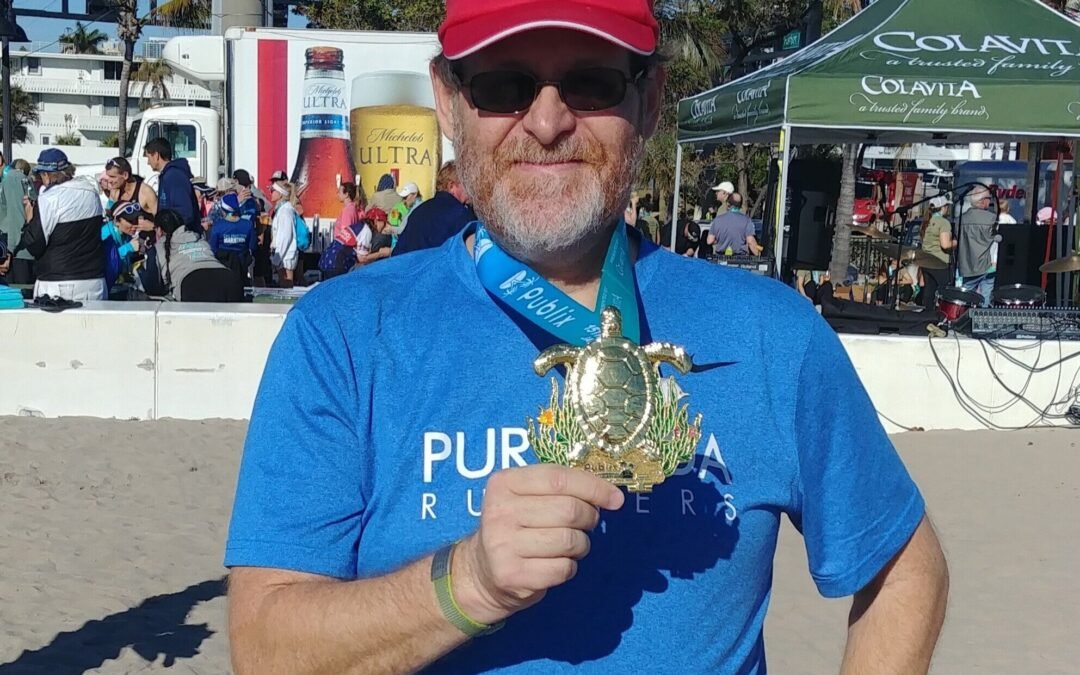
My personal triumph was to go sub-3 in all three races, including a season-best of 2:54:23 at the 305 Half Marathon in Miami Beach in early March. During the season I also participated in two 5Ks and one 10K race, just for the pleasure of keeping myself competing in the activity I love and sharing my friends’ achievements.
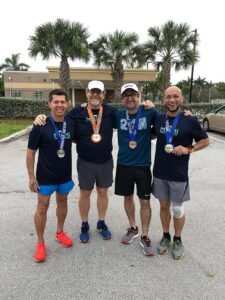
With my 3 runners from the Miami Marathon
There were highlights to my season, though. I had the chance to run an entire 5K with my dad and finish together, holding hands. I had three coaching clients finish the Miami Marathon, two of them smashing their PRs. I was also able to lock in four more runners who requested my coaching services. Also, my half marathon count reached 40, which I take as a secondary milestone.
It is a dilemma to be so thankful about being able to keep active and participating yet being so frustrated when you see a season pass by without being able to accomplish what you would have hoped. But as the sports cliché goes: “there is always next season” and, as the suffering Brooklyn Dodgers fans used to say: “Wait till next year”. Even though I am not completely healed from my ailments, I already started running a little bit and enjoying the runner’s high, the camaraderie and the time alone with myself on the road. So, I look forward to a better season recap a year from now.
Thanks for all the support. I couldn’t have done it without it.



 When you examine the greatest runners from the First Running Boom, names like Frank Shorter, Alberto Salazar and Bill Rodgers, dominate the conversation, as they should. A name that is usually left out yet should be at least part of the discussion is Dick Beardsley. A 2:08:53 runner when running 2:08 made you a world class athlete, which Beardsley was.