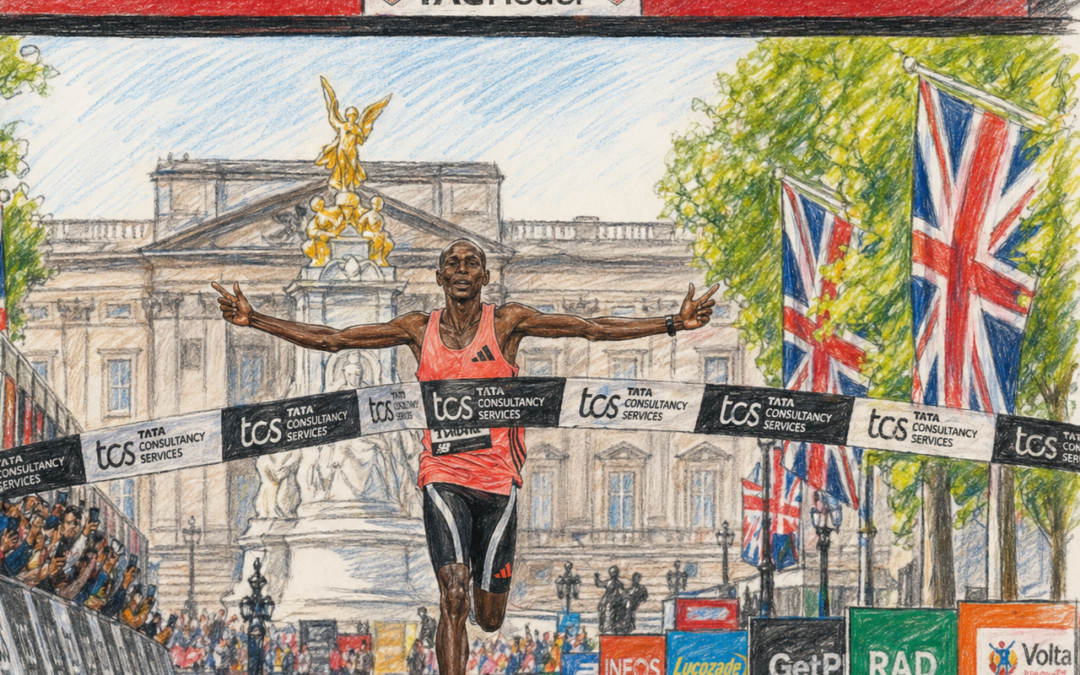
If you have any interest in the sport of running, you already know the mythical 2-hour barrier for the marathon has fallen. As this blog is not for news reporting, and this happened barely 36 hours before this writing, I want to share a reflection and perspective on what these results at the London Marathon mean for our sport.
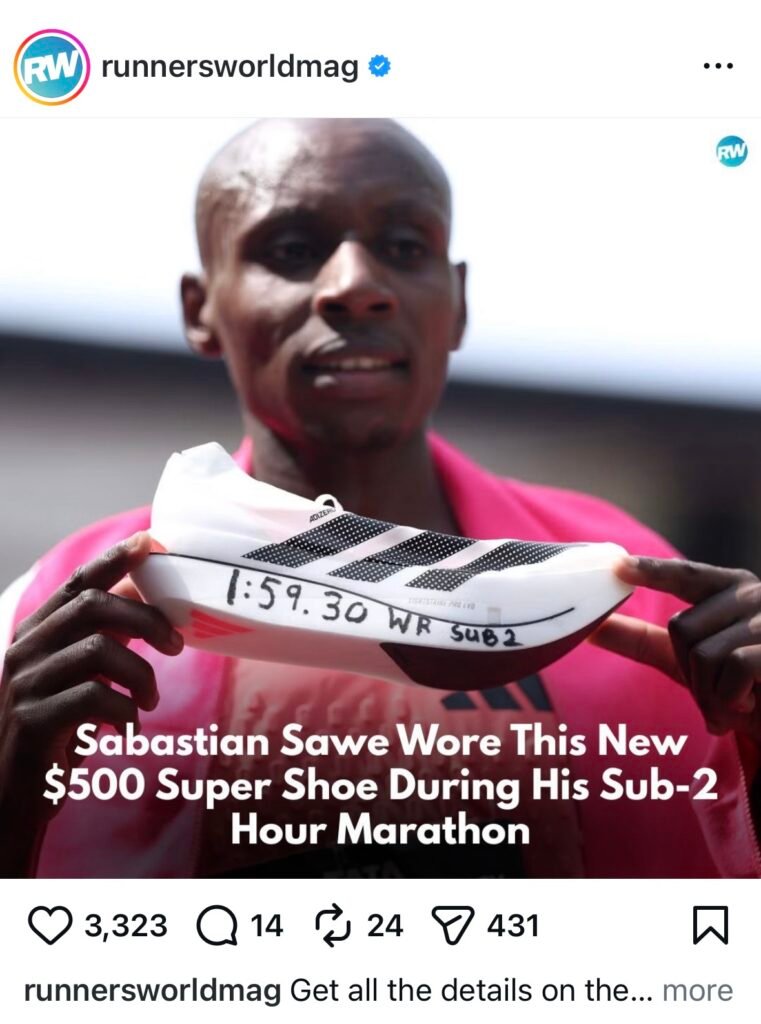
Sure, super shoes help, but they are not what make Sebastian Sawe an elite runner (From RW Instagram feed)
When I ran my first marathon in 1983, the world record was 2:08:34 (Derek Clayton, 1969). Then, it started falling little by little. First by a few seconds, then surprisingly faster. As it approached the 2-hour mark, Nike put on the Eliud Kipchoge show in 2019, where he ran 1:59:40. Sure, it wasn’t official, and it wasn’t supposed to be. But it proved that a sub-2 was physiologically possible. And now it has happened in competition.
Was it the Super shoes?
Some would like to think that with shoes acting like springs, these new records mean nothing. As a purist, I would love to think that too, but we live in a world where progress, innovation, and new technologies are an intrinsic part of our lives, and we must accept it. If we didn’t, Formula One races would be on horseback, the Tour de France would be on bikes with no gears and iron frames, and running shoes would still be made of leather. The regulatory entities have taken measures to ensure certain basic conditions are met, so it is not a free-for-all. It is a step in the right direction, so we may avoid grey areas bordering cheating.
We must understand that super shoes will not make you, or me, a world-record contender. These runners are the best the world has ever seen. These shoes only provide the edge they need to get that little extra that puts them within the realm of possibility. They were already great runners before they tied those $500 Adidas at the start of the 2026 London Marathon.
What’s next?
Back in May 1954, Roger Bannister ran the first sub-4-minute mile. It was a matter of time before he, Wes Santee, or John Landy got there. Bannister did it first. And once it was proven physiologically possible, the sub-4s started piling up. Landy shaved 1.4 seconds off Bannister’s record just 6 weeks later. And two months later, he lowered it again. 72 years later, over 1700 runners have gone sub-4. Still an elite group, but not that exclusive.
Why am I bringing this up? Because it has now been proven possible, expect the record set by Sebastian Sawe to fall again shortly and often. Just as Bannister, Sawe will always be remembered as the first. He is the Neil Armstrong of the Sub-2. Yomif Kejelcha made his marathon debut going sub-2, but 11 seconds behind, so he will always be the Buzz Aldrin of the sub-2. Impressive achievement, but not the first. This will not be an unbeatable record. Quite the contrary, it just established a new benchmark from where to keep improving.
I venture to predict that by the end of the year, after marathons like Valencia or Chicago, the record will fall again. And by the end of 2027, there will be 5 to 10 runners under 2.
Boston: Nike Sign Controversy
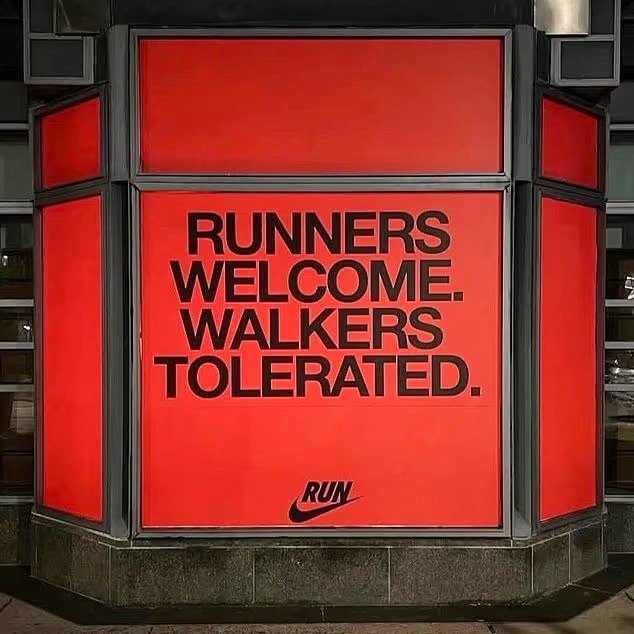
Since I am reflecting on recent events at Marathon Majors, I want to chime in on the Nike fiasco at the recent Boston Marathon. For those who don’t know, Nike set up a huge sign stating “Runners Welcome. Walkers Tolerated”, which sparked severe backlash and was quickly removed.
This is the controversial sign placed by Nike in Boston during Marathon week.
Was it insensitive? Was it stupid? Did Nike assume responsibility? Can you do something about it if you were offended? Yes, yes, yes, and yes.
First: No race states that you can’t walk. Until then, walk all you want. Orlando Pizzolato won the NYC Marathon in 1984 and walked. Nobody cried foul. Gelindo Bordin slowed down, walked, and was not stripped of his Olympic marathon gold medal in 1988. Want to walk? Walk! And don’t give a s*#% about what Nike has to say about it.
What really bothered me about this fiasco was the “offended professionals” taking it to social media. Those who enjoy feeling upset on your behalf so they can feel morally superior as they fight for “what’s right”. Most of those calling for the pitchforks had no stake in running, Boston, or Nike.
Just like you and me, Nike is protected by the First Amendment to make as many stupid statements as they please. Offended? Act. Don’t purchase a Nike product ever again. Show up at their headquarters in Beaverton and picket. A friend of mine didn’t like it and sold her Nike stock. She didn’t pout on Instagram; she took a stand.
Conclusion: Feel offended? Act or shut up! Pouting on social media is not taking action.
Please share your thoughts in the comment box below.
👇Do you want the key takeaways of this blog post? 👇 👇Click below to watch the video summary 👇
Editorial note: Last week we talked about the Abbott World Marathon Majors Series. This week, my friend Starr Davis tells her account of achieving the milestone despite some physical problems she encountered along her journey.
For me, 2018 was the year of comebacks. In October 2017, I began having hip issues. Surgery was recommended to remove a bone spur and repair/replace the labrum. My surgeon and I decided because I had amazing marathons ahead of me, we would postpone surgery until after I finished them. Then, he would be able to repair any additional damage. We weren’t sure if this would end my running career. From October through December 2017, I ran the Chicago, Marine Corps, Berlin and Havana marathons, plus a 50K Ultra Marathon.
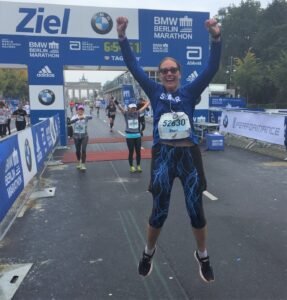
Starr at the iconic finish line of the Berlin Marathon.
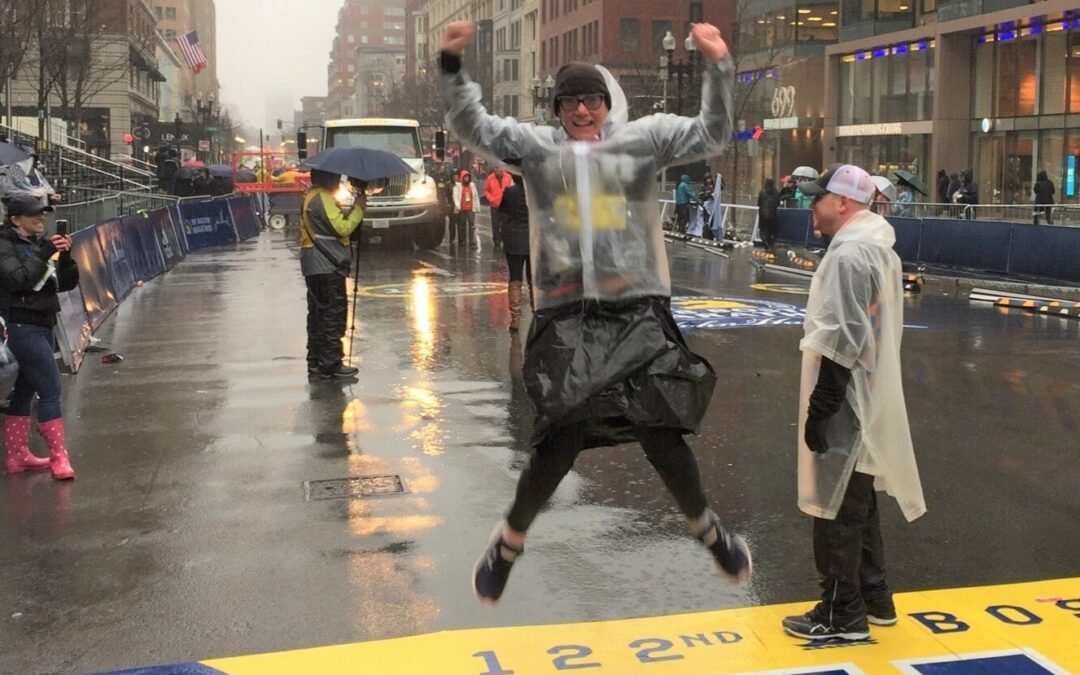
Still postponing surgery, in April 2018, I was able to complete both the Boston and London Marathons. Boston was a challenge as temperatures were in the 30’s with constant rain. I wound up in 11 medical tents with hypothermia symptoms. However, because I had raised $6500 for charity from friends and I knew this was my one opportunity to do Boston, I finished the race.
Six days later, I ran the London marathon. The temperature was in the 80s. Between the contrast in weather and my hip, I wound up walking the marathon from mile 8. But I was totally overjoyed to complete two races in 6 days.
Three weeks later, I had hip surgery. I was truly fortunate that it was not as major as anticipated—the labrum wasn’t torn but had a bone spur sticking out of it that was labor intensive to remove. Of course, when I woke up, my first question was “when can I run?” I had been offered a sponsorship race entry to the NYC Marathon in November, and I really wanted to do it. I was told that running it would be impossible, but I should be able to walk it.
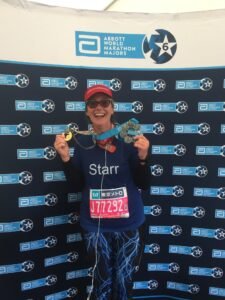
Receiving the coveted Six Starr medal after finishing Tokyo in 2019
Twenty-four weeks after surgery, I was able to walk the NYC marathon. My body had done so much better than I expected. There were hours and hours of therapy and minimal training. I feel so blessed to have been able to have the “perfect” conditions. I was joking with doctors that Boston was too cold and wet; London was too hot and finally, New York was “just right.” He has now nicknamed me “Goldilocks.”
I ran the Tokyo Marathon just March 3rd of this year, and it was epic, albeit miserable race conditions. It was 43 degrees with constant rain—but it was 8 degrees warmer than Boston and rain was coming straight down instead of at an angle.
Let’s focus on the good things. After Tokyo, I became an Abbott World Marathon Majors Six Star Finisher. What does that mean? I am one of 4,989 people in the world who have successfully completed the six major world marathons: Berlin, Chicago, New York, Boston, London and Tokyo. Of these finishers, 1,376 are women and 929 are from the USA. I’m so over the moon that I was able to successfully complete this, especially as a 50-year old who overcame crazy health challenges.
That stretch of 19 months of running was amazing for me—they’ve given me the opportunity to meet amazing new people, travel to great locations and most importantly, change my attitude of what can be accomplished. I have changed my eating habits and developed a better relationship with myself. It’s amazing what running some miles can do for you.
Starr Davis is a lifelong educator who has a passion for helping others grow in their career. She earned the coveted Six-Starr medal in 2019. She lives in South Florida and is a newly retired marathon runner.
Most of my readers may already know about the Abbott World Marathon Majors Series. After all, if you are reading this, most likely you are a runner and may have even completed at least one of the races, if not more. But for those who don’t know about it, or just would like to refresh their knowledge on the subject, I am hereby writing this quick blogpost.
The Abbott World Marathon Majors was established in 2006 with the five, highest-profile races in the globe: New York City, Berlin, Boston, London, Chicago, Then, in 2013, the Tokyo Marathon was added. It is a championship-style group of races in which the Marathon World Championship is awarded. Each series consists on seven races, starting and ending with the same race and then moving on to the next one. The series also includes the Olympic Marathon and the IAAF World Championship on the years those take place. The last completed series was the XII, which started in Berlin 2018 and finished in Berlin 2019. Series XIII has been crippled by Boston going virtual, Berlin and New York cancelled, and London hanging by a thread. Not sure what will the World Marathon majors do about it.
Abbott Laboratories is the title sponsor for the World Marathon Majors Series
The 12 Abbott World Marathon Major Series have been won 11 times by a Kenyan and one by an Ethiopian on the men’s side, and 8 times by a Kenyan, three by a German and one by and Ethiopian on a Women’s side. The current champions are Eliud Kipchoge and his compatriot Brigid Kosegi on the female side. Five runners have won more than one series, with Kipchoge leading the way with four.
But 99.9% of the runners will never, ever get close to scoring a single point on the Abbott World Marathon Major rankings, so what is it in it for them? Abbott has developed a successful marketing campaign in which by crossing the line of any of their runs, you earn what is known as “a star”. Once you complete all six, then you earn the “The Six-Star Medal”, a commemorative piece to memorialize your cumulative achievement. It is one of the most coveted medals in the sport, since it is something you can’t purchase, and it requires an immense investment of time, effort, and money.
Obtaining the Six-Star medal is not about just having the resources to travel to all six destinations or being physically able to complete six marathons. Marathoning has become so popular in the last decade and the Abbott World Marathon Major Series has become so big, that securing a spot in the races is usually the first obstacle for may runners. For Boston you need to qualify and only the faster times get to the starting line, unless you raise funds for charity, which has challenges of its own. London is extremely popular and hitting that lottery could be as difficult as hitting the Power Ball. For New York, Tokyo and Chicago, there are usually over 100 wanna-runs for each spot available. It is said the “easiest” lottery to hit is Berlin, but if that is the perception, more and more runners will gravitate towards that one, making it tougher to hit a spot.
Having earned the Six-Star medal usually makes you a celebrity in your local running community. Fellow runners want to take pictures with you and your medals. It is a cool think to have in your hand. A friend of mine got hers and brought it to our local running store. You feel like you are holding an Olympic medal. It is that cool.
Next week I will post the experience of an actual Six-Star Medal member, Starr Davis, who overcame a series of physical obstacles to earn her medal. Hopefully, you will earn yours, soon and tell us all about it.
For more information on the Abbott World Marathon Majors Series, visit their website by clicking here.
These are the six World Marathon Majors. How many Stars do you have so far?