
Getting Rid of Old School Thinking

Getting Rid of Old School Thinking

By Coach Adolfo Salgueiro

Last week I was talking to a friend who is helping his brother train for his first half marathon. He told me the toughest part of the process is making him understand that the “no pain, no gain” old-school mentality no longer applies to running. The days of alchemy are over. The collective thought has evolved and adjusted to new science studies or discoveries, thus, we understand matters in a new way, one that 5, 10 or 50 years ago was unheard of.

In 1968 Kathrine Switzer had to finagle her way into the Boston Marathon because back then women were thought to be so fragile, they could not endure such physical punishment. The carb depletion pre-marathon protocol was the rage in the mid-1980s, today we know it makes no sense. The “I run through pain” approach that showed bravado 20 years ago, displays recklessness, today. And like that, many more running ideas that once we thought gospel, today are barely gimmicks.
Old School Thinking

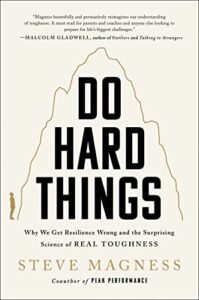
A good book worth the time and the money. Highly recommended.

In his book “Do Hard Things” author Steve Magness, one of my coaching role models, talks in depth about getting over of this old-school thinking. He explains how toughness is navigating through your training, not bulldozing through it. This how we avoid overtraining, and even worse, injuries. It is about being smart.

He goes through eight strategies to develop real toughness as a runner. I am not going to go through all of them, of course. If you want to go in depth into them, that’s what the book is for. But I will briefly touch on three that caught my attention and that I now teach my coached athletes.

A – Our alarms are adjustable: “Being tough gets easier the fitter you are.”

What an avant-garde concept! Think about it this way: If you spent the last 10 years on the couch watching TV and eating Doritos but decide to go for a 5K run, most likely you will suffer through it, regardless of your commitment or toughness. But, if you got the running bug, you trained smartly, diligently, and two years later you complete a marathon, it is not because you have multiplied your toughness. You reaped the benefits of your work and got better at it. Just like the first time Bruce Springsteen picked up a guitar, which these days is an extension of his body.

B – We need hope and control: “The key to improve mental toughness doesn’t lie in constraining and controlling individuals. It doesn’t lie in developing harsh punishments to teach a lesson. It doesn’t lie in screaming at the person to complete the task in front of them.”

The era of “I am not done when we are tired, I am done when I am done”, is done (pun intended). If you are training for a marathon, you need to run 18 miles but you are feeling unwell, stressed at work, just had a fight with your spouse last night, didn’t sleep well, it is a hot/humid summer morning and you are beat up at mile 15… what’s best? Calling it a day and be happy you completed 80% of your workout despite the circumstances, or pushing through while destroying yourself, to prove your machismo and then having to take 7-10 days to recover from the effort? … Exactly!

Old School Thinking

Finishing exhausted after a training session could lead to injury. Be smart and always live to run another day. (Photo: Pexels)

C – Feelings and Understanding need interpretation: “The power through mantra only makes sense if you take stock in what you are powering through.”

I want to make sure my readers understand I am not saying you need to be complacent when training gets difficult. We need to learn how to power through difficult trainings, races, cross training and life. The key is to understand why we are doing what we are doing. If we are trying to run at race pace, then race pace sessions will be difficult. But we need to push through them if we want to understand and teach our bodies how to run at that pace. When we start strength training, or add yoga to our plan, everything will hurt, but there’s a good reason to keep going despite the aches and pains. It is not about suffering for fun; it is about reaping benefits in the near future.

These is my take on three of these principles, I fully recommend the book. “Do Hard Things” is a good investment of time and money for any runner out there. And it is not just for runners, but for every person wanting to get better at leaving their comfort zone behind and actually going for what they want, for their life goals, not just the athletic ones.

Please leave me your thoughts nn this blogpost, in the box below.

 
Running Resolutions for 2023

Running Resolutions for 2023

By Coach Adolfo Salgueiro

Happy New Year!!! May 2023 bring you countless, injury-free miles and PRs in all your distances.

As we turn the page onto a brand-new notebook, one where all the pages are still to be written, we set up our running hopes and goals for this new trip around de sun and we must start dialing in and focusing on what we want to accomplish when it comes to our physical activity. This way we can have a roadmap and not improvise along the way. So, come December, we are not regretting a lost opportunity to accomplish something big.

Running resolutions

A brand new year to fill in with hopes and goals so, come December, we don’t realize we have wasted 12 good months (Photo: Bich Tran, Pexels)

As we analyze our goals for 2023 and we ponder our fears about coming short, we start by making sure we are well prepared and focused by setting goals that require effort and challenge you to be active for 12 months. Below find six guidelines to set up realistic running goals.

1 – Set up a bold yet attainable goal: Easy goals that can be achieved with little effort don’t mean much. Unfeasible goals that will not be realized, will leave you in frustration. So, be reasonable. Goals can be accumulative, like running 1000 miles in the year, or 200 kilometers per month, or five times a week. You can also strive towards running a particular distance or have a goal time for a distance. The key is to make it a real challenge, one that will leave you elated when you achieve it.

2 – Choose your goal race or races for the year, now: Set up a road map so you know how to get from where you are to where you want to go. Select the races where you want to excel and/or set up your PRs and then work toward is with plenty of time. If you want to set up a marathon PR, you must set up enough time aside so to include all the elements of a training plan. If your goal is a 5K or 10K PR, then you need to plan enough speed work, which also requires time. Make sure you are not surprised when your goal race is 4 weeks away and you are not ready.

3 – Set up a reasonable training schedule that will fit your life: Once you have figured out what you want to accomplish for the year, it is time to get it all into your schedule. Don’t wait until you have time to fit in your training. If you do, you will never train. Write in your running and your cross-training activities into your schedule (actually, write it in, yes!) so, when something comes up, you’ll know you are not available, since there’s a previous appointment in your agenda. This simple technique has worked very well for me, so I highly recommend it.

Running resolutions

Block off your exercise time in your daily planner, so you won’t double book it (Photo: Bich Tran, Pexels)

4 – Don’t just run: Sure, running is what we want to do. Yet, the constant percussion this sport places on our bodies requires us scheduling time for repair and restoration. Incorporating one or two days a week of yoga, swimming, Pilates, elliptical or any other non-impact exercise will go a long way to make you a more resilient runner. And if you don’t have time to ad that to your schedule, then trade in a run for one of them. In the long run, your body will thank you and your racing times will reflect the benefits.

5 – Include strength training: I procrastinated about this one the entire 2022. Weight work specifically designed for runners and core exercises to help your body withstand the pounding of the long miles are no longer optional. If we don’t prepare our bodies and make them stronger, it is a matter of time before we will have to stop and recover from an injury. My #1 goal for this year is to restart my strength training.

6 – Upgrade your sleeping habits: If you put all the recovery tools together; the massage guns, the protein shakes, the compression gear, the amino acids and the write-in-your-favorite-here, the sum of them won’t be as restorative to your body as a good, full night of sleep. Skipping sleep is not a badge of honor, it is a mistake that will not allow your body to recover and with luck, you will end up underperforming. Without luck, you will end up injured.

If you liked this blog post, please give it a like, below; or leave a comment if you want to contribute to the discussion.

 
9 Tips to Run Safely in the Dark (Repost)

9 Tips to Run Safely in the Dark (Repost)

As daylight gets shorter and the further north you go the less opportunity there is to run under natural illumination, and the more we need to adjust if we want to keep active in our favorite sport. I wrote this post two years ago, but I find it important to revisit as we adjust to our new running reality.


By Coach Adolfo Salgueiro

Running in the dark

If you can’t run without headphones, do not get into this setting. Jump on the treadmill, instead.

With the autumn months in full swing and the winter ones in the on-deck circle, there are longer nights which present a slew of challenges for runners.

It is paramount to understand that our safety is our individual responsibility. In this litigious world where nobody takes responsibility because they think they can sue whoever hurts them, you must be aware that as a runner, it doesn’t matter who had the right of way, who had the obligation to see you, or who will win the argument in court. If you get hit by a vehicle, you are the one getting hurt. Is up to you to make sure you are seen by those who could harm you.

The following are nine recommendations to keep you safe while enjoying your runs in less than ideal lighting conditions:

1.     Do not improvise your routes: When you are running in the dark is not the appropriate time to be adventurous. Select routes you know are safe, well-lit and familiar to you. This is not the time to cross a street and find out there is no sidewalk, or that you are lost.

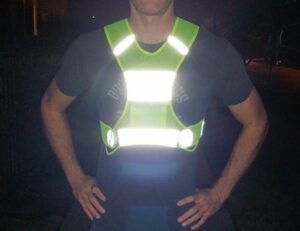
2.     Wear at least one light/reflecting device: You must prepare to be visible at the time you end your run, not just at the start. You can run lit like a Christmas tree, or you can use a reflecting vest, or you can wear blinking lights on your shoes, shorts, or hats. The options are plenty and they fit every budget.

3.     Run against traffic: It can’t be easier than this. By running against traffic you can be alert to any danger ahead of you. Drivers maybe playing with their phones and heading towards you. You won’t see these idiots unless you are facing them. This doesn’t mean to run in the middle of the road, make sure you obey all traffic guidelines.

4.     Rethink your usage of headphones: Running in the dark has its own challenges. Don’t handicap yourself by not having your auditive sense available and/or half of your brain distracted with music or a podcast. If you can’t run without your headphones, jump on the treadmill or choose a well-lit, familiar route where you don’t have to cross any streets.

5.     Run with your phone: Well into the XXI Century, phones are ubiquitous. Not even sure why we still call them telephones. Make sure you run with yours when you are in the dark. It is better to have it and not need it than to need it and not have it.  Sharing your location on WhatsApp or any other app is a good practice. There are so many options to carry a phone these days, that there are no excuses to leave it at home if you are running into the dark.

6.     Always tell someone where you are going and how long you plan to run: Even if you are taking your phone, but especially if you are not, make sure someone knows what your route is and how long do you expect to be gone. If you are going for 5K around the block and it has been two hours, someone should be checking on you.

Running in the dark

Reflecting vests are good and affordable options. They also made you seen from both sides.

7.     Run in groups whenever possible: There is always additional safety in numbers. It is easier for a driver to see a group of runners than to see just one. Plus, more eyeballs, more brains and more safety devices together can only increase the safety of your run in the dark.

8.     Carry ID: I am not paid by them, but I do believe RoadID is the best alternative for carrying identification with you. I have been using it for years and they have plenty of unobstructive, affordable options so someone can take care of you if you are ever found in a ditch. Worse comes to worse, carry your driver’s license in a pocket.

9.     Carry pepper spray: Having it is not enough. It must always be accessible. The moment you need it is not the time to figure out where it is or how it works. Mind the wind, or you will pepper spray yourself.

These are by no means all the safety precautions you must take to run safely in the dark. For one, make sure you trust your instincts always, so you don’t have to second-guess yourself when it is already too late. If something doesn’t feel right, get out of there immediately.

Anything else I forgot, or you would like to recommend to your fellow readers?

My Running Pet Peeves

My Running Pet Peeves

By Coach Adolfo Salgueiro

When I started thinking about my running pet peeves, my first though was: “what tin the world is a pet peeve?”  Well, according to the Oxford Dictionary, it is “something that a particular person finds especially annoying.” Merriam Webster defines it as “a frequent subject of complaint.”  While the term it is rooted in the XIV Century word “Peevish,” the term as we know it today originated around 1919. I haven’t finished the first paragraph and I already went on a tangent.

We all have pet peeves in our lives and running in no exception. We are all annoyed by certain behaviors by certain runners at certain times in certain situations that we happen to find particularly irritating. And, since pet peeves are by definition, individual, here are mine. Maybe we share some of them.

 I am not trying to be mean or condescending here. But, since I am talking about what annoys me, please forgive my tone. 

Pet peeves

There is a reason why this is listed #1 in my list (Photo: Matheus Bertelli, Pexels)

1.    Runners with loudspeakers: I don’t understand why in the age of light weight headphones, Bluetooth air pods and bone conduction headphones we must put up with runners carrying loudspeakers. How can anyone assume I want to listen to his/her music while I run? This is regardless of my liking or not of their choice of music. Do you like to run with music? Great! Keep it to yourself.

 2.    5K Marathons: Marathon is a fixed distance, not a multitudinous foot race. A marathon is 42,195 meters as measured in the metric system or 26.2 miles if you prefer the imperial system. If referring to things by fractions of a unit (half marathon, quarter pounder) is appealing to you, I suggest expressing the distance as a tad above 1/9th marathon, 5/42nds of a marathon or 11.85% of a marathon. Other than that, it is just a plain and simple 5K.

 3.    The Full Marathon: Because of the booming popularity of the half marathon distance, talking about “the full marathon” has become a thing now. The entirety of a unit should not be preceded by the qualifying full, as it is implicit unless stated otherwise. A full marathon is just a marathon. Yes, petty, I know, but it does bug me.

 4.    Finish line shoppers: With your race entry you get to take part on the post-race spread as well as access to whatever the race sponsors have to offer. This doesn’t mean supermarket day. All runners that also paid and should have access to what’s offered. We’ve all seen runners with cases of hydration products, boxes of cookies and entire pizzas. Come on!!!

 5.    Oversharing on social media: Sure, you’re proud of your race result, or you want to receive accolades for your PR, or long run while preparing for your marathon. Yet, we don’t need to know about your half mile on the treadmill, or the two-mile brisk dog walk around your neighborhood. Unless these are true personal accomplishments, of course.

 6.    Running fast on recovery days: Our body doesn’t get stronger when we complete a long run, or when we nail a hard speed workout. Quite the contrary, it weakens. It is when the body repairs from that effort that it gets fitter and stronger. You won’t see the benefits of today’s hard workout for at least 14-21 days. So, make sure you recover on recovery days. Hence the name.

Pet peeves

Is this really appropriate when you have over 40,000 runners around you?

7.    Racing in bulky costumes: I dislike the clowning of the bulky costumes. As if running a marathon wasn\’t tough enough, certain runners make a mockery of it by doing this stuff. Sure, you can have fun dressed as Superman, a caveman or Pheidippides. The problem is with the bulky ones that restrict movement or view. Organizations like the London Marathon unfortunately encourage this behavior. When someone gets seriously hurt, it will stop being funny and by then, it will be too late.

 8.    Skipping runs because your watch ran out of battery: The watch is not the director of your running life; it is only the record keeper. The fact you missed recording one session is not going to diminish your health, your fitness returns or your ego. Hit the road and make sure you don’t run out of battery the next time.

 9.    Ruining other runner’s race photos: We all love race pictures, and they are ubiquitous these days. You want to look good for the photographers, and that is great. But must you go out of your way, cross the racecourse cutting runners, or jumping in between a runner and a photographer so you can have an extra pic?

 10. Rude Runners: Do I need to explain?

 What are your running pet peeves?

 
It’s Gotta Be Fun!

It’s Gotta Be Fun!

By Coach Adolfo Salgueiro

There are countless valid reasons why we engage in running. Health, weight loss, social interaction, doctor’s orders, keeping stress at bay, we are dopamine junkies, or fill in the blank. And, unless you have an underlying physical condition or health issue, most people can complete a 5K or even a 10K race with no major problem. More adventurous runners can get to the half marathon or even marathon club. But if you want to become more than a check-it-off-the-bucket-list runner, if you want to develop into a lifelong athlete, if you want to constantly assess your limits; your running must include one unavoidable characteristic: It’s gotta be fun!

You would be surprised at how many runners focus so much on results, times, Instagram likes and stats that never realized they could also be having fun.

Explaining why it should be fun is a waste of space. It is so obvious: if it stops being fun, then you will quit. So, I will use my space in this post to list eight basic tips you can apply to make sure you won’t get bored or burnt out in the long run (pun totally intended).


Fun

There are no podiums during training sessions. Don’t become that runner (Photo Pexels)

1 – Find a running partner or group: Even though many people run because they want to be alone and take a break from the world, someone to run with can make a world of difference in your athletic life. Being a member of a team may not work for everybody but running buddies will change your life.

2 – There are no podiums during training sessions: We all know that one person who runs all out in each single training session. The one person who will accelerate and refuses to let you pass. Well, that person is on its way to injury, burnout or both. Don’t become that person.

3 – Let the GPS watch do what it was designed to do: Always remember the GPS watch is an indicator of your performance, not the director of your training. It is the GPS watch that serves you, not the other way around. Same principle applies to Instagram, Strava and all other social media platforms.

4 – Learn about the sport: You don’t have to become an erudite on the subject, but you should know the basic elements of running physiology, science and mechanics so you can monitor yourself as you progress and prevent injuries.

5 – Register for a race: Maintaining a race in your schedule is the biggest motivation to keeping you focused on your training. If you know you must run X distance on X day and you paid X Dollars for it, then most likely you’ll plan ahead and make it happen.

Fun

Yoga is one of many options to cross train and get better at running (Photo Pexels)


6 – Cross train: As much as we love running and it is our primary sports activity, you won’t last long if all you do on behalf of your running is run. Strength training, yoga, biking, swimming or walking are just a handful of alternatives that may complement your overall program to make you a better runner.

7 – Vary the elements in your route: Switch your running course, run somewhere else, change your daily distance, vary your speed, switch the surface in which you run, the time of the day, get rid of those old, beat-up shoes. This will help you keep it fresh and exciting.

8 – Recover properly: Make sure your body has recovered from your previous workout before you take it for another hard running session. Rest and recovery are as important to your running as running itself. Recovery will keep you fresh, injury free and thus, looking forward to your next run.

Peter Magill sums it up like this in in his book Build Your Running Body: “In the long run, it’s the combination of fun and results that keep your motivation from waning. When you are accomplishing your goal and having a blast, too, chances are that you’ll keep going.” 


Skip to content