
Getting Rid of Old School Thinking

Getting Rid of Old School Thinking

By Coach Adolfo Salgueiro

Last week I was talking to a friend who is helping his brother train for his first half marathon. He told me the toughest part of the process is making him understand that the “no pain, no gain” old-school mentality no longer applies to running. The days of alchemy are over. The collective thought has evolved and adjusted to new science studies or discoveries, thus, we understand matters in a new way, one that 5, 10 or 50 years ago was unheard of.

In 1968 Kathrine Switzer had to finagle her way into the Boston Marathon because back then women were thought to be so fragile, they could not endure such physical punishment. The carb depletion pre-marathon protocol was the rage in the mid-1980s, today we know it makes no sense. The “I run through pain” approach that showed bravado 20 years ago, displays recklessness, today. And like that, many more running ideas that once we thought gospel, today are barely gimmicks.
Old School Thinking

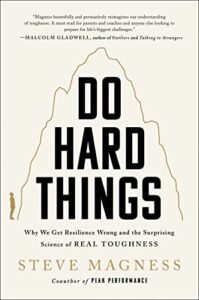
A good book worth the time and the money. Highly recommended.

In his book “Do Hard Things” author Steve Magness, one of my coaching role models, talks in depth about getting over of this old-school thinking. He explains how toughness is navigating through your training, not bulldozing through it. This how we avoid overtraining, and even worse, injuries. It is about being smart.

He goes through eight strategies to develop real toughness as a runner. I am not going to go through all of them, of course. If you want to go in depth into them, that’s what the book is for. But I will briefly touch on three that caught my attention and that I now teach my coached athletes.

A – Our alarms are adjustable: “Being tough gets easier the fitter you are.”

What an avant-garde concept! Think about it this way: If you spent the last 10 years on the couch watching TV and eating Doritos but decide to go for a 5K run, most likely you will suffer through it, regardless of your commitment or toughness. But, if you got the running bug, you trained smartly, diligently, and two years later you complete a marathon, it is not because you have multiplied your toughness. You reaped the benefits of your work and got better at it. Just like the first time Bruce Springsteen picked up a guitar, which these days is an extension of his body.

B – We need hope and control: “The key to improve mental toughness doesn’t lie in constraining and controlling individuals. It doesn’t lie in developing harsh punishments to teach a lesson. It doesn’t lie in screaming at the person to complete the task in front of them.”

The era of “I am not done when we are tired, I am done when I am done”, is done (pun intended). If you are training for a marathon, you need to run 18 miles but you are feeling unwell, stressed at work, just had a fight with your spouse last night, didn’t sleep well, it is a hot/humid summer morning and you are beat up at mile 15… what’s best? Calling it a day and be happy you completed 80% of your workout despite the circumstances, or pushing through while destroying yourself, to prove your machismo and then having to take 7-10 days to recover from the effort? … Exactly!

Old School Thinking

Finishing exhausted after a training session could lead to injury. Be smart and always live to run another day. (Photo: Pexels)

C – Feelings and Understanding need interpretation: “The power through mantra only makes sense if you take stock in what you are powering through.”

I want to make sure my readers understand I am not saying you need to be complacent when training gets difficult. We need to learn how to power through difficult trainings, races, cross training and life. The key is to understand why we are doing what we are doing. If we are trying to run at race pace, then race pace sessions will be difficult. But we need to push through them if we want to understand and teach our bodies how to run at that pace. When we start strength training, or add yoga to our plan, everything will hurt, but there’s a good reason to keep going despite the aches and pains. It is not about suffering for fun; it is about reaping benefits in the near future.

These is my take on three of these principles, I fully recommend the book. “Do Hard Things” is a good investment of time and money for any runner out there. And it is not just for runners, but for every person wanting to get better at leaving their comfort zone behind and actually going for what they want, for their life goals, not just the athletic ones.

Please leave me your thoughts nn this blogpost, in the box below.

 
On Running While Holding your Phone

On Running While Holding your Phone

By Coach Adolfo Salgueiro

I live in South Florida, not too far from the beach. One of the projects I am currently working on has me driving through Ft. Lauderdale Beach on a regular basis at various times of the day.

One of the favorite pastimes during my commute, has become checking of the form of the many runners I see along the beachside. It started as something fun to do and now it has turned into an exercise to become more proficient at analyzing running form issues. Yes, I do understand there is no one-size-fits-all running form, but there are blunders that are blatantly wrong and if not corrected, they’ll lead to injury.

Running While Holding Your Phone

Holding the phone in your hand while you run, could lead to injury.

I’ve noticed that at least 75% of runners with bad arm mechanics are holding their cellphones in one of their hands. By now, when I spot form flaws from afar, I can bet who is holding a phone, and I rarely miss.

Phones have many advantages and functions and they’ve become ubiquitous. They provide music, tracking, feedback, safety and security, among many others. Yes, it is important to carry it while you run, but that doesn’t mean you must carry it in your hand. With so many options in the market, there are plenty of alternatives to clenching to it. And this is why:

In his book “Running to the Top”, legendary coach Arthur Lydiard states that “If we clench our fists – and I often see people running with weights clenched in the hand – we tighten the upper shoulder muscles and, consequently, start to get a shoulder roll. Something has to go back when you\’re running; it should be your hand, but put tension on those arms and the shoulder will begin to roll, and that\’s undesirable.”

Of course your phone is not as heavy as the lightest of weights, but it is a precious object, both in monetary and emotional value. So, regardless of how light your phone may be, you are holding in tightly. You don’t want to drop it. This means you are contracting the muscles in your hands, and thus, arms, shoulders and even chest, screwing with the counterbalancing your gait needs by compromising the flow of your kinetic chain. While this happens, your other arm is doing its own thing. A recipe for unbalances in your leg, hip and shoulder, and thus, injury.

This is not a new phenomenon. It has been touched upon in many magazines and websites for several year, now.

In a 2019 article from Cosmopolitan UK, by Caitriona Harvey-Jenner, professional running coach Alexa Duckworth-Briggs, urges runners to carry phones in a waist belt. \”When you hold something in our hands, there are subtle knock-on effects to your gait. It creates muscular imbalances, affects the distribution of weight across your body, and makes you a less efficient runner in general. By making one arm heavier, you’re altering the momentum of your limbs. And your body will attempt to compensate for the imbalance by working certain muscles harder than others. That’s where repetitive strain injuries will come into play.\”

Running While Holding Your Phone

Arm bands are a little bit better, since you don’t contract your muscles, but they are not the solution, either.

In another article, this one in Active.com, author Hunter Hewitt explains how “running with something in your hand causes you to use body parts differently than you normally would. Proper running form starts with muscle equilibrium and even distribution of weight across your body. Holding something creates asymmetry, as you use your hand and arm differently compared to when you\’re running hands-free. These asymmetrical effects lead to poor form and muscular imbalance, which make you a less efficient runner.”

Since we are touching on the subject, the same principles apply to water bottles, towels and any other artifacts you may want to bring with you while running. Carry them on you, sure, but don’t hold to them.

Although an arm phone carrier is better than holding it in your hand, it is not the solution, as it adds weight to one of your sides. And even though you may think it is negligible, and for one day or two it may be, running mile after mile, week over week, month over month, at the rate of about 1500-1700 steps per mile, the cumulative effect will eventually get to you.

Let’s get this bad habit fixed before we end up holding those phones to take pictures from the sidelines while our friends, those who carry them in their belts, finish their races.

 
Should I Run Through Pain?

Should I Run Through Pain?

By Coach Adolfo Salgueiro

 This is a broad question that all runners have asked themselves at one point or another. Running and pain have a complex relationship. It is a rare occasion when there’s not a little pain here or a kink there that worries us after a hard workout, or as a race approaches. Most of these come with the territory of being a runner. Comedian Dana Carvey wisely said: “If I only ran when nothing hurts, I would never run”.

By the way: I am stating here that I am not a medical doctor, nor a physical therapist, nor a practitioner of any of the medical sciences. These are just suggestions based on 40+ years of experience as a runner. Consult your physician before making any health decision. Don’t base them on what you read here. With that out of the way, I continue.

Running through pain

Be smart when dealing with pain and you will avoid injuries (Photo Pexels: Kindel Media)

Most of our daily aches and pains are usually a product of the normal wear and tear from practicing our sport, and many times it is OK to run through them. But beware. The era of the “no pain, no gain” approach to running is long gone. The “nothing can stop me” macho attitude is not conducive to a long or a healthy running career. It is not the same to finish a marathon when you started limping at mile 25, than running through that same limp since mile 7. Aches and pains can be red flags and we must be able to identify them on the fly.

Most running injuries happen from a combination of repetitive movement and/or not enough recovery. When we approach this place in our training, our body usually provides us with warning signs. The more in tune we are with our bodies, the clearer we receive such communications. And the only way to be in tune with your body’s signals is to acquire more experience by running more.

 When can we run through pain?

1 – When your pain is a product of basic muscle soreness: By running we put an extraordinary amount of stress into our musculoskeletal structure. Muscle soreness is a natural byproduct of it. The more experience you gain as a runner, the more you will be able to discern on the source and type of your pains. Some muscle soreness if normal. If you don’t have to compensate and/or change your form, you should be ok by running through minor discomfort.

2 – If pain subsides or decreases as you warm up: It is normal to feel some pain and discomfort as you initiate your run. If you just woke up or spent an extended period sitting down, this is normal. Muscles, tendons and ligaments need to get back into shape to carry you through. Resetting your range of motion with exercises such as the lunge matrix, and/or warming up properly should help you accomplish this, and allow you to have a good session.

If you have determined that you will run through the pain and discomfort, don’t be afraid to adjust your training session to the current situation. Don’t be afraid to go slower, cut the run short, or dial back the intensity if needed. Always have in mind that no one training session will make you or break you. It is the small, consistent gains what’s will make you better. And you won’t be able to compile them if you are out of commission with a preventable injury.

When should we not run through pain?

1 – If there is excessive fatigue: It is normal to be tired from training, especially when you are increasing your mileage, add weight training, or you approach the peak portion of your race program. What is not normal is to wake up so beat up that you are not sure if you can complete your session for the day. This is a clear sign that it is time to dial back and recover before you get overtrained or injured.

Running through pain2 – When it forces you to alter your form: Minor aches or discomfort is one thing, altering and adjusting your form because pain is too severe is a red flag and you should stop immediately. If you keep going, you could damage something else by moving in a way your body wasn’t designed for or by adding stress to structures unprepared to sustain it at the time.


3 – If it gets worse as you run: If whatever you feel increases as you go through your training session, stop immediately. It is not going to get better by running further. Assess the situation and figure out if it needs professional consultation.

4 – Through intense pain: Regardless of how seasoned you are as a runner, you should be able to discern what intense pain is. You know what a normal nuisance is. Use common sense to identify the types and levels of pain you are not supposed to run through. If it hurts that bad, something must be wrong. Stop. Assess. Consult a professional.

Have in mind that running is an impact sport. You are hitting the ground with about 300% of your body weight about 800 times per leg, per mile. This causse muscle and soft tissue damage. So, something is usually going to ache or be sore. It is when the body repairs itself from that stress that you become fitter and stronger.

Be smart. Make sure you live to run another day.

 
1000 Miles: Reflections on a Challenging Year

1000 Miles: Reflections on a Challenging Year

By Coach Adolfo Salgueiro

 For this week’s blogpost I want to do an introspection to reflect on what the year that is coming to a close has been on a personal level. I just reached the 1000-mile mark last weekend. This alone is a miracle for me, even though I have reached the milestone several times before. 2021 came for me with many challenges that go beyond the Covid pandemic completing its second year. I faced serious health challenges that, held by the hand of the Lord and with the support of my wife, family, and friends, I have been able to overcome. It has been quite a journey.

Challenging Year

This was me at the hospital, two days after my open-heart surgery

On June 23 I underwent open-heart surgery after two years of trying to manage the issue. My arteries had a wiring problem since birth that suddenly, at age 53 and having been active all my life, started becoming an issue. I also got a coronary artery by-pass.

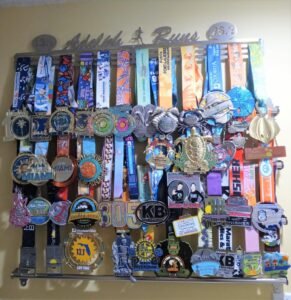
Recovery was an arduous process. I started walking around the ICU floor, two days after the procedure despite having 13 different things connected to my body. Once I got home, I developed a circuit around my house (living room to kitchen, to living room to 2nd bedroom, to master bedroom to bathroom and back). I made sure to walk right by my medal rack so I could make sure to see where I had been and where I wanted to get back. Then the walk progressed outdoors to pick up the mail and then to half a mile. Finally, on July 10th, 17 days after my procedure, I was able to walk a full mile. One month from my procedure I was walking 4 miles a day, and after 2 months I started cardiac rehab. I had walked close to 200 miles since surgery.

By August 30 I was able to run five, one-minute intervals and two-and-a-half weeks later I ran 20 minutes straight and was released from cardiac rehab. From there I started a run/walk protocol to enhance my endurance and little by little was able to run more, walk less and rack up mileage. On November 3rd I completed my first 10-miler and on December 4th completed half marathon distance in 2:25. On December 18th I run/walked 17 miles and the next day I completed 1000 miles for the year. If it wasn’t because I am the one doing all this, I wouldn’t believe it was possible. I would need Strava proof to make sure nobody is trying to trick me.

Challenging Year

Walking by this display kept me focused on the goal.

There is a reason why I write this, and it is not to toot my own horn. I am writing this because I am the living proof that having an active life is the key to develop a body capable of repairing itself promptly and efficiently. I have been active my entire life and have been running or walking non-stop for 14 years since my return to the asphalt. In my estimation, this has been the key to my miraculous recovery. So much that, with my cardiologist’s blessing, I will be participating in the Houston Marathon on January 16th, just 207 days after my procedure.

This could have not been possible without surrendering my health and recovery to God, while doing my part to assist. This could have not been possible without the devotion and dedication from my beautiful wife, Meki, during my recovery. This could have not been possible without the support of my family, who were ready to help in anything I could need. This could have not been possible without the support of my buddies from No-Club Runners, who epitomized why runners are such a special bunch of crazy people. This could have not been possible without being fit and healthy for a prolonged time.

So, as life got back to normal, I returned to work after seven weeks of recovery and the pandemic continued to wreak havoc in our lives; my cardiologist told me it is time to turn the page on this episode of my life. To move on to bigger and better things. And thus, as I reached the psychologic barrier of the 4-digit number of miles for this challenging year, I reflect on the year that was and the life I have left.

The Dreaded Piriformis Syndrome

The Dreaded Piriformis Syndrome

By Coach Adolfo Salgueiro

 A few weeks ago I read a social media posting by Mike Wardian, one of the ironmen of our sport, stating he was withdrawing his participation in an important race because of piriformis syndrome. My thought was that if this can happen to the king of recovery, a runner who competes every weekend, guy who is out there achieving superhuman feats, what is there left for the rest of us? Mere mortals that are just trying to do our best with what we have.

In his Instagram post from October 18, Wardian wrote: “Pro tip: don’t get Piriformis Syndrome the day before the race you have been looking forward to for years. It is a pain in the arse & literally brought me to my knees. Unfortunately, I need to withdraw from the #bigsbackyardultra so gutted to be unable to participate”.

Piriformis Syndrome

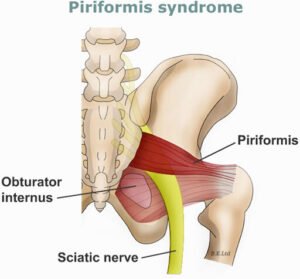
Because it crosses the sciatic nerve, it can become tight from too much sitting or it come become strained from overuse. The tightness or strain will cause it to compress and rub against the sciatic nerve

The piriformis muscle is a small muscle located deep in the buttock (behind the gluteus maximus). It runs behind the hip joint and aids in the external hip rotation or turning your leg outward. Because it crosses the sciatic nerve, it can become tight from too much sitting or it come become strained from overuse. The tightness or strain will cause it to compress and rub against the sciatic nerve.

According to the Spine-Health website, piriformis syndrome is a condition in which the piriformis muscle, located in the buttock region, spasms and causes buttock pain. The piriformis muscle can also irritate the nearby sciatic nerve and cause pain, numbness and tingling along the back of the leg and into the foot (similar to sciatic pain).

In his book “The Athlete’s Book of Home Remedies”, Dr. Jordan Metzl, states the pain is often felt deep inside the buttock muscles and it makes it difficult to sit on the affected buttock.

Diagnosing piriformis syndrome is not an easy task even for the most experienced doctors. According to what I have read, and I am no doctor so please don’t take medical advice from me, there is no specific test for this condition so it is usually diagnosed by eliminating alternative options to the patient’s symptoms or pain.

Piriformis Syndrome

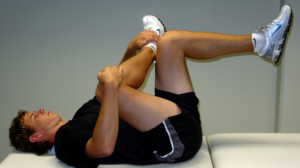
A home-based stretch and strengthening routine could help prevent a visit to the doctor.

According to Dr. Metzl, many of the interconnected muscles in this region—piriformis, glutes, hip flexors, hamstrings, quads—support one another, and weakness in one area can mess up the works. If you face an unexplained soreness in the deep buttock area, and if the home-based care doesn’t improve your symptoms in a week, or sooner if the pain is severe, he recommends you see a doctor.

My point with this post is that this is an extremely painful condition that can easily sideline you. I have experienced it on a very mild level, and I do not want to know how much worse it can get. If it can bring a badass like Mike Wardian to his knees, it must be a horrible condition.  I overcame it very quickly with home stretching and strength exercises. If you are diligent in doing these as soon as you feel a, putting it plainly, deep pain in the ass, you may be able to avoid pain and lost time.

While researching for this blogpost, I found the following video. It is about 6 minutes long and it talks about the differences between piriformis syndrome and sciatica, which need to be treated differently. I found it worth my time.

I also found the following video of five sciatica stretches for piriformis syndrome, which I found interesting, especially because they can be done anywhere and with no specific equipment.

I sincerely hope you never have to use the information in this blog post, but if you ever do need it, I hope you will be able to recognize the issue in its early stages so you are not brought to your knees and you don’t miss any miles.


Skip to content