
Basics of Fueling Strategy

Basics of Fueling Strategy

By Coach Adolfo Salgueiro

When I started running marathons back in the early 1980s, the only fueling strategy available to most weekend warriors was to drink enough water so you wouldn’t dehydrate. Yes, I know. This is not a fueling strategy. But consuming calories during a race was not a thing back then. The most calories I consumed during a marathon were when a friend handed me oranges al mile 15 or my girlfriend waited with a sugary lemonade around Mile 21. No wonder I hit the wall every time.

Fueling Strategy

Carbohydrates with a bit of protein is still the pre race day preferred meal (Photo: Engyn Akyurt, Pexels)

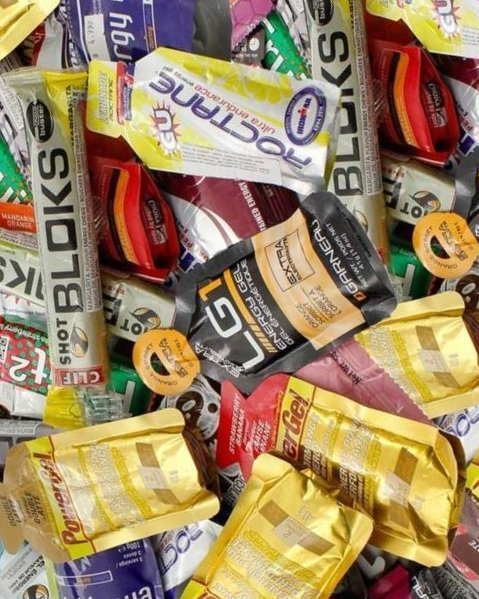
But both science and the running consumer goods industry have developed exponentially in the last 4 decades. Not only do we know that the average body doesn’t have enough resources (beyond fat if you have trained to properly tap into it) to last you 26.2 miles, but we also have dozens of products to assist us on which calories should be consumed and when.

Although fueling consists of both Hydration and calorie intake, this post is only addressing the latter. Hydration was referred to in a previous post, “Hydration Basics for Runners”, which you can read by clicking here.

Despite the average body having enough fat stored to run over 1000 miles, and the first known 100-miler without fueling was recorded just a few months ago, most runners are not trained to run on fat as their prime fuel source. So, we depend on glycogen, of which we have a finite amount, around 2000 calories, which is needed to fuel everything, not just your running muscles, so it is insufficient to last a marathon.

When it comes to fueling, it is not just about the gels you will consume in your race. There are four distinctive phases you need to address. From the list below, the “During Race” segment is not intended for 5K or 10k efforts, as an average well-nourished and well hydrated body should have plenty of resources for those distances. While most intermediate and advanced runners should be able to complete a half marathon with no additional fuel, it isn’t required, either. But when you go for a marathon or an ultra, you must fuel the body, so your tank won’t deplete, and you won’t hit the wall. And yes, it is like hitting aa actual wall.

DAY BEFORE RACE – By this time you should know what works and what doesn’t work for you. As healthy as a big bowl of salad may be, consuming all that fiber right before a race may not be a clever idea. Complex carbs and protein are usually what work best. Fatty foods should be avoided, same as simple carbs. The carbs in a bag of Doritos will be burned way before you need them at the race and are crap. It is obvious that your pre-race fueling strategy is not just a dinner thing, but a full day affair if not a full week one. Also, please, you need to dine at a time that will allow enough time to digest it. Last thing you want is compromising your digestion within hours of the starting gun.

PRE-RACE – Your body consumes glycogen and other resources just by being alive. The brain, the liver, the beating heart, etc. need energy to perform their duties. So, to get to the starting line with your tank topped off you need to replenish whatever was consumed during the night, if you have a morning race, or during the day for an afternoon affair. You can certainly run short races in a fasting state, but when it comes to a half and beyond, why would you start with your tank at 70-75% when you can do so at 98 or 99%? Carbohydrates and a touch of protein is the way to go. And, as usual, this must be perfected during training. Don’t wait until race morning to try it out.

Fueling Strategy

Chocolate milk is the post-race refueling product by excellence. This is my favorite brand.

DURING RACE – Fueling strategy is as personal as your choice in running shoes. It is what works for you, not for your friend. Your fueling strategy on race day is the execution of the plan you’ve already perfected during training. So, apply it! Mile 20 is not the time to figure out a caffeinated gel will send you to the port-a-potty, or that you can’t stomach a 5th serving. Fueling also includes replenishing electrolytes either though a product you already know, trust and you carry yourself, or through whatever your race is serving. Personally, I don’t advise relying on the availability of Gatorade in a race. After you’ve invested so much time, money, emotion and effort on your race, better carry what you’ll need and know works for you.

AFTER RACE – Once your race is over, it is time to splurge, sure, but don’t rehydrate with alcohol and junk food. That comes later. Both carbs and protein need to be consumed as soon as possible to replenish and start the muscle repair process right away. Chocolate milk is the recovery drink for excellence. This is the day to go crazy. Have all the extra beer you want, that fatty burger you passed on during training or go for the entire pizza instead of just a couple of slices. But please do so after you’ve taken care of your initial post-race care recovery.

Now, go for that half or marathon PR!

 
The Lore and Facts of Carbo Loading

The Lore and Facts of Carbo Loading

By Coach Adolfo Salgueiro

 When I started running marathons in the early-1980s, back when dinosaurs roamed the earth, guzzling carbs indiscriminately was the way of life. The more carbs you ate, the more energy you would have stored for your long run the next day. It didn’t matter if they came from a pizza, your sixth bowl of pasta or a handful of cookies. The point was to ingest in as much as you could.

Carbo Loading

Regardless of how much pasta you eat the night before, your body can’t store beyond its capabilities (Photo by Anna Tis, from Pexels)

The thought process was that if carbs were good for endurance, more carbs would be better. And many, many more carbs would the way better. I recently heard an interview with Dr. Tim Noakes, the influential South African sports scientist and author of several books on exercise and diet, where he regretted his role in the popularization of the carbo-loading myth. He said that if you had an earlier edition of his groundbreaking book The Lore of Running, published in 1985, you should rip off the entire chapter on nutrition, where he champs this topic. He now preaches a low carb, high fat diet.

Now that there is money to be made, running has gone through tons of research in the last couple of decades. Nutrition is one of the subjects with most studies and scientific papers. Therefore hydration and gel options have grown exponentially in the last few years. Same with pre and post-workout powders and supplements. None of this was available way-back-when. We still call “water stations” by this name because when they started, that is all they offered. Gatorade came later. Earlier runs didn’t even have water. But I digress.

The science on glycogen is a bit complex to get into it in this post, plus, this is not a peer-reviewed paper for publication. There are plenty of resources available to explain what glycogen is and how it is metabolized to produce the energy that will push you forward. What is important to know is the new, science-based approach, about how to practice the proverbial carbo-loading.

Most runners are well familiarized with the term glycogen, the most immediate source of energy while we run. Anecdotally, I must have heard that word for the first time about 15 years ago, even though glycogen was discovered in 1857, four years before Abraham Lincoln became President.

In the early eighties there was this theory that if you depleted your body from carbohydrates the week of the marathon and about 3 days prior you started consuming carbs indiscriminately, your body would absorb more and thus have a bigger reserve. Despite the fact this silly theory has been disproven, it is still practiced by some marathoners today, to atrocious results. The amount your body can store is finite. So, regardless of how much pasta you swallow the night before, you won’t be able to collect more than what your body’s capacity allows.

Carbs are very important for a runner, thus the carbo-load. We do so to restore the glycogen stores in our muscles and liver. Just by being alive, our body burns through its glycogen. They deplete faster with activity. We need to replenish them to provide our body with quick fuel to burn during our runs. You could train your body to burn fat instead of glycogen as its primary source of fuel but that is beyond the scope of this post.

Carbo Loading

It is not just about carbs. They have to be the right carbs (Photo by Dana Tentis, from Pexels)

Assuming you are well hydrated, appropriately fed and in good health, your body has all the resources it may need to run from a 5K to a half marathon. There’s no need to overthink those aspects of your race unless it is an extremely hot or humid (or both) day. Beyond that, each mile is pushing your body closer to its reserve limits. And when the reserves get depleted, you hit the no-longer-so-mythical wall. Therefore, for longer races a hydration and fueling strategy is imperative.

Now, the other important point to consider is that not all carbs are created equal. Stuffing yourself with Oreos, Doritos and donuts is not carbo-loading. Those are simple carbohydrates that are broken down immediately and enter the bloodstream as sugars. They do not get stored for later use in your muscles or liver, thus, contributing nothing to what you should be trying to accomplish. This is the reason most sports drinks and gels are packed with sugars and simple carbs. So they can be tapped immediately by your system to produce energy. You wouldn’t carbo load with those.

What you’d rather be doing is consuming complex carbohydrates, such as brown rice, quinoa, oats, sweet potatoes, vegetables, and whole grain pastas. They take longer to break down and get stored in your muscles so they can be used later, like when you are running/racing. All this works better if you prepare your system, so these products become a compliment to your body resources and not the only source of energy production for long distance running.

Time has come to change our view on the old science. Time has come to adopt what the new research has shown to work. Let’s move forward, then.

 
Skip to content