If you are reading this post within the first few days of our brand-new year of our Lord 2026, your running goals should already be set and in motion. You shouldn’t need to cram in the later months, nor should you have to adjust because you were caught unprepared. If your goals are not set yet, click here before proceeding. If they are, let’s focus on how to achieve them.
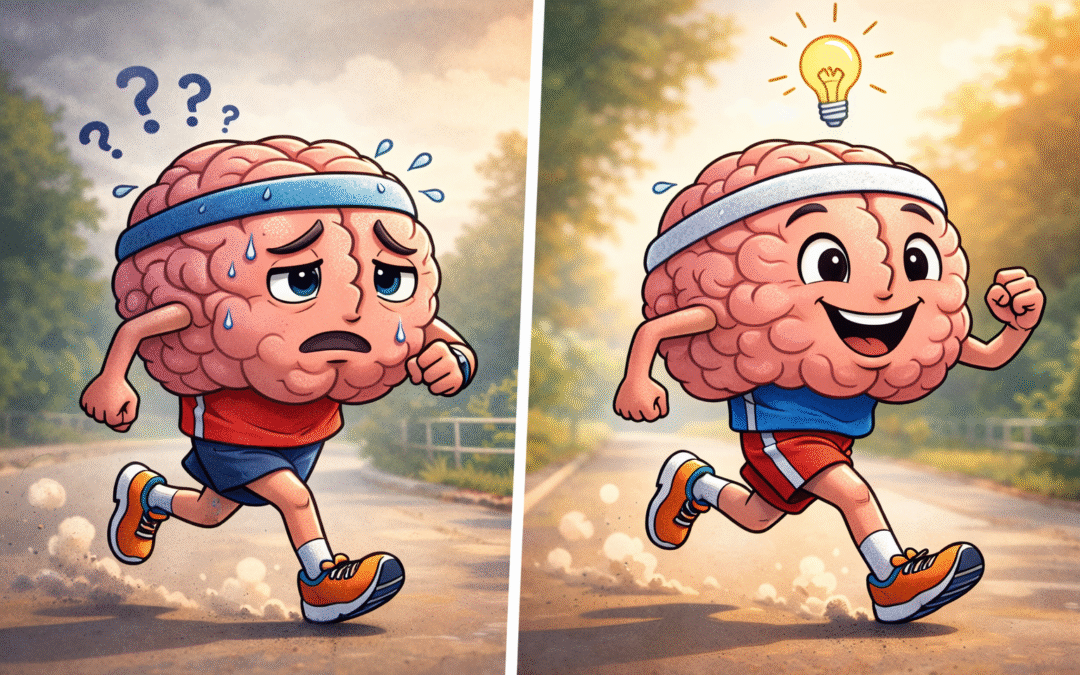
It is all about the way you present it to yourself. Image by ChatGPT
A sure way to keep yourself focused on your goals is to shift certain paradigms in your mindset. Little adjustments that, when applied, should put you in a position to achieve your 2026 goals. Some may apply to you, some may not. Let’s check them out:
1 – Focus on effort, not on pace – Easy pace is not measured in minutes and seconds per mile. It is about effort. An easy effort, hence the name. Sure, there are workouts where specific paces must be maintained. There are speeds and progressions to hit. But that is only in selected training sessions. Most of your training is always at an easy pace. So, keep it easy. Let the pace be a product of your effort, not the other way around. If sharing it on Instagram is embarrassing, keep it to yourself.
2 – Break your training into sections – Every single training has components that must be compartmentalized and distinguished so they can be appropriately executed. A light mobility session and a warm-up should be part of every single run. It is once you’ve taken care of these that your actual training session, where there are benefits to realize, starts. Regardless of what it is. Short intervals, long intervals, fartlek, progressions, you name it, all consist of segments that should be understood, respected, and executed. They are all there for a reason, so don’t rush or skip them. The same applies to the cool-down. There’s no need to jump into your car 30 seconds after turning off your watch.
3 – Running is a privilege, not a chore – Why do you run? Is anyone forcing you? Is the Boogeyman going to catch you if you stop? We run because we have chosen it as our sport, our vehicle for health, or our release valve from the stresses of life. Make it an enjoyable part of your day, not a chore. Make it your “me time” or your “social time” with your buddies. Will there be days when you would rather walk through crushed glass than go for a run? Of course! But those should be few and far between. Our running is not guaranteed. Injuries, time constraints, family demands, weather, work, and so many other distractions conspire against our running time. Understand the privilege of being able to run today and be thankful for it.
4 – Reframe your thoughts – Most runs don’t fall apart because your legs quit, but because of a thought you let go unchallenged. “I’m slowing down.” “This isn’t my day.” “I should back off.” Reframing is stepping in and editing that sentence before it becomes a decision. Not with unquestioning optimism, but with perspective. ‘I’m tired because I’m working.’ This pace still gets me where I need to go. “I don’t need to quit; I need to adjust. Once you start deliberately executing this, you will realize how often your mind jumps to conclusions your body hasn’t made yet. Running becomes less about fighting discomfort and more about managing the dialogue that surrounds it. Change the words, and the experience will often follow.
5 – Running is a journey, not a destination – There is no finish line. Races, PRs, and medals matter, of course, but they are just checkpoints. Accepting running as a lifetime journey changes the measurement of success. It’s no longer about faster times or longer distances, but about what running teaches you along the way. The patience to keep training when progress is slow. The humility of setbacks. The satisfaction of keeping showing up. Goals stop being pressure points and become refueling stations. They give direction without defining your worth as a runner. Miss one, and the journey continues. Hit one, and you keep moving forward. This mindset will keep you running for decades to come. Not because you are chasing one more medal, but because running still has something to teach you.
In 2026, let’s focus on the joy of running. Achievements and setbacks are part of the process, part of what makes running special. Always remember why you chose to run.
A moment creeps into our lives when we realize we cannot perform at the level we are accustomed. A point where we cannot keep up with our kids. A point when we need to ask a teenager to assist with our technology queries. A point when we figure out the pace we ran in our 20s, 30s, or 40s is no longer available to us. Accepting it is not a sign of defeat but of maturity.
Age-group racing may be a great opportunity to keep your competitive juices alive (Photo Pexels)
In his pivotal essay Stages of Life, Swiss psychiatrist and psychoanalyst Carl Gustav Jung (1875-1961), stated that “we cannot live the afternoon of life according to the program of life\’s morning, for what was great in the morning will be little at evening and what in the morning was true, at evening will have become a lie.”
Right on the money. Adjust or perish.
It is a matter of perspective. For those who started running and competing in their 50s, 60s, or later, it is not uncommon to continue getting better. Since there is no earlier record to compare, and they are expanding their physical and cardiovascular condition, setting a lifetime marathon PR at 65 is achievable. A different matter is when you set up that marathon PR in your 20s or 30s and no longer can match that physical output at 65.
If competition and progress are important to keep running, accepting the inevitable process of aging is essential. Dividing age groups every 5 years is arbitrary, sure. There is no scientific reason determining a 56-year-old cannot do what a 55-year-old can. But I do believe it is a God-sent system to reframe our expectations, our PRs, and remain improving within a segment of our lives. It is about picking up a battle with someone our own age and having a realistic chance to succeed.
There is a meme stating that age is nothing more than a better chance to qualify for the Boston Marathon. Bill Rodgers, the legendary lifetime runner and 4-time champion in both Boston and New York, puts it this way: “Every five years, everything changes. Hitting a new age group—It’s a fresh new world. We all have a wonderful opportunity, again.”
The fact is that as we age, we transit through life events that will inevitably force adaptations in our lives. Women go through menopause. You may have experienced broken limbs, heart conditions, diabetes, Parkinson\’s, or one of so many other conditions that tend to happen the longer you remain alive. They are physical and mental challenges to reckon with which will impact your physical output. So, accept your reality, don’t compare, and continue moving forward.
The way I’ve adjusted to running in my 50s after starting in my teens is as follows. I recommend you consider it.
Running as we age
– Reset your PRs: Choose if you will do so every 5, 10 years or after a life event. Make sure improvement is feasible, so frustration and depression won’t set in.
– Adjust volume and pace: Since your value as a person, or as a runner, is not based on miles per week or minutes per mile, figure out what is the most you can do without going overboard. It will be less and less as you age. Accept it or consider retiring.
– Set new goals: You may still brag about your all-time marathon PR despite knowing it won’t be broken. Understanding what’s the best you now, and going for it, will assist in keeping that fire alive.
– Set non-timed-based goals: Times are getting slower as we put more effort, so why don’t we better set goals based on different parameters? Running 1000 miles per year is a popular one.
– Embrace Age-Group Competition: Want it or not, you will be paired with runners your own age. Make the best of it. Choose your new rivals for friendly competition and/or bragging rights.
– Let your running tell stories: Running a sub-50 10K at 50? Completing my 10th marathon before age XX. Becoming an ultramarathoner in my 60s. Participating in XX races during the calendar year. Find your story.
Writer and lifetime runner Jonathan Beverly puts it this way: “If you don’t reset, your PRs and you adjust volume and speed as your age, eventually, your body will drop back to zero and force you to restart from scratch. So, you decide.” Sound advice.
And to that reader in his/her 20s or 30s who may think they’re invincible and this post is only for old farts: be aware that if you want to become a lifetime runner, you better get your best performances out of the way now, because in the blink of an eye, you will realize you can’t compare today’s performances with what they will be in 20 or 30 years.
Any thoughts? Let me know in the comment box below.
In our training, it is not if life will get on the way but when. It has happened to all of us regardless of how committed we may be. Whether to alter an entire training plan or to screw up a single run, if life events haven’t gotten in your way yet, keep running and they will. Being confronted with a constant barrage of personal challenges is part of the human experience. Adjusting ourselves to such reality is what keeps us moving forward.
It is important to note that just because life got in the way, quitting your goal-race, or even running altogether, is unnecessary. If we wait for perfect circumstances, we would still be waiting to start our running journey. The key is being smart enough to adapt to the reality you are confronted with so you can make sure you enjoy the benefits of whatever work you were able to stitch together during these grim times.
A well adjusted training plan and a smartly executed race, earned my trainee his coveted unicorn medal.
Let’s keep things in perspective here. If you undergo emergency triple-bypass surgery in the middle of your marathon training or if you split your femur in two, you are not running that race, period.
I started thinking of this concept because I had a trainee in last week’s Boston Marathon who was forced to make such adjustments. And despite running 14 minutes over his PR, he had a spectacular experience in the premier world marathon. His journey was worth a few tears at the finish line. A result to be proud of.
This runner worked on his BQ for a couple of years and finally got it last year. As the training was about to start, he found himself moving to another state to start a new business. Settling in a new area, changing schools for the kids, finding a home, adjusting his family to a new routine and working longer hours became the priorities. As they should have. No one expected him not to provide for his family because he had to train for Boston. Early in the training cycle it became evident that the marathon training was becoming a challenge. What to do?
Well, runner and coach had lengthy phone conversations in which matters were put into the right perspective. The runner realized that the BQ was taken care of, and he was already in the Boston Marathon. So, instead of feeling annoyed because he wouldn’t be able to run at his top capacity, we shifted the focus into finishing the race and enjoying the experience. Completing as many sessions as possible, focusing on distance instead of speed, and working towards a race to remember.
And that is exactly what happened. A well-executed race plan allowed him to finish strong, happy, smiling, with a unicorn medal around his neck and, most importantly, uninjured.
If you are about to start today’s run and you feel like the person in this image by Engin Ekyurt, from Pexels, you better adjust your expectations, or skip it altogether.
But life not only gets in the way when training for a Marathon Major. Sometimes it is the petty things that can screw up training on any given day. And we better adjust, too.
Last week, one of my trainees had a 6-mile run scheduled but got to the start with indigestion. He had eaten a hotdog about 5 hours earlier and it was giving him stomach trouble. Like the trooper he is, he went for it but at Mile 3, everything unraveled. He felt tired, dizzy and started walking.
As I always preach, we need to take the inevitable bad days as an opportunity. If we don’t learn from them, we’ll never accumulate the experience needed to confront a similar challenge the next time it is facing us. And it is a matter of when, not if.
On a bad day, you must adapt to the reality of what your body has available at that given moment. Regardless of the reason this is happening. You ate bad food, you didn’t eat at all, you just had a rift with your spouse, stressful day at work, you just got bad news, or fill in the blank. It doesn’t matter why. Accept that you just don’t have it today. If you decide to take the macho route and decide to push through when your body is not ready, you are in for trouble.
You are better off downgrading those 6 miles to 3, intervals to an easy trot, a long run to a mid-distance effort or a tempo to a comfortable walk; than forcing yourself and ending up exerting yourself beyond your limit, thus requiring extra days of recovery. Or even worse, getting injured. That will set you further behind than cutting short one day, or even skipping it.
Remember: It is all about training smarter, not necessarily training harder. Harder is important, but smarter will keep you running.