

By Coach Adolfo Salgueiro
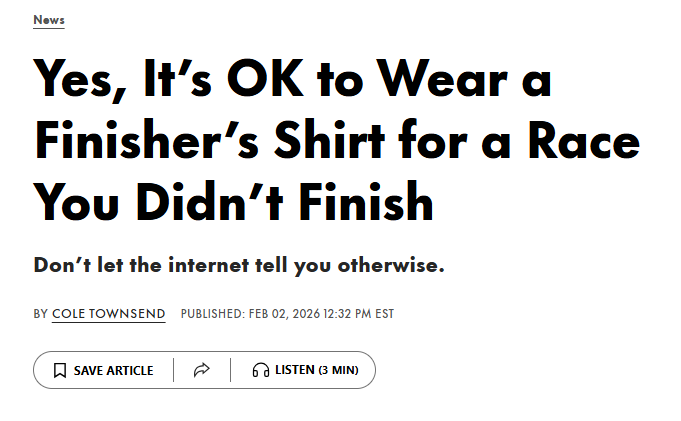
This past February 2nd, a controversy was sparked by an article that ran on the Runner’s World website. It was an opinion piece by a writer named Cole Townsend (whom I don’t know). The piece was titled: “Yes, It’s OK to Wear a Finisher’s Shirt for a Race You Didn’t Finish”. Hence, the rebuttal in the title of this blog post.

Townsend states things as: “I think we need to have an honest conversation about who’s ‘allowed’ to buy finisher tees,” and “Your hard work doesn’t disappear because mile 1 or mile 19 didn’t happen”.
These statements, just as the article’s title, rubbed me the wrong way. Sure, everybody is entitled to their opinion. Sure, wearing a shirt that states you finished the Boston Marathon when you didn’t is trivial compared with what’s happening in Ukraine. Sure, you are not going to ponder what I may think when choosing your wardrobe. Yet, in my book, it is still not right.
Would you wear an Olympic medal you did not win around your neck, just because you own it? You can proudly display it at home, especially if a relative earned it. I display my dad’s marathon medals at home. But they are hung separately from my earned medals. They are my property, but not my achievements.
My beef with the entire affair is two-fold:
1 – How can an entity of Runner’s World’s reputation think that publishing this was OK? I am all pro-First Amendment, but you are not obligated to provide a tribune to someone for just about anything, especially if it is unsound, which it should be for runners. Would you run a story advocating the superiority or inferiority of a certain race, or defending a flat earth, just because it is someone’s opinion?
2 – The article, as the headline clearly states, talks about finisher shirts. A finisher’s shirt is earned when you finish a race, hence the name. Not when you register, not when your boyfriend crosses the finish line, not when you purchase it in a fire sale. This is not a participation trophy. This is between you and your conscience, sure, but in my book, it is still a lie.
Is it OK to wear a military uniform and let people assume you served your country? Would you walk through a mall wearing a priest’s cassock, or scrubs with a stethoscope draped over your shoulders? Exactly. And no, I’m not comparing military service or serving God to finishing a marathon. I’m pointing out something simpler: what you wear creates assumptions about who you are and what you’ve done. Letting those assumptions stand when they aren’t true is plain wrong.
There is a difference between a finisher’s shirt and a race or a souvenir shirt. If you ran London and brought me a hat, I would be grateful and wear it, even though I haven’t run it. When I returned to road racing after a 26-year hiatus, I gave my race shirt to my dad as a tribute, since he inspired me to start running when I was a kid. He wore it proudly. But it only said “2012 Miami Marathon and Half Marathon”; it didn’t state he finished the race, even though he ran the distance hundreds of times.
The author concludes with this statement: “We don’t need to start a ‘stolen valor’ debate. What you wear should reflect what matters to you—not what the internet thinks you’re entitled to. If you care, flip the question: why are you wearing it? If the answer is ‘because it means something to me,’ that’s enough.”
This would be a logical conclusion if the article didn’t state “Finisher’s Shirt”. That’s where, in my opinion, both the writer and the Runner’s World editors went terribly wrong.
Any thoughts? I really want to hear from runners who disagree with me. Please share in the comment box below.
You can read the article in this link: https://www.runnersworld.com/news/a70222480/finisher-shirt-stolen-valor/
I completely agree! I wear my Boston finisher jacket and shirt with pride, as a symbol of my hard training and the thrill of reaching my goal. I earned this, so anyone wearing a finisher attire without having truly finished is misleading and misrepresenting the significance of their shirt.
Totalmente de acuerdo
Excellent articulated.
Totalmente de acuerdo , buen artículo , no quieras aparentar lo que no has logrado porque de nada vale
Funny story. I mentioned in this post that if a friend ran the London Marathon and brought me a hat, I would proudly wear it even if I didn’t run London. Well, two days after publishing this post, a friend who ran London 10 months ago and bought me a hat remembered he’d never given it to me. So he gave it to me, and I proudly wore it during our post-run dinner.
What are the chances of that?
Totally true
Muy cierto Coach😃