The Joy of Barefoot Walking on Grass

The Joy of Barefoot Walking on Grass

By Coach Adolfo Salgueiro

We all know about how important it is to run or walk in the right shoe. Depending on your foot and the way you strike the ground, a shoe may be the right one for you, but this doesn’t mean it is the best option for your running buddy. There are forefoot runners, heel strikers, neutral steps and all the variations in between. But there is one variety where we are all equal: barefoot. We all have the feet we were provided at birth.

Barefoot WalkingLet’s be clear that I am not advocating for barefoot running. It is not for everybody. After the minimalist craze of the early 2000s, lots of people shifted to five-fingers and barefoot without the property transition, assuming it made sense, and a barrage of injuries followed. Some people can handle it, some people don’t.

But what I passionately believe after reading about it and experiencing it, is that barefoot walking on grass is wonderful. The joy of being in direct contact with the earth below you in invigorating and will recharge you for the rest of the day. As I was researching this blogpost, I learned that this practice even has a name, actually two: it is called “grounding” or “earthing”.

I started walking barefoot in my back yard about five years ago. One day, my wife and I decided to go for a barefoot walk around the neighborhood and, surprisingly, it was an invigorating experience. We came back with more energy and more relaxed that than we set out. Since then, I put some 3 to 4 miles out there once every couple of weeks. Getting your feet wet, dirty, stained, and constantly adjusting for the irregularities of the terrain has become a pleasure. I wish I could fit it in more often.

According to an article by Carrie Denner, from The Washington Post, published in July 2018, research suggests physical contact with the Earth’s surface can help regulate our autonomic nervous system and keep our circadian rhythms — which regulate body temperature, hormone secretion, digestion and blood pressure, among other things — synchronized with the day/night cycle. The idea behind it, is that “humans evolved in direct contact with the Earth’s subtle electric charge but have lost that sustained connection, thanks to inventions such as buildings, furniture and shoes with insulated synthetic soles.”

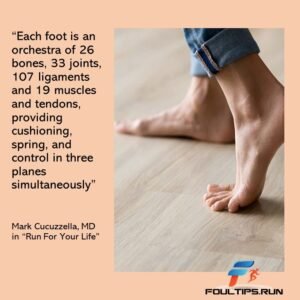
Regardless of what you may think, your feet are ready for the task. In his book Run for Your Life, Dr. Mark Cucuzzella, states that “each foot is an orchestra of 26 bones, 33 joints, 107 ligaments and 19 muscles and tendons, providing cushioning, spring and control in three planes simultaneously”.

I’ve heard people complaining about the possibility of a rock or a piece of trash damaging their feet, but my experience is that, of course you may get a cut or stung by an insect, but in general terms your feet are ready to avoid it. According to Dr. Cucuzzella: “Our feet have 200,000 sensory receptors that are constantly, an unconsciously, appraising our position so that we can make micro adjustments to our balance”. And believe me when I tell you that it works like a charm.

As for where to go for a barefoot walk, it is understandable that not everybody has a backyard where to go even 100 times around if necessary, but most likely there is a park you’re your place where you can set up for this experience.

In their book “Barefoot Walking”, Michael Sandler and Jessica Lee talk of barefoot walking as an experience to free your spirit. They do so in a very poetic way, that, as someone who has experienced it, is not far from reality: “When you go barefoot you’re plugging back into the soil, back into the earth, and back into our global community. As Henry David Thoreau said, ‘Heaven is under our feet at well as over our heads’ […] In essence, by going barefoot, it is as if you are plugging back into the Source—whatever that spiritual connection means to you—because you are going back to the ground from which we came”.

As if this wasn’t benefit enough, you will make your feet stronger by making them work harder without the benefit of shoes. As Dr. Cucuzzella well puts it: “shoes have eased the burden on our feet so that they need to work less. But our feet are designed to work hard. In doing work, they gain strength. Our ancestors did not have golf courses”.

If you don’t believe in the hype I am placing into this barefoot walking on grass thing, find a nice patch of grass at your local park and invest 15 open-minded minutes of your life into giving it a shot. It may not become a transcendental experience, but who knows, it just may. Isn’t it worth finding out? Let me know how it went.

The Basics About Electrolytes

The Basics About Electrolytes

By Coach Adolfo Salgueiro

Electrolytes

Table salt is the most basic and cheapest way to keep your electrolytes in balance, but there is still much more to it than that.

As runners, we’ve all heard the term “electrolytes”. We know they are key to our success and most likely they are at fault when we bonk during a long run on a hot day. We know that Gatorade has them. We know we better replenish them lest we get into trouble. As Robb Wolf, co-founder of LMNT Hydration well put it: “Electrolytes can mean the difference between feeling like a champ and feeling like garbage”.

But… do we know what they are? Do we know what they do? There hast to be more than one of them since the word is plural, so, which ones are they?

According to Medlineplus.gov, “Electrolytes are minerals in your body that have an electric charge. They are in your blood, urine, tissues, and other body fluids. Electrolytes are important because they help balance the amount of water in your body, balance your body\’s acid/base (pH) level, move nutrients into your cells, move wastes out of your cells and make sure that your nerves, muscles, heart, and brain work the way they should.”

As you can see, you don’t need to be much of a scientist to realize these are important elements to keep well stocked and balanced within your body, not only during long runs but during your daily life.

Your body can and should take in electrolytes during the day through the foods and drinks you consume. You don’t need to drink Pedialyte all day to keep them topped off.

Electrolytes

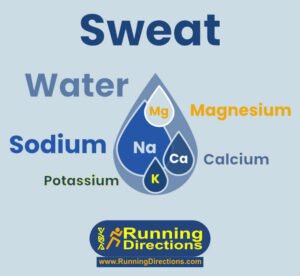
As you can see in this graphic, there is way much more than water in your sweat.

We need to be careful with electrolytes as we may run into trouble not only if we run low, but we can also break homeostasis if we consume too much of them. Have you ever washed an electrolytes tablet with Gatorade in the latter part of a long run? Believe me, you don’t want to know.

It all has to do with the delicate balance of water your body requires to function properly. Tipping such balance either way will affect the electrolyte concentration and could have you either dehydrated or overhydrated. None of these options are good.

The key electrolytes to keep your eye on, are:

Sodium and chloride: maintain fluid balance and nerve function.
Potassium: prevents cramping.
Calcium and magnesium: control muscle contraction and heart rhythm.
Phosphate: Used as a building block for the substances used by the cells for energy, cell membranes and DNA

According to hydration experts, during your running the most common electrolytes you sweat are sodium (Na) and chloride (Cl). These are the two elements that form common table salt (NaCl). This comes to show that replenishing basic electrolytes can be as basic and cheap as having a plan to do so before you get into trouble. Other elements like potassium, magnesium and calcium are sweated in lesser amounts but shouldn’t be overlooked.

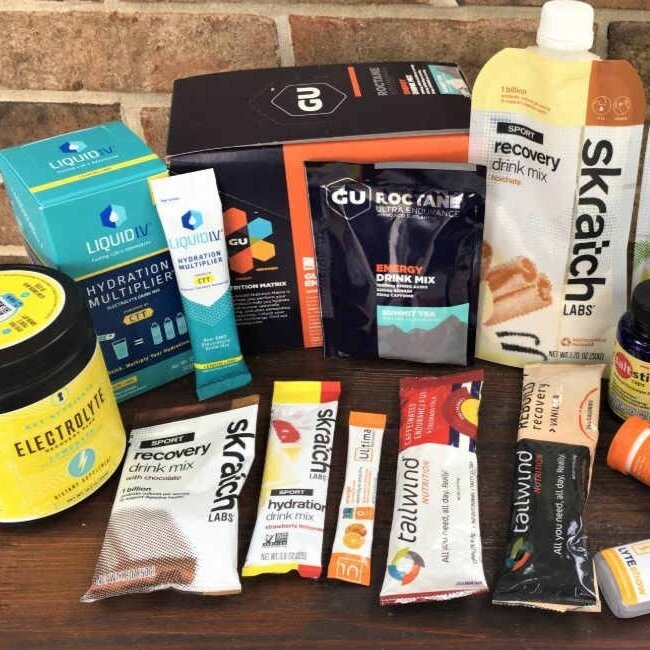
There are many electrolyte options in the market to keep yourself properly hydrated and balanced throughout your day and long runs. Personally, I am not a fan of Gatorade because of the excess sugar, which causes a spike as soon as you ingest it, but it is followed by a crash. That is why I no longer take it even during races.

My electrolyte choice for the last couple of years has been the Nuun tablet. I also consume Hammer Endurolytes as an alternative and they both have worked like a charm for me. I have also experimented with Generation UCan hydration with solid results but no longer use it. Coconut water is amazing but since it is not easy to carry around and it is not offered during races, I had to stop using it.

None of these products endorses me. There are plenty of other options in the market. The ones I mentioned are based on my individual experience. Visit your local running store and ask for help, they should be able to offer you choices based on what type of runner you are.

Keep yourself hydrated and your electrolytes well balanced so you can safely enjoy the countless benefits of a long run.

Running with a Mask in Times of Pandemic

Running with a Mask in Times of Pandemic

By Coach Adolfo Salgueiro

Before we get started, I must remind everyone that I am not an infectious medicine specialist. If you want scientific advice, I recommend you listen and follow what Dr. Anthony Fauci has to say regarding Covid-19. With this disclaimer out of the way, the following are my thoughts on running with a mask during times of pandemic.

Running with a Mask

By trial-and-error we will find what works best of us individually (Photo by cottonbro from Pexels)

Eight months or so into the Covid-19 pandemic, and four after the economy was inevitably reopened, we’ve returned to our group activities such as work, extended family and exercising with as much caution as possible. Social distancing keeps being the new norm, hugs and kisses have been replaced to fist and elbow bumps, and masks have become a political issue. As runners, we’ve had to adjust to this new reality in order to keep moving forward and to keep the social aspect of our sport alive. The uncomfortableness of wearing a mask is a small price to pay.

According to Certified Personal Trainer Timothy Lyman in a recent article in Runner’s World Magazine,  “Running with a mask, or any other type of face covering, is inherently more difficult because you have to work harder to get the same amount of air into your lungs”. Of course this will vary depending on the type of are wearing.

Getting used to running covering your nose and mouth requires time, commitment and training. Figuring out what mask works better for you, when is the best time to have it on or just available for immediate use, are part of such training. Knowing in what situations you should or should not wear it has also been a trial-and-error endeavor.

The same article in Runner’s World states that: As a general rule, a mask is necessary if you’re running in a populated area where you’re likely to encounter other people. If you’re running alone in an area where you won’t encounter others or come within 6 feet (at a minimum) of others, it’s likely not necessary. But keep in mind that wearing a face covering is not a substitute for physical distancing—make sure to still keep at least six feet of distance between yourself and others while running.

Through my personal experience running over 600 miles during the pandemic, what I’ve figure out is that even though I may not need a mask when I run alone, I rather have one because inevitably I will cross paths with strangers that either do not care to help you create the safe distance or, you meet them in places where it is just impossible to separate. Therefore, I always run with a cloth mask on my chin or neck, which I can immediately access to cover my face when required. It has worked so far for me and I recommend it.

Running with a Mask

It is important to keep your social distance even if you are running with your buddies (check how I have a mask on my neck ready to be used at a moment’s notice) – Photo by Ted Sassi.

In my two running groups, we all use face coverings until we start. As for running together, we try to stay close enough to keep the social aspect of running alive but separate enough to adhere to the protocols. The post-run cafĂŠ-con-leche or beers, are strictly held outdoors.

For group running, Dr. Jennifer Marin, from @Obesalud, recommends not running one behind the next but keeping a diagonal formation with 5-meter (15 feet) of separation. This is an interesting, overcautious suggestion, worth looking into.

An important consideration is that, regardless of the type of mask you wear, you need to go out of your way to keep it clean and disinfected. The constant breathing will dampen it and thus less effective. I you don’t wash it; it will attract microorganisms that you will be breathing in and may negate the benefits of wearing a mask in the first place. So make sure you keep several of them in your running bag so you can rotate them appropriately.

Yes, running with a mask is a pain in the ass. No questions about it. But a worse option is having Covid-19. So suck it up, get used to the discomfort, wear a mask like a good citizen and keep on running with your buddies.

So, Tell Me About Your VO2Max

So, Tell Me About Your VO2Max

By Coach Adolfo Salgueiro

It is interesting when you with your running buddies and they start bragging about their VO2Max number. “Mine is 41”, says Runner #1. “Mine is currently at 39 but it has been going up for the last 3 weeks”, comes back Runner #2. “I am down to 43 but have been up to 44 as recently as last month”, chimes in the Runner #3. Funny thing is that if you ask any of them what VO2Max is, you can pretty much bet that none of them will know.

VO2Max

These are the elements that conform VO2Max (British spelling used here)

VO2Max stands for the maximum (Max) volume (V) of oxygen (O2) that your body can utilize at maximum effort. It is obvious that the more oxygen your body can handle, the more efficient it is and the faster you should be able to run. Eliud Kipchoge has been measured at 75 while the fittest of my readers most likely be under 50.

VO2Max is measured as an absolute rate in liters of oxygen per minute (L/min) or as a relative rate in in milliliters of oxygen per kilo of body mass per minute (ml/kg/min). Yes, this is a little bit technical, well, more than a little bit. The point here is to understand that if you can barely grasp the concept and how this parameter is measured, you shouldn’t make it your end-all factor to measure your progress, let alone your value as a runner.

The VO2Max is a valuable tool if you know what you are looking at. But lately it has become overemphasized, primarily because watches now flash the number as if it were a badge of honor.

VO2Max

Unless your watch can be hooked to this machine, it cannot measure your VO2Max

VO2Max is tested in a specialized lab. While on a treadmill, with a mask covering your nose and mouth, while running to exhaustion, the machinery measures how much oxygen goes into your body and how much oxygen comes out. The difference between the two numbers while at maximum effort, is the maximum amount of oxygen your body can process at such speed, thus, your VO2Max. Your watch cannot measure this, regardless of how sophisticated and expensive it is.

In conclusion, VO2Max may work or not, I am not a sports scientist nor have read enough to know the extent of its reach. But what I do know is that it is not the end-all parameter to measure your progress or success. To me, a PR on my next 5K or marathon seems a much better way. And, once again, it CANNOT be measure by an equation on your watch.

It is not in the scope of this blogpost to advocate for or against VO2Max. It is not either to explain the science and value of the parameter, which, of course, does have a value.

If you want to learns more about the subject and are ready for a deep technical read, Steve Magness, head coach for the University of Houston, and an authority on the science of running, has a few articles on this, which I highly recommend. You can click on the links below to access them:

Skip to content