
The Power of Goal Setting

The Power of Goal Setting

By Coach Adolfo Salgueiro

When it comes to setting running goals, my experience is that there is nothing like having a race on the schedule. One where you have already registered, paid and let everyone in your running circle know about it. It is what keeps me with something to look towards during any period of the year, especially the tough times. It doesn’t matter if the race is in a month or a year down the road. That said, goal setting is way more than spending $35 in your next 5K race or ponying up a few hundred bucks on your next Marathon Major.

In the realm of sports psychology, extensive research has revealed the profound influence of goal setting on athletes. A prominent figure in this field is Dr. Edwin Locke, a psychology professor at the University of Maryland, whose studies have significantly contributed to our understanding of goal-setting theory. In Chapter 4 of \”The Runner\’s Brain\”, a book by Dr. Jeff Brown and Liz Neporent, the authors explore Dr. Locke’s research, shedding light on how setting goals can transform running performance.

Goal Setting

This book is the source of this blog post. A good book well worth the money and time.

They identify four principles for goal setting:

Principle 1: Directed Attention – Goals serve as a compass, directing our attention towards specific aspects of our training. Whether it\’s completing a running loop in under an hour or improving pace, breathing, and form, setting goals sharpens our focus. Additionally, breaking down long-term goals into smaller milestones helps measure progress and brings a sense of achievement to our training.

Principle 2: Motivation – Goals provide the driving force that keeps us pushing forward. When we have a clear objective to work towards, we are more likely to stay enthusiastic and engaged throughout the training process. The pursuit of our goals gives us a purpose and ignites the determination needed to overcome challenges.

Principle 3: Celebrating Success – Viewing our efforts as a series of failures can be demoralizing. Setting long-term goals allows us to establish checkpoints along the way, creating multiple opportunities for success. Celebrating these smaller achievements transforms the feeling of missing the mark into a string of mini triumphs, boosting our confidence and motivation.

Principle 4: Continuous Learning – Goal setting propels us into the learning zone. It encourages us to explore new resources, equipment, and strategies to achieve our desired outcomes. As we seek innovative approaches, we develop new skills and expand our knowledge. Embracing new experiences and novel approaches improves our abilities and stimulates our brains, preparing us for future goals.

Now, as in everything in life, we must set limits. While goal setting plays a pivotal role in not just feeling like but becoming a successful runner, it is crucial to establish balance. Research suggests we should avoid an overemphasis on goals or setting unattainable targets, as they can lead to anxiety and a decline in self-assurance. Resilience and the ability to manage disappointment are integral to the goal-setting process.

We should also include backup goals in our training and recognize our achievements at various levels so you may stay motivated and derive satisfaction from our efforts. Remember, goal setting should be complemented by an appreciation of the journey, listening to your body, and finding joy in the process. When it is no longer fun, you will either stop running or burn out.

In conclusion: goal setting is not New Age mumbo-jumbo; it is a science-backed practice that may enhance your running performance if approached correctly. By embracing it, runners can unlock their full potential and achieve their best while maximizing the benefits of their training.

Join the conversation by commenting in the text box below and share your thoughts on goal setting in running! Every step counts towards greatness.

On Runners’ Mental Toughness

On Runners’ Mental Toughness

By Coach Adolfo Salgueiro

It wasn’t too long ago when completing a 20-mile-long run, overheated, dehydrated, destroyed, and borderline injured was considered a badge of honor. The “no pain, no gain” mentality taken to the extreme. This outdated machismo has cost many careers and even lives. Thank God that science and collective thought have evolved, leading to an updated concept that is not only more humanitarian but also safer.

I don’t know how it works in other sports, but runners, please adjust to the new way of thinking.

We’ve all heard the stories of football players collapsing with heat strokes under the misguided direction of coaches teaching toughness. We’ve heard of runners ending up in an emergency room rather than at the finish line of a race because they refused to “show weakness.” The story of an athlete ending up overtrained or injured because they refused to take a day off is all too common. Surprisingly, most of this could have been avoided by understanding what mental toughness is not.


Toughness is laudable, unless you get injured because of it. Always live to run another day (Photo Sukh Winder, Pexels)

In a recent podcast interview, I heard Dr. Justin Ross state that mental toughness could mean different things to different people, making it difficult to define. Dr. Ross is a licensed clinical psychologist who specializes in health, wellness, and human performance psychology. He has spent the bulk of his career in mental health and wellness initiatives for those performing in stressful, high-demanding environments, including athletics.

Ross defined what mental toughness is not: “Mental toughness is not running when you are injured. It is not running when you are sick. It is not ignoring your body because your mind wants to reach a certain volume for the week, thinking that missing a workout would hinder your success. That’s not what we understand mental toughness to be.”

I look back at the training of great runners like Emil Zatopek, who is known to have done 50×400 workouts several times per week. Sure, he won five golds and a silver in the 1948 and 1952 Olympics and set a bunch of world records, but the peak of his career was compressed into those five years. These days, runners like Eliud Kipchoge have a peak lasting 15 years. For us mere recreational runners, if we want to run until we meet our maker, we should regulate our intensity and make sure we see the big picture while we train.

Listening to your body is a mental exercise where you must overcome the optimism that hip pain will magically go away if you keep running. Or that completing this last mile repeat, despite running on empty, is the difference between a personal record and a mediocre race. If you fail to recognize the warning signs, most likely you will end up overtrained or, even worse, injured.

“Optimism holds a place in the mental toughness conversation,” says Dr. Ross. “What doesn’t hold a place is irrational optimism.”

Coach Steve Magness has a great quote that I often cite to my trained athletes when they refuse to take a day off: “It is better to take three days off now than three weeks off three days from now.”

You can apply mental toughness by being overcautious and playing it smart rather than pushing through when we know it is not advisable. Doing the right thing takes massive amounts of willpower, especially when you really don’t want to. A running friend once walked to the starting line of an important 10K when he realized the tightness in his calf was going to be an issue. So, he turned around, sat it out, watched all his friends finish, and lived to run another day. A few weeks later, he beat me in a half-marathon. Now, this is mental toughness.


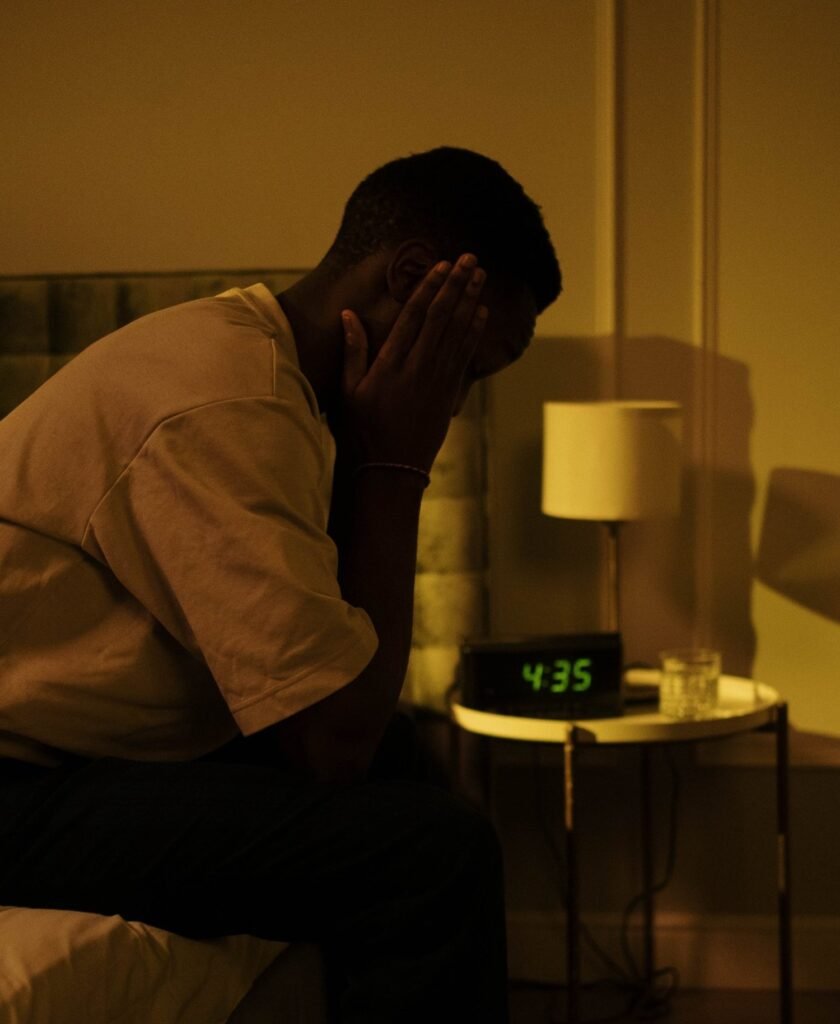
Sleeplessness is no badge of honor. It is assuring you won’t be able to recover from your physical activity (Photo: Cottonbro Studio, Pexels)

Don’t confuse this updated concept with complacency or laziness. Uncomfortable and/or painful moments are inevitable in running. And normal. We must learn to recognize and overcome them. At the same time, we need to be aware of what is expected and what our brain is turning on the engine check light and signaling that there is a problem to be addressed.

Ross defines mental toughness as: “a psychological set of resources and skills that you can apply when you are challenged.” The more challenges and uncomfortable situations you face and overcome, the more mental toughness you’ll build. Just as in mastering a second language or solving the Rubik’s Cube. It takes time and dedication to build up, just like a long run.

“While mental toughness is often equated with perseverance,” says Coach Jason Fitzgerald, “it also requires you to be in tune with your body. Pushing through illness or injury is not mental toughness. But challenging yourself in a workout, or not giving up on a tough long run, is walking the fine line of being able to dig deep while finding the internal resources to do difficult things. You may not want to lace up because it’s early, dark, cold, you are tired, or you didn’t sleep well. Yet, you overcome that obstacle and go anyway. That is developing mental toughness.”

I hope you find these insights helpful as you navigate the concept of mental toughness in running. Remember, it’s essential to listen to your body, recognize the signs of overtraining or injury, and find the balance between pushing yourself and knowing when to rest and recover. Mental toughness is about applying psychological resources and skills to face challenges, and it grows stronger through perseverance and self-awareness.

Keep running strong, and may your journey be filled with both physical and mental resilience.

runners and sleeplessness
Sleeplessness is no badge of honor. It is assuring you won’t be able to recover from your physical activity (Photo: Cottonbro Studio, Pexels)
Heat Exhaustion Vs. Heatstroke (Repost)

Heat Exhaustion Vs. Heatstroke (Repost)

By Coach Adolfo Salgueiro

As we are about to enter officially into the summer season, for all runners training in the Northern Hemisphere it is time to adjust their running to the new weather patterns. I am reposting this article I wrote a couple of years ago because it could save your life. Make sure you read it and understand it.

Once again, the usual disclaimer: I am not a doctor, so please do not take medical advice from me. If you have any questions on what you are about to read, please consult a professional, which, yet once again, it is not the author of this blogpost. Now, let’s proceed.

Heat Exhaustion Vs. Heatstroke

Running in the summer heat requires a certain level of preparation to avoid heat related issues, including death (Jill Wellington, pexels.com)

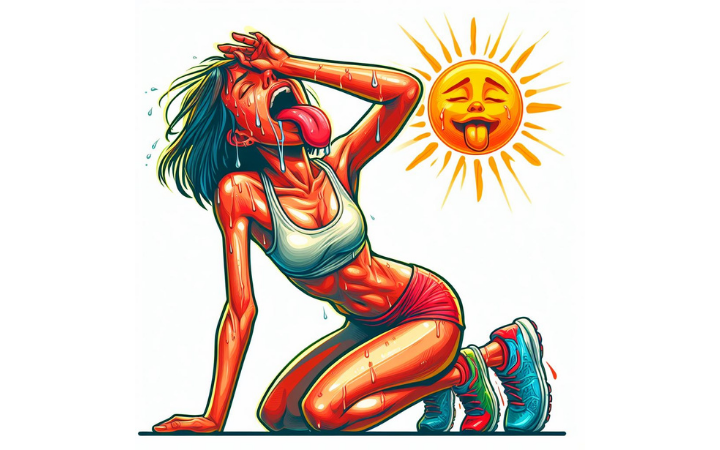
As we enter the Summer months in the Northern Hemisphere and the coolness of the spring weather turns into a combination of heat and humidity that can make even the most motivated runner miserable, the time has come to refresh our knowledge on two important concepts. It is extremely important to understand and differentiate the signs and symptoms of heat related illnesses, such as heat exhaustion and heatstroke. They are both serious conditions, but one can lead to death.

According to the Mayo Clinic’s website, there are three heat-related syndromes that may affect your body depending on your exposure to extreme heat conditions. In order of severity, they are: heat cramps, heat exhaustion and heatstroke.

Heat Exhaustion is caused by exposure to high temperatures, particularly when combined with high humidity and strenuous physical activity. Without prompt treatment, it can turn into a heatstroke, a life-threatening condition that can be prevented by avoiding entering in the heat exhaustion zone in the first place.

Heatstroke is a condition caused by your body overheating, usually as result of prolonged exposure to physical exertion in high temperatures. This most serious form of heat injury, it can occur if your body temperature rises to 104 F (40 C) or higher.

Certain conditions and medicines can enhance your risk of a heat-related illness. Ask your doctor if any of your medical history or current prescriptions can make you more susceptible to these diseases considering your level of physical activity during the warmer months.

I can’t state enough how important to know and understand the symptoms of each one of these syndromes. Not only it could help you prevent them, but it can avert a tragedy.


Heat Exhaustion

The evaporation of your sweat regulates your body temperature. However, when you exercise strenuously or otherwise overexert yourself in hot, humid weather, your core temperature (body\’s heat combined with environmental heat) fails to regulate, preventing your body to cool itself. A normal core temperature is around 98.6 F (37 C).

 If you don’t deal with this situation immediately, it may develop into a dreaded heatstroke.

The symptoms of Heat Exhaustion are:

  • Cool, moist skin with goose bumps

  • Heavy sweating

  • Faintness

  • Dizziness

  • Fatigue

  • Weak, rapid pulse

  • Low blood pressure upon standing

  • Muscle cramps

  • Nausea

  • Headache

Should you feel these symptoms, stop your activity immediately, move to a cooler place, drink cool water and/or sports drinks and rest. If these symptoms don’t get better within in an hour, contact your doctor. Remember you are avoiding at all costs to have this escalate into a heatstroke.

Heatstroke

Heatstroke not only requires immediate treatment, but it can quickly injure the brain, heart, kidneys, and muscles. Damage can get worse the longer treatment is delayed and lead to serious complications and, once again, even death.

The symptoms of Heatstroke are:

  • High body temperature (over 104 F or 40 C),

  • Altered mental state or behavior (Confusion, agitation, slurred speech, irritability, delirium, seizures),

  • Alteration in sweating (skin feels hot and dry to the touch),

  • Nausea and vomiting,

  • Flushed skin. (Skin may turn red as the body temperature increases),

  • Rapid breathing (rapid and shallow),

  • Racing heart rate (Pulse may significantly increase),

  • Headache (Throbbing).


Prevention

It is imperative to be proactive, both for ourselves and on behalf of our running mates, in the avoidance of situations that may trigger heat exhaustion during the hot summer months. The Mayo Clinic recommends the following:

  • Wear loose-fitting, lightweight clothing,

  • Protect against sunburn,

  • Drink plenty of fluids,

  • Take extra precautions with certain medications (ask your doctor),

  • Take it easy during the hottest parts of the day,

  • Get acclimated to the new weather conditions.

Last year we wrote a blog post on Training Adjustments for the Summer Months, which may be worth revisiting as we prepare for the upcoming weather conditions.

Let’s take a little bit of time and learn about heat exhaustion and heatstroke so we can prevent a tragedy.

13 Tips for Summer Running

13 Tips for Summer Running

By Coach Adolfo Salgueiro

With Summer around the corner, maybe already here if you are reading this a few days after publication, it\’s essential to adjust your running routines to ensure a safe and effective experience. Running in hot weather requires intentional modifications to prevent dehydration, heat-related injuries, and negative impact on your fitness. These are 12 quick tips for summer running.

1 – Slow Down: Running in the heat is physically demanding, and your body requires more effort to maintain the same pace. Embrace the reality of running at a slower pace to accommodate the increased effort it requires. It\’s about maintaining the level of perceived effort rather than focusing on speed. It doesn’t matter if it screws your Strava averages.

Summer running

Running safely during the summer is perfectly possible, but it requires planning (Photo: Pexels)

2 – Plan Your Hydration: Proper hydration is crucial during summer runs. Plan your routes around areas with ample fluid sources or strategically seed water along your route in advance. Remember to consume water at scheduled intervals, before you feel thirsty, which may indicate dehydration has already set in.

3 – Overhydration is a Thing: While staying hydrated is important, be cautious about overdoing your water intake. Drinking in excess can lead to hyponatremia, a potentially life-threatening condition caused by dilution of sodium levels in the blood. Stay hydrated throughout the day, not just while you run, and ensure your urine is lightly colored as a sign of healthy hydration.

6 – Dress Appropriately: Opt for light-colored clothing, which reflects more light and deflects heat. Avoid wearing long sleeves, long pants, or outfits designed to induce excessive sweating, as these can hinder your body\’s ability to cool down.

7 – Freeze Your Running Clothes: Sounds weird, but if you place your running shirt and hat in the freezer and you put them on just before you leave home, your body will cool down, and delay the inevitable. Sure, it will get hot anyway, but isn’t it better for it to start at mile 2 or 3 than at the first step?

8 – Stay Connected: Carry your mobile phone during runs. Inform somebody of your whereabouts and expected return time. Consider using apps or services that allow loved ones to track your real-time location for added safety.

Summer running


Click this image to see the correlation between relative humidity and temperature

9 – Factor in Humidity: If you train in a high-humidity region, be aware that running in saturated air requires more effort compared to drier conditions. Adjust your expectations and accept that maintaining the pace may require additional effort, so you may have to run shorter. Mental preparation and acknowledging this difference may help you stay motivated.

10 – Adjust Your Training Schedule: Be flexible with your schedule, especially if you\’re preparing for a fall marathon. Should the weather conditions be extreme, consider rescheduling long runs or intense sessions to a more suitable time of day. Avoid pushing too hard in unfavorable conditions to prevent extreme exhaustion and/or injuries.

11 – Choose Shaded Routes: Plan your routes intelligently by selecting paths that offer ample shade. This will help shield you from direct sunlight and reduce heat exposure, making your runs more comfortable and safer.

12 – Listen to Your Body: Don\’t be a hero. If you feel dizzy, fatigued, or overheated, don\’t hesitate to stop, cut the run short, seek shade, ask for assistance, or just call it a day. Prioritize your safety and well-being, as taking these precautions will aid in faster recovery and enable you to resume running sooner.

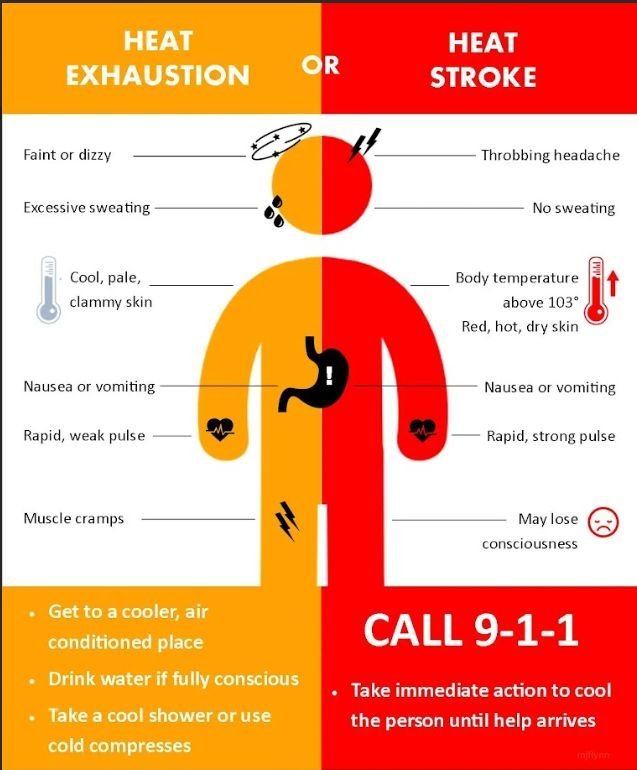
13 – Differentiate Exhaustion from Heat Stroke: It\’s crucial to distinguish between normal exhaustion due to heat and a potentially life-threatening heat stroke. Familiarize yourself with the symptoms of heat stroke to avoid any severe consequences. Refer to the graphic below, borrowed from www.weather.org, for a comprehensive understanding of heat stroke symptoms.

Summer running

Learning this information could save your life

Running during the summer months is possible with the right adjustments and precautions. Many of the world’s greatest marathons, such as Berlin, New York and Chicago, take place in the fall, which means you must train during summer. By planning ahead, making smart choices, and prioritizing safety, you may continue training effectively and ensuring a smooth transition into the upcoming racing season.

Always err on the side of caution and enjoy running while staying safe.

American Runners are Slower than Ever

American Runners are Slower than Ever

By Coach Adolfo Salgueiro

A couple of weeks ago I came across a statistical mega study that confirmed what the title of this blog post states. Using over 34.6 million results from over 28 thousand races, researchers Jakob Andersen and Vania Andreeva Nikolova, sliced and analyzed the data in multiple ways to reach their conclusion.

American Runners

The statistical analysis concludes slowing down in males and females in all distances (Photo: Pexels)

As I glanced through the research, I realized I started reading with preconceived notions on what they would find. More runners, unhealthier athletes, aging, gender gaps. The usual. Back in my youth, when I ran marathons in the 3:30s in the mid-1980s, I finished around the 50 percentile of finishers. A stat I just read from the Chicago Marathon stated that 18% of runners finished sub-3:30 this year. An obvious shift. I must say all my biases were addressed in the study and the conclusion still holds.

If after reading my take on this study you want to delve into the minutiae and the data, you can find the research paper in its entirety by clicking here.

This thorough study includes racing in the four most popular distances (5K, 10K, half and marathon), and races with more than 2000 finishers between 1996 and 2016. The reasons why this data was selected, the terminology and methodology of its handling, is detailed in the study, if you are interested. One more thing, researchers state this study took place because the deteriorating health of the American population is an important topic to be studied, and they wanted to find if this reality is reflected in the finishing times of races.

The study could have been a great episode of Discovery Channel’s Mythbusters TV show, as it takes time to disprove many of our preconceived notions about these numbers. These are:

1 –        The proportion of women participants is increasing, and women are slower in general: Men speed is decreasing at a faster rate than the women increment in participation. If this trend continues, by 2045 both sexes will be at an equal average pace.

2 –        People with inappropriate fitness level just walk the races: The study found the proportion of participants finishing races on every distance, at a slower than the average brisk walking pace is rather consistent throughout the years, so there is no statistical difference.

3 –        Just the slow are getting slower: An easy idea to assume but the study measured the average final time for the 100th, 1000th, 2000th and 5000th finisher on each race throughout the years of the study, on both sexes, and concluded the fastest females have slowed down 9.87% while males have done so at a 9.94% clip.

4 – The average age of the participants is increasing and older equals slower: The average participant age has increased from 37 to 41, so the study analyzed not just the finishing times for these 4-year gap, but for every 4-year gap on all ages as well as every single age and concluded this could not be the sole reason of the slow down.

American Runners

The study found a direct correlation between the slowing down and Americans getting heavier and unhealthier (Photo Andres Ayrton, Pexels)

So, if these are myths, what are is slowing down American runners?

The study considered the parameters of adult obesity, teenage obesity, diabetes and hypertension, and average annual medical expenditure. It found an across-the-board direct correlation with the slowdown. The authors make sure to emphasize that these are just correlations and by no means they can infer the condition of each runner, yet the numbers are very clear on what is happening as the population is getting heavier and unhealthier.

The study concludes the following:

1 – The average American runner has never been slower (across gender and distance).

2 – This effect is not due to the increase in female participants or people who run slowly or walk the race.

3 – Signs of poor health are highly correlated to the decrease in speed, though they cannot with certainty say that these are the causes for the slowdown. And if they have causal nature that they show the full picture.

The study was led by Jens Jakob Andersen and assisted by Vania Andreeva Nikolova. Andersen is a former competitive runner and statistician from Copenhagen Business School. Nikolova holds a Ph.D. in Mathematical Analysis.

 
On Heel Striking

On Heel Striking

By Coach Adolfo Salgueiro

While we would love to run with the grace of an Eliud Kipchoge, or the flawless form of a Shalane Flanagan, or the speed of a Priscah Jeptoo despite her unorthodox mechanics, our individual body structure allows us just a limited and highly individualized path of movement. While there are wrong ways to run, the consensus is that there’s not a uniform right form that everyone should adopt. Our running form is as individual as ourselves.

This includes the way your foot strikes the ground. Just because Kipchoge sets world records running on his forefoot, it doesn’t mean we all should imitate him. It is not like the way his foot strikes the ground is what makes him run a marathon in 2:01:09. That said, you should always work on perfecting your individual running mechanics. The one that is unique to you and your structure. It always starts with you.

Heel Striking

This is Kenenisa Bekele on his way to winning the 2019 Berlin Marathon in the 2nd best time ever at the time. Take a look at his left foot.

I am a heel striker. In my decades of running, I’ve tried to “correct that deficiency” multiple times. But the more I try, the weirder I run, the more other body parts suffer and the less fun I have. My eureka moment came when I realized that heel striking has never injured me. I do wear out the heel of my running shoes in 250 miles rather than their usual 300-350 lifespan, but that is an economic consideration, not an orthopedic one.

In a post published this January in the Up and Running Physical Therapy blog, Dr. AJ Cohen, founder of the Up and Running Physical Therapy Clinic in Fort Collins, Colorado, stated that “the vast majority of recreational runners, close to 90% are heel-strikers and around 75% of elite runners. Non-heel strikers are kind of like left-handed people… they do it because it works for them and it’s what their body has determined it does the best with… but it’s not “better” or “more efficient” for the rest of humanity.”

If you haven’t made peace with your heel striking yet, hopefully this statement will put you at ease.

In his book “Your Best Stride” (highly recommended), author Jonathan Beverly emphasizes that “rather than the place on the foot where you land, it seems what is happening on your leg motion and body mass at the moment you touch down is more important.”

The idea is to create a stride that touches lightly without breaking. One that flows smoothly. Landing with your foot far in front of your body, usually with your heel, is what causes trouble. Your foot hits the ground with such force and in such an angle that your entire body breaks, increasing the force up your kinetic chain and multiplying the normal pounding that is intrinsic with the sport. This is where heel striking becomes a problem.

Jay Dicharry, a physical therapist, teacher, biomechanics researcher and author based in Bend, Oregon, says that “it is not rearfoot, or midfoot or forefoot that matters. It is where the foot contacts in relation to the body’s center of mass.” The closer you strike under your center of mass, the smoother your stride will be. It is that simple.

Based on these experts’ testimonies you can see the problem is not the heel but where it hits the ground in relation to your body. If you are overstriding, and here is where injuries may happen, the first thing to do is fix that particular issue, not the heel striking per se. Start by shortening your stride so you can increase your turnover (cadence).

Heel Striking

This is the author, heel striking on his way to finishing the 2022 Houston Marathon

“Research shows that when runners increase their turnover, they reduce the impact in the knees and hips and often improve their stride mechanics,” said Dr. Brian Heiderscheit, PhD, Physical Therapist, Professor in the Departments of Orthopedics & Rehabilitation and Biomedical Engineering at the University of Wisconsin-Madison. “Increasing the turnover will help your chances of your foot landing underneath your pelvis, reducing overstriding tendencies, and increase your lower extremity stiffness, with less bounce and breaking in your step.”

This blog post is meant to reduce the stigma of heel striking. For runners not to feel they’re doing something wrong, or that they must change their form to become more efficient, more economic or less prone to injury. Of course, if you are overstriding and landing with your heel, you should be working on it right now. Cut your stride, increase your cadence (turnover) and work on landing as close as possible to under your pelvis. Other than that, have fun running and go for that PR. You have better things to worry about than suffering because you hold the heel striker label.


Skip to content