by Coach Adolfo Salgueiro | May 30, 2023 | Article, Coaching, List, Reflection
By Coach Adolfo Salgueiro
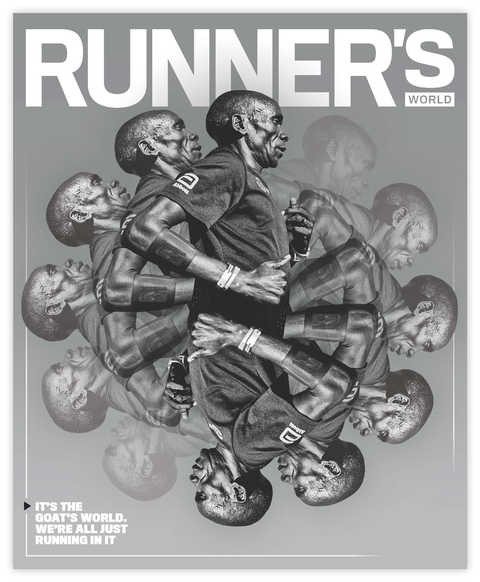
The most recent print edition of Runner’s World Magazine (2023/3) was Eliud Kipchoge centered. It had 8 stories that told us from his humble origins to his monastic lifestyle to a dissection of every detail of his record-setting running shoes to Evans Chebet as his most likely successor. It is the most detailed account I’ve seen of Kipchoge related info in one place.
Runner’s World magazine cover for the issue with the 8 Eliud Kipchoge related stories
The story that caught my attention is titled “Train Like Kipchoge (Sorta)”, by Sarah Gearhart, in which she shares five key aspects of Eliud’s training. My first thought was: how can we transfer them to us, simple mortals, to improve our running results. The article talks about how the greatest of all time (GOAT) does it, which doesn’t mean we must apply it in the exact same way. The key is to harness the key lesson of each one and make it part of our current circumstances.
These are the five principles, as per Runner’s World, with a personal commentary on how to apply it to our recreational runner training repertoire:
1 – Sleep like your run depends on it: Kipchoge sleeps 9 hours a night and takes naps. Most of us don’t have the time for that, but neither we are professionals, nor do we run 120 miles per week. The point is to be purposeful about your sleeping habits. Sleep as much as your body needs and don’t brag about your lack of sleep as a badge of honor. Our body recovers and rebuilds while we sleep, which is more valuable than all other recovery tools in your arsenal put together.
2 – Revive Sore Muscles with an Ice Bath: He takes 10-minute ice baths twice a week “to aid his post run recovery.” As recreational runners we may not have the facilities, the time or will tolerate this uncomfortable activity. But the point is that it works for him and despite the pain and inconvenience, he does it anyway because he works diligently on his recovery. Remember that you don’t become a better runner just as you finish your hard workout. You become a better runner once your body has recovered and adapted to the stress it just went through. So, be as diligent as Kipchoge in your recovery.
3 – Upgrade Your Diet with Protein: Kipchoge’s high-carb diet is essential for his training and performance, yet in 2017 he upgraded his protein intake “to aid his recovery as well as help to build and maintain his lean muscle.” The point here is that diet is key to training, performance and recovery. It is not a matter of how many calories we take in but the quality of those calories. If we fuel with a dozen donuts and a pint of ice cream, our weekly milage or our daily nap won’t really provide the benefit they should.

Stationary biking is one of the multiple options to enhance your aerobic capacity without overtaxing your system (Photo: William Adams, Pexels)
4 – Meditate to Build Mental Strength: Kipchoge is a “mindful runner” says his coach Patrick Sang. “While training and racing, he focuses on his breath and his movements, and aims to minimize outside distractions.” While not all of us can or want to live Kipchoge’s spartan life nor we have the will to perfecting the art of mindfulness, we can separate 10 minutes for daily meditation, we can read a book on mental toughness or practice the visualization of our goals without becoming Zen masters.
5 – Build Bonus Endurance on a Bike: Interesting to note that to add to his training volume “without increasing his risk of a running injury, Kipchoge rides a stationary bike for an hour twice a week after his runs.” For mere running aficionados like us, this is what we call cross training. Participating in a non-running activity once or twice a week to enhance our strength or aerobic training while resting our muscles and soft tissues from the pounding of running. Biking, rowing, weight training, yoga, elliptical, etc. Make sure you do something other than running to complement your training.
If these techniques work for the GOAT, scaling them down to our level would be beneficial. Don’t just think about it, do something about it and don’t take too much time getting started. Marathon season is around the corner.
To read the full Runner’s World article, you may click here.

by Coach Adolfo Salgueiro | Apr 4, 2023 | List, Personal, Reflection
By Coach Adolfo Salgueiro
As a runner who seldom, if ever, runs with music, I usually get deep in my thoughts. This doesn’t necessarily mean that my thoughts are too deep, but they do accompany me through my miles. When you come back from a 2+ hour run alone, you can’t believe how many things crossed your mind. Some thoughts were ephemeral, some were transcendental, some dark and some, just bizarre.
I was pondering this last week and decided to recall some of the thoughts that usually cross my mind when I run alone. Maybe some readers can relate, some may think I am crazy and some may want to add their 2-cents to the list. So, here I go:
1. What a wonderful day for a run. Beautiful weather to get lost in my thoughts and enjoy the sport I love.
2. This sucks! Why am I running today? The weather is awful, I am tired and I don’t want to be here. But I know that when I get back home I will feel better about it, so let’s keep moving.
3. It broke! I’ve been running for at least 45 minutes and this stupid Garmin says it’s only been nine.

Shoes. Running shoes is the answer to most of our running thoughts (Photo: Pexels)
4. I can’t believe my run is over! It was so quick, and I felt so good. I could have gone longer.
5. Oh no! I’m back to my car/home and my watch says 8.87. I’m not done yet.
6. Who had the brilliant idea of registering for a fall marathon so we could train in the Florida summer?
7. This pace is too fast to qualify as easy. I always point this out to my trainees. Screw it! I feel great!
8. I knew I had to go to the bathroom before I left. Let me find a bush.
9. Almost done! It is the equivalent of once around the park plus twice my neighborhood’s short loop.
10. That was an amazing run. Some people need drugs to feel like this.
11. What a spectacular sunrise! This is why I wake up at 5AM on a Saturday and run long.
12. I am 10 miles in and have 10 to go. Why couldn’t I take a sport for normal people, like billiards or ping pong.
13. No! Not another gel. I think I’ll puke.
14. I get it now! That’s how trigonometry works. Now the world makes sense.
15. Ok, I made it to the bench where I was to take a walk break, but I will run until the next light pole and reassess.
16. I am beat up and ready for a walk. But too many people know me here. It will be embarrassing.

Running math in your head while you run, may not bring exact results (Photo: George Becker, Pexels)
17. Let’s see. It will be ham and mushrooms on that pizza, washed down with a beer. No, with two beers… But I’ll get donuts first.
18. Come on!! Ditch those negative thoughts. I run because I like it, not because I have to.
19. I’ve run nine miles so far. So, I don’t need to do 13. Nine is a ton of miles. But 13 is better. How about we compromise at 11? Stop negotiating with yourself and run those 13!
20. This is the 3rd time I have crossed paths with this runner. I wonder what marathon she’s training for.
21. I will kill it next season. I will set up PR in every distance. I am going to train so hard that I will never feel this crappy again.
22. It will be so impressive when I cross the finish line in that race. I will smile and raise my arms just like this.
23. If I keep this pace for 26.2 miles, I will set a PR by 22 minutes. WOW!! No… wait a minute. That’s wrong. Maybe I shouldn’t be running math in my head at mile 16.
24. I love these shoes. Maybe I should buy myself another pair.
25. I hate these shoes. Maybe I should buy myself another pair.
26. These shoes are just OK. Maybe I should buy myself another pair.
27. Do I really need another pair of running shoes? Of course, I do!

by Coach Adolfo Salgueiro | Mar 7, 2023 | Article, Reflection
By Coach Adolfo Salgueiro
As the 2022-23 racing season move towards its end, with just a handful of goal competitions left in the calendar, the time to start planning for the 2023-24 season rapidly approaches. The running season usually goes from November-March, with adjustments depending on your latitude and location. This is time to reflect on what happened, what did not happen and why did or did not happen.
The first question that comes to mind after this intro is: Do runners really need time off?

Rediscover the pleasures of sleeping in on a weekend morning instead of going for a long run (Photo Pexels)
It has been discussed for decades, but based on my years of experience, my answer on the matter is a blunt and unequivocal YES!!!. In all caps and with three exclamation points.
Regardless of your age, level of fitness and commitment to the sport, your body cannot keep its peak level of fitness forever. There is such a thing as an upper limit which cannot be surpassed regardless of how much you run, lift or cross train. So, it is imperative that you provide your body with enough time to rest and relax. This will inevitably decrease your fitness, sure, but you must see it as an investment, a process to go through to continue your path of long-term progress.
The key concept is that once you have recovered and you are ready to restart, given that you haven’t overdone the junk food, alcohol and time off, you will be doing so at a higher level of fitness than where you started last season. This may allow you to achieve an even higher level for the upcoming season.
I will define the off-season as the period between your last race of one season and the first race of the following one. Within that period, I have identified four phases to devote individual attention so you can prepare properly for success.
1 – Rest and recovery – This doesn’t mean you stop all sports activities until next race. Some runners may need a week to a month off just to reset the body and have fun catching up on the pleasures of life that they’ve deprived themselves of during hard training, such as pizza, beer, binging on TV until late or sleeping in. Other runners will want to drastically cut their mileage, or their running days so their bodies can recover and prepare for what is coming up. You must enjoy the process and running’s gotta be fun. Otherwise, a burn out may be on its way and you will no longer run.
2 – Planning – This phase may overlap the previous one, or even with the previous racing season. The time has come to figure out what are your goals for next season. I am a firm believer that having multiple races in your schedule is what will allow you to remain focused so you don’t slack off until you realize the race you were shooting for is around the corner, or it is sold out. You don’t want to plan every workout for the next 6-8 months, but you just need to know when you need to be ready and for what goal.

This is the time to enjoy the pizza and the beer, but obviously, don’t overdo it (Photo Pexels)
3 – Build up – After your recovery time is taken care of, it is time to rebuild your endurance and your speed. This takes time, method and requires patience. Accept you will not start at the same point where you left off. The silver lining is that you will be able to get back there sooner and safer the longer you have been running. Getting back to 50-mile weeks is a quicker process for someone who has been doing it for 10 years than for a runner who just did it last year for the very first time. Put you plan on paper. Block and label the weeks and/months you will need to go through this process. Then, execute.
4 – Training – Everything you did between your last race of the season and the start of this phase is what will determine the success of your next season. A 16-week training plan, especially for a marathon, doesn’t mean you’ll start running again 16 weeks prior to race day. It means that 16 weeks before race day you must be ready to hit the ground running. By then, your aerobic capacity, your core, your strength program and your speed training should be a work in progress. So, in these 16 weeks you just dial in the variables to achieve your goal at the set date.
Other components such as nutrition, sleep, hydration and recovery are year around elements than need to be addressed continuously and are part of all four phases.
If you take the time to plan ahead, even small injuries, periods of sickness, vacation or any other unexpected surprises life will inevitably throw at you, may be fit into the off-season. Prepare yourself with plenty of time and enjoy reaping the benefits of a well-executed plan.

by Coach Adolfo Salgueiro | Feb 21, 2023 | Coaching, List, Reflection
By Coach Adolfo Salgueiro
In a recent phone conversation with a runner I train, she expressed concern about two consecutive bad runs she had just experienced. She had an important race coming up in a few days, though not a goal race. She began to freak out a little bit, thinking she may not be ready, or she may fail, or she just wasn’t a good runner.
I told her that these things happen to everyone. That they are an inherent part of running. When you have good days, the bad days are around the corner. Just as when you feel on top of the world but then you feel underprepared and crappy when it counts. It is part of the process, one from which you should learn, so you can keep them at bay.

One of your running dreams will eventually come to die in porta potty (Photo Pexels)
Keep running and it will happen. “What will happen?”, you ask: Everything! Both the good and the bad.
One or more of these dreadful things happening, even simultaneously, doesn’t mean you are finished as a runner, or that your race is doomed. Just as one or more great achievements don’t mean you’ve made it. It only means you are travelling through one of the typical high-and-low cycles of life, which also reflects itself in your running.
40+ years in running have taught me that if it hasn’t happened yet, it is only because you haven’t run enough. Keep running and it will happen. Guaranteed.
The Bad:
-
You will fall. Hopefully, you won’t break a bone, but you will fall.
-
You will underperform in a race, just when you thought you’re PR was in the bag.
-
You will crap/pee in your pants.
-
You will twist an ankle. How bad, that’s another conversation, but it will happen.
-
You will have a close call with a car. Hopefully, it won’t go beyond that.
-
You will have a close encounter with an angry dog. Be prepared.
-
You will have to stop a run far from your finishing point and require help getting back.
-
You will eat something that unsettles your stomach and spend a pre-long-run night throwing up or sitting on the throne.
-
You will have a bad night of sleep, or two, or three; just before your goal race.
-
You will experience uncooperating weather during your key training run or goal race.
-
You will miss an important run because life just got in the way.
If any of these hasn’t happened yet, just keep running.
Remember: Experience is what we get when we don’t obtain what we originally set out for. Make sure you take advantage of the inevitable and learn a lesson, so you minimize the chances of it happening again.
Good things you haven’t experienced will happen if you keep running. Here is a small sample of them.

One day your battery will die and you will need help getting back to the start. (Photo Pexels)
The Good:
-
You will experience an unexpected PR on a race when you thought it wasn’t even a possibility.
-
You will overcome obstacles to realize you are stronger than you thought.
-
You will reap the rewards of having embraced the lesson from a previous failure.-
-
You will find the assistance from a running angel at the perfect time, or even better, you will be that angel for a runner in need.
-
You will run farther and longer than you once thought possible.
-
You will inspire someone who didn’t know he/she was a runner to fall in love with the sport.
-
You will become friends with people you couldn’t believe you had much in common.
-
You will find some of the best friendships of your life by hanging out with likeminded people.
-
You will surprise yourself and your doctor with the results of your annual physical.
If any of these hasn’t happened yet, just keep running.
Anything you may want to ad to these lists? Let me know in the box below.

by Coach Adolfo Salgueiro | Feb 7, 2023 | Article, Coaching, Reflection
By Coach Adolfo Salgueiro
Last week I was talking to a friend who is helping his brother train for his first half marathon. He told me the toughest part of the process is making him understand that the “no pain, no gain” old-school mentality no longer applies to running. The days of alchemy are over. The collective thought has evolved and adjusted to new science studies or discoveries, thus, we understand matters in a new way, one that 5, 10 or 50 years ago was unheard of.
In 1968 Kathrine Switzer had to finagle her way into the Boston Marathon because back then women were thought to be so fragile, they could not endure such physical punishment. The carb depletion pre-marathon protocol was the rage in the mid-1980s, today we know it makes no sense. The “I run through pain” approach that showed bravado 20 years ago, displays recklessness, today. And like that, many more running ideas that once we thought gospel, today are barely gimmicks.
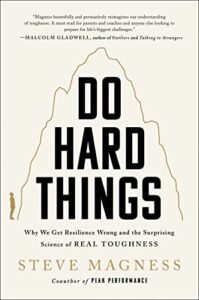
A good book worth the time and the money. Highly recommended.
In his book “Do Hard Things” author Steve Magness, one of my coaching role models, talks in depth about getting over of this old-school thinking. He explains how toughness is navigating through your training, not bulldozing through it. This how we avoid overtraining, and even worse, injuries. It is about being smart.
He goes through eight strategies to develop real toughness as a runner. I am not going to go through all of them, of course. If you want to go in depth into them, that’s what the book is for. But I will briefly touch on three that caught my attention and that I now teach my coached athletes.
A – Our alarms are adjustable: “Being tough gets easier the fitter you are.”
What an avant-garde concept! Think about it this way: If you spent the last 10 years on the couch watching TV and eating Doritos but decide to go for a 5K run, most likely you will suffer through it, regardless of your commitment or toughness. But, if you got the running bug, you trained smartly, diligently, and two years later you complete a marathon, it is not because you have multiplied your toughness. You reaped the benefits of your work and got better at it. Just like the first time Bruce Springsteen picked up a guitar, which these days is an extension of his body.
B – We need hope and control: “The key to improve mental toughness doesn’t lie in constraining and controlling individuals. It doesn’t lie in developing harsh punishments to teach a lesson. It doesn’t lie in screaming at the person to complete the task in front of them.”
The era of “I am not done when we are tired, I am done when I am done”, is done (pun intended). If you are training for a marathon, you need to run 18 miles but you are feeling unwell, stressed at work, just had a fight with your spouse last night, didn’t sleep well, it is a hot/humid summer morning and you are beat up at mile 15… what’s best? Calling it a day and be happy you completed 80% of your workout despite the circumstances, or pushing through while destroying yourself, to prove your machismo and then having to take 7-10 days to recover from the effort? … Exactly!

Finishing exhausted after a training session could lead to injury. Be smart and always live to run another day. (Photo: Pexels)
C – Feelings and Understanding need interpretation: “The power through mantra only makes sense if you take stock in what you are powering through.”
I want to make sure my readers understand I am not saying you need to be complacent when training gets difficult. We need to learn how to power through difficult trainings, races, cross training and life. The key is to understand why we are doing what we are doing. If we are trying to run at race pace, then race pace sessions will be difficult. But we need to push through them if we want to understand and teach our bodies how to run at that pace. When we start strength training, or add yoga to our plan, everything will hurt, but there’s a good reason to keep going despite the aches and pains. It is not about suffering for fun; it is about reaping benefits in the near future.
These is my take on three of these principles, I fully recommend the book. “Do Hard Things” is a good investment of time and money for any runner out there. And it is not just for runners, but for every person wanting to get better at leaving their comfort zone behind and actually going for what they want, for their life goals, not just the athletic ones.
Please leave me your thoughts nn this blogpost, in the box below.
by Coach Adolfo Salgueiro | Jan 24, 2023 | Article, Opinion, Personal, Reflection
By Coach Adolfo Salgueiro
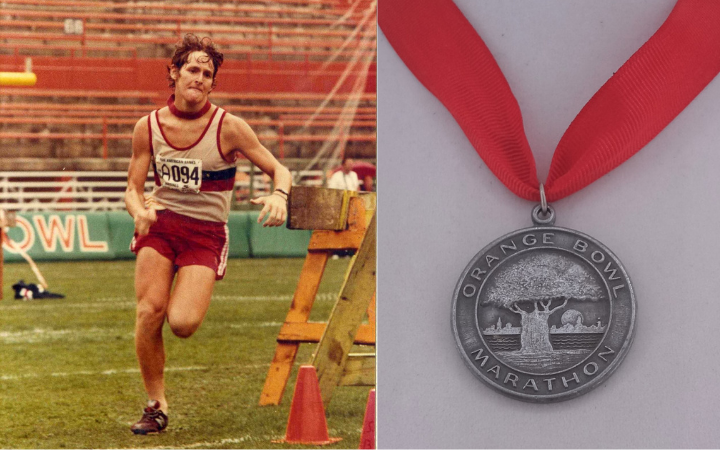
I still can’t believe that it has been 40 years since my first marathon. Four decades since that unforgettable January 22nd of 1983 inside the old Orange Bowl Stadium in Miami. 14,610 days have passed since that unprepared 17-year-old higschooler crossed a finish line that became the gift that kept on giving.
Since I can remember, I wanted to run a marathon. Not sure why. Maybe because I read about the athletics exploits of Abebe Bikila, Emil Zatopek or contemporaries like Frank Shorter and Bill Rogers. Who knows? Somehow, I always loved the extremes. I started running when I was 12 or 13 while living in Caracas, Venezuela, and at 15, ran my first 10K race. Then, a couple of months after turning 17, my dad told me he was running the Orange Bowl Marathon in January 1983, and if I trained, he would take me to Miami. Maybe I just wanted the trip and a few days off school, or it could have been a legitimate attraction for the physical challenge. Regardless, what I know is that 6 weeks later I was lining up at the foot of the iconic home of the Miami Dolphins, who eight days later were taking on the Washington Redskins in the Super Bowl.

The Miami Orange Bowl stadium (1937-2008) seated 72,319, hosted 5 Super Bowls and was home of the Miami Dolphins from (1966-1986)
I’ve written before about that race. So, on this anniversary I don’t want to reminisce about that particular day, but on what the race has meant to me throughout my life. Last year, on the 39th anniversary of the marathon, I wrote a memoir about that day because I didn’t want details to be forgotten. If you would like to read more about it, please click here. I also wrote a post about getting my finisher’s medal 37 years later, back in 2020. If you want to read about it, please click here.
After that magical morning, 40 years ago, even if I never ran another step in my life, I was a marathoner. It is a label that sticks forever. It doesn’t fade away with time, or by forgetting the exact date and finishing time, or by never wearing a pair of running shorts again.
I kept running for a handful of years after my first marathon. By the time I turned 21 I had four under my belt, with a couple of them in the 3:30 range. I ran through my first three years of college and even had escalated disagreemtns with my girlfriend, who at times was fed up with not going out with our friends on Saturday nights because I had a Sunday morning long run. Many a time I had to put my foot down and state that I would drop her before my training. Today I would have handled it in a different way, but that was then.
As I have mentioned in other writings, as I was training to go sub-3 in 1986, I had a devastating non-running injury on my left knee that left me on the sidelines. It was such a demoralizing blow that I stopped running for decades. While not running I discovered the pleasures of sleeping in on weekends. I didn’t want to have the same issues with new girlfriends, so I went out partying on Saturday nights, and on Friday nights, too. I focused on getting my career in sports journalism started, graduating from college and all the stuff “normal” people do when they don’t need to wake up early to run long next day. The day I turned 18, I went to bed at 8PM because I was running 30Km (19 miles) next day as part of my training for the NYC Marathon. What a weirdo!

There is not much to be found online about the 1983 Orange Bowl Marathon. Surprisingly I found this cotton race shirt in eBay for “just” $149,99. Thanks, I’ll pass.
Yet, somewhere deep inside, I always knew I had one more marathon in me. Just one, to remind myself I could still do it, or to fool myself into thinking I was still as good as when I was a teenager, or to revisit old glories, or to show my young son what you can accomplish when you work hard towards a difficult goal. Whatever it was, I still wanted to hit the asphalt and take that 26.2 trip once more. Just once.
But sometimes you cross paths with the wrong people and they clip your wings. At 39, after a 2nd knee surgery in July 2004, I told the doctor I still had one more marathon in me and asked if he thought my knee could take it. He told me in no uncertain terms that I shouldn’t and couldn’t. I was stupid enough to take his word for it.
But one day, out of the blue I started walking for hours at a time, feeling good about it and experiencing the runner’s high once again. I found racewalking and then racewalked four half marathons, transitioning to the 26.2 at the 2012 Philadelphia Marathon. Three years and two more marathons later I realized that I just took the doctor’s word and did not run because he said so, not because I tried and failed. So, I got my running restarted and ran my first marathon since 1985, in 2017. Five years, four marathons and an open-heart surgery later, I am still running and looking towards my next 26.2-mile adventure.
The Marathon Training Academy podcast runs a great tag line: “You have what it takes to run a marathon and change your life”. I certainly had what it took to run it again, and my life hasn’t been the same since I completed that 2017 NYC Marathon after I became a runner for the 2nd time; nor since I racewalked the Philadelphia Marathon in 2012 after a 26 year hiatus, nor after that magical morning at the Orange Bowl Stadium, 40 years ago, this week, when my lifetime love affair with the mythical 26.2 monster got started.