
Become the CEO of Your Running

Become the CEO of Your Running

By Coach Adolfo Salgueiro

A good friend of mine shared a post in LinkedIn, last week, where 10 tips for CEO success were listed. The further I read, the more I felt this advice could perfectly translate into our running lives. After all, everybody should the CEO of their own running.

CEO of Your Running

Obstacles are inevitable whether in business or in running. You better be prepared to face them (Photo: Ann-H, Pexels)

It is important to note that my friend specified he could not find the source of these tips, so neither him nor I are claiming ownership of them.

Below, I am duplicating the tips for CEOs as I got them (though translated from Spanish) and then sharing how they apply to taking charge of your running life. Let’s get started.

1 – Focus on the important issues – There are way too many diversions fighting for your attention. Too many goals, too many races, too many social media platforms competing for your likes, etc. If you are to take charge of your running life, you need to pick your direction and your goals, so you know what you are working towards. Setting up PRs in all the distances, every race, every season, is unfeasible. So, choose where you’re going and start focusing on it, now!

2 – Make quick decisions and apply them as soon as possible – Just as in running a company, there are multiple options to choose from, but you must stop procrastinating and pick the one you’ll pursue. You can’t wait for the stars to align before you define if you are changing your season goal to a marathon when you’ve been training for a 5K PR.

3 – Use few rules, as too many rules prevent flexibility, change and innovation – A training plan must be dynamic and everchanging. Don’t overthink every single aspect of your training to the point that you’d rather get injured than adjust. Focus on the main parameters, not on the minutiae. Be openminded enough to realize when your plan needs adjustment.

4 – Learn to say No – When you decide to go for a running goal, you are to be 100% focused. So, to continue your progress you may have to skip certain parties, happy hours or comfort foods for a while. Nobody expects you to miss your best friend’s wedding because you have a long run, but you should not get drunk out of your mind at the party if your goal marathon is in two weeks. Focus now, party later!

5 – Keep a goal in mind, even if it is difficult to achieve. Have a long-term vision –Running is a journey, not a quick weekend road trip. Your goal may take more than a race or a season to achieve. Some runners have worked 10+ years towards their BQ. Accept that there will be bumps along the road, learn from them, and keep running towards that goal.

CEO of Your Running

Your goal may take more than one race and more than one season, but if you keep focused, you may achieve it (Photo: Iconcom, Pexels)

6 – You should be willing to spend many hours at work – Hard work require long hours. It is that simple. There are no shortcuts, simply hard work.

7 – Study, learn, update your knowledge – You won’t be able to improve if you keep doing the same thing over and over. There’s new science being published every month, there are books, articles, podcasts and magazines to guide you through your journey. And, if you don’t feel like doing this part of the job, hire a coach who will do it for you.

8 – Be courageous when facing adversity because you will find obstacles – It won’t be easy. Face it and accept it. It will require sweat, pain, funds and sacrifice. Sometimes, even injury. Be ready to work through it because these obstacles are coming fast at you, so you better be ready to confront them.

9 – Put passion into your work – You can’t run a marathon or train year-round just to please someone else. You must enjoy it and be willing to invest the time and sweat this requires. If you are not passionate about it, do yourself a favor and find another hobby.

10 – Develop communicational skills – Even though ours is not a team sport, running in a group or a team can ad so much to your running life. Sharing your journey with friends, or through social media groups specifically created for this purpose, can boost your confidence, knowledge and experience. Don’t go solo in your running life, especially in the 21st Century.

Take charge of your running in the same fashion as you would take charge of your own business. If you visualize it, focus and work hard towards your goals, there is a good chance you will achieve them. Nobody will do it on your behalf.

Any thoughts?

 
8 Tips to Succeed on Your Running Journey

8 Tips to Succeed on Your Running Journey

By Coach Adolfo Salgueiro

As runners, we would all like to improve on a weekly or monthly basis. If we could set up PRs in all our trainings, races and in all our distances, why wouldn’t we? It must be a lot of fun. But the human body is not set up for an indefinite, upward linear progress. There comes a time when such progress wanes down. And there are also times when you get in a running rut.

Tips to succeed

Keeping the motivation alive is the key to the success of your running journey (Photo: run-ffwpu, Pexels)

It is easy to lace up and hit the asphalt or the trail when things are going well. When you are running in-the-zone, effortlessly, when the miles pile up without feeling them. But the key to becoming a successful and life-long runner is to be able to keep your motivation up when things are not going well. When you are injured, when you can’t figure out why your body doesn’t give you more than 4 miles, when it hurts just to think on putting on your running shoes, when everything just sucks.

 Fortunately, there are plenty of strategies to apply to keep that running journey alive. To get back to where you want to be. Here are eight of them:

 1 – Create feasible, short-term goals to keep you focused: Regardless of where you are on your journey, having an achievable goal in front of you is crucial to keep moving forward. The operating adjective here is “achievable”. Even amid a long-term goal, such as a BQ in 3 years or running 2000 miles this year, you must structure a plan that will allow you small triumphs to keep your dream and your motivation alive.

 2 – Register to a race, now: I am convinced there is no bigger motivation out there than being registered to a race. This way, you know you need to be ready to run X distance by X Day. This will allow you to set up a plan, set expectations and motivate you to keep moving forward during the inevitable challenging times. Even more, let everyone know you have registered, so it is even tougher to back out.

 3 – Find a running partner/group: While running could be the perfect time for introspection and solitude, having a running partner with similar goals to be accountable to, is always a good strategy. You can also join a running group or team where you can find yourself welcomed and become part of your local running community. This will change your running life. Guaranteed.

Tips to succeed

Diet doesn’t have to be fancy. Just eat more of the the good stuff, cut the junk, and you will see immediate improvements. (Foto: Polina Tankilevitch, Pexels)

4 – Dial in your nutrition: If you eat junk all day, there is no training plan able to help you become the best runner you can be. Nobody expects you to never again eat a donut, but you can’t eat six them and flushing them down with Coke, every single day. A solid and balanced diet will take you a long way. It doesn’t need to be a fancy nutrition plan. Eat your veggies, consume good carbs and fats, take it easy with the alcohol and don’t overindulge. That alone, will take you a long way.

 5 – Make rest part of your program: You can work as hard as you want, but if you don’t allow your body to heal and repair, you will become overtrained and injured. Not a matter of if but when. Cross training days, when your body works out but doesn’t receive the pounding, or a weekly day with nothing in your schedule, should be an integral part of your plan, so you can keep healthy and so you won’t burn out.

 6 – Do not sacrifice sleep: Remember you don’t improve when you work out, you improve while you sleep. The long run, the tempo, the weightlifting, or the speed session damage your body. It is when you sleep that your body gets repaired. If you skip on sleep, you won’t realize all the benefits of the training, but you will keep the muscle damage. It is that simple.

 7 – Work with a coach: This is not a self-serving tip. There are reasons why even multi-billion dollar companies hire consultants. Someone who can see things from the outside and assist in maximizing their resources to improve results. Same applies to your running journey. The knowledge and experience of a specialist at your service, can only enhance your experience and thus, your performance.

 8 – Just have fun: If you don’t have fun, you won’t last as a runner. It is that simple.

 Any other tips you may want to contribute?

Alcohol and Running

Alcohol and Running

By Coach Adolfo Salgueiro

As adults with a full life, alcohol is a ubiquitous part of most of our lives. Some of us enjoy the occasional drink in a social setting, some have one every day, some can’t stop consuming it, and some finally overcame alcoholism.

As far as I have read, there’s no proof that the occasional post-run beer will wreck your recovery, nor that it will help it either. Yet, alcohol has undeniable social benefits associated with consuming responsibly it with your buddies, like after a run. I am not a scientist or a wine drinker, but I’ve read about the benefits of a glass of wine when it comes to HDL cholesterol and antioxidants. I’ve also read how more is not necessarily better. You should not be having 3 or 4 glasses because it the positive effects don’t necessarily compound.

Alchohol and Running

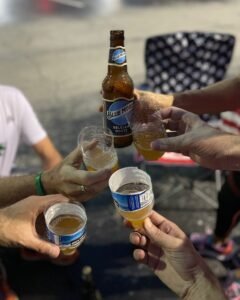
A post-run beer has many social benefits and won’t ruin your recovery. The operating word here is “A”, meaning “one”.

I am not here to proselytize on alcohol consumption, which is a personal choice. But as athletes wanting to improve on our fitness and/or racing times, we need to be aware what are the negative effects that too much alcohol can have on our recovery, which is half of our training (Work + Recovery = Training).

For starters, alcohol is a diuretic. A diuretic is a substance that promotes the increased production of urine. This means that it produces dehydration, a big problem for runners. The consequences of moderate dehydration are, among others, cramps and fatigue. Severe dehydration, which can occur after combining drinking and running, include urinary and kidney complications, low blood volume, heat-related injuries and even seizures. As if that weren’t enough, I am sure that running with a hungover must suck all the joy we could get of the sport.

As I was researching this topic, I googled “alcohol and running” and, among the 812 million results I got, the very first one was this paragraph, which resumes most of what I wanted to say: Alcohol is a powerful diuretic, and dehydration is never a runner\’s friend. The risk for muscle cramps, muscle pulls, muscle strains and general fatigue increases when dehydrated, so drinking extra water after a night of hitting the bars is more than necessary to regulate your body for your next run.”

As we have mentioned in this blog, many times before, the number one recovery tool in your arsenal is sleep, which is the time your body uses to repair itself from the pounding of your training and the stress of your day. Alcohol consumption affects and impairs your sleep. Don’t let anyone fool you by telling you that drinking makes them sleepy like a baby, so it doesn’t affect them. Even if you are asleep, drinking in excess will affect your REM sleep, which restores your brain and is good for your memory and learning. Sounds kind of important to me.

Alchohol and Running

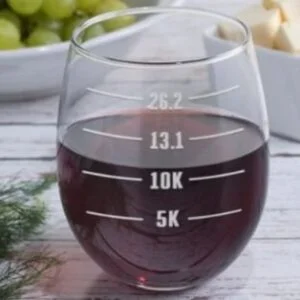
Wine has plenty of documented benefits, but they do not compound the more your drink.

Consuming alcohol in excess, also affects your fitness, which is the capacity of your body to recover so you can do it again. If your liver is too busy processing the excess alcohol you consumed, it would not be able to assist repairing of your body, which is needed after every training session, regardless of how easy it was.

The definition of “excess” is personal and individual. What is suitable for a fit, 200-pound male, may not be suitable for a 115-pound female recovering from Covid. Each runner must understand what is good for their lifestyle and make sure they can live with their decisions.

In a podcast I recently listened, Coach Jonathan Marcus made a comparison between two separate issues. One of those fits perfectly in what the last paragraph was explaining: “You can down a whole bottle of wine in 45 minutes. You can do it. You can, physically, get the liquid into your stomach. But what is going to happen afterwards is not going to be pretty. Or, you can have half a glass of wine in an-hour period, sipping on it though dinner, multiple nights in a row and enjoy it as part of a meal. Your body can extract the nutrients, flavors, etc. from that, versus being overly consumed by the poison of the alcohol that then forces a harsh and severe, nasty metabolic response”.

This post is not for pointing fingers, preaching on lifestyle or proselytizing on the virtuosity of abstention. Just make sure you understand what the consequences of mixing running with alcohol are for both your body and your training, so you can make the right choices when the time comes.


On Running While Holding your Phone

On Running While Holding your Phone

By Coach Adolfo Salgueiro

I live in South Florida, not too far from the beach. One of the projects I am currently working on has me driving through Ft. Lauderdale Beach on a regular basis at various times of the day.

One of the favorite pastimes during my commute, has become checking of the form of the many runners I see along the beachside. It started as something fun to do and now it has turned into an exercise to become more proficient at analyzing running form issues. Yes, I do understand there is no one-size-fits-all running form, but there are blunders that are blatantly wrong and if not corrected, they’ll lead to injury.

Running While Holding Your Phone

Holding the phone in your hand while you run, could lead to injury.

I’ve noticed that at least 75% of runners with bad arm mechanics are holding their cellphones in one of their hands. By now, when I spot form flaws from afar, I can bet who is holding a phone, and I rarely miss.

Phones have many advantages and functions and they’ve become ubiquitous. They provide music, tracking, feedback, safety and security, among many others. Yes, it is important to carry it while you run, but that doesn’t mean you must carry it in your hand. With so many options in the market, there are plenty of alternatives to clenching to it. And this is why:

In his book “Running to the Top”, legendary coach Arthur Lydiard states that “If we clench our fists – and I often see people running with weights clenched in the hand – we tighten the upper shoulder muscles and, consequently, start to get a shoulder roll. Something has to go back when you\’re running; it should be your hand, but put tension on those arms and the shoulder will begin to roll, and that\’s undesirable.”

Of course your phone is not as heavy as the lightest of weights, but it is a precious object, both in monetary and emotional value. So, regardless of how light your phone may be, you are holding in tightly. You don’t want to drop it. This means you are contracting the muscles in your hands, and thus, arms, shoulders and even chest, screwing with the counterbalancing your gait needs by compromising the flow of your kinetic chain. While this happens, your other arm is doing its own thing. A recipe for unbalances in your leg, hip and shoulder, and thus, injury.

This is not a new phenomenon. It has been touched upon in many magazines and websites for several year, now.

In a 2019 article from Cosmopolitan UK, by Caitriona Harvey-Jenner, professional running coach Alexa Duckworth-Briggs, urges runners to carry phones in a waist belt. \”When you hold something in our hands, there are subtle knock-on effects to your gait. It creates muscular imbalances, affects the distribution of weight across your body, and makes you a less efficient runner in general. By making one arm heavier, you’re altering the momentum of your limbs. And your body will attempt to compensate for the imbalance by working certain muscles harder than others. That’s where repetitive strain injuries will come into play.\”

Running While Holding Your Phone

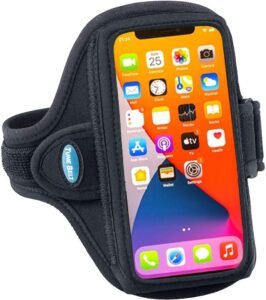
Arm bands are a little bit better, since you don’t contract your muscles, but they are not the solution, either.

In another article, this one in Active.com, author Hunter Hewitt explains how “running with something in your hand causes you to use body parts differently than you normally would. Proper running form starts with muscle equilibrium and even distribution of weight across your body. Holding something creates asymmetry, as you use your hand and arm differently compared to when you\’re running hands-free. These asymmetrical effects lead to poor form and muscular imbalance, which make you a less efficient runner.”

Since we are touching on the subject, the same principles apply to water bottles, towels and any other artifacts you may want to bring with you while running. Carry them on you, sure, but don’t hold to them.

Although an arm phone carrier is better than holding it in your hand, it is not the solution, as it adds weight to one of your sides. And even though you may think it is negligible, and for one day or two it may be, running mile after mile, week over week, month over month, at the rate of about 1500-1700 steps per mile, the cumulative effect will eventually get to you.

Let’s get this bad habit fixed before we end up holding those phones to take pictures from the sidelines while our friends, those who carry them in their belts, finish their races.

 
Race Recap: Miami Half 2022

Race Recap: Miami Half 2022

By Coach Adolfo Salgueiro

 The biggest and most important event in the South Florida racing calendar is the Miami Marathon and Half Marathon. In 2022 it ran its 20th edition. A must for all local runners and a destination run for international runners, especially from Latin America. Even though the field was reduced to “just” 15,000 due to Covid restrictions, it was nevertheless, a great race.

Race Recap

Free race pictures are a staple of the Miami Marathon. At least I got a good one to cap the sufferfest

As the name states, the race has both marathon and half marathon distances ran simultaneously. They separate around mile 12.5. I cannot say much a about the marathon because I have never run it. As for the half, 2022 was my 11th consecutive participation in the event.

The expo took place in the newly renovated Miami Beach Convention Center. The bib pick up was quick and easy. The expo was packed with vendors of every kind, with diverse samples of drinks, foods, gels, food services and electrolyte concoctions. You could also find shoes, shorts, socks and the newest gadgets. Stands for many international races were present. Even a coaching service where you could talk with an actual Olympic marathoner. For the first time, I saw free haircuts. Go figure!

In general, the race ran smoothly. Gear check was impeccable, signage was good and there were plenty of porta-pots. No urinals around, though. I still can’t figure out the logic behind the opening of Corral H. While the race started at 6:00, the gate to corral, inconveniently located in front of a row of porta-pots, remained closed past 6:15, as thousands of runners congregated in front of an empty corral. Other than to annoy runners on purpose, I can’t figure out any other reason for this to happen.

The half marathon course is always a delight, running by the cruise ships as the sunrise bathes the runners with sunlight while they enter the world-famous South Beach. Then through Miami Beach, followed by the spectacular views of the city on the way back to Downtown and the finish line.

Race Recap

A nice medal to commemorate the 20th edition of the Miami Marathon and Half Marathon.

The sour note was the screw up at the water stations. How can a race of this caliber and in its 20th edition, f-up the water stops so badly? When I stopped for water the first time, I picked the left side of the road, only to learn that it was the “Gatorade side”. This meant that if I wanted water, I had to cross the street while I had thousands of runners coming at me. And this happened more than once. At Mile 6, the water stop was abandoned and after that, a handful of stops did not have enough cups readily poured. This on a day with 93% humidity.

MY RACE

 On the personal side, my race was terrible. Despite the fact this was my 11th time running the half, and my 43rd half marathon, I made many mistakes, many of them rookie blunders, which guaranteed me a forgettable sufferfest.

It started when I woke up at home and went to eat a bagel, only to realize my wife served me the last one for breakfast, the day before. It was my mistake not to ensure there was one available, and I assumed it. I didn’t bother to check the weather and the humidity caught me by surprise. Then it was the issue with the corrals, which got me in a bad mood just before the race.

Because I had ran the Houston Marathon three weeks earlier, I thought that half was a done deal, and didn’t even bother mentally preparing for the task at hand. I found myself at the starting line not even sure what I wanted to do with the race. I knew I wasn’t going to push and that I just wanted to have fun, but never bothered to review what that really meant or how get it accomplished. By the time I found no water at Mile 6, I had already bonked mentally. I didn’t go fast nor was I tired. I just didn’t feel like I wanted to run another 7 miles.

All that is on me. They were my mistakes. I can’t blame anyone else. I was cocky, overconfident and acted like a teenager who thinks he knows better than anyone. I paid for it.

As I tell the athletes I train, bad days, mistakes, failure and poor races are important to experience because they will give you invaluable experience that can only make you a better runner. I learned my lesson: never underestimate any distance, regardless of how many times you’ve ran it.

One of the remarkable things about the Miami Marathon is that it includes free photos for all the runners. I got was an amazing image from the culmination of my sufferfest. Final time was 2:33:27, by far my worst running half.

Did you run in Miami on February 6? Please share your experiences with the readers by leaving a comment.

Race Recap

A nice medal to commemorate the 20th edition of the Miami Marathon and Half Marathon.


Race Recap: Houston Marathon 2022

Race Recap: Houston Marathon 2022

By Coach Adolfo Salgueiro

 On Sunday, January 16th, I participated in the 50th anniversary edition of the Chevron Houston Marathon. I want to start by stating that it was one of the most amazing experiences I’ve had in 40+ years of racing. From the organizational perspective, the race is at the same level of any big-city event. It is up there with any Major. On the personal side, it was uplifting. From the coaching side, it was memorable.

Race Recap

About to cross the finish line with a hand in my heart and the other one thanking The One who made this miracle possible

I knew the event’s center of operations was the George R. Brown Convention Center, which is huge. I never expected it to take the entire place. The execution of the bib pick up was flawless even though a bit more signage would have been welcome for the sake of out of-towners, such as me. I did not visit the expo, though. Friends told me it was a smaller version, given the Covid reality of the world.

Running morning was cold, cold, cold. Thirty-six degrees when we left our Airbnb. But we were able to find refuge, toilets and a place to rest while we waited for our corrals to open. Everything was so well organized and orderly that your only worry was walking to the start. The whole shebang was taken care of for you.

The course was flat, sans an overpass and two, minor underpasses. We ran through beautiful areas of the city and crowd support was solid without being overwhelming. There were so many port-a-pots throughout the race that I never saw a waiting line. There were even urinals at the starting line, first time I’ve seen this in the US. I stopped about mile 14, not because I had to but as a preemptive measure, just because I could and there were no lines.

Last mile, back in downtown, was stunning. Lots of fans and photographers lining up to welcome back the runners. After picking up our spectacular finisher’s medal, we went into the Convention Center to get our finisher’s shirt and food bag. The only unflattering thing I have to say about the race is the shirt. It was a cheapy fabric, fits poorly and the design was nothing to write home about.

I fully recommend this event to anyone interested in a big-city race. This is a Marathon-Major-like organization without the Marathon Major label nor price tag.

COACHING EXPERIENCE

I had a wonderful experience with my four coached athletes in the race. All three marathoners set PRs even though two of them contracted Covid just three weeks before the race. This hindered their expectations and the size of their PRs, but they both achieve their A-Goals through courageous performances. The half marathoner was able to cross the finish line strong, healthy and with a big smile on his face. His goal was finishing after a long hiatus, and that was accomplished, too.

All runners trusted the process, followed their training diligently and executed their race plans to the tee. Thus, the results.

There is nothing more satisfying for a coach than one of your runners telling you: “Thank you. I couldn’t have done it without you”. Even though it sounds (and it is) self-serving, it reminds you that, even though they all had in them the ability to achieve what they just did, your guidance made a difference in this runner’s race. And that is priceless.


MY RACE

On the personal side, I was able to complete the Houston Marathon (my 11th), just 207 days after open-heart surgery. I trained with a race/walk protocol that allowed me to make this a reality, despite having time for just two long sessions (16 and 17 miles). Yet, in just four months, I was able to complete the race in 5:16:45. The time is nothing special, but on my race, time was irrelevant. It was all about crossing the finish line.

Race Recap

Even though it was my 11th marathon, this finish line was special.

The chilly weather was helpful. I ran the first 7 miles biting an 11 pace, and from there started my walk/run protocol of .18/.82 (weird splits, sure, but it was where, after much practice, I felt more comfortable). I reached miles 16, 18 and 20, tired but strong. Legs started to hurt reaching miles 21 and 22 and after the walking break for Mile 23, the legs just stop firing. I tried to restart the running, but it wasn’t happening. I ran some quick math and realized that if I restarted now, I could go sub-5, but the legs were shot. Then I realized that being at Mile 23, 30 weeks after OHS, was miracle enough and I wasn’t going to let the clock dictate the terms of my happiness or what God was allowing me to do. So I walked most of the last 5K with a big smile, never resenting the time lost or wondering why I didn’t go for the half.

I crossed the finish line with teary eyes and a couple of seconds later, I hear the unmistakable screams of my beautiful wife welcoming me. Unfortunately, she was on the other side of the street, and it would take about an hour for me to hug her. But the fact that she witnessed the miracle of my finish, firsthand, uplifted my spirit.

Houston was a spectacular experience in every sense of the phrase. As a runner, as a coach and as the protagonist of something improbable. Because what I personally accomplished is so unlikely that it can only be explained by the divine intervention of God, through me. This is what proves that it is a miracle. Sharing it with my friends from the No-Club Runners multiplied tenfold the experience.

I can’t wait to see what’s next!

 
Skip to content