
Mastering the Mile-Repeat Workout

Mastering the Mile-Repeat Workout

By Coach Adolfo Salgueiro

While there is no magic workout, the long interval workout is mandatory if you want to run longer and faster. There are many iterations of the long interval, but to me, there is nothing like the mile-repeat. It is challenging yet not unconquerable. It is long but not unending. You can start with a few reps and progress to as many as you can handle. If performed at the right pace, you can recover and do it again right away. And if all that wasn’t enough, it hits all the systems.

Mile-Repeat Workout

Mile-repeats can be executed on track or road and properly executed, it will do wonders for your speed and endurance (Photo: Ernest Flowers, Pexels)

I remember reading Alberto Salazar’s autobiography many years ago. He was adamant that this was his key workout from his high school days to his time at the top of the world’s elite marathoners. Since then, I have performed it and prescribed it to my trained runners. The results have always been palpable.

Ā A mile repeat improves your cardiovascular system while upgrading your endurance and speed. Cadence is increased, mental toughness is developed, and physiological indicators such as VO2Max and lactate threshold are enhanced. Because you are performing at a high rate of energy consumption, the brain ensures that wasted movement is kept to a minimum, resulting in better running form.

Ā Mile repeats are more than hauling ass one mile as fast as you can go. Anyone can do that. The key is to understand the purpose of the mile you are running. This will determine the pace and effort in which it should be performed.

Ā Benefits of mile repeats include:

Ā ā–ŗ Speed Increase: When performed at race pace or even faster, you are stressing your multiple systems and teaching your body to withstand harder efforts for longer. You are also teaching it how to recruit additional muscle fibers when the usual ones are beaten up.

ā–ŗ Pace learning: Because we run mostly at an easy pace to maintain and improve our aerobic base, learning how to reach, feel, and maintain our race pace is key. Mile repeats are a perfect way to get there before starting to extend the race-pace mileage. The key is to be constant at the desired pace and not believe that faster is necessarily better.

ā–ŗ Endurance improvement: Running roughly at the pace you could sustain running all-out for one hour (Tempo) will improve the amount of oxygen you can consume at max effort (VO2Max) and push the line in which your body is unable to use lactate to fuel itself and become unable to clear it, thus triggering fatigue (Lactate Threshold).

Mile-Repeat Workout

The keys to the mile-repeats workout are being constant and keep the movement going (Photo: Mikhail Nilov, Pexels)

In a recent article in the Marathon Handbook website, Amber Sayer stated a great point to be considered when executing this workouts: “The longer your race (half marathon or marathon, for example), the earlier in your training program you can do mile repeats at race pace, because a mile is a significantly smaller percentage of the overall distance.”

And mile repeats don’t need to be performed on a track necessarily. I wrote a post on that issue, which you can read by clicking here.Ā 

Ā Executing your mile repeat workout safely and properly requires certain preparation:

Ā ā–ŗ Know and understand your workout: It is imperative to be prepared for a difficult workout, so you won’t have the mental space to improvise. Know how many reps you have, what your recovery time is, what is the pace and what is the purpose of this workout. This will predispose you to a successful effort.

ā–ŗ Warm- up properly: You will be performing a hard workout. You must prepare your body for it not only to avoid injury (as if that weren’t enough reason) but also to make sure you can reap maximum benefits. If you want to read more about the value of the warm-up, click here.

ā–ŗ Keep it constant: Running the first 400 meters in 1 minute, 2nd 400 in two minutes, 3rd in 3 minutes, and 4th in four is not a 10-minute mile. It is a shitty, worthless mile. Maintain your effort and pace as consistently as possible. This is what’s going to make you better, not a one-off 400-meter stretch at world record pace. Consistency and frequency are what will reap the most benefit for your effort.

ā–ŗ Continuous movement: You will be tired once your mile is done. Of course, don’t stop, collapse, or sit down. Keep moving. This is the closest you will replicate the demands of a race. I recommend a light jog in between miles, but if this is too much, walk until you catch your breath and then jog. The point is to continue moving forward as you recover and get ready for the next rep.

ā–ŗ Focus on your current rep: Stay focused on the mile repeat you are executing right now. Don’t dwell on the last one being too fast or too slow. Don’t think about what will happen after this one. You are executing this one now, and it must be executed properly. Thus, it is the only one that matters.

ā–ŗ Cooldown: You performed a hard workout. Your body is in overdrive. You are tired, exhilarated, most likely amid a runner’s high. This is not the time to jump in the car and go home. A mile or two of easy running will help blood flow. Muscle recovery, and removal or metabolic byproducts. If you want to read more about the value of the cooldown, click here.

Ā Make sure you add this workout to your training repertoire. The benefits will surprise you.
Should I Run With a GPS Watch?

Should I Run With a GPS Watch?

By Coach Adolfo Salgueiro

As I write the title of this blog post, I feel like the answer to such silly questions is, ā€Duh! Of course, I should run with a GPS watch. How Am I going to know what I’m doing if I don’t.ā€ Yet, there is a reason why I chose this topic for this week’s post. The answer is not so simple.

GPS Watch

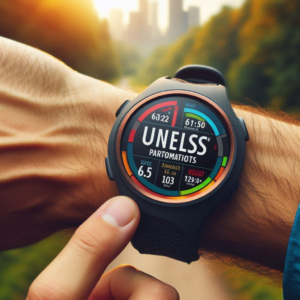
For a few hundred bucks we have more computing power on our wrists thatn what NASA had to land Apollo 11. Let’s use it wisely (Image by WIndows Copilot)

Our GPS Watches, generically called Garmin as it is the dominant brand in the market, are nowadays as ubiquitous as our smartphones. They are an extension of our smartphones, and they can’t work if they are not paired with them.

I’ve written before about not letting our watchesĀ become the directors of our runsĀ instead of the recording devices. Also, about theĀ data overloadĀ ruining our experience. But this is about what type of runner may benefit or be affected by the use of a GPS device on their wrist.

You should use a GPS Watch if:

ā–ŗ You understand the data you are looking at and know what to do about it should it need adjustment in the middle of the run. Worrying about your right foot oscillation or maximum power is futile if you don’t know what it means, let alone how to fix it or if it even needs fixing.

ā–ŗ You are running on perceived effort. The pace and all the stats will be the result of how hard you are running, not the other way around. With time, the data will allow you to measure progress.

ā–ŗ The first thought when you check your metrics in mid-run is, ā€How does this reconcile with my running plan for today?ā€ instead of, ā€Wait until my friends see this posted in my social media feedsā€.

ā–ŗ You can complete an entire easy run without looking at your watch once, regardless of how many times it beeped to let you know data was available. An easy run is about putting in some easy effort miles (hence the name) regardless of your pace.

ā–ŗ Your self-worth as a runner or as a person is not linked to the number of marathons you ran, your weekly mileage or your average pace.

ā–ŗ You can maintain your running as your primary focus while receiving feedback from your watch. If the feedback impairs your brain function, makes you wish you were a mathematician or makes you unable to enjoy what you are doing, it may be time to give it a break.

GPS Watch

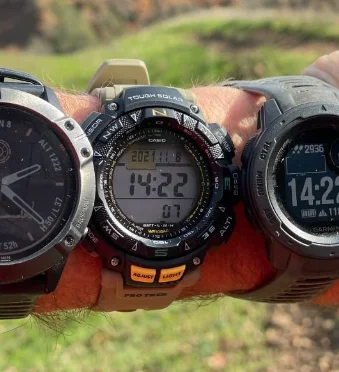
There is no need to connect all this stuff to your wrist when you are running (Photo: Obsahovka Obsahovka, Pexels)

You should ditch the GPS Watch if:

ā–ŗ Knowing your pace is a few seconds off makes you anxious. Sure, we all want to hit specific paces and at certain times. But if running that split in 2:02 instead of 2:00 feels like the end of the world, you are better off running watchless.

ā–ŗ You feel the need to stop your watch at a traffic light, or a water stop, or to tie your shoe because it will ruin your averages. Races don’t stop the clocks when you stop at the port-a-potty. The stoppage is part of the deal. It doesn’t matter if it adds a couple of seconds per mile.

ā–ŗ You see your splits, and the thought of seeing it published on Strava for the world to see worries you to the point that you must make up for it. Especially on training runs.

ā–ŗ You feel dodging traffic at an intersection or beating a freight train to avoid extra time is a risk worth taking.

ā–ŗ your need for hyper connection to the world is so endemic that your watch constantly beeps with texts and emails, and you can’t help but check them.

I am not advocating against the GPS watch. I am advocating against it ruling our running. We don’t need another smartphone-type device sucking the joy of something we love and controlling our lives. We are not professional runners. We run because we want to, and if the GPS watch is hindering such enjoyment, why allow it?

The physiological benefits of your training will be realized whether the mileage is posted on Instagram or not. It is not like that last 20-miler won’t help you on the marathon because it doesn’t show on Strava. You can also apply a revolutionary concept: keep the watch running and not look at it. Then you can analyze the data later instead of during. What a revolutionary concept!

A GPS Watch is an extraordinary tool. One that, for a few hundred bucks, provides you with more computing power than what NASA had at its disposal to land Apollo 11 on the Moon. If you can use it as a collector of data to be analyzed at the appropriate time so you can become a better runner, go for it! If not, then rethink its use.

Please like this post and share any recommendations from your previous experiences in the box below. Let’s build a community of informed and prepared runners.

Ā 

Book Review: The Great Grete Waitz

Book Review: The Great Grete Waitz

By Editors of Runner’s World Magazine

Reviewed by Coach Adolfo Salgueiro

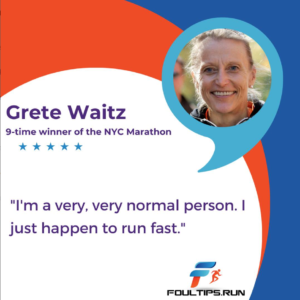
When it comes to the pioneers of women’s long-distance running, Kathrine Switzer is usually the first one to come to mind. Joan Benoit Samuelson is another. Roberta Gibb, Micki Gorman, Ingrid Kristiansen, and others deserve participation in the conversation. But one that usually gets left out is Norwegian Grete Waitz. If you never heard that name, just know this: she is a 9-time winner of the New York City Marathon. No, not a typo: Nine times!

The Great Grete Waitz

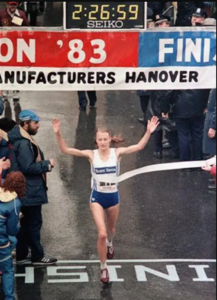
In 1983 Grete Waitz won her 5th NYC Marathon, just a couple of days after we crossed paths running in Central Park.

In these days of social media and harvesting of likes, when you don’t even need to be a good runner to become famous, the field of celebrity athletes has become very crowded. Yet, Grete was known for shying away from fame, endorsements, and interviews because as much as she enjoyed running and winning, she disliked fame and the inconveniences brought by fortune.

The trailblazing pigtailed blonde revolutionized women’s distance running by showing the world what was possible. She initially competed in shorter distances, but it was her switch to the marathon that cemented her legacy. She made history in 1978 when she won the New York City Marathon with a world record in her first attempt at the distance despite having neither experience nor training. Later she became the first woman to finish under 2:30 and also earned the silver medal in the 1984 Olympic marathon, the first time the event was held for women. Throughout her career, she set several world records, won five World Cross Country Championships, participated in three Olympics, and inspired countless male and female runners globally.

The Great Grete Waitz is an eBook compilation of eight articles published by Runner’s World Magazine between March 1981, after her third straight NYC win, and July 2011, a few months after her untimely passing due to cancer at age 57. The articles vary from lengthy features to short write-ups. Seven of them were written about her by other people, except for “My First Time” a candid, memorable, first-person account of her first marathon, which is the lore of legend.

There is also a beautiful first-person account by the marathon founder Fred Lebow about his side-by-side run with Grete of the 1992 race. The back story, if you don’t know it, is that Lebow was diagnosed with brain cancer. He always wanted to run his five-borough race, but as his time was running out, he ran it with his friend in 5:32. A delightful read that guarantees teary eyes even on the toughest macho reader.

The Great Grete WaitzBecause this eBook consists of so many articles written within such a wide time frame, some facts are constantly repeated. Some stories may have a few minor contradictions here or there because they are memories of the same incident by so many people over such a long period of time, but they are not a reason to question her accolades or achievements.

I heard the name Grete Waitz for the first time in 1982, as she won NYC the year my dad ran his first marathon. The following year, when I ran my first NYC she won again. My best Grete memory was when my dad and I went for a shakeout run in Central Park the Friday before my race and we saw her running. For an 18-year-old kid from Venezuela, crossing paths with The Great Grete Waitz was the equivalent of seeing a Martian.

Beyond her racing success, Waitz was known for her humility and dedication to giving back. After retiring, she focused on philanthropy, supporting cancer research and youth sports, even as she battled cancer herself. She remains a beloved figure in the running community, celebrated not only for her extraordinary accomplishments but also for her role in making distance running more accessible for women. While Kathrine Switzer was the catalytic force that brought women\’s running to the forefront, Waitz showed the world what women could achieve if they were just allowed to try.

This eBook is only 127 pages and can be acquired via Amazon for your Kindle for just $1.99. It must be available for other platforms. It is a negligible investment for an insight into one of the names of women’s running that should never be forgotten or underestimated.

Please like this post and share any recommendations from your previous experiences in the box below. Let’s build a community of informed and prepared runners.

Taper: Nothing to Win, Everything to Lose

Taper: Nothing to Win, Everything to Lose

By Coach Adolfo Salgueiro

As you prepare to reap the benefits of your hard weeks of training. Or you may be wondering if you have done enough to hit the starting line in PR shape. Or as you realize you have screwed up your training and will have to wing it. If you plan to race hard, or long, you will need to taper.

Taper (or tapering) is the label commonly used to identify the short training cycle between the end of our race-focused training cycle and race day. The word taper is an intransitive verb. According to the Merriam-Webster Dictionary, it means “to become progressively smaller toward one end. To diminish gradually.” In running, that’s exactly what we are referring to. We start reducing our workload as race day approaches. But why?

TaperingOur bodies usually take 14-20 days to adapt to whatever we do in training. If we ran 20 miles today, we are not better for it tomorrow. As our body recovers, it adapts to the benefits of such stressful events and thus becomes stronger. This is why whatever we do in the last two, maybe three weeks before race day, will be of little or no benefit.


There is nothing to gain during taper, but everything to lose. Many races have been ruined by not taking the taper seriously. Don’t become a victim.

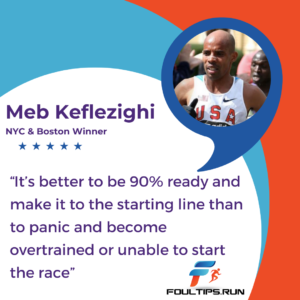
Meb Keflezighi has a great quote that epitomizes the last few paragraphs: “It is better to be 90% ready and make it to the starting line than panic and become overtrained or be unable to start the race.”

According to Jess Movold, in a 2024 article in Runner’s World magazine: “Tapering is one of the most critical parts of any marathon training plan, but in many cases, it’s also one of the hardest to implement. Ever heard of the taper tantrums?”

In my personal experience, I’ve felt better with a 2-week taper. But if the fatigue accumulation really beats you up and feel like another long run will destroy you more than help you, an additional week is beneficial.

Theories abound about how to handle the taper, but the scope of this blog post does not include analyzing any models. It wants to point out a handful of errors and misconceptions you may incur that will eventually negate your training gains.

While on taper, be on the lookout for the following so you don’t ruin your race:

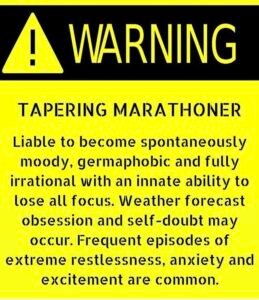
Tapering

I know I picked this up from Instagram, but I don’t know the source I should credit.

1.Ā Ā Ā  Follow the original plan: If you got here with your plan, then this is not the time to improvise, regardless of how confident you are or not about attaining your goal.

2.Ā Don’tĀ try one more long run: There is no place for it. It will add to the fatigue, hinder your recovery, and won’t produce adaptations in time for race day.

3.Ā Ā Ā  Focus on nutrition: Avoid detoxes, new supplements, weight-shedding schemes, carb unloading/loading protocols, and indulgent eating. Eat clean and enough.

4.Ā Ā Ā  Tapering means you are still training: You shouldn’t think you can stop because it’s tapering. It is still part of the training program, and it requires work.

5.Ā Ā Ā  Manage your excess energy: With the decrease in activity, as your body rests and recovers, you will bounce off the walls. Expect it and control it.

6.Ā Ā Ā  Take the extra sleep: Your body is repairing itself, so it may ask for more sleep than usual. Don’t skimp on sleep. It is the best recovery tool.

7.Ā Ā Ā  Control your training effort: Because you’ll feel energized, compared with the last few months, it is easy to push harder and even perform your race effort before the actual race. Don’t!

8.Ā Ā Ā  Focus on the main goal: Everything you do must serve your race. This is not the time to try new stretches, foods, gels, shoes, or routines. Stick to what has worked so far.

9.Ā Ā Ā  Strengthen your immune system: Your body is working overtime to repair itself, so your immune system is low. Be proactive. It is no time to get sick.

10. Tread carefully: Be extra cautious as you transit through life. Don’t take unnecessary risks. Don’t climb ladders, jump the sidewalks, text while walking, or rearrange furniture. All that can wait.

Please like this post and share any recommendations from your previous experiences in the box below. Let’s build a community of informed and prepared runners.

Tips for Out-of-Town Racing

Tips for Out-of-Town Racing

By Coach Adolfo Salgueiro

Ā As the racing season for big marathon races picks up, many runners have unique plans in sight. Many runners make it extra special, building an adventure around their race. We may drive or board trains and airplanes to make it either a weekend or a longer vacation.

There is no sense crossing the ocean to go to Berlin or Sydney just to race and come back home. Or you can always make it a nice long weekend if you just need to hit the road for a few hours. The key to a successful out-of-town race is to understand why you are there in the first place: to run a marathon. The fact that it is in Chicago or New York is what makes it a getaway. Most likely, there would have been no trip if you had not been running the marathon. Remember, the running portion of your trip is the priority. Don’t let the allure of tourist activities distract you from your main goal.

Out-of-Town Racing

Sure, you can visit the Eiffel Tower… after the race (Photo: Rafaelf1, Pexels)

This is an important concept to grasp. I know way too many stories of runners sightseeing too hard, so they reach the starting line tired. On more than one occasion, I’ve met runners (usually younger) who were hungover because they couldn’t resist partying while away from home. A friend shared a story about his family resenting him because they had to wait to visit the Eiffel Tower until after the marathon, which added unnecessary stress to his pre-race routine.

Exploring the world\’s great cities, celebrating for a few days, sipping margaritas at the beach, and discovering the less traveled paths in lesser-known parts of the world is always a bonus for our efforts. But traveling to a race, especially your goal race, doesn’t come without its challenges. It requires additional planning. If you don’t prepare ahead, the chances of fixing a hiccup on the fly diminish considerably.

So, if you worked hard on your marathon training and are setting out on a running/travel adventure, these tips will hopefully help you get to the starting line mentally and physically sharp:

1.Ā Ā Ā Ā Ā  Do not check your running gear: If traveling by plane, whatever you are wearing on race day goes in your carry-on. The last thing you need is lost luggage derailing your race plans. You don’t want to run in brand-new shoes you purchased at the expo or with borrowed shorts.

Ā 2.Ā Ā Ā Ā Ā  Run first, tourist later: The running portion of your trip is the priority. Don’t arrive too much in advance before the race. Save the touristy plans for after. You want to get to the starting line focused, well-rested, mentally and physically ready. Afterward, you may walk all you want or enjoy as much alcohol and crappy food as you can tolerate.

3.Ā Ā Ā Ā Ā  Know where your pre-race meals are coming from: Never take your food intake for granted. Make sure you know that what you need to eat is available nearby. It happened to me once. After identifying the restaurant I wanted in Philadelphia, I went on pre-race night only to find I needed a reservation. Ā If you are staying with relatives, make sure you let them know exactly what you must eat and when.

SUBSCRIBE TO THE FOULTIPS.RUN NEWSLETTER BY CLICKING HERE

4.Ā Ā Ā Ā Ā  Know how to get to the starting line: Do not improvise. Plan for the worst-case scenario. If you are taking a cab, have the phone number and confirm they provide the service at the time you need it. Have a B plan in case there are no Ubers available. If you are taking public transportation, purchase tickets in advance. If a relative is driving you, be aware of road closures and alternative routes.

Out-of-Town Racing

All the gear you will need during the race goes inside the cabin with you (Photo: Guiirossi, Pexels)

Ā 

5.Ā Ā Ā Ā Ā  Have family and companions understand why you are there: If you are traveling with family or friends, it is imperative they understand that the first few days are all about you and your race. Runners are the protagonists. Everything else can wait. Remind them they wouldn’t be in Amsterdam, or Buenos Aires or DC if it weren’t for the marathon.Ā 

6.Ā Ā Ā Ā Ā  Adjust for time changes: Never underestimate jet lag and time zone differences, as they can screw your sleep and derail your race. Find out in advance how to adjust to the time zone in which you will be competing. There are plenty of online resources for this. You don’t want to be falling asleep at Mile 10 because it feels like 4 AM for you.

7.Ā Ā Ā Ā Ā  Pack for any weather: Remember, you are not home, so you can’t just go back to your closet to pick up something else. Pack for any possible weather change, and don’t rely 100% on your weather app. It is always better to bring back something unused than to need that pair of gloves you left at home.Ā 

8.Ā Ā Ā Ā Ā  Ā Don’t do anything you wouldn’t do at home: Pre-race is not the time to be adventurous. Trying new, exotic foods, white water rafting, Segway tours, or running a beautiful trail when all you know is the asphalt is for after the race. These could be recipes to guarantee a bad race. Hold the fun stuff for after the finish line.

Please like this post, share any other recommendations from your previous experiences, and let’s build a community of informed and prepared runners.

Ā 

Optimism vs. Wishful Thinking

Optimism vs. Wishful Thinking

By Coach Adolfo Salgueiro

I recently read Ball Four, the classic baseball book from the 1970s by the controversial major league pitcher Jim Bouton. In it, Bouton discusses the 1969 spring training with the expansion Seattle Pilots and the high expectations management had for their upcoming season: ā€œWe may be building ourselves up to that kind of fall with this club. Everybody is saying we’re going to be great. There’s a difference between optimism and wishful thinking.ā€

Optimism vs. Realism

Sitting on the couch wishing you were running won’t get you very far in achieving your goals (Image by Windows Copilot)

Don’t we all know a runner who fits into that last sentence? When was the last time we were the runner matching it? I smelled a blog post right away. Thus, here we are.

As runners, we are all about optimism. We must be optimists if we want to look into the future and visualize what we want, how to achieve it, and how to set up a map from where we are to where we anticipate being. Sure, some daydreaming is allowed, and it is even necessary to keep ourselves moving forward, especially through the inevitable periods of difficulty that will show up in every training cycle.

According to the Merriam-Webster dictionary, optimism is ā€œan inclination to put the most favorable construction upon actions and events or to anticipate the best possible outcome.ā€

If we ran a 1:05 in our last 10K, we dream not just of the 59:59, but why not a 55:00? If we ran a 3:20 marathon, we would know by heart all the mathematical breakdowns needed for that magical Sub-3. These are healthy and within the boundaries of feasibility.

But if you just ran that first sub-20 5K and started focusing on qualifying for the Olympics next year, or if you are eying that marathon PR but haven’t run in three months, then we are entering the realm of wishful thinking.

The same dictionary defines wishful thinking as ā€œthe attribution of reality to what one wishes to be true or the tenuous justification of what one wants to believe.ā€

Optimism is a great tool to keep you engaged and focused. Wishful thinking is a recipe for a letdown and/or injury. Sitting on the couch wishing you were running will not make you a better runner.

Examples of Optimism:

• I am trusting the process my coach has laid out for me. I will follow it up to the best of my ability.

• I’ve seen gradual improvements in my training, and I know I can keep progressing if I stay consistent.

• I didn’t hit my goal in this race, but I know what I need to adjust in training to improve next time.

• I’m excited to tackle the next training cycle because it’s designed to address my weaknesses.

• My pace has been steadily improving, and I know that if I stay disciplined, I’ll reach my target time.

• I’ve learned from my setbacks, and I trust that I’ll achieve my personal best with perseverance.

• I’ve been putting in the work, and I trust that the results will follow with patience and dedication.

Optimism vs. Realism

Being an optimist and doing something about it is the path to achieve your running goals (Photo Pexels)

Examples of Wishful Thinking:

• When I get off this couch and start training, I will really focus on being the best runner I can be.

• I haven’t trained consistently, but I can still PR in my next race if I push hard on race day.

• I skipped a few workouts this week, but I’ll just make up for it by running harder next week.

• I don’t need a specific training plan; I’ll just wing it and rely on my natural ability.

• I haven’t been doing speed work, but I still can hit my goal pace in my upcoming race.

• I’ve been running the same pace for months, but I’m sure I’ll somehow drop 30 seconds per mile next week.

• I’m planning on hitting a huge PR in my next race, even though I’ve barely trained, and my body feels off.

Let’s focus on our goals and create a solid plan to get from point A to point B, then follow through with discipline to achieve it. It sounds simple, even obvious, but haven’t we all found ourselves stuck in wishful thinking at some point—maybe even recently? Now that we understand the difference, let’s commit to staying on the right side of the line and strive for the best, most realistic performance we can achieve.

Please like the post and share it with someone who may benefit from it.

Skip to content