So, Tell Me About Your VO2Max

So, Tell Me About Your VO2Max

By Coach Adolfo Salgueiro

It is interesting when you with your running buddies and they start bragging about their VO2Max number. “Mine is 41”, says Runner #1. “Mine is currently at 39 but it has been going up for the last 3 weeks”, comes back Runner #2. “I am down to 43 but have been up to 44 as recently as last month”, chimes in the Runner #3. Funny thing is that if you ask any of them what VO2Max is, you can pretty much bet that none of them will know.
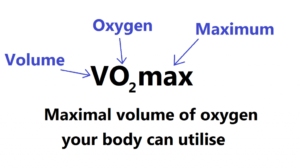
VO2Max

These are the elements that conform VO2Max (British spelling used here)

VO2Max stands for the maximum (Max) volume (V) of oxygen (O2) that your body can utilize at maximum effort. It is obvious that the more oxygen your body can handle, the more efficient it is and the faster you should be able to run. Eliud Kipchoge has been measured at 75 while the fittest of my readers most likely be under 50.

VO2Max is measured as an absolute rate in liters of oxygen per minute (L/min) or as a relative rate in in milliliters of oxygen per kilo of body mass per minute (ml/kg/min). Yes, this is a little bit technical, well, more than a little bit. The point here is to understand that if you can barely grasp the concept and how this parameter is measured, you shouldn’t make it your end-all factor to measure your progress, let alone your value as a runner.

The VO2Max is a valuable tool if you know what you are looking at. But lately it has become overemphasized, primarily because watches now flash the number as if it were a badge of honor.
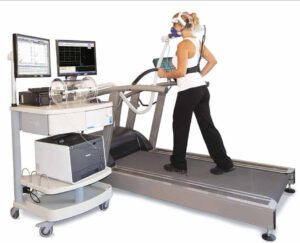
VO2Max

Unless your watch can be hooked to this machine, it cannot measure your VO2Max

VO2Max is tested in a specialized lab. While on a treadmill, with a mask covering your nose and mouth, while running to exhaustion, the machinery measures how much oxygen goes into your body and how much oxygen comes out. The difference between the two numbers while at maximum effort, is the maximum amount of oxygen your body can process at such speed, thus, your VO2Max. Your watch cannot measure this, regardless of how sophisticated and expensive it is.

In conclusion, VO2Max may work or not, I am not a sports scientist nor have read enough to know the extent of its reach. But what I do know is that it is not the end-all parameter to measure your progress or success. To me, a PR on my next 5K or marathon seems a much better way. And, once again, it CANNOT be measure by an equation on your watch.

It is not in the scope of this blogpost to advocate for or against VO2Max. It is not either to explain the science and value of the parameter, which, of course, does have a value.

If you want to learns more about the subject and are ready for a deep technical read, Steve Magness, head coach for the University of Houston, and an authority on the science of running, has a few articles on this, which I highly recommend. You can click on the links below to access them:
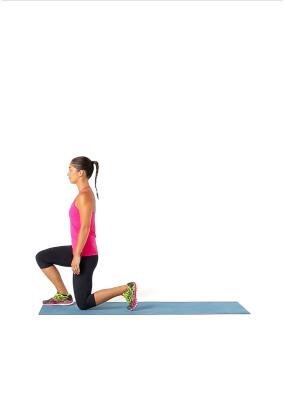
The Lunge Matrix

The Lunge Matrix

By Coach Adolfo Salgueiro

Lunge MatrixBack in 2017 I started running with a local group on Saturdays and stretching was always initiated with this particular set of lunges. They were five different exercises. Ten of each. Most teammates hated them, but I learned to embrace them. When I asked the head coach what those were, or where they came from, he said his coach told him to do them before every run. A few months later he set a marathon PR and reassured me how much these lunges had helped him out. At that time, he was already preaching to the choir.
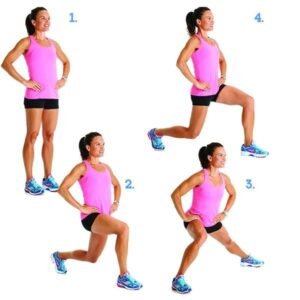
As a curious mind, I started searching for the origin of this set of exercises and it led me to something called “The Lunge Matrix”. It was originally developed by a physical therapist named Gary Gray, a specialist in human biomechanics, also founder of the Gray Institute, dedicated to functional movement. The Lunge Matrix has been so effective that now is recommended by multiple running and strength coaches, most of them as the very first thing you would do as you get warmed up before your physical activity. Important to know that it will only add 3 to 5 minutes to your warmup routine.

Lunge MatrixThe Matrix combines a series of strength and stretching movements in a sequence that is easy to follow and rapidly becomes second nature as you get use to performing it. According to Dr. Marc Cucuzzella, “The goal of the Lunge Matrix is to reset your range of motion in all of the planes of movement”. This comes in very handy when you are coming from an 8-hour night of sleep or 8 hours sitting down at the office. Jay Johnson, coach of elite athletes with 20+ years of experiences, states that “after three weeks of doing the Lunge Matrix before your runs, you will not think of taking your first running step until you go through the routine”.

The five lunges on the matrix are the following:

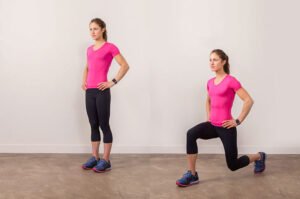
Front lunges
Lunges with a twist
Lateral lunges
45-degree lunges
Backward lunges

You need to make sure to take your time performing these exercises right as you become accustomed to them. Avoid getting into bad habits either by ignorance or plain laziness. Keep the proper posture, the right muscles engaged and do not overdo it. You can start with six of each, then up it to eight and finally to the recommended 10. You do not need more than 10. If you want to do more, perform the set again, at the end of your run, too.

I found this great video on YouTube, which you can find below. It explains the sequence in detail, as well as the posture, the planes of motion and at the end, goes through common mistakes, so you can avoid them.

Three to five minutes well invested towards your running health. Feel free to let me know about your experience with them in the comment box, below. 


The Trap of Information Overload

The Trap of Information Overload

By Coach Adolfo Salgueiro

Information Overload

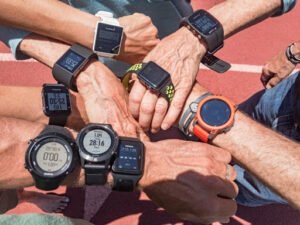
GPS watches are great, but not all the info is needed right away

Let’s start by stating that I see nothing wrong with being on Strava, having an Instagram account to share your runs or checking Facebook every so often to see what your running buddies are up to. It is great to live in a time when, via social media, we can still be in contact with people we haven’t seen in 30 years, or keeping in touch with that cousin that moved to another country and you rarely have the chance to see anymore.

It is great to being able to make social media acquaintances even though you never met them in person. In my case, I follow a Dutch marathoner named @mistermarathon on Instagram and he followed me back. When I visited Amsterdam, he took me for a running tour of the city, we had coffee and had a great talk. A few years later he visited Florida and even though I was injured and couldn’t run, we met for coffee and had another great conversation. That is awesome.

Now, there must be a limit. The data overload from social media, from our watches, from WhatsApp groups and from measuring up with strangers, is stealing the joy from a considerable portion of the running universe. And the main reason we run is because we like it. So, if something is stealing our joy, it must go or, at least, its presence must be adjusted.

Yes, a pre-run picture with your buddies is cool, but if you missed it, you can still run. Forgetting to charge your watch is not an excuse to skip a scheduled training. Checking your favorite elite runner on Strava and trying to match their trainings is a recipe for injury. Thinking that an ultrarunner in Germany or Australia or Argentina is your buddy because he likes your posts on a regular basis is the prelude for a letdown. Wanting to run from New York to Los Angeles because so-and-so did it, is insane.

It starts with regulating the consumption of information we get from our GPS watches. It is wonderful to have all the information you can possibly want at the flip of your wrist. But, with certain exceptions dictated by a specific segment of your training program, the usefulness of such information is relatively innocuous. It is just a reflection of what you are doing, not what you are doing and definitely not your worth as an athlete. You don’t have to pause the watch because you are at a red light or because you stopped 10 seconds to say hi to another runner. You don’t have to check your cadence every mile unless you are specifically working on it. And don’t get me started on VO2Max, that’s for another post. I think you get the point.

I am amazed by the data the website I synch my watch to, can provide. Most of it is great for analysis of my training, progress and to keep historical data. The more I use Strava, the more my mind gets blown away on what it can do, but I don’t follow people I don’t know. I only follow runners I train, so I can see what they are doing, this way, I can coach them better. If I want to know what a friend is doing, I call him or text him. I don’t need to know what Eliud Kipchoge is doing every day and compare him to my progress. I don’t need kudos on my run from 50 runners I don’t know.

Information OverloadTheodore Roosevelt, the 26th President of the United States, once said that “comparison is the thief of joy”, and I agree 100% with him. Of course, we can’t avoid it all the time, it is part of our human nature. But if we want to get joy out of OUR running, we need to concentrate in what WE are doing and what WE can control. We need to center OUR running life, in OUR progress, OUR failures, OUR injuries, OUR parameters.
Most of the data is useless at the time we are running. It is afterwards that we can learn something from it and adjust. If you list the top-10 reasons why you run, I doubt that “to show up my Mary in Strava” or “to have more Instagram followers than Jimmy”, or “to improve my likes on Facebook” makes the list. Let’s go back to basics. Take advantage of the tools that technology provides but don’t be a slave to them.  

Book Review: Run for Your Life

Book Review: Run for Your Life

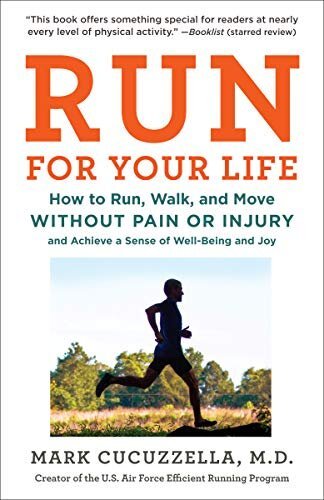
Run for Your LifeBook Author: Mark Cucuzzella
Review by Coach Adolfo Salgueiro

I read about Mark Cucuzzella for the first time through mentions on another book I have read a couple of years ago. To the author he seemed to know what he was talking about. Then, in the Marathon Training Academy podcast I heard an interview of the author about his “Run for Your Life” book and I knew I had to read it. It took a bit longer than I wanted to get my hands on it but once I got it, I consumed it with passion.

Cuccuzzella is a doctor and a runner who is passionate about both. His bio on Google Books reads as follows: Dr. Mark Cucuzzella, Air Force Reserve lieutenant colonel, practices family medicine in Ranson and Martinsburg, West Virginia. He is a professor at the West Virginia University School of Medicine and conducts Healthy Running Medical Education courses. He has run competitively for almost four decades, with more than one hundred marathon and ultramarathon finishes, and he continues to compete as a national-level masters runner with an active streak of thirty straight years under a three-hour marathon. Cucuzzella owns the first minimalist running and walking store, Two Rivers Treads, in his hometown of Shepherdstown, West Virginia.

The book is divided into three parts and an Appendices section. The parts are: Before the Starting Line, The Body in Motion and Running is for Everyone. Each one touches in form a different perspective, the importance, the right way, and the approach to human movement so you can do it smarter, stronger and springier. This book is as much for sub-3 marathoners as it is for walkers wanting to complete their first 5k.

Run for Your Life

Dr. Cucuzzella has run sub-3 marathons for 30 years in a row

Each one of the 19 chapters concludes with a short section of drills to address what was taught in the previous pages. Such drills are not just strengthening or stretching exercises, but approaches, mental exercises or adjustments in your mechanics, your approach to exercise on your everyday life. It also has a companionship website where the recommended exercises and drills are explained in video format and additional scientific resources are available.

Dr. Cucuzzella is a firm proponent of the minimalist shoe. He gives a scientific-based explanation on why this is the way to go, as well as the right way to transition there. As interesting and well supported as his theory is, I don’t see myself switching to a minimalist shoe anytime soon, although it has made me reassess my selection of footwear, which I have already discussed with the manager of my local running store.

Part II was the key section of the book for me. It is about the science of running. The part the brain controls, the engine that builds endurance, nutrition, recovery, injury prevention, flexibility; how to make your muscles, tendons and ligaments work on your behalf and biomechanics of our gait. His explanation is so well adjusted for non-doctor readers and so solidly and convincingly based on science, that I have already adopted a few of his recommended adjustments and have seen amazing improvements on my step, which are confirmed in the way my running shoes have started wearing out.

This book is worth the money and the time invested in reading it. It is not about how many miles to run on Saturday and how many 400 reps you need to do on Wednesday. Once you are done with the book, make sure to keep it handy because it will become a consultation volume for years to come.

I someone knows Dr. Cucuzzella, please send him a big thank you on my behalf. There are many great running books out there. This is certainly one of them.

Training Adjustments for the Summer Months

Training Adjustments for the Summer Months

By Coach Adolfo Salgueiro

 As summer approaches rapidly in the northern hemisphere, days are becoming hotter and humidity is ramping up with the passing of each day. We became accustomed to the mild spring (even if most of it was indoors due to the current world circumstances) and now we need to adjust to the harsh reality of the hot weather.

Training Adjustments

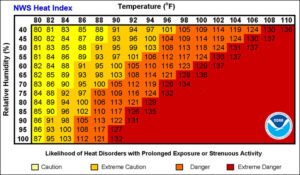
This Heat Index Chart by the National Weather Service, clearly explains the correlation between temperature and humidity. Be aware of it during your summer training. For a better view, click on the image to expand it.

When we run in hot weather, we get exhausted quicker and we must take precautions to avoid bad experiences or, even worse, dealing with dehydration and/or the dreaded heat stroke. Some situations could lead to permanent damage to the body or even, in severe cases, to death.

Adjusting to running in the heat is not just about drinking more water. It is about understanding the processes that will allow you to continue with your training in a safe way. Also, equally important, allowing you to recover quickly so you can keep going.

I have compiled 10 tips for you to be able to run safe during the summer. Especially if you are new to the activity or new to an area where heat is one of the considerations as you lace up your running shoes. These are by no means the end-all precautions to take, but it is a start.

 1.      Slow Down – Running in the heat is not the same as running in comfy weather. Your body is exerting itself at a higher rate to maintain the same level of perceived effort. You will need to run at a slower pace to keep the level of perceived effort. Make peace with this reality and keep moving forward.

2.      Plan your hydration needs ahead of time – Plan your route around places where water is plentiful. If that is not possible, plant water in your route, ahead of time. Remember to consume water before you become thirsty. Once you are thirsty, it may be too late to avoid dehydration

3.      Don’t overdo it with the water – With water intake is not about the-more-the-merrier. Hyponatremia is a life-threatening condition in which too much water in your body dilutes the amount of sodium in the blood. Keep yourself hydrated through your day and make sure your urine is lightly colored.

4.      Dress appropriately – Dress in light colors, which reflect mor light, thus deflect the heat. Avoid long sleeves, long pants, of outfits designed to sweat in excess.

5.      Stay connected– Well into the 21st Century is so easy to keep yourself connected while running. Carry your mobile phone during your runs and let someone know where you are and when are you expected to be back. You an also let a loved one track you in real time.

6.      Be aware of the effect of humidity – If you train in a region of high humidity, make sure you understand that displacing a saturated mass of air requires more effort than doing so with a drier, lighter one. This means additional effort to maintain the same pace as when it is dryer. Make sure to account for this difference. Make peace with it.

7.      Adjust your training schedule – If you are training for a fall marathon, make sure you are flexible on your schedule so you can switch that long run or that speed session to another day or time. Don’t be so strict that you end up hurting yourself because you refuse to push a difficult session for tomorrow.

8.      Opt for shady routes – Be smart with your routes. Plan accordingly, making sure there is plenty of shade, and places to stop should you need it.

9.      Don’t try to be a hero – Do not be afraid of stopping, cutting the run short, taking refuge in a shady place, asking for help, or calling it a day if you feel dizzy. Not only you will live to run another day, but your recovery process will be much easier, and you will be able to be back running, sooner.

Training Adjustments

Chart from www.weather.gov. For a better view, click on the image to expand it.

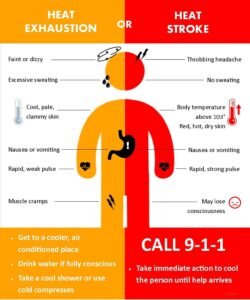
10.   Differentiate heat exhaustion from heat stroke – Being spent because of heat is one thing, heat stroke is quite different and also life threatening. Make sure you learn the symptoms so you may avoid tragedy. Please get familiarizes with the graphic below, which is borrowed from The US National Weather Service.

Conclusion

Running in the summer months is perfectly doable, but you have be smart. Plenty of people from hot and humid climates participate in great autumn races all over the world. New York, Berlin and Chicago, just to name the World Marathon Majors. The key is to plan ahead, be smart and always err on the side of caution, so you will live to run another day.

Skip to content