Back in December of 2020, something called The Barefoot Mailman 5K Virtual Race popped up in the South Florida racing calendar. We talked about it among my peeps from No-Club Runners and decided we would make an adventure of it. Not only that, but we would also run it barefoot, so we could emulate the 19th Century mail carriers who took the 100-mile mail route down the beach from what today we know as Palm Beach to the little fisherman’s village we now know as Miami.
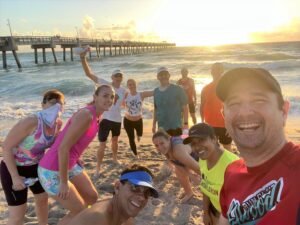
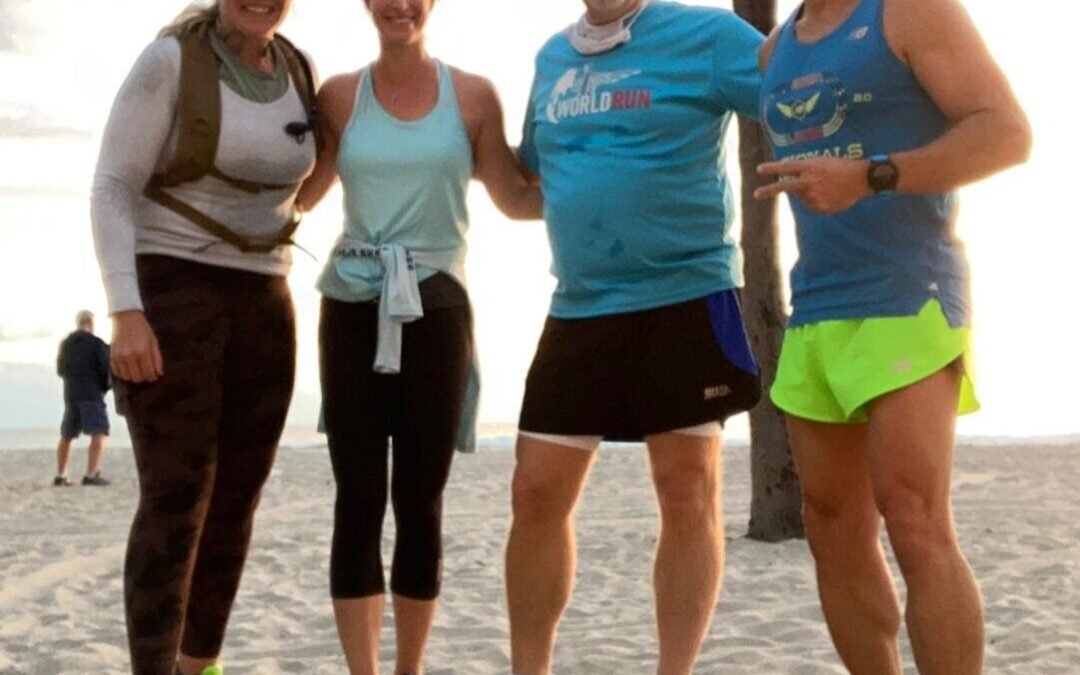
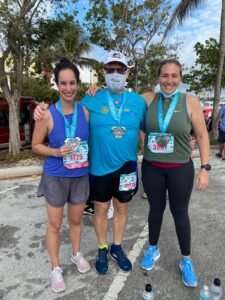
If you have access to a beach and an appetite for a running adventure, gather your running buddies and go for a barefoot run. The smiles of all the people in this photo should give you an idea of what a cool experience this is.
We were not sure what to expect. We ran about 1.5 miles to the beach as a warm-up, left our shoes and started running. It was an overcast day, with choppy waters and the start resembled the opening scene of Chariots of Fire. The rest of the 5K was even better. Running on the packed sand, waves coming in and sometimes splashing water up to your knees… Magic!
It was so freaking cool, that we decided to make it a regular occurrence. On February 27th, a larger group met at the same place in Dania Beach to run the 5K to The Pier and back. This time we were in for a surprise. Sand was not as hard-packed as we remembered it, and each step required additional efforts. It didn’t take much for most of us to start walking. Once we got back, with burning legs, exhausted and sweaty, we still decided we had to do it again, sometime in the near future.
A couple of months ago I wrote about the wonderful experience of running barefoot on grass. Most of the benefits of grounding yourself are perfectly transferrable to doing it on the sand. But the sand offers a few extra challenges and benefits, that running on the smooth grass doesn’t.
The first requirement to enjoy your sand run and do it safely, is to forget about your watch. Your time, cadence, VO2Max, etc., are irrelevant. You must switch off your data-driven brain. This is about fun, not about PRs.
Nicolas Vitale, Coach with Club 10K, stated in a recent article that running on sand could provide benefits in the areas of agility, equilibrium, strength, power, joint strength, adaptivity to effort and endurance. After your first mile on the sand you will agree with all seven of these items. The variability of terrain the sand offers from step to step will force you to make many adaptations, sometimes simultaneously.
To get the most out of your run in the sand, you can always move from the hard-packed sand on the shore to other areas of the beach where the sand is looser. This will help you use other muscles, go through a harder effort, get less return from the ground, and adjust on the fly to adverse conditions. All at the same time.
By the way, the fact that No-Club Runners runs it barefoot doesn’t mean it is the only way to do it. If it works better for you in shoes, nothing is stopping you. Personally, I enjoy the multiple advantages that direct contact with the ground provides. We have plenty of opportunities to run in shoes.
My recommendations for running on the sand include:
1 – Regardless of the instability of the terrain, work on maintaining correct running posture. 2 – Start with a shorter distance or time until your body gets used to it. Don’t overdo it. 3 – Shorten your stride if the sand is too loose and you feel you are overworking. 4 – Don’t forget hydration, especially on hot or humid days. 5 – Focus on having fun and recharging from the direct contact with the ground. Forget you have a watch. 6 – Take advantage of the water and jump in once you are done.
If you have access to a beach and appetite for a different running adventure, grab your running buddies and meet at the shore. You won’t regret it.
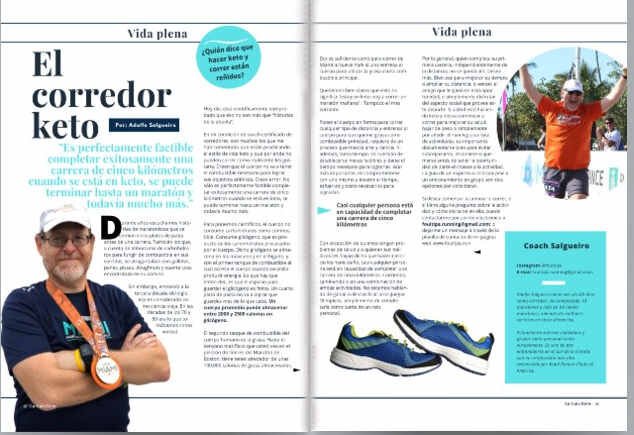
A story by Coach Adolfo Salgueiro was published in La Guia Keto Spring 2021 Edition.
This Spanish language guide to the keto lifestyle includes articles on wellness, exercise, self improvement and keto friendly recipes.
The Spring 2021 issue is geared towards women over 50 looking to enjoy a full life at an age when things may look like they’re starting to get complicated. In this issue, Coach Adolfo talks about the feasibility of becoming a runner or even achieving great athletic results while you are in the Keto lifestyle.
You can order La Guia Keto thorugh Amazon by clicking here.
My name is Ethel Belair. I am 51 years old and I am a runner. I enjoy long distances. At one time half marathons were my favorite. I\’ve ran over 25 of them. But I wanted to try something a little more challenging.
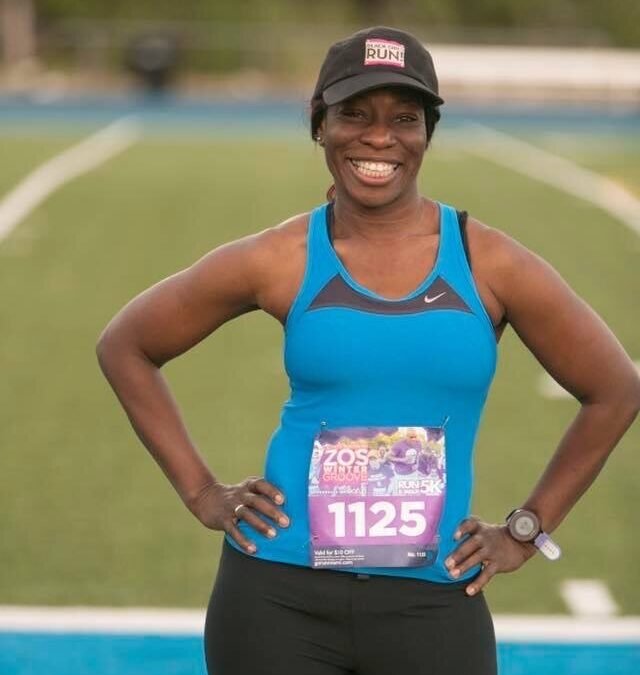
Not much explanation needed on how Ethel felt after achieving her goal. Just look at her face.
In 2016 I signed up for the Miami Marathon. It was tough because I had just lost my father, Jean Belair, to cancer. He passed away three months before my running, so I ran in honor of his memory. He always inspired me, reminded me to be strong and keep going. After running that marathon, which was on my bucket list, I was done. Or so I thought.
The very next day I went for a recovery run and friends though I was crazy. But after running three miles and walking one, my legs felt okay. I wasn\’t tired at all, so I said to myself: “I think I\’ll do another one”. I\’ve ran 6 full marathons so far.
What led me to ultramarathons? A week prior to my 50th birthday, I ran a “Birthday Unofficial 50k” (31.069 miles) with a few friends. Then, on June 26th of last year, my actual birthday, I met up with friends and had another birthday run, this one was 51 miles.
A fellow runner, Lucien, asked me why not run a hundred miles? “You\’re a distance runner”, he said. I told him that I didn’t believe I was ready for that. He then suggested 100k (62.137 miles) to get started. I prayed about it and got the go to do it. Two months later, I ran and finished 100 kilometers. Two weeks later, I signed up and ran an official 50 miler.
On December 26 of last year, I ran a 40-miler in Atlanta. This was the toughest race I\’ve ever done. It was held under freezing conditions (23°), with hills galore and hurting inclines. Grateful to God, I completed the race despite injuring some tendons. My Doctor recommended two weeks of rest. I was not a happy camper.
Yep! That’s right! First you skydive and then you run 100 Miles.
Despite the harsh experience in Georgia and the injury, I was still considering the Skydive Ultra 100-miler in February. I was registered since October. I had to pray, dig deep in my faith, ask God\’s grace for strength and healing. I was battling feelings of fears and anxiety. Should I still do the race? I prayed to God and found the peace to do it. “You will finish. You are strong. Be strong and courageous”. Strong is the word I kept hearing.
On January 16th I ran 5 miles for my very first run of the year. By the end of the month, I ran the #MiamiFamous Virtual Half Marathon and felt great for most of the race. At mile 10, while I was doing a recovery walk, I felt pain in my tendons, so I decided to do intervals—more running than walking. I was overly concerned as the Skydive Ultra 100-miler was only a week away. I even considered calling an Uber. But I pushed through to completion, with some additional mileage for or a total of 16.67.
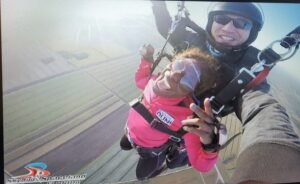
Race day was here. I wanted to skydive when I turned 50 but didn\’t get a chance to do it. I\’m one who fear heights, yet I took a chance by participating in \”The world\’s only running race that starts with a skydive”: The Skydive Ultra in Clewiston, Florida.
I got on the plane and my instructor asked me if I wanted to deploy the parachute. I Did. I was the 2nd person to jump. I just looked down and jumped. I felt great free falling 14,000 ft. (4,267 Mts). The endorphins… Wow! After landing, it was time to run my hundred-miler.
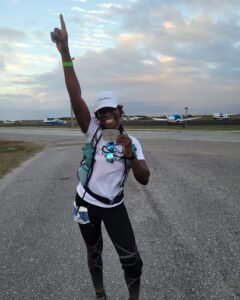
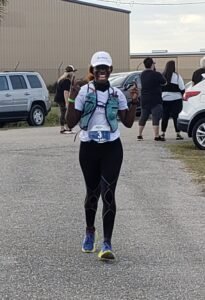
Somewhere along the 100-mile route sporting her trademark million-dollar smile.
The loops were 7.25 miles. I met people along the way. My amazing crew of Monique and Gerda supported me with anything I needed. I had many fellow friends and runners who called to check on me through my crew and cheered me from afar. I ran strong with God\’s grace and power. I felt the prayers of my friends and family. Every mile I felt happier and stronger.
Mile 86 was a turning point in the race. This is where my entire body started to hurt. I had to summon my will power and remain focus on my faith. I had to dig really deep and from the kindness of friends to push through to the end. Marcus, a runner himself, who was working as the DJ for the event, was kind enough to help me run two loops through a very dark night. Monique walked 2.5 miles with me, and Gerda accompanied me the last two loops. She held my hands as I pushed through the pain. My left pinky toe had a big blister, which it caused me to slow down tremendously. Then, my left knee began to ache. I told Gerda that if I had to crawl to the finish line, I would.
I am grateful to God, for the prayers, persistence, perseverance through pressure and great support from my friends. I finished 101.50 miles, my first hundo in 33:29:38. I am forever grateful. Never, ever give up!
\”The most powerful tool you have to run long distance is your mind, and when you master it, the boundaries of your endurance disintegrate.\” Michael D\’Aulerio
“Let us run with endurance the race that is set before us.” Hebrews 12:1
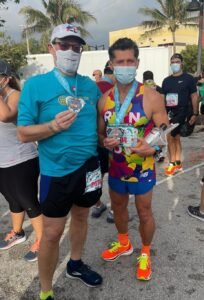
The expectations for February 14th were high. It was the first live race for most of us in almost a year. But the South Florida weather was not on our side. The temperature at the start was 77 degrees and the humidity was at 90%. Tough running for conditions any given day, so we adjusted expectations as we walked towards the beach to the starting line of the A1A Publix Half Marathon.
I had three running pupils in the starting corral. They came from different walks of life as well as individual challenges and race goals. Given the trying racing conditions, I am satisfied with the final results, and my runners have expressed the same. This makes for a successful day.
Yolmer G. set up a PR with 1:31:12… Now it is time to focus on his next two, 2021 running goals.
I have been working with Yolmer G (44) for a couple of years now. His goal was to run a sub-1:30 half. He just overcame a broken big toe earlier last year and was back in top shape. The 13.1 miles were not an issue for him. Despite a physically demanding job, he committed to the battery of hard speed workouts prescribed to work towards maintaining the 6:50 pace throughout the race. He came to the race with a PR of 1:32. Unfortunately, he spent the last week keeping a bout of plantar fasciitis at bay. Even though it was a tapering week, it messed up the final tune up process. By Friday he wasn’t sure if he would be able to run.
I crossed paths with Yolmer twice during the race and he looked strong, focused and with good form, which suggested the PF was under control. He passed the 10K mark within range of the goal, but the weather conditions took their toll, and a negative split was not in the books. His final time was a PR of 1:31:12. A success nevertheless, and with plenty of time to make up for those 73 seconds. After a rest period we are focusing on two other goals for 2021.
Sally K (33) is one of the most strong-minded people I’ve ever met. She excels in a high-stress job that demands a lot of her time. Originally, we started working towards a 4:20 for her first marathon. The goal was within range but a trip half around the world, two 2-week work trips, and a sick week, took their toll on her training. I have no doubt she could have ran a 5-hour marathon but at the expense of tremendous suffering through the experience. We talked about it and 10 days before race day she switched to the half.
Sam and Sally battled the heat and humidity to reach new heights on their running journeys. This is just the start.
Because of the constant interruptions on her training we could not work much on speed, so she ran on endurance alone. We planned for a 2:12-2:15 finish. The weather took its toll and yet she pushed through. She had a huge smile the two times I crossed paths with her. Finishing time was 2:14:38, ahead of 1099 participants and over half the ladies in her age group. Her 4:20 marathon is one solid training cycle away.
Samantha C. (27) approached me requesting assistance to complete her first half marathon in 20 weeks. She had run a bit here and there but nothing organized or recent. In her first week she struggled to complete 5K. She struggled with side stitches through the first half of the training. But she trusted the plan and followed it as close as possible to overcame self-doubt and realize she is indeed a distance runner. Our original plan was for a 2:30 finish. Two weeks before the A1A, we had a trial run at the Miami Virtual Half, where she surprised everyone with a 2:09:03 finishing time.
Even though an improvement of the previous mark was the A-goal, we knew in advance that weather conditions were playing against it. So the new race plan called for a 2:12ish finish unless there was anything left for a final kick. There wasn’t. At the finish line she told me she had nothing left. She gave her all to finish in 2:12:59. This young lady has such a bright future in running. All she needs is experience, the commitment is already there.
Personally, I couldn’t be prouder with the results of my trainees, especially under such trying weather conditions. So I take the day as a win. As an amazing day for the adventure that is Foultips.run. Thank you Yolmer, Sally and Sam for trusting my experience and guidance. I look forward to taking you all to your next running goals.
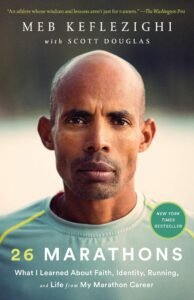
By Meb Keflezighi (With Scott Douglas) Reviewed by Coach Adolfo Salgueiro
When we talk about the top US marathoners in the United States during the first fifth of the 20th Century, the name of Meb Keflezighi automatically jumps to the forefront. If you don’t consider him at the top of the list, which you are entitled to, it seems difficult he won’t be on your Top-3 or Top-5. He is the only runner to ever win Boston, New York and earn an Olympic medal. And even though he only won 3 of his 26 career marathons (hence the name of the book), his personality, constant top-level performances and contagious smile, made him an icon on the world stage between 2002-2017.
A good book, well written and worth the time and the money
In his latest book, Keflezighi goes into detail about each one his 26 marathons. How he trained, what were his life challenges at the time, how he performed and the sports and life lessons he took from each one of them. He enjoys and doesn’t shy away from the glory of his successes, yet at the same time makes himself vulnerable by taking us through his failures and how to deal with them when you are expected to perform at a certain level and you just can’t.
This is a short book, about 250 pages, and a very pleasant read. Succinct chapters allow you to soak in a marathon or two in each sitting, without being overwhelmed by excessive details.
At times it becomes difficult to relate to Meb’s running experiences because 99.9% of runners will never need to ponder if we are ready to respond to Eliud Kipchoge’s surge in the Olympics or how to prepare for what may come to us in the last 10K of the New York City Marathon when you enter First Avenue as part of the leading pack. But that doesn’t matter. We read books about great baseball or football players though we will never be on the field with them at the next World Series or Super Bowl. Meb’s tales from the front are well told and through his words, he does bring us with him to that place we will only see when we are watching a race on TV.
The book is geared towards life lessons on planning, patience, adjustment to goals, change of expectations made on the fly and many other subjects that mean something to us when they come from first-hand experiences from a world-class athlete who has been there not one, but many times.
A leitmotif for Meb’s career was his spouse’s support. He doesn’t hide that his wife, Yordanos, was the family’s backbone that permitted him to achieve his goals. As runners, we all need the support of our wives, husbands or significant-others to achieve what we are looking for, and the Keflezighis show us how.
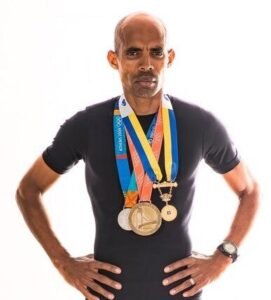
Only athlete ever to win Boston, New York and an Olympic medal
I loved Meb’s conclusion about his career as a marathoner. We may not be able to relate to some of his tales from the leading pack, but everyone who has completed multiple marathons, somehow will see himself/herself in this:
“I did twenty-six marathons over fifteen years, one for each mile of the race. I learned that the marathon can hate you or love you. It can make you go though misery or experience great joy. I learned that no matter what it happens, eventually you’ll look back and think, ‘That was a beautiful thing. I’m glad I did it.”
If you want to know more about Meb’s personal life, his childhood in Eritrea, move to the United States, life and career, “Run to Win” is your book. “26 marathons” is a good book, well written and worth the time and the money you will spend on it. But I do think it is important to understand what the book is and what it is not, before you tackle it, so you can be in the right frame of mind when you read it and thus, get the most out of it.
If anyone knows or has access to Meb, please thank him on my behalf for both books and for being an inspiration to the running community throughout his long career. His name is up there with Alberto Salazar, Bill Rodgers, Frank Shorter, Ryan Hall, Clarence De Mar, etc. in the pantheon of great US runners of all time.