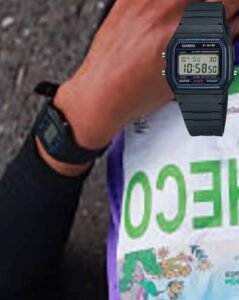
Last August, Peruvian Olympian and 2:07 marathoner Christian Pacheco won the Mexico City Marathon. Yet his victory was somehow overshadowed by traditional and social media because he was wearing a basic Casio watch, which retails for $22. No GPS supercomputer tracking all the latest and trendiest parameters.
Where is the fun in running like this? And this image doesn’t even show taking the mandatory selfie (Image by ChatGPT)
I thought this was remarkable. I don’t know what he uses for everyday training, but in images I reviewed, he won the Pan American Games and the South American marathon championship wearing the same basic watch. At least to me, who has been running since the 2nd running boom, it is refreshing to see some elite runners still capable of improving without the latest space-age technology and gadgets.
I am not against the use of technology. Running has advanced as an industry through investment, research, and the development of consumer products, and that is good. Very good. I don’t think we should go back to the jealous days of hardcore amateurism and leather running shoes. What I don’t like is overcomplicating what should be a very simple sport, especially for those of us who run for fun, to the point where joy and progress are subservient to the broadcast of your VO2Max or strangers pitching in on your latest 400-meter repeats.
Talya Minsberg, a runner and a New York Times fitness and health writer who has extensively reported on distance running, recently wrote: “Running is a simple sport. You don’t need a ton of equipment or expertise to do it, and running is a great way to improve your health, spend time outdoors, and connect with other runners.”
If you are not trying to make it to the Olympics and your living is earned outside the sport, enjoyment should be enough to make running a part of the rest of your life. It is not permission to be lazy or to be OK with being stuck in a rut. If you can run a sub-3 marathon, go for it! If we want to pursue that elusive sub-2 marathon, keep working towards it! If you want to run 1000 miles this year, focus on it. Goals are good.
Check the wrist. This is the Casio watch that suddenly became famous again.
Steve Magness, a running coach I look up to, recently wrote an article titled “An Exercise Program for Life, Not Instagram”. More than a cliché, it is a guideline many runners should start adopting. “Nail the basics for a very long time, and you’ll get 99% of the way there,” said the coach.
In his book The Kenyan Method, Joseph Kiprono explains that the edge of Kenyan runners from the Great Rift Valley isn’t based on genetics, running to school as children, altitude training, or super shoes. It is based on accepting that running should be very simple.
“The Kenyan method is not complicated,” states Kiprono. “That is precisely what makes it hard for the modern runner to accept. It is built on things your grandmother would approve of: run mostly slow. Run sometimes very hard, and mean it. Rest like it is your job. Eat simple food. Run with other people. Be patient for years, not weeks. Respect the hill. Keep your life quiet enough that your running can speak.”
To me, the key to the entire paragraph is the part about “what makes it hard for the modern runner to accept.” We can’t run if the watch runs out of battery. We use our $300 Nike Alphaflys even though we heel strike. We become running philosophers, posting runs with motivational quotes on how tough we are. We pause our watch when we stop for water so it won’t mess our averages on Strava. We sweat over our VO2Max or our functional threshold power, having no clue what they mean, let alone what they measure.
Look. I am not pontificating on the return of the 1960s-style bare-bones running. I do have a Garmin watch, I use highly engineered fueling gels and running shoes, too. It is not about becoming monastic about our running. It is about understanding that all the gadgets out there just give us an edge. And no edge will set a PR for us if we don’t put in the work. Just like that. As simple as The Kenyan Method.
As the subtitle of this book clearly defines, this is the story of “the incredible journey of Kenya’s legendary coach Patrick Sang and the fastest runners on Earth.” Author Sarah Gearhart had unprecedented access to Sang and his Global Sports Communications training camps, located in Kaptagat, a small town nearly 8,000 feet above sea level in Kenya’s Great Rift Valley. From there, she reports through short chapters, kind of small essays, about what happens there and how some of the best runners the world has ever seen train and interact within and outside those walls.
Patrick Sang may not be a household name to most running fans. Maybe a handful of the most knowledgeable historians remember his steeplechase silver medal in the 1992 Barcelona Olympics when Kenya swept the podium. But for sure, most casual fans must have heard about some of Sang’s top trained athletes: Geoffrey Kamworor, Faith Kipyegon, and the one and only Eliud Kipchoge.
When Eliud Kipchoge broke the marathon World Record in Berlin, the first thing he did was hug Patrick Sang
Sarah Gearhart goes into detail about Sang’s life story, from his early days in rural Kenya to his Olympic glory, going through his competitive years as part of the University of Texas and then his years competing in Europe. Then, his beginnings, establishment, and apotheosis as a running coach.
The book reviews a handful of Sang’s top pupils. The likes of Victor Chumo, Laban Korir, Jonathan Korir, and their triumphs are well-detailed. But she centers Sang’s impact on three of the top runners ever. There’s Geoffrey Kamworor, a two-time winner of the NYC Marathon, 3-time half-marathon world champion, and former world record holder in the distance, who overcame a nasty injury after being hit by a car during a training run to return to the top of his game. He finished 2nd in the 2023 London Marathon.
There’s also Faith Kipyegon, who, after winning gold in the 1500 at the Rio Olympics in 2016, had a daughter and had to juggle motherhood and world-class athletics to repeat the feat in Tokyo 2020. Her sacrifices in family and parenthood, and her determination to succeed where few women of her origin can, become inspiring through Gearhart’s pen. As a corollary, which comes after the book was published, in June 2023, she broke two world records (1500 and 5000) at the Diamond League Meeting in Paris.
After motherhood, Faith Kipyegon came back to win olympic gold and set new world records
And then there is this skinny teenager who once approached Sang asking for workouts. He graciously gave him a couple of weeks of work and forgot about it. The teenager kept returning for more and, through constant and hard work, became the Eliud Kipchoge we all know and who needs no introduction.
There are no earth-shattering revelations in this book. It is not about what gives Kenyans the edge in long-distance running. It is an intimate look inside the walls of the Global Sports Communications camp, which happens to have the best in the world. It is about a running unsung hero and the essence of what it takes to be a member of his elite Global Sports Communications running group, which happens to bring out the best of the best out of the most talented Kenyan runners and has produced some of the top runners, of both sexes, the world has ever seen. It is about Patrick Sang’s personality and kindness. Can you imagine what would have happened if he had not been kind to Eliud Kipchoge when he approached him?
I don’t want to finish this book review without sharing the introduction to Chapter 23, titled “Pushing.” It is not attributed to anyone, so it is not clear to me if this was written by the author or picked up from someone else. Regardless of its origin, there is not a wasted word. I hope you enjoyed it as much as I did.
“He can quit anytime. When his muscles tighten, leaving his body uncomfortably numb. When his lungs plead for more air. When cramps pinch with arresting tension.
He can quit anytime. When a blister balloons on his feet, the friction a piercing pain. When his body boxes with his mind.
He can quit anytime. When his competitor pulls ahead, the speed unmatched. When the finish line seems to stretch. When the last mile is more punishing than the others.
He can quit anytime. When his legs begin to lose the fight. When his goal slips out of sight.
He can quit anytime. But he keeps going.”
NOTE: Since the writing of this article, Eliud Kipchoge is no longer the world record holder in the marathon. Kelvin Kiptum broke the record in the 2023 Chicago Marathon.