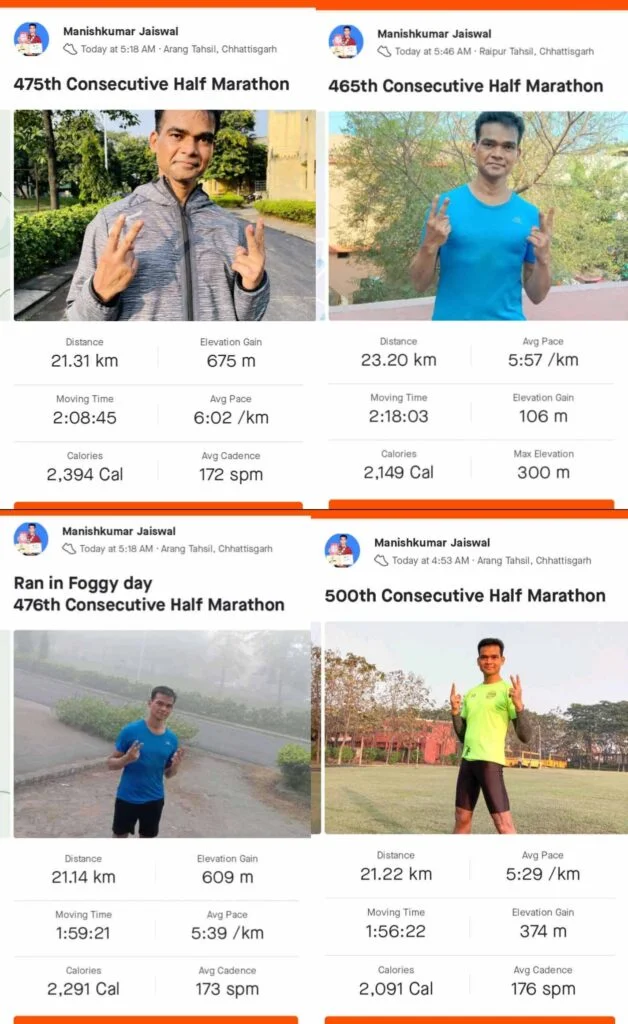
I met Manish Kuman Jaiswal in a WhatsApp group of international runners I was invited to participate a few months ago. Every day I would find cool posts on what runners are accomplishing all over the world, and in a handful of languages. One of the things that intrigued me was this guy from India who kept posting a half marathon every single day. So I had to ask. At the time he responded, he had run one for 475 consecutive days.
So let me introduce you to Manish Kumar Jaiswal, a 46-year-old runner from Raipur, in the state of Chhattisgarh, who started running in 2007. A teacher by profession, started his running journey just like most of us, to keep himself fit, healthy and with enough energy to keep up with his son, who is now 15.
When I approached Manish, he told me his goal at the time was to get to 500 days in a row, which occurred last Sunday, December 12th. With some simple math to put this monumental task in perspective, we are talking about 6,550 miles (10,539 kilometers) in the lapse of one year, four months and 15 days. A Ruthian-sized accomplishment, whatever way you want to analyze it.
A collage of Strava posts from a handful of Manish’s latest runs.
Manish quickly fell in love with the challenges and satisfactions of long distance running and promptly became a marathoner. During his years as a “regular runner” he completed 5 marathons (Raipur, Durg, Rajnandgaon, Dhamtari and Mumbai) as well as a bunch of half marathons.
One day, some friends challenged him to run 21 half marathons in 21 days. For those of you who live within the Imperial measurement system, the 13.1 miles of a half is equivalent to 21,097.5 meters. So, therefore on July 30, 2020, he embarked on this short streak that little by little has become enormous.
“In the beginning I just wanted to do 21days, 21 Half Marathons–confesses Mr. Jaiswal—But I enjoyed it a lot and now that I completed my 500 Consecutive days, I don’t want to stop. Now I am addicted to running.”
The new goal has been moved to 730 consecutive days with a half marathon. Equivalent to two years. Something tells me it is not going to stop there and 1,000 will suddenly become the updated goal, come July of next year.
No streak like this happens without taking risks that otherwise you wouldn’t have. Manish has run during heavy rains, thunderstorms sweltering hot and freezing cold temperatures. “Sometimes it would have been almost impossible to complete my half marathon, but I didn\’t give up. I put on my raincoat and managed to get my run in.”
Time management is an important task for an enterprise of this magnitude, yet Mr. Jaiswal assures me it hasn’t interfered that much in his daily life. “My daily half marathon running didn\’t affect my personal or professional lives. I did it with proper time management, planning and in a well-organized way.” He averages about 2:05 per run, with his PR at 1:48 and his slowest at 2:25.
Runners everywhere have one important question for Mr. Jaiswal: How about his running shoes?
He wears Kalenji shoes, the Decathlon model and he needs to switch to a fresh, new pair every 30 to 35 days. So far, he estimates he has used 15 pairs during his quest.
“At last -said Manish to conclude- I would like to thank my friends and family members my wife and son for their motivation encouragement and support.”
All of us runners, regardless how dedicated we are to our craft, at times become experts in creating the perfect excuse to justify not running on a specific day. There are some valid excuses, of course. No one expects you to run during an electric storm or when the temperature is 120 or -50 degrees?
What it is not and will never be a valid excuse is not having a functioning GPS watch. It doesn’t matter if it doesn’t have enough charge, if you forgot it at home, if the wrist band broke or fill in the blank. There are plenty of options to get around this minor setback and get your training in.
If you your battery doesn’t have enough charge for your run, it is your fault. Assume the msitake and go run.
The following is a list of ways to overcome obstacles when it comes to GPS watch issues, so you can go train, anyway:
1 – The watch doesn’t have enough charge for my run: That is your fault. Own your mistake. Run on a known course and when you get home, do the simple math necessary to project what your watch was able to record to what you know is the distance you ran. Option B is to run with a buddy and get screen shots of the activity.
2 – I forgot or misplaced my watch: This is your fault. Own your mistake. Your run doesn’t need to be recorded for posterity to benefit your health or make you a better runner. What really counts is that you do run. One day without posting it in Instagram or Strava shouldn’t hurt your ego that much.
3 – My watch is not acquiring the satellites: It happens. Sometimes you have the time to wait a bit longer or restart your watch. Sometimes your group is leaving, or the race is starting. Get moving without the satellites and when they hit, start your watch. Once at home, do the simple math necessary to project what your watch was able to record and have an approximate run. It is better than not running.
4 – How am I supposed to know my pace without GPS? As many benefits as a GPS watch has, the main drawback is that runners have forgotten to run by feel. Take this as an opportunity to have fun, run by perceived effort for a change, without a gadget dictating your pace and effort. Feel the fun of an easy pace, or the thrill of comfortably pushing if that is your scheduled workout. Have fun with Fartlek or just, for a change, enjoy the view and remember you run because it is fun.
GPS watches are wonderful additions to any runners arsenal, but they have made us forget the freedom of running by feel.
5 – I can’t do my interval training without a functioning watch: Sure, interval training without a watch is hard. But if you don’t have it with you, most likely it is your fault, and you need to own your mistake and find a solution. There is an alternative, though. Boring but available. It is a treadmill. If you don’t have a treadmill, do your intervals based on available landmarks. To the third tree, to the next traffic light or to whatever is accessible and fits your plan for the day.
6 – My dog ate the watch: Check issues 1 through 5 above, overcome your objections, lace up and start running
One more thing. Most of us have additional apps in our phones that can assume on the work for a day: Strava, MapMyRun, RunKeeper, etc. There are many more and most of them have a free version. If you don’t run with a phone and can’t live with the most updated data, run with the phone that day and voila!!! Issue resolved.
As you can see, all excuses regarding your GPS watch can be easily overcome. So, remember that nobody came back from a run hoping they would have stayed at home doing nothing. Each run is transformational. Don’t miss on it because of an inconsequential obstacle.
When set up to prepare for a race, we usually do so with a specific goal in mind. Maybe it is a PR. Maybe we want to go under a certain arbitrary round time like a Sub-4 marathon, a sub-1:45 half or a sub-50 10K. Maybe, given a certain personal issue, just finishing in one piece is the objective. They are all valid goals worth pursuing.
But life can and usually gets on the way of our perfect plans. Stars may not align on race day and then your car breaks down on the way to your race or there’s a traffic accident that makes you miss the start. Or it was too hot and humid, or you started too fast when you should have known better. It happens. So, what to do?
Sometimes, achieving goals B, C or D can still mean a successful race (Foto: Pexels)
It may sound obvious, but in the midst of the frustration, runners don’t know how to react and adjust. So I will spell it out in a direct manner: Set up A, B, C and even D goals for your races. And if your race doesn’t go as planned, sometimes it is good to have a back-up race to fall on to.
I follow a sub-elite runner in Instagram, who ran the recent Boston Marathon. In his post-race recap he said how his objectives kept changing throughout the race. His main goal was giving it his all to go sub-2:30, but as the miles went by, he realized this was not going to happen, so he decided to settle for a PR. In the 28th Km (17th mile), he suffered cramps that forced him to slow down. He ran some math in his head and realized he could still go Sub 2:40. At the end, 2:40:31 was his time. His final assessment was that despite not accomplish any of his preset goals, he wasn’t upset because he gave it all he had for the day. And he also knows this is not his last race.
This is the epitome of setting up multiple goals and completing a solid race despite facing multiple obstacles throughout. It is about learning to face and overcome those issues on the fly. It is about conquering what we are unable to control and yet, conquering those obstacles.
Just as it happens with the performance in a single competition, there are times that even the best prepared runners, or Goals R, S and T can’t cover a disappointment. When that happens, embrace the failure, learn your lessons, and move on to, or set up, your back-up race.
Back Up Races
It is not only a bad race that needs redemption. Sometimes circumstances beyond your control get in the way and derail your plans in a catastrophic manner. A second chance to perform is what will save the time, effort, money, and emotion you have invested in your training.
A few weeks ago, one of my trainees was on the plane to the Berlin Marathon. Door closed. Seatbelt fastened. Pre-flight instructional video played. But then… just like that… they kicked everyone out of the plane. The flight was cancelled. The only alternative given by the airline would put him in Berlin on Saturday at 5PM, with barely any time to pick up his bib and rest to make it to the starting line.
Make sure you live to race anothe day, by being smart before you tackle the marathon agian, after a debacle. (Photo: Pexels)
This runner was lucky enough that had enter several Marathon Major lotteries and hit two of them. So, despite the frustration, at least he had Chicago, two weeks later. The plan had been to push in Berlin and coast for fun in Chicago. Now, the plan is to push in Chicago, even though the taper was extended to 4 weeks. Notwithstanding the disaster, he was able to put his training to effective use and ran 3:24. Below his expectations but solid enough for his abilities and given the circumstances.
Even though having two marathons lined up worked for this runner, this time, it was circumstantial. Having a marathon to fall onto is not necessarily the best strategy. A marathon requires a level of commitment and effort that for most runners it requites just all you’ve got. So, having another marathon in store just in case, in a few weeks, may mess you up subconsciously and may alter your subconsciously because you know you have another race coming up, so you can play it safe, or run too fast and crash.
My recommendation is that if you need to pick another marathon because you missed your goal race, there are plenty or marathons to fall back to. You won’t lack for options, so you don’t need to plan ahead. But, if you had a crappy marathon and need to redeem yourself, be smart, recover properly and reassess where you are and where you want to be eventually before doing something foolish and getting hurt.
You can run multiple 5Ks to make up for a bad one. You can run another half marathon or two, or three, to make up for a bad race. The marathon is a different animal.
Not too long ago, a friend forwarded to me a posting of a runner’s prayer. It was so uplifting. You didn’t even have to be Christian or a profoundly or devout follower on any religion to enjoy it and find it inspiring. This is what it read:
Being thankful for the privilege of running is a key component of most runner’s lives.
A Runner’s Prayer Run by my side; live in my heartbeat; give strength to my steps. As the cold surrounds, as the wind pushes me, I know you surround me. As the sun warms me, as the rain cleanses me, I know you are touching me, challenging me, loving me. And so I give you this run. Thank you for matching my stride. Amen.
Because of my journalistic background, I always want to attribute credit to authors. So, I did a quick Google search and found not only the author for this one, but a slew of inspiring runner’s prayers.
Originally, I intended to publish something short and uplifting, but with so many good runner’s prayers out there, I decided to compile a handful of the ones I found most inspiring to me. I hope they touch you, too.
Prayer Before Facing a Race A contemporary prayer for someone preparing for a race or marathon By Tamra Dollin Source: https://www.myjewishlearning.com
Dear God, As I stand here, at the foot of Mt. Sinai, I am filled with gratitude, For You, who have given me life. For my family, who sustains me with their love. For my community, who support me with their warm embrace. For the strength of my body, which I have cared for and prepared to greet this day. For the capacity of my mind, to allow me to reach beyond what I thought possible. For the courage of my soul, to conquer my fears and pursue my dreams. For the spirit You have placed in me that will allow me to prevail.
I humbly ask of You… Remove all obstacles from before me. Help me to run swiftly and without impediment. Grant me the courage to persevere in moments of weakness. To see and do acts of loving kindness along the way. And that through this endeavor, I may glorify your Great Name.
As it says in Isaiah 40:13, “…For those who hope in God will renew their strength. They shall soar on wings like eagles; they shall run and not grow weary.”
A simple prayer may change the outlook of your run.
Another Runner’s Prayer
Prayers don’t need to be too deep or full of theology. The simplest of them can touch us profoundly and rejoice our souls, like this one, I found in RunnersWorld.com:
May the road raise to meet you May the winds be always at your back May the race day temps be between 45 and 55 degrees And when we meet again May you be in another age bracket
Runner’s Serenity Prayer
The popular “Serenity Prayer”, written by the American theologian Reinhold Niebuhr (1892–1971) in 1951, has been adapted to many aspects of life. Running is not the exception. I found a couple of them.
I could not find a source for this one:
“God grant me the strength to travel this distance, The courage to push through pain, And wisdom to know when to pick up the pace. Without your guidance and understanding, I could not be the runner I am. Amen”
This next one is authored by Josh Cox, and it goes like this:
“God grant me the serenity to accept when I cannot run; The Courage to run when I can; and the wisdom to know the difference.”
Before Hitting the Road
And to complete this short sample or runner’s prayers, there is this one if found in fuelrunning.com, which I find particularly uplifting:
O Strong and Faithful God
Make me swift, today, as I run; give me stamina, courage, and strength. But mainly, O God, give me faith in You and in myself. For you have said: “For they who wait on the Lord shall renew their strength… they shall run and not be weary, they shall walk and not be faint.”
By striding with this faith, my efforts will be crowned, and my spirit rest secure in you, and in the knowledge of a race well run.
I make this prayer in imitation of all the saints who have run to you. O Lord, amen.
It doesn’t matter to what God you pray, or to what religion you feel either affinity or affiliation. May it be God, Jehovah, Allah, the Universe, Nature or any other; most of us feel a bigger power guiding our steps. Voicing out our gratitude or putting ourselves in the hands of that superior being, is of great comfort when we are about to participate in our favorite sport. I hope these prayers will help.
This is Marci’s second contribution to the Foultips.run blog. She wrote “The Journey of the Fat Runner” back on March 30th, which is by far, the most read post in the history of this blog.
“It’s not a workout if it’s not at least 3 miles.”
“I have to hit the gym for an hour, at least.”
“I run every single day.”
“If I don’t work out for 30 minutes, it doesn’t count.”
I’m guilty of thinking and doing all these things in the past. How about you?
10,000 steps a day is an arbitrary number set by a marketing ocmpany (Photo: Blue Bird, Pexels.com)
Did you know that 10,000 steps is an arbitrary number picked by a marketing company, not by science? 4,500 steps per day is the number found to make a difference in overall health, and the benefit doesn’t increase much, the higher your step count.
American lives are busy. Our culture doesn’t value rest, so we are constantly driven to be productive. We keep our kids in every activity imaginable, we work full time, we are expected to have clean houses and manicured yards, cook “healthy” meals, and, oh! don’t forget self-care! Not to mention, our bodies are held to a physical ideal that most people will never match, no matter how much time we spend in a gym. But we must look like we’re trying, so we add in working out regularly to the list of other productive things we must do each day.
No wonder we’re all exhausted.
As a running coach, there are two questions I get more than any others. One is, “How do I get rid of shin splints?” (not covered in this post). The other is, “How do I stay motivated?”
And it’s no wonder that people feel the need to ask that question, because our lives are so full and so busy that fitting one more hour-long workout into our days can sometimes seem like a herculean task. We forget all the other things we’ve been motivated to do all day and feel worthless and exhausted at the end of the day because that workout just didn’t fit into all of it.
Have you ever considered doing… less?
Fitness isn’t a look, it’s a lifestyle. It’s movement, which our bodies are designed to do naturally. And if you’re one of those people who never has a problem with motivation and gets to the gym or hits the road every day, like clockwork, and never feels a lag in your desire to do so, great! But I’d be willing to bet that something else in that list of societal expectations will suffer sooner or later. Because our bodies need rest, and our societal expectations are waaay too high.
There are a few things I would suggest to help change that.
If you find yourself constantly saying: “The workout doesn’t count if it isn’t ___.” But then you also find yourself skipping workouts because you can’t fit another ___ timeslot into your day, you might consider changing your outlook on fitness. Our bodies are designed to move, but that movement doesn’t have to be in prescribed timeslots or for continuous periods. Fitness should be a lifestyle, which means movement every day WITHIN our days, as a part of our days, naturally.
You can always fit in movement into your office hours if you plan it properly (Photo: Andrea Piacquadio, Pexels.com)
Small bites work. Doing a mobility exercise for two minutes after sitting at your desk for an hour has measurable benefits. Keep a list of easy exercises beside your computer and take 2-5 minute breaks throughout your workday, and you’ll have completed a 30 minute workout by the time you go home. You will feel better in your mind and body, plus you’ll have freed up a 30-minute period to cuddle and read a story with your kiddo.
Other things like taking the stairs instead of the elevator, or parking further back in the lot help, as well. Setting a reminder on your phone or watch is helpful. Taking a walk or run on your lunch break can be beneficial, but please, don’t skip the meal if your body is hungry (looking into intuitive eating would be a good thing, too).
All these things help to take motivation out of the equation, because the movement becomes a habit, not a requirement. Even running can be done like this (unless you’re training for longer distances, then please follow your coach’s plan). A 5-minute run is better than no run. And you may find that you feel just as good after a quick loop around the block in the middle of the day as you would after an hour-long run after a busy day.
What I’m saying is, be gentle with yourself. Take small bites. Of life, of fitness, of society’s expectations. Start small. You may find that it leads to larger things, but if it doesn’t, that’s perfectly okay, too. We all have our responsibilities – do what you can to fit fitness into your life in a comfortable way. It should never hurt, and you should always feel good about it at the end of the day.
*Maci is a RRCA Certified running coach, who runs “The Fat Athlete” website. If you want more information on her groups, you can request it by emailing coach.thefatathlete@gmail.com; or you can follow her in Instagram @The_Fat_Athlete.
When I worked for the Florida Marlins in the early 1990s, manager Rene Lachemann often used a phrase that has stuck with me, almost 30 years later. Whenever a reporter asked him about an aspect of the game that was beyond his grasp, such as a pitching change from the opponent or the weather, he would indefectibly respond: “I can’t worry about something I can’t control.” For me, this has become a life lesson: If you can’t control it, don’t dwell on it, adjust, and move forward.
This applies perfectly to our running lives.
Crowded racing conditions are beyond our control, so suck it up and move forward (Photo: Pexels)
Just like Lachemann preached, we should only worry about the aspects of our running that we can have under our grasp. Other than that, we adjust to the realities that face us on the asphalt or the trail as soon as possible and then move forward. The obstacles are not going away regardless of how frustrating they may be, regardless of how much you bitch about them, so move on.
When it is time to run, workout or race, being cold, hot, humid, raining, too many people in the gym or the Garmin is not hitting the satellites, are irrelevant. No one expects you to run in the middle of an electric storm or run by a pack of stray dogs just because you carry mace. But you can always hit the treadmill if you have access to one, regardless of how boring it may be. You can run with a bottle of water if it is too hot and/or humid. You can dress up in layers for the chilly weather. You can run by feel if you forgot your watch. You can change your route if something doesn’t feel right. You get the point.
Also beyond our control are racing conditions. A bottleneck in the first curve, having to weave around slower runners, headwinds, inconsiderate people walking five side-by-side when they should have started at the back, people who abruptly stop at a water station, etc. Unless you always run in the front, you must have experienced most of these circumstances.
An uncharged running watch is not a valid excuse for skipping a workout
There are also issues that should have been under our control that just pop up unexpectedly. I’m referring to shoelaces getting undone, dropping off your phone, not carrying enough gels or chafing, just to name few. When these things occur, is there a solution? Yes, there is: Own your mistake. Do what you must do, get over the obstacle and keep moving forward. Don’t let it ruin your race. No amount of kicking and screaming will fix it. So suck it up!
Instead, concentrate on the aspects of your training and racing that are 100 percent under your domain. Those for which you can’t make excuses. Those where, if something happens, it is all on you. I am referring to, among others:
– Following your training plan
– Following your racing strategy
– Sticking to your fueling and hydration plan
– Dressing appropriately for the weather
– Inspecting your running gear to avoid forgetting something or malfunctions
– Making sure your shoes are tied up properly
– Charging your running watch
– Developing a personal mantra that will keep you strong during the inevitable challenging times
– Preparing mentally for the workout or race you are about to undergo
– Choosing a training course or race that suits what you are trying to accomplish
– Hydrating and fueling properly before your run/race to ensure optimal results
Of course, this is not a comprehensive list of items that are under your control, just a handful of them to enlighten you on how much actually is in your hands when you set up for a training session or you stand on a starting line.
So let’s be diligent on what we can control and let’s make sure we can endure what we can’t, and then move forward.