Racewalking can give you a second career on the asphalt.
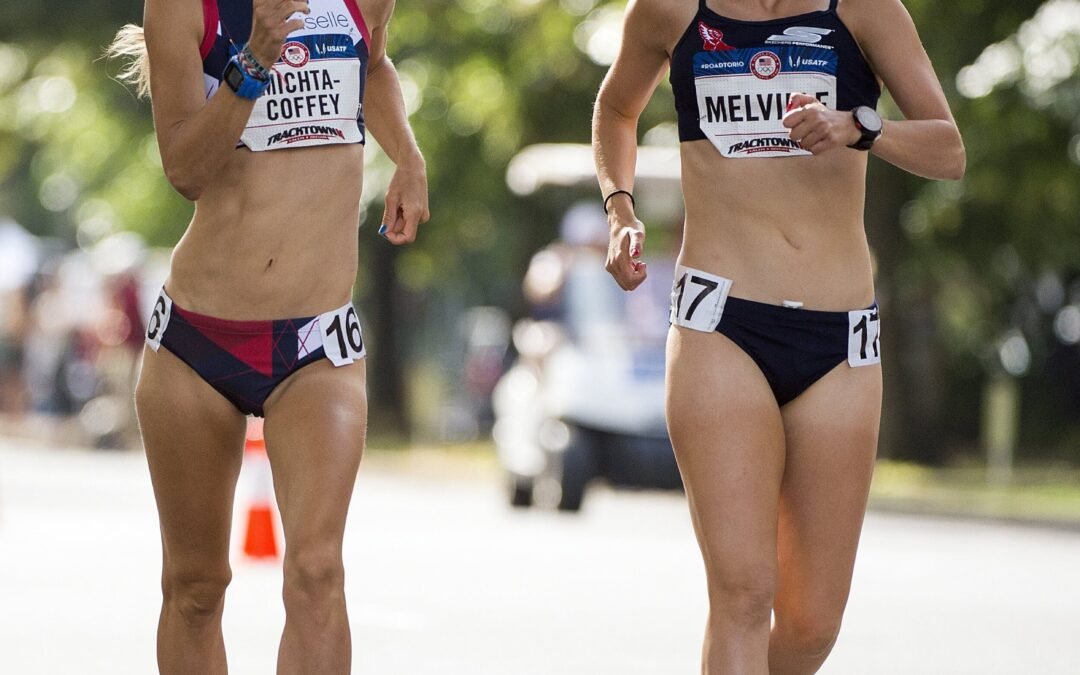
During Olympic competition we always see those weird-looking racewalkers shaking those hips while keeping short steps and swinging arms like crazy. A select few know about what’s going on, some wonder what it is they’re doing, and the vast majority just laugh out of ignorance. Racewalking has been around since long before the Boston Marathon was a thing and it is an athletic discipline that requires the same training and dedication and any other discipline. Most important for this audience, it can give you a second career on the asphalt.
Personally, racewalking was my segue into running. After my second knee operation, at age 39, I told the doctor I still had another marathon in me, and I wanted to make sure I could do it. He was very clear telling me “your marathon days are over”. Sadly, I took his word and stopped completely until eight years later, when I realized I could still participate even if it was walking. Shortly after, I discovered racewalking, met with a racewalking group and the rest is history.
Racewalking is not just walking fast; it is not power walking either. Racewalking has two basic rules: a – one foot always must be in contact with the ground (as discerned by the naked eye), and b- the front knee must be straight when it makes contact with the ground. There are other techniques and details you need to know but this is what you need in order to get started.
Racewalking is gentler on your knees because you are not dumping the additional weight of a jump on them when you land. That alone can give a second career to both those knees and its owner. It still provides you with cardiovascular benefits if you exert yourself hard enough and you can still enjoy the runners-high we all crave. If that wasn’t enough, you can still participate in races, as there are no limitations against walking, you just need to observe the right etiquette, which in not on the scope of this blog post.
Less stress on your knees
The one thing you will have to adjust when you move to racewalking is switching your mindset. Throwing out the window all your previous PRs, race paces, tempos, age group rankings and being comfortable at the back of the pack. You will have to be content with just racing against yourself and enjoy getting better and progressing. Just realize you are still racing in a 5K, or a half marathon, or even a marathon, which is a better alternative to reading on how your friends via your WhatsApp group.
It is unfortunate that there are not that many racewalking groups out there, given how beneficial this discipline can be to so many. I was lucky enough to find a group and to meet coach Danny Koch, who guided me through 13 half marathons and 3 full marathons before I was able to return to running. Regardless if you find a coach or not, I can recommend “The Complete Guide to Racewalking”, by Dave McGovern, as the go-to book to learn about the philosophy and technique of racewalking.
If your knees can’t handle running anymore yet you still want to remain active and/or competing, I invite you to give racewalking a try. It worked for me so who knows, it may work for you, too.
During these challenging times when we are all cooped up given the reality affecting the world, the time for our sempiternal “I-will-do-it-when-I-have-some-extra-time” has finally arrived. Every expert, every magazine and every everyone is coming up with suggestions for good uses of your time, do-it-yourself videos or online classes. Why would Foultips.run be different? even if we are just recycling an old YouTube video from 2013.
I had some tight hip issues for a while and during the 2018-19 racing season I suffered a lot. As I was doubled in pain during the last mile of a half marathon in Miami Beach, a friend who was reeling me in told me she would send me a link to some exercises she’s been doing for her hips. The rest is history. I was a convert after my first try.
She sent me a link to a video by Runner’s World called the “Myrtl Hip Routine”. A series of 12 floor and stand-up exercises that can be done in less than 10 minutes. Performed twice or three times a week will do wonders for your tight hips. I can only talk through my experience but unless you have underlying orthopedic issues, I don’t see why it wouldn’t work. I started with 10 of each move; then went up to 15 and 20. It may not be necessary to go that high, but as runners we are well known for being obstinate and overdoing things a little from time to time.
I tried to do some research to figure out who came with this routine but was unsuccessful. What I did find is that many coaches recommend with slight variances, which makes no difference. Also found that contrary to what you may think, Myrtl is not the person who developed this routine. Somehow the name is based on the are the routine is focused in, which I didn’t get either. Anyway, this is just anecdotal.
What is a fact is that all exercises are designed to increase the range of motion and strengthen your hip area. And I can guarantee you they do work. So, take advantage of your indoor, social distance time and get those hips ready for when the doors are opened again and you are ready to charge your running as if you were a bull on the streets of Pamplona during the San Fermines.
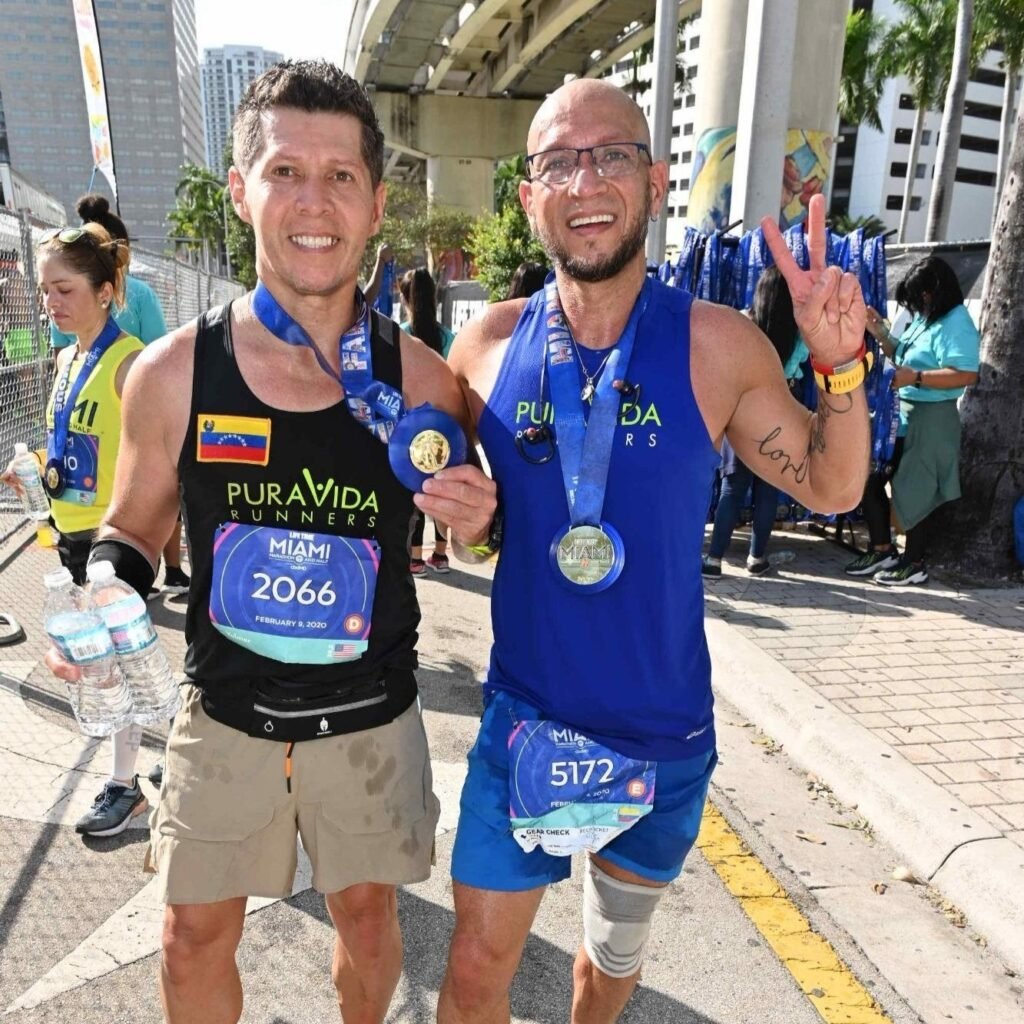
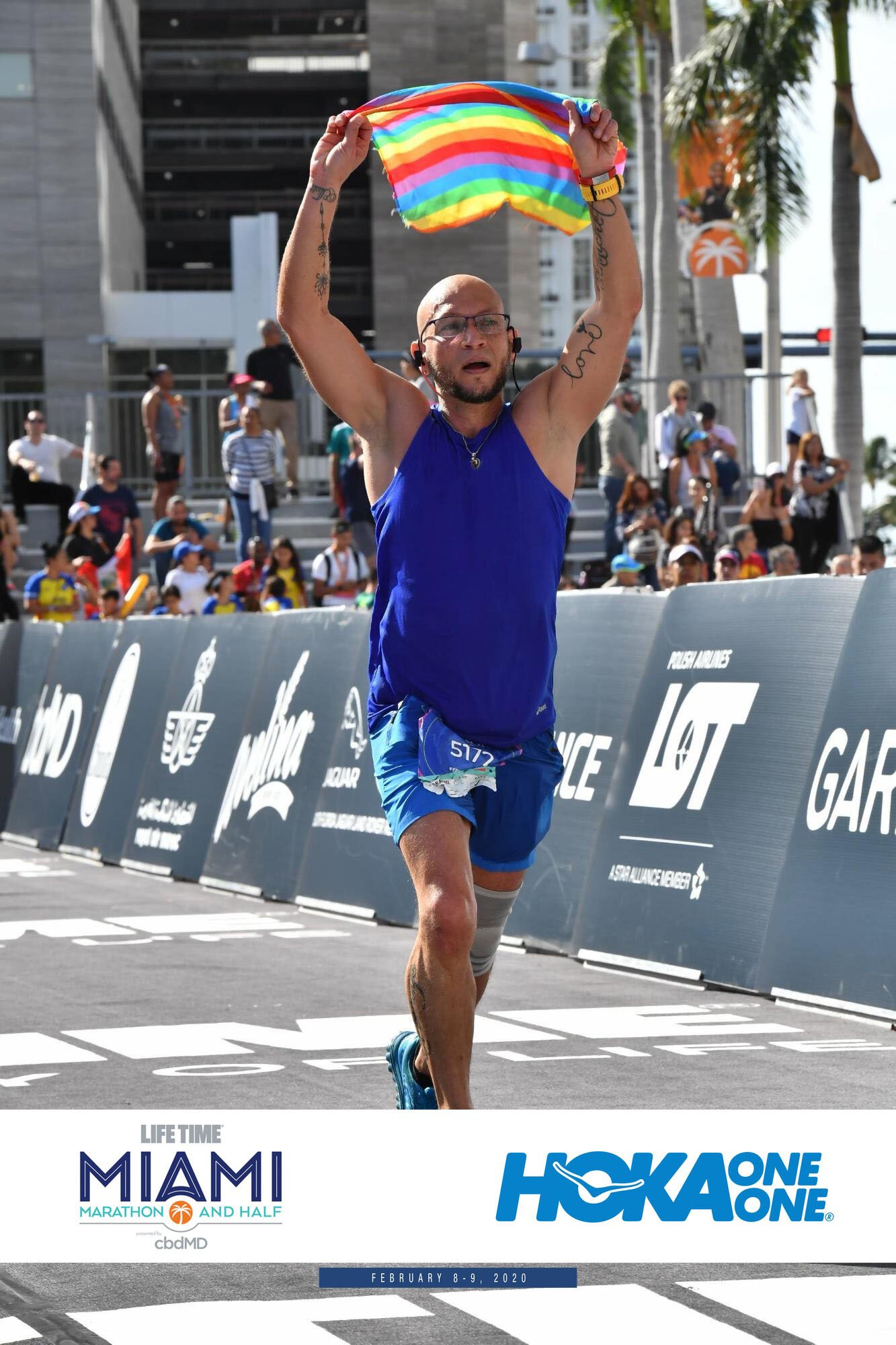
The Miami Marathon and Half Marathon were run last Sunday, February 9th, in Downtown and its surrounding areas. Despite more than a few personal bumps in the road during last year, I was able to keep my streak alive and completed my 9th consecutive Miami half in an irrelevant time. But I still had one of the best days of my running life, as the two runners I trained for the full marathon not only set, but crushed, their PRs by 10 ½ and 11 minutes.
Jhon H, 49, trained very hard to bring his PR down to 3:36:42, an 11-minute improvement from his best previous result, set in this same race back in 2018 (3:47:42). His main issue in his previous marathons had always been the last few miles. Cramping, exhaustion and doubts were creeping in as the dreaded wall approached. So, we set a different program for him. We used the Hansons Brothers method so he could be stronger at the end. After working diligently on his program, he got stronger as he progressed and not only had a negative split but his last 10K were the fastest in the entire race. As he turns 50 next year, I am sure a 3:25 BQ is perfectly achievable.
Yolmer G (42) also set a massive PR with a 3:43:36. Despite an irregular last month of training when life got on the way, not only he improved 10:30 from his New York 2019 finish (3:54:06), but he also bettered his register from his first marathon, which was this same Miami, just last year by 32:55 (4:16:31). And his best race is yet to come. A BQ of 3:15 for his age group is attainable.
As a coach, you can’t ask for better than these two athletes, which in the process have also become close friends. I can’t wait to see what is next for them. I look forward to working with them.
If you want to take your running to the next level, make sure to contact me via foultips.running@gmail.com to asses your goals and get going.
“I ended up with a massive new PR and a finish time of 3:36:42. I was so full of emotion as I crossed the finish line that I could not contain my tears of joy and accomplishment.”
On November 18, 2019, I started training with coach [Adolfo] Salgueiro. I approached him expressing my desire to train with the goal of increasing my running speed and try to qualify to the Boston Marathon. His response was, “yes, we can increase your speed, absolutely. But we don’t have much time to train because the Miami marathon is very close.” He prepared a 12-week training plan with the Hansons Method, which I had never heard of before. I was skeptical because I was accustomed to running at a 9:00 to 9:30 minute/mile pace, and I said to myself, “I will not be able to reach that speed because I am too old and my knee will not respond.”
When I received my training plan for the first 4 weeks, I saw the speed metrics that Coach Salgueiro prepared for me, and immediately my self-doubt kicked in and said this was too fast for my ability. But I also decided to do my best to meet Coach’s speed targets for me, to trust the Coach and embrace the training program that he designed for me.
Tuesdays soon became my favorite training day because I did track, with speed goals from 7:30 pace to 8:00 pace. Since I don’t have access to a track where I live, I improvised a 400-meter training loop in a local parking lot. Coach was always aware of my training, monitoring my progress through Strava, and he was very willing to correct me and happy to answer any questions so I could reach my full training potential. With this plan, my long-distance runs were set for two consecutive days, teaching me to run on tired legs and keeping me on pace for the marathon. I found this new training style perfect for me.
But with just 2 weeks before the marathon (February 9, 2020), I had a problem with the back of my left knee. I don’t know what it was, but it was painful, and it prevented me from continuing with my training. I felt frustrated and defeated. I talked to Coach, and he suggested resting days with care at home, raising my knee, putting ice on it and using the foam roller. We also talked about what other options I might have and whether I should postpone running the marathon. After more than a week of rest, ice and rolling, I tried running again, a mere five days before the marathon. Thank God I felt no pain! I felt strong, and so we continued to plan for my marathon.
On the day of the marathon, Coach gave me his final training instructions: take it slow at the start, do not weave around runners, and if you feel strong enough keep on going, pick up the pace. Since I wanted to try to do negative splits to conserve my energy at the start and to comply with Coach’s race plan, I was especially thankful for my friend Ray, who traveled from Minnesota to Miami to be able to run the marathon with me. Ray helped me a lot in the first 8 miles, monitoring my pacing, keeping me focused on not going out too fast, and staying confident. Together, we did so, and it was a fantastic experience for me because all the hard work that I put in following Coach’s training worked just as it was designed to do.
Taking Coach’s instructions and conserving my energy for the last miles of the marathon was exactly the right race plan for me. And to my great surprise and delight, I ended up with a massive new PR and a finish time of 3:36:42. I was so full of emotion as I crossed the finish line that I could not contain my tears of joy and accomplishment. Yay! I fully trusted coach Salgueiro, and now I can’t wait to train with him again to help me attain that now much closer BQ time.